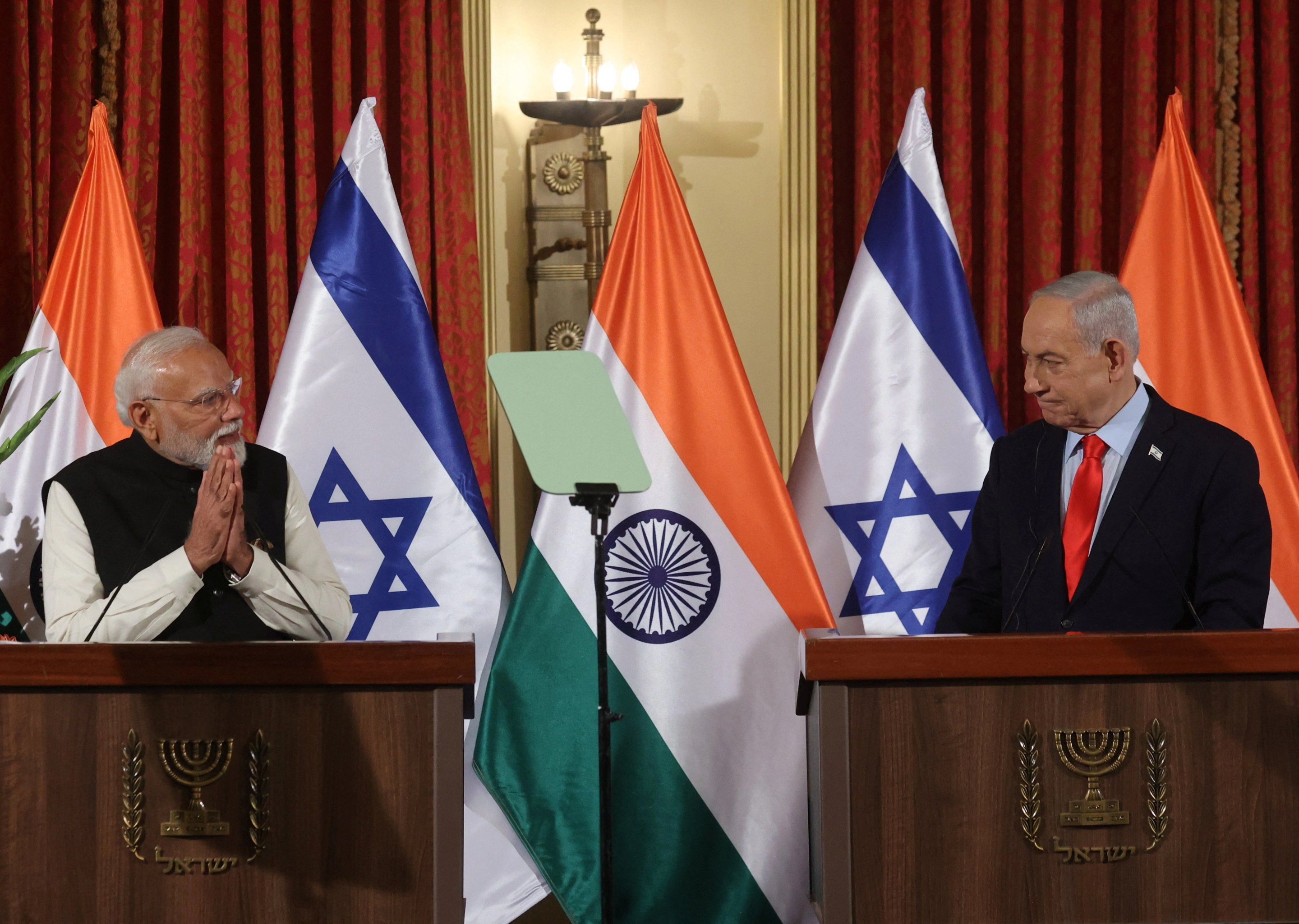
On February 25, Narendra Modi arrived in Tel Aviv for a two-day state visit. Israeli Prime Minister Benjamin Netanyahu — facing an International Criminal Court arrest warrant and prosecuting a war in Gaza that much of the world was calling a genocide — rolled out the red carpet. Modi addressed the Knesset, the first Indian prime minister ever to do so. In his speech, he told the Knesset: "India stands with Israel, firmly, with full conviction, in this moment, and beyond."
Forty-eight hours after Modi left Israel, the US and Israel launched Operation Epic Fury.
The timing was not coincidental. The Diplomat reported that retired Indian diplomats believe Modi "may have been briefed by Netanyahu on the proposed Israel-US military action" before leaving Tel Aviv. New Delhi has declined to confirm or deny this. But it has not criticized the US-Israeli attacks on Iran or the operations in Gaza and Lebanon. In the six weeks of war that followed, India's only public statement attributing blame was a call from Modi to the UAE president condemning the Iranian missile strikes on Gulf infrastructure, without naming Iran. It was, as The Diplomat noted, "the first and so far only official condemnation by India of any side."
FROM THE SHADOWS
India and Israel established full diplomatic relations only in 1992, after decades in which New Delhi publicly supported the Palestinian cause while quietly accepting Israeli military assistance. Even before formal ties, Israel supplied arms, ammunition, and intelligence to India during the 1965 and 1971 wars with Pakistan. After Indian Prime Minister Indira Gandhi was assassinated in 1984, Israeli security experts advised on the protection of senior officials. After the 2008 Mumbai terrorist attacks, Israeli counterterrorism teams arrived to advise on urban security.
The clandestine dimension ran deeper. Speaking on the One Decision podcast on April 7, Sushant Singh, a lecturer in South Asian Studies at Yale and former Indian military officer, noted that during the period when Pakistan was developing its nuclear capability under A.Q. Khan, there were indications of a clandestine relationship between India and Israel on nuclear matters — an area where neither country is a signatory to the Non-Proliferation Treaty. Neither government has confirmed the specifics; the intelligence relationship between India's Research and Analysis Wing and Israeli intelligence is not a matter of public record, though it has been reported consistently since at least the 1980s.
The relationship became public in 2017, when Modi became the first Indian prime minister to make a standalone bilateral visit to Israel. The partnership was upgraded to a "Strategic Partnership" that year. It was upgraded again, to a "Special Strategic Partnership for Peace, Innovation and Prosperity," during the February 2026 visit, with 17 agreements signed covering defense, AI, semiconductors, quantum computing, cybersecurity, agriculture, and labour mobility.
THE DEFENSE ARCHITECTURE
Defense is the spine of the relationship. Israel has been among India's three largest arms suppliers for most of the past decade — accounting for roughly 34 percent of India's arms imports between 2015 and 2019, before declining as India pushed for domestic production. The systems involved are not peripheral. Israel has supplied the Heron and Searcher drone fleets, the Barak naval air defense system, SPICE precision-guidance munitions, the Harop loitering munition, and the Phalcon airborne early warning radar — mounted on a Russian IL-76 platform in a deal that required US approval, a measure of how central the three-way relationship has become.
During India's Operation Sindoor — the May 2025 military clash with Pakistan — Israeli-supplied equipment featured prominently. Netanyahu publicly praised India's "measured and decisive response." Israel's ambassador reiterated "India's right to self-defense." Pakistan, by contrast, relied overwhelmingly on Chinese-supplied systems — 80 percent of its arms imports in 2021-25 came from China, according to SIPRI's 2026 report.
The February 2026 visit produced defense agreements estimated at $8.6 billion, encompassing potential transfers of Iron Dome and Iron Beam air defense technology, the Arrow ballistic missile defense system, and David's Sling — systems that performed under fire during the Iran war and that India wants for its own Mission Sudarshan Chakra, the air defense modernization programme Modi announced in August 2025. For Israel, the deals serve a dual purpose: revenue, and the development of India as a manufacturing base for Israeli defense systems at a moment when Spain, the Netherlands, Belgium, Canada, and Japan have imposed embargoes or near-total bans on Israeli arms exports. An Israeli defense source told The Print in December 2025: "We have realised who our real friends are."
The commercial dimension runs alongside the military one. Gautam Adani, Modi's closest business ally and Asia's richest man, has invested in Haifa port — one of Israel's principal commercial gateways — and in Israeli infrastructure more broadly. Israeli defense companies have established Indian subsidiaries and invested in Indian electronics and electronic warfare firms, embedding the relationship in the industrial base in ways that will outlast any individual government.
THE IDEOLOGICAL DIMENSION
Modi's Bharatiya Janata Party is a Hindu nationalist party; its intellectual tradition has drawn parallels between Hindu nationalism and Zionism since at least the 1920s. Both movements defined themselves against Islamic polities — Pakistan in India's case, the Arab states in Israel's. Both have faced accusations of marginalising Muslim minorities within democratic frameworks. Under Modi, India's Muslim population — roughly 15 percent of the country, as many people as live in Pakistan — has faced documented political and economic marginalisation; Modi's party does not have a single Muslim member of parliament or minister, for the first time in India's history.
That convergence is visible in how both governments frame the relationship. Netanyahu, welcoming Modi to Israel in February, described a shared struggle against "radical axes" — a formulation that encompasses both Iranian-led Shia networks and, more ambiguously, Sunni Islamist movements of the kind that have historically operated in and from Pakistan. Modi's Knesset speech framed the partnership as a meeting of democracies facing common threats. The specific content of those threats — terrorism, nuclear proliferation, hostile neighbours with close relationships with Iran — maps closely onto both countries' security environments.
THE COSTS
India has long positioned itself as a champion of the Global South — a non-aligned power that speaks for developing nations excluded from Western-dominated institutions. That position is increasingly difficult to maintain while standing conspicuously with Israel during a war in which Iran has framed itself as the victim of Western aggression, and in which much of the Muslim world — including the Gulf states where millions of Indians work and from which India draws most of its energy — has been caught in the crossfire.
India has a large Gulf diaspora whose remittances sustain millions of families. It imports most of its oil from the region. It has spent years building diplomatic relationships with Saudi Arabia, the UAE, and Qatar that Modi has framed as evidence of his global standing. All of those relationships are under some strain from India's silence on Iranian civilian casualties and its public endorsement of Netanyahu — whom the ICC has charged with war crimes — two days before the strikes began.
The opposition Congress party has been explicit. Its leader Rahul Gandhi called Modi's foreign policy "compromised" and accused the government of "blindly siding with Israel." Pakistan's foreign minister described India as a "Dalal for Benjamin Netanyahu" — turning Jaishankar's own language back on New Delhi. The accusation found an audience.
India's traditional counterargument — that it maintains balanced relations with all parties and that its Israel relationship is purely bilateral, not directed against any third country — was articulated again by Jaishankar in the weeks after the strikes began. Modi had left Jerusalem 48 hours before the bombs fell. India has not condemned them since.
THE CALCULATION
Israel offers what no other partner can: advanced defense technology without political conditionality, intelligence cooperation at a high level of trust, and a common adversary framework that encompasses both Pakistan-linked terrorism and Iranian regional ambitions. As Russia's reliability as an arms supplier degrades — its defense industry is consumed by Ukraine — and as India seeks to reduce that dependence, Israel's defense industrial base, and its willingness to transfer technology, becomes more valuable, not less. Jaishankar told an Indian think tank in 2025: "Israel is a country with which we have a strong record of cooperation in national security. It has also stood by us at different moments when our national security was under threat."