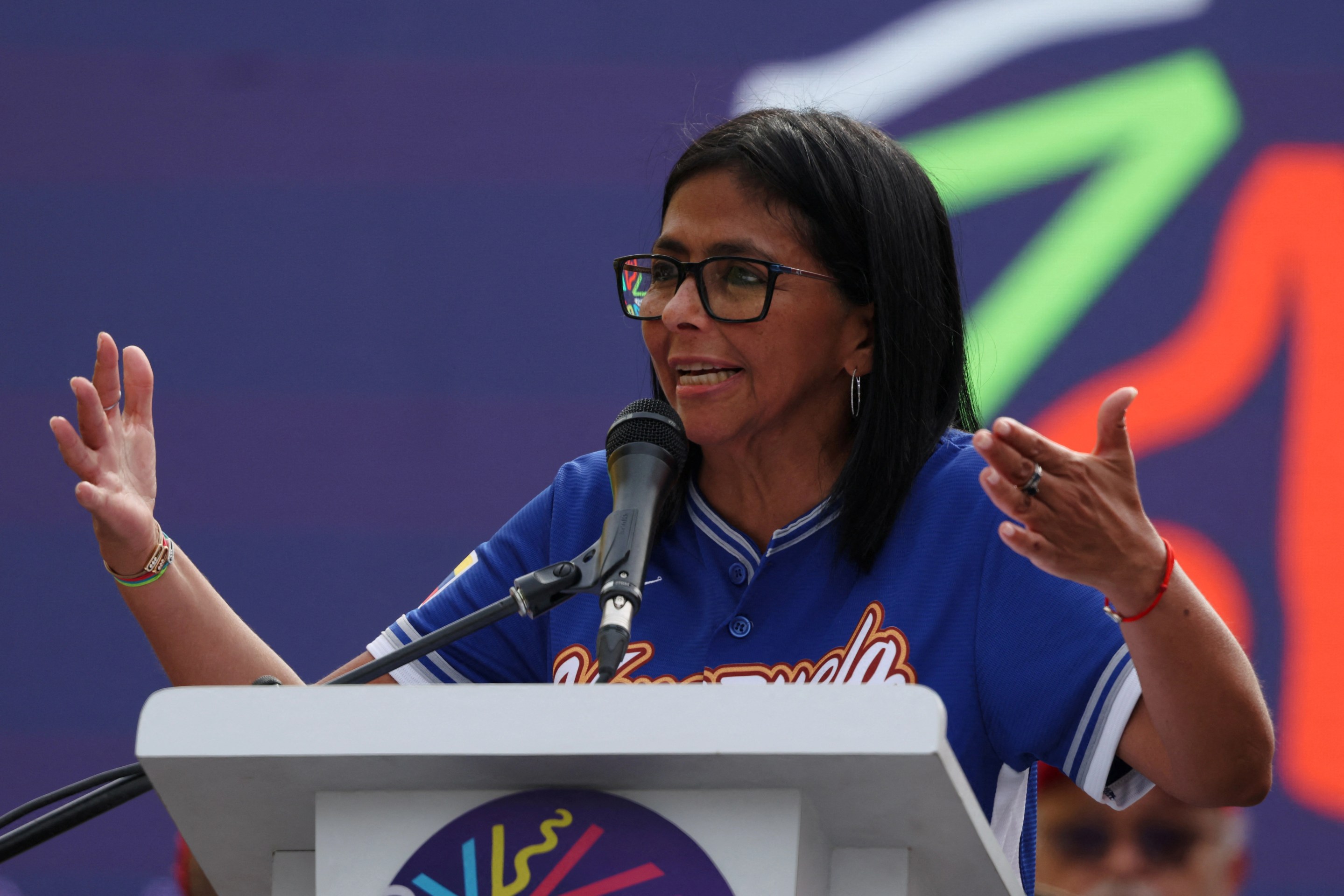
Delcy Rodríguez has governed Venezuela for more than four months. Her 90-day mandate expired more than a month ago, no elections have been called, and her hold on power relies heavily on US backing.
On April 4 — five weeks ago — the 90-day period during which Delcy Rodríguez was authorized to serve as Venezuela's acting president expired. The National Assembly, controlled by her own party and presided over by her brother, has not voted to extend it. She remains in office anyway.
The constitutional basis for that arrangement was contested from the beginning. When US forces captured Nicolás Maduro in Caracas on January 3, Venezuela's Supreme Court — packed with loyalists — declared his absence "temporary" rather than "absolute," a distinction that carries significant legal weight. Under the Venezuelan constitution, a permanent vacancy requires new elections; a temporary absence allows the vice president to serve for up to 90 days, extendable by the National Assembly for a further 90. The court's determination that Maduro had been "kidnapped" rather than removed made the temporary designation possible. The Washington Office on Latin America noted that the Supreme Court's invocation of Article 234 — allowing the existing government to remain in power without calling new elections — was the same maneuver used after Hugo Chávez's death in 2013.
The illegitimacy runs deeper than the current impasse. Maduro's 2018 re-election was not called through parliament as required; it was organized through a parallel entity created to bypass the legislature, which was then controlled by the opposition. In the 2024 election, the opposition — barred from running its preferred candidate, María Corina Machado — participated anyway, documented its victory with voting tallies from tens of thousands of polling stations, and watched Maduro declare himself the winner without presenting evidence. Rodríguez was his vice president throughout. Raúl Stolk, managing director of Caracas Chronicles and a lawyer who has covered Venezuelan politics for years, told the One Decision podcast on May 7 that Rodríguez now operates in a constitutional limbo even by Chavismo's own rules: the 90-day period has expired, no extension has been formally granted, and no election has been called. Writing in Foreign Affairs in February, economist Francisco Rodríguez was more direct: "the first, and most obvious" problem with Venezuela's current trajectory is the government's "lack of electoral legitimacy." Rodríguez became president not through a democratic contest but through a US military operation.
THE US AS GUARANTOR
On April 2, the US Treasury Department lifted sanctions against Rodríguez directly, NPR reported, the latest in a series of steps formalizing the Trump administration's recognition of her authority. The administration has recognized her as the "sole Head of State" of Venezuela in a federal court filing in New York, authorized PDVSA to sell crude directly to US buyers, and had Energy Secretary Chris Wright meet with her at the Miraflores presidential palace in February. Moisés Naím, writing in Foreign Affairs in April, described the result as "an unusual arrangement" — power sharing between Washington and an interim government headed by one of the most prominent figures of the Maduro regime.
When Maduro was captured, the Venezuelan military — whose loyalty had been the foundation of Chavismo's grip on power for two decades — effectively froze. Gustavo González López, an intelligence officer seen by military insiders as an outsider, was appointed to manage Rodríguez's security and became, in Stolk's description, a liaison between US intelligence and the Venezuelan military command. The entire high command was replaced. Stolk later added: "Right now the United States has a direct line with the Venezuelan Armed Forces. [...] She gets her protection from her relationship with the United States."
OIL, STABILITY, AND ELECTIONS
Naím observed in Foreign Affairs that Washington "seems to care far more about the fortunes of Venezuela's economy, notably its oil industry, than those of its democracy." That assessment is shared by analysts closer to the ground. Phil Gunson, a senior analyst at the International Crisis Group based in Caracas, told NPR in February that Rodríguez is performing "a very difficult balancing act" between meeting reform demands from Washington and managing pressure from her own supporters, who "definitely don't want to see a political opening." James Story, a former US ambassador to Venezuela, said her strategy appears to be to "do just enough to make it look as if they're complying," while waiting to see whether US attention fades.
The Iran war has made that wait more plausible. Naím noted in Foreign Affairs that Trump and Secretary of State Marco Rubio are "too distracted by the war in Iran to pressure Caracas to hold elections any time soon." Rodríguez's interest, he wrote, is plainly to delay elections for as long as possible.
The 90-day period's expiry without a formal extension or an election call has left the government in an undefined position, the Washington Times reported. The National Assembly — controlled by Rodríguez's own party — could declare the presidential post permanently vacant and trigger a snap election, but has not done so. Protests demanding elections have begun appearing inside Venezuela. The administration has been progressively shortening the timeline it mentions for elections — from 24 months to 18 to 14, according to Stolk. Elections as early as December 2026 are now being discussed; the latest plausible date, in Stolk's assessment, is the first half of 2027.
THE GOVERNANCE PROBLEM
The legitimacy deficit has direct economic consequences. Venezuela's economy is expected to grow by double digits this year as oil revenues rise and sanctions ease. But Francisco Rodríguez notes in Foreign Affairs that investors know any commitments Rodríguez makes could be undone if she loses power — a risk that constrains the long-term investment Venezuela needs to rebuild its oil industry, restructure its $145 billion in external debt, and tame an inflation rate that has been in double digits for more than 40 years. Venezuela also ranks last among the 143 countries monitored by the World Justice Project Rule of Law Index, according to Naím.
The pool of technically competent people willing and able to work with the Chavista government is also small. Stolk describes this as one of the central arguments Machado's movement makes: that a genuine government reset would allow the return of diaspora professionals — petroleum engineers, financial specialists, logistics experts — whose skills Venezuela has lost over a decade of economic collapse. As Naím notes, nearly eight million Venezuelans, more than a quarter of the country's population, have left since 2014.
THE WILD CARD
The tension between Rodríguez's power and her lack of legitimacy has a human embodiment: María Corina Machado, whose opposition candidate won the 2024 presidential election by a wide margin according to voting tallies collected from tens of thousands of polling stations — results Maduro refused to recognize — and who has since received the Nobel Peace Prize. Machado is living in exile, has met with Trump and multiple US senators, and told the Washington Post in March that she planned to return to Venezuela "in the coming weeks." Two months later, she remains in exile.
The scale of her popular support is documented. A February 2026 survey by the Caracas-based polling firm Meganálisis found that Machado would receive 82.4 percent of the vote in a head-to-head race against Rodríguez, who would receive 4.8 percent.
Machado is waiting for US backing before returning. She could also act unilaterally, entering Venezuela without authorization and campaigning on the documented results of the 2024 election. A return on those terms would put Rodríguez's already contested legitimacy under direct public challenge, with a candidate whose support dwarfs hers. "She has her finger on the trigger," Stolk said, "and she could pull it at any moment."