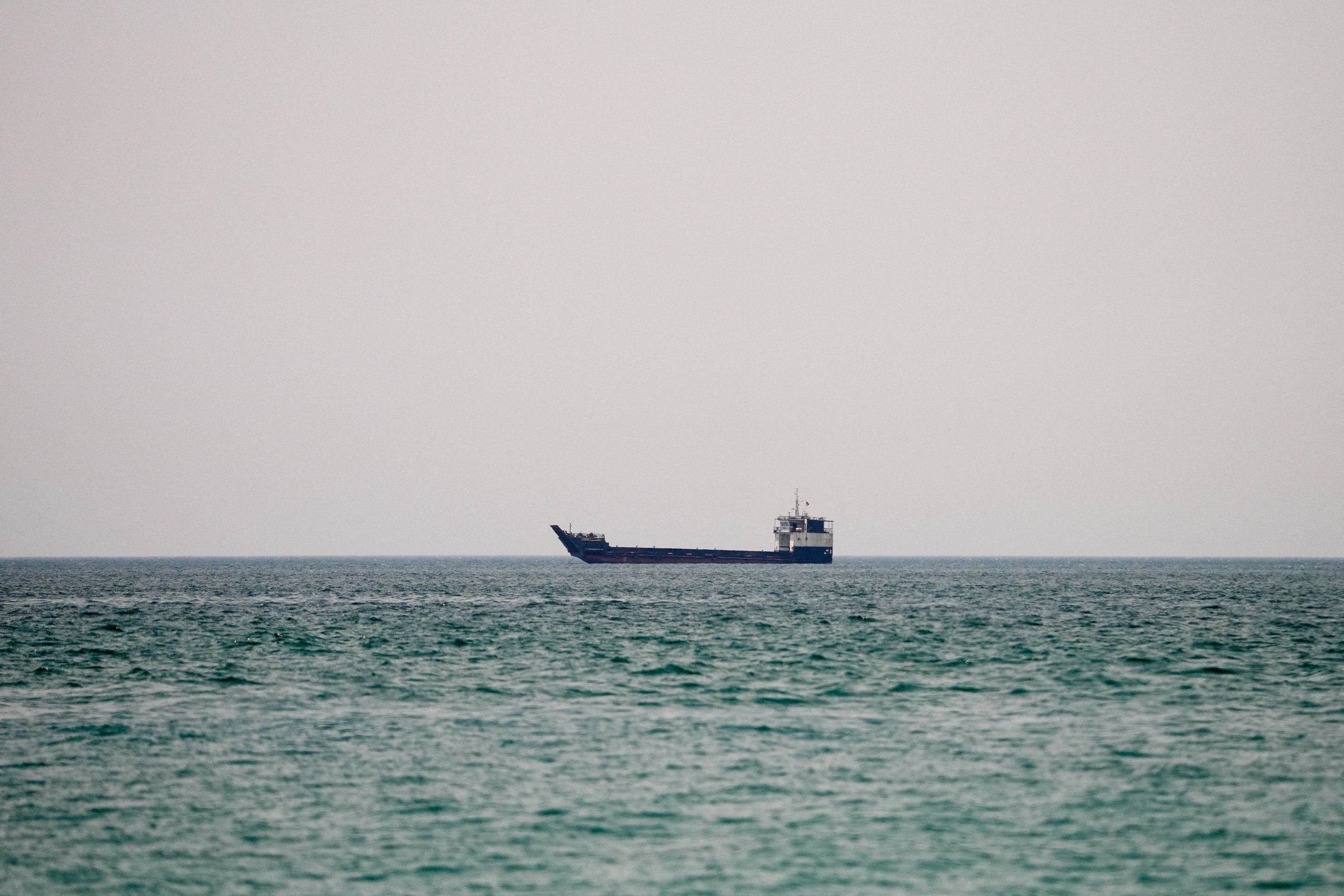
On April 14, a Chinese-owned tanker called Rich Starry passed through the Iranian-controlled northern channel of the Strait of Hormuz, appearing to pay a toll to Tehran in yuan before slipping out into the Gulf of Oman. The ship, owned by Shanghai Xuanrun Shipping and already under US sanctions since 2023 for trading with Iran, was carrying 250,000 barrels of methanol. US Central Command denied it had passed the blockade. Shipping data from LSEG and Kpler suggested otherwise. The vessel's movements encapsulate China's position in this conflict almost perfectly: threading between two powers at war, benefiting from the chaos, and accountable to no one.
A nine-day ceasefire announced on April 8 has paused the fighting in the Gulf region while resolving little. Iran has not reopened the Strait as the terms require; the US blockade of Iranian ports, declared on April 13, remains in force; and the diplomatic talks that produced the ceasefire are stalled.
Speaking on the One Decision podcast on April 7, Evan Medeiros, the Penner Family Chair in Asia Studies at Georgetown University's Walsh School of Foreign Service and former Senior Director for Asia on the National Security Council under President Barack Obama, described what China is doing: pursuing a strategy of "calculated neutrality" designed to protect its commercial interests across the Gulf, avoid confrontation with the US ahead of Xi Jinping's May 14 summit with President Trump, and preserve leverage with Iran without committing to its defense. According to Medeiros, this is "classic Chinese statecraft" drawn from the same playbook Beijing followed after Russia's invasion of Ukraine.
CALCULATED NEUTRALITY
China's official position since February 28 has been one of principled restraint. Foreign Minister Wang Yi called the conflict something that "should never have happened" and warned against the world reverting to "the law of the jungle." Beijing voted against a UN Security Council resolution on freedom of navigation in the Strait, citing the draft's failure to capture "the root causes and the full picture of the conflict." It evacuated its 3,000 nationals from Iran. It called for a ceasefire. It co-sponsored, with Pakistan, a five-point peace proposal that the Trump administration received with what the Associated Press described as "little enthusiasm."
Beneath that diplomatic surface, China's actions have been more calibrated. US intelligence assessments, reported by CNN on April 11, indicated that Beijing was preparing to ship man-portable air-defense systems (MANPADs) to Iran through third countries, a claim the Chinese Foreign Ministry denied. Multiple sanctioned Iranian ships carrying sodium perchlorate, a precursor material for solid-propellant rockets, traveled from China to Iran since the war began. A Financial Times investigation, citing leaked Iranian military documents, reported that the IRGC Aerospace Force had secretly acquired a high-resolution Chinese reconnaissance satellite in late 2024, a claim Beijing also denied.
The transfers were never intended to alter the battlefield outcome. "This is a game the Chinese have played with the Americans going back to the 1980s," Medeiros said — one-off shipments calibrated to remind Washington that Beijing has a response to US arms sales to Taiwan, timed for maximum effect ahead of the May 14 summit.
THE STRATEGIC OPPORTUNITY
The US military commitment in the Gulf is pulling resources directly from the Indo-Pacific. Patriot missile defense batteries have been withdrawn from South Korea and redeployed to the Middle East — a move South Korean President Lee Jae-myung said publicly he opposed but "cannot fully push through." Components of the THAAD anti-missile system, the only foreign deployment of THAAD in the world, have followed. A Marine Expeditionary Unit was pulled from its deployment on Okinawa. According to CSIS analysis, the US has used between 50 and 80 percent of its entire THAAD interceptor stockpile in the conflict with Iran. Maintaining a blockade of the Strait of Hormuz, according to CENTCOM, requires over 10,000 personnel and more than a dozen warships — assets drawn directly from a force the Pentagon has spent a decade reorienting toward the Pacific. For Beijing, which has watched the US spend down its Pacific-oriented assets in a Middle Eastern war, the opportunity is straightforward: a distracted and depleted rival is a less credible guarantor of regional security.
South Korea's response illustrates the effect on US alliances. President Lee publicly flagged the redeployment as evidence of "the necessity of reducing reliance on the United States for security." Philip Shetler-Jones of the Royal United Services Institute told CNBC that the redeployment "feeds the perception that the US is prioritizing its Middle East interests ahead of an Asian ally."
THE GLOBAL SOUTH PLAY
Ben Cavender, managing director at China Market Research Group, told Euronews that China is "quickly becoming seen as a more stable and rational nation compared to the US, and countries may be more receptive to trade realignment towards China." In Latin America and Africa, where fuel shortages and price spikes have followed the Strait's closure, Chinese officials and state media have been explicit: Beijing is the stable partner, the investor without conditions, the power that does not start wars that upend its partners' economies.
The Observer Research Foundation, in a March 21 analysis, noted that China is deploying its four global initiatives — the Global Security Initiative, Global Governance Initiative, Global Civilization Initiative, and Global Development Initiative — to position itself as "a responsible actor" advocating negotiated conflict resolution "particularly among countries in the Global South that remain skeptical of Western interventionism."
China is also positioning itself for what comes after. After the 2003 invasion of Iraq, Chinese state-owned firms moved systematically into reconstruction contracting and oil sector development while US political energy was consumed by counterinsurgency. When Syria's civil war wound down, China was among the first external actors invited into reconstruction planning. Analysis from World Geostrategic Insights identifies the same logic at work now: allow the US to bear the political, military, and human costs, then arrive with capital, engineering capacity, and no ideological conditionality. Iran, with its substantial Chinese-built infrastructure and $400 billion investment framework under the 2021 Comprehensive Cooperation Agreement, offers a more favorable version of that dynamic than either Iraq or Syria did.
DISPLACE, NOT REPLACE
The 2025 Pentagon assessment of Chinese military power concludes that the PLA is "a key component of China's ambition to displace the United States as the world's most powerful nation." That ambition, as the Iran war is making clear, does not extend to replacing what the US actually does — guaranteeing freedom of navigation, absorbing the costs of enforcement, underwriting the security commitments that keep allies inside the tent.
The costs the US has absorbed are specific and documented. It has spent an estimated $2.4 billion on Patriot interceptors alone in the first five days of the conflict. CSIS estimates the US has burned through roughly half its Patriot interceptors and between 50 and 80 percent of its THAAD stockpile. It is maintaining a blockade that, according to CENTCOM, requires over 10,000 personnel and more than a dozen warships. It has generated friction with European allies over freedom of navigation, with Gulf states over their economic destruction, and with South Korea over the withdrawal of its defenses.
Chatham House noted in February that China "has always avoided backing Iran militarily" — including during the twelve-day US-Israel conflict in June 2025 — while simultaneously positioning itself as the voice of de-escalation with Gulf states and the Global South. MERICS concluded that Beijing's approach "reflects cool economic and geopolitical pragmatism rather than any anti-Western ideology."
The Suez analogy — the idea that the Iran war will prove to be the moment China visibly supplants the US the way the US supplanted Britain in 1956 — has circulated among foreign policy analysts since the conflict began. The analogy may overstate the drama of the moment. Gedaliah Afterman, head of the Asia-Israel policy programme at the Abba Eban Institute for Diplomacy and Foreign Relations explained: "China is gaining not by doing any dramatic moves, but by waiting and seeing and using opportunities as they come to position, and letting the Americans deal with the mess."