Hosted by Christina Ruffini and Sir Richard Dearlove
Guest
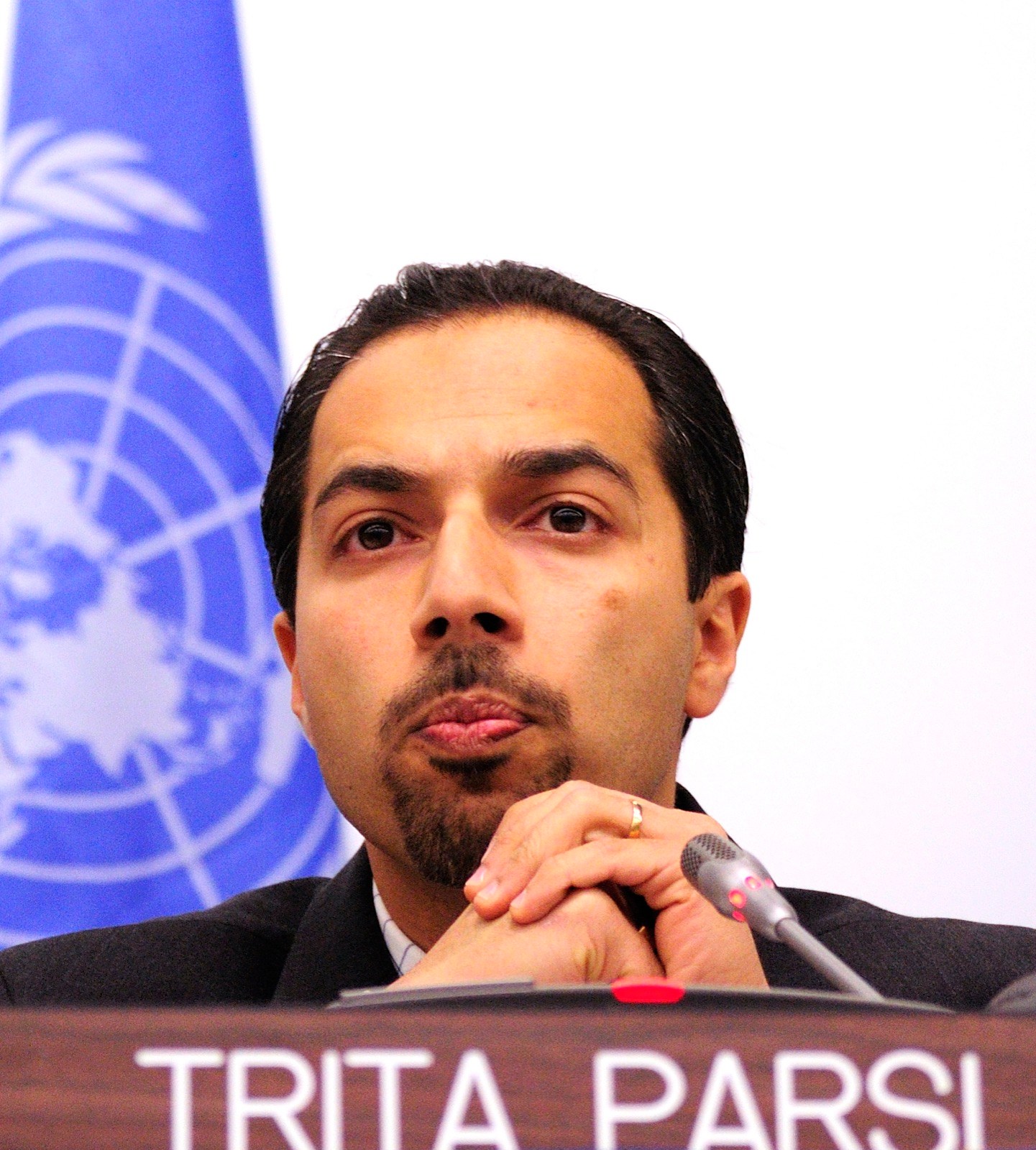
Trita Parsi
Trita Parsi is co-founder and Executive Vice President of the Quincy Institute for Responsible Statecraft, co-founder and former president of the National Iranian American Council, and author of four books on US foreign policy in the Middle East.
Episode Summary
Iran's strategy isn't to defeat the US militarily. Trita Parsi argues that it's to make the cost high enough, fast enough, to collapse domestic support before Iran loses. With MAGA turning against the war, oil markets destabilizing, and both parties alarmed by talk of ground troops, Trump urgently needs a face-saving exit. Plus, Parsi believes that Iran's revolutionary system was built to withstand exactly this kind of pressure.
Trita Parsi is the co-founder and Executive Vice President of the Quincy Institute for Responsible Statecraft, co-founder and former president of the National Iranian American Council, and author of four books on US foreign policy in the Middle East.
In this episode:
01:19 Succession After Assassination
03:13 Army vs IRGC Dynamics
10:55 Iran Strategy and US Politics
15:44 Why No Uprising
22:42 Gulf States Security Fallout
25:43 Saudi Shift After Oct 7
30:03 MAGA Backlash and Exit Ramps
33:32 Why Trump Went In
39:56 One Decision to Watch
Hosted by Sir Richard Dearlove (former MI6 Chief) and guest co-host Rosanna Lockwood (International Journalist)
Listen & Subscribe
- Watch on YouTube
- Listen on Apple Podcasts
- Listen on Spotify
Transcript
COLD OPEN
Parsi: They're willing to go through every red line because this is truly existential for them. Who's in control? Who decides to ceasefire? They just need to bring Trump's presidency as close to a collapse or to a destruction before they lose the war.
Dearlove: So if the domestic negatives were so profound and so obvious, why on earth did Trump do it? Why?
INTRODUCTION
Lockwood: Hello, and welcome to One Decision. I'm your guest co-host, Rosanna Lockwood, and I'm joined by my co-host as ever, Sir Richard Dearlove. Hello, Sir Richard.
Dearlove: Hi, Rosanna. Yeah. I'm in London this time.
Lockwood: Oh, it's hard to catch up with you wherever you are in the world. I'm not in The Middle East for once. I'm in The US, and that's probably a good thing because it's been quite the week there. And of course, around the world, taking out Iran's supreme leader was, of course, just the beginning. In this episode, we look at succession planning within Iran and repercussions across the region. Trita Parsi has spent his career analyzing the intricate diplomatic maneuvers between Washington and Tehran. He is the executive vice president of the Quincy Institute for Responsible Statecraft, a co-founder and former president of the National Iranian American Council, and he's authored four books about US foreign policy in the region. Welcome, Trita. Great to see you there. Thank you for making time.
Parsi: Thank you so much for having me.
INTERVIEW
Lockwood: Let's get straight into it. It's a very fast moving story, of course. And at the time of recording, we're wondering what's happening in Iran in the regime at the moment. Now some of the top levels of command and control have been taken out, and succession is the word on everyone's lips. At the time of recording reports that Mojtaba Khamenei, Ayatollah Ali Khamenei's son, has emerged as a leading choice. Of course, all of this is subject to change. But talk to us about what's happening there at the moment.
Parsi: Yes. So The United States had a tactical success within the first twenty four or so hours of this war that Israel and The United States launched with the killing of the Supreme Leader, as well as, as you mentioned, several people that were part of the command and control. I think it's important to notice that the Supreme Leader himself was not operationally involved and had been taken out of the operations already after the June war, I think halfway through the June war. So his death in and of itself does not impact how the military and their defenses is functioning. And I think we've seen clear evidence of that, that there wasn't much of a pause or confusion within the Iranian military ranks. The other people, of course, do matter, but the Iranians had also created a situation in which they had up to five replacements for all key positions already identified. They had also decentralized decision making so that even if central command would end up becoming compromised, the rest of the military would be in a better position to be able to operate by making sure that the decision making was decentralized and put at the level of local commanders. Whether that is functioning in the long run or not, I don't know. I'm not a military expert. But nevertheless, they seem to have taken a lot of precautions and a lot of preparations for exactly this type of a scenario in which a large number of their decision makers will be taken out.
Dearlove: Can I just follow-up with a brief question? Because I think it's an important distinction to make between, let's say, the Iranian military, the IRGC. I mean, if one has a parallel with Iraq, you had the Republican Guard, the Special Republican Guard, the Iraqi Army, two rather different organizations. Is that distinction valid, in Iran? I suppose what I'm thinking is, is it's possible that you will see the emergence, let's say, of a military group separate from the IRGC who might have a different view of the country's future?
Parsi: So that is, first of all, I think that distinction is very important, and I think the manner in which this works is that the IRGC was deliberately created because the revolutionaries did not trust the Iranian army, the Artesh. It was seen as being too loyal to the Shah, and as a result, they needed something that literally guarded the revolution. And this is an important point in general, because I think we tend to forget that this is a revolutionary system that was built to be able to withstand a counter revolution. And as a result, redundancy and having several different layers and parallel structures is built in this system in order to be able to withstand whether it's a regime change effort from the outside or from the inside. Now, the army has a reputation of being much more professional. It tends to view itself only as the defender of Iran, not the defender of a regime. In this scenario, can there be a wedge between the two sides in the sense that the IRGC ends up fighting this war perhaps beyond what the army feels is justified. It is more to preserve the regime rather than to preserve the country. That certainly appears to be the hope of the American planners and the Israeli planners, that that type of a wedge would come about. Here's where I think the manner in which the Israeli American war is conducting itself, at least if we were to believe some of the latest things coming out of the administration over here, that I think completely counters that hope. If it turns out that it's true, that the CIA has been planning and training Kurdish separatist forces in Iraqi Kurdistan, then you're not going to have as easy of a scenario in which the Artesh believes that it should actually lay down weapons. This is exactly what they were built to defend against. They are defending the homeland, the country, not the regime. And in fact, we saw that during the protest movement in January, in which for the first time the Artesh said that they were actually involved in the suppression of some of these protests, and what they were referring to was groups in Iranian Kurdistan that had infiltrated, and there was a lot of violence there before January 8. This is the first time we've seen that. In previous protest movements, the government has actually called on the Artesh to intervene, to clamp down on protest, and the Artesh has refused, saying that is not their job. In January, they did that, and I think that's an indication of how they see the situation. Yes, they're not there to defend the regime, but if they're seeing that there's actual threats to the country as a whole, its territorial integrity, its unity as a state, then that is something that will trigger them to get involved. And if that is the route that The United States and Israel chooses to go here, and I think the reason why they're doing so, and we can talk about that later, is because their plan A crashed down very quickly, then I think it's going to completely contradict the hope that they have that there will be a split between the Artesh and the IRGC.
Lockwood: In terms of, because everyone, Trita, in the Western world is looking for a name, looking for a successor, talking about Mojtaba Khamenei, talking about Reza Pahlavi. And then you're talking about the potential for this Kurdistan operation, if we can call it that, that could be the sort of plan B or the plan that's been there all along. We'll come back to why plan A crashed, like you said. But are we just wasting our time then discussing which gentleman could take the lead next? Is it the case that The US is just gonna take out Ayatollah Ali Khamenei's son if he gets installed? I mean, what I'm asking here is basically, is the West gonna decide who is the succession, or is Iran gonna be able to do it?
Parsi: I don't think the West, or I don't know if it's actually fair to call it the West. I don't think The United States and Israel will be deciding who is. They might be deciding who isn't by taking them out. But in terms of actually being able to install someone in Iran, I'm not seeing the situation in Iran being anywhere near that type of a scenario at all. In fact, I don't think this war is going particularly well, at least compared to where the Trump administration thought that they were going to be by now. It is quite natural, of course, to have this speculation about who will be taking over. It would obviously be a very important designation and appointment if this system survives. If it survives, obviously, will be a very key position. I would not be surprised if the Iranians decide to keep this three person committee running it in the intermediate term for a much longer period than perhaps was initially planned as well, precisely to avoid some of these situations. I think that the first twenty four hours after the Supreme Leader had been assassinated, that that was the most sensitive period in which if there had been any organization amongst the population in Iran that could mobilize people to try to overthrow the government, that was the moment of tremendous vulnerability, and we didn't see anything of that. So I think at this point, they probably feel relatively in control. They're following the procedures. They're not rushing it, and as a result, there are definitely people within that system that actually prefer that there isn't a new supreme leader, that there actually is a committee, which also according to the constitution would have been the plan after Khomeini's death in 1989. So I think the speculation is gonna continue. I personally doubt that it would be the son of Khamenei himself, Mojtaba Khamenei. A lot of people I've spoken to believe that this is Israeli misinformation in order to sow confusion and mistrust within the system. And I find it would be the ultimate irony that the Islamic Republic would overthrow a monarchy only to turn itself into a monarchy.
Dearlove: Can I push a bit more on the question of, as it were, the destruction of Iranian power and reach? So it doesn't seem to me that Iran has many military options in the region other than to sow, let's say, chaos. So, you know, the firing of missiles even at Arab countries with which it's been allied. It seems to me that the regime is gonna be focused on an internal role. I mean, they still, as far as we know, can control the street and control the streets of the major cities. I mean, what are the options for the regime now that, you know, the axis of resistance is gone, their allies or their surrogates have gone. How are they gonna be thinking both strategically and tactically about, let's say, the next two to three, four weeks?
Parsi: I think it's a very important question, Richard. And I think the first thing we have to remember, and I think this is where we really are in a completely new situation compared to before, is that they truly believe that this is existential. If there was any doubt in their mind, the assassination of Khamenei removed all doubt. And it is precisely because of that existential battle that you are seeing them doing things that on the face of it clearly looks very counterproductive. Attacking Qatar has played such a crucial role in trying to prevent this war. I have to say I myself was surprised. I thought that there would be an escalation ladder. There might be attacks against The UAE, against Bahrain. Not that more or less all GCC countries say Oman would be attacked right away. And I think, again, it goes to show that at this point, they do think that this is completely existential, and as a result, I don't think there is a tremendous amount of thinking that is going into their decision making about what do they do the day after if they manage to survive. To them right now, that seems to be a problem for a couple of weeks from now, not for the immediate term, and they're behaving accordingly. I think also that they are aware that in The United States, and probably in Europe, there has been a belief that has been strengthened over the course of the years that what the Iranians believed to be their showing of restraint, their showing of de-escalatory move. They took a lot of hits from the Israelis without responding at first. They called it strategic patience. Later on, when they did respond, it was very polite responses, symbolic responses that ultimately was aimed at not escalating the matter further, and that all of this has left the impression that the Iranians simply don't have the guts to face The United States in a direct confrontation. Now I think the Iranians are doing everything they can to dispel that notion and show that they're willing to go through every red line because this is truly existential for them. I think that's the first point that one has to understand. I was in meetings just before this war with folks from, or former officials and military officials from the administration that had a hard time grasping that we could be in this situation, and again, myself, I'm surprised how fast we've gone into it, but I think it was because there wasn't that understanding that once this actually is existential, a lot of the threats that they made before that turn out to be bluffs are no longer bluffs, and we're seeing that very clearly at this point. So what is the strategy? I think the strategy is that they believe that they absolutely do not have the military advantage over The United States or over Israel, clearly. They do have other advantages. They can define the geography of this war. They can define the scope and the length of this war, and frankly, I think at this point they are more in control of that than The United States and Israel. They have expanded the geography of this war. It's taking place in several different areas at this point. Particularly, what I personally was surprised by, I thought that the tactical success of killing Ayatollah Khamenei would give the Trump administration some sort of a bump. It didn't. So the country is not in favor of this war. If then they manage to destabilize oil markets, shoot up global inflation, shoot up inflation in The United States, get the base of Trump to increasingly become vocal in their opposition against this. This will create significant political challenges for Trump and for the Republicans, particularly with the upcoming midterm elections. We're already seeing that the more the Trump administration talks about why they're going into the war, the more support they lose. Rubio going out there and essentially saying that they have to do this because they had more or less outsourced the decision making to the Israelis, really galvanized the Democrats in a manner that we had not seen before. In fact, in the days before this, some of these Democrats that are now very aggressive against this war were somewhat ambivalent and only focused on procedurals. Did they go to Congress? Did we have a debate? Not whether the decision is right or wrong. Moreover, I think the briefings that was given to the members of Congress yesterday show that the administration is planning to put in ground troops into Iran without a clear plan, and this is now freaking out both Republicans and Democrats, recognizing that this is going to create massive, massive challenges internally in The United States. This is what the Iranians are banking on. They don't have to defeat The United States or Israel militarily. They just need to bring Trump's presidency as close to a collapse or to a destruction before they lose the war.
Lockwood: Trita, there's a lot to discuss, and I'm conscious we need to make the most of your expertise across war strategy. You've just touched on there US strategy insofar as it exists in a coherent form at the moment. But one thing I do want to just get to before we get to that, because there's a lot we wanna ask, back to just the Iranian domestic situation just briefly. I think listeners could do with an explainer from somebody with your knowledge and insight as to why. And I know to me this sounds oversimplified because I've spent a lot of time in the region, but why there hasn't been and isn't going to be a popular uprising against the regime, the kind that Trump asked for in his battle speech, telling Iranians to take to the streets like they haven't already? Talk to us about why that's not such a cut and dry scenario.
Parsi: I think it's a very important question as well, and I think precisely why it hasn't happened yet is something that a lot of people here in Washington are grappling with. I wouldn't rule it out. I mean, I don't think that, you know, this is a scenario in which at some point the Iranians might not rise up. But I don't see the signs of it at all at this point, and there's several different reasons. First of all, the brutality that the theocracy showed in clamping down on protests on January eighth and ninth when they had shut down the internet, and we could not see exactly what they were doing, but clearly thousands of people were killed, I think has shocked the nation, and it has really terrified people, and it really sent the message that this theocracy is going, it's not going to go down without a fight, and it will take anyone else down with it in that fight. There had been a narrative that had been created that I always thought was false, which was saying that the regime is just so weak right now because of all of its regional losses and everything that has happened in the last two and a half years that just a little bit of a push is enough to get it to fall down. And I think some people may have been under that impression inside the country as well, and they were taken by surprise or by shock to see the brutality that the theocracy was willing to clamp down. I just spoke to a person inside of Iran before our call, just wanted to see what the situation is. And on the ground now, he said, I mean, this is a person who's not in support of this system at all, but he's saying that on the ground, you know, a lot of people have now left Tehran. Tehran is very much empty after seeing the indiscriminate way that the Israelis have been bombing, particularly in the last forty eight hours. But that at night in these other towns where people have more or less fled, there's a lot of gatherings in the evening in support of the regime. Some of that is probably organized in order to just make sure that they show a force of strength, a showing of strength just to make sure that no one tries anything. But he said that you don't even see any signs of that, because what is concerning right now is making sure that people survive, and it's making sure that the country doesn't get blown to pieces and the fear of a potential civil war, particularly now when the US government is openly talking about supporting separatists, militant separatists in the Iraqi areas. I mean, this is just fueling that type of a nationalism that the regime itself could not whip up. It could not do this, but now it is being whipped up because of the manner that this war is going forward. And again, I think it's going forward in this way because plan A did not work.
Dearlove: You're talking principally about the Kurds presumably in the North. The Baluch or Balochi in the South seem to be the two potentially powerful ethnic minorities. And I appreciate what you're saying about the strength of the Iranian identity and Iranian nationalism. But, I mean, for example, the Americans don't have a very good record with the Kurds given what happened in Northern Iraq. And similarly, that must be making the Turks incredibly nervous. You know, whereas the Turks were willing to support the insurgency in Syria. If it's a Kurdish insurgency in Iran, there's no way that the Turks will get involved. I mean, how do you see the echoes of that regionally? Because it seems to me a certain naivety in Washington's attitude if they really think that is gonna generate some sort of Iranian disintegration?
Parsi: I think you're absolutely right, Richard. This is naivety, and I think it's naivety born out of desperation. Let me just say why I think that first. I think the administration really thought that this will be wrapped up by Sunday evening, particularly after they took out the supreme leader. They thought that there would be a regime implosion, they would have their Venezuela moment, and by the Monday morning when the markets open up, everything would be fine. They're not there, and they did not have a plan for what would come afterwards, and they're scrambling. They're grasping at straws. You can see that in their shifting justifications, their shifting goals, and I think the reaction is just throw as much power as they can without taking into consideration any of these factors that you rightfully put out, that this would have regional repercussions that are tremendously dangerous, and it really puts The US at odds with a NATO member who is hypersensitive about this issue. And of course, what I just mentioned about how this will play out internally in Iran. I do personally believe that this Kurdish element of this may actually prove to be a bit of a facade, and that the core of any type of invasion force actually will be US and Israeli troops, but that it is important to say that this is part of, oh, that this is led by Kurdish fighters or something like that for a variety of political reasons here in The United States. But nevertheless, by then putting that out there, that is fueling the Iranian nationalist reaction, and at the same time is further putting pressure on regional powers, exactly what the Iranians want: to get those powers to put pressure on Trump, to back off, find some sort of an exit, declare some sort of a victory, and stop this. This has been the entire gamble by the Iranians, to increase the cost as much as possible for everyone else so that there is pressure on The United States to stop this. And there's an added reason for this. The Iranians believe that it was a mistake, at least the IRGC believes, that it was a mistake for them to agree to the ceasefire in June. They believe that towards the end of the war, the Israelis were running out of interceptors, the Iranian missiles had become more effective, and if they had continued the war, they would have been in a better position. They didn't. They agreed to a ceasefire, and The United States and Israel used that ceasefire to regroup, remobilize, and relaunch the war seven or so months later. So as a result, they are not going to go for a ceasefire, and they've already rejected two, unless they believe that this has been so costly for everyone, so that no one thinks this was a good idea, and no one thinks it's a good idea to restart the war. That's the only way they think that this can be made, and during a ceasefire. And that means that they deliberately want to see these costs on all of their neighbors as well. And the strategy that The US is using is only playing into that.
Lockwood: So I was gonna ask you about that, who's in control, who decides to ceasefire. Stockpile depletion is a major topic of discussion at the moment in the Arab Gulf states and, of course, across the region. But as you say that this might be part of the overall strategy. So let's touch on your point about the surprise that some are feeling in Washington DC and Trump saying it himself that retaliation at Arab states happens so quickly and so forcefully and is not abating. America has traditionally been a sort of guarantor of stability in the region, particularly for nations like Saudi Arabia, like The United Arab Emirates, Qatar, Bahrain. How is this all affecting that calculus?
Parsi: I mean, this, ultimately, I have to say, is really problematic for The United States. Clearly, the Saudis in particular and all the other GCC states are infuriated with Iran for the attacks against them. But at the same time, there's also a lot of anger at The United States, partly for having started this war in the first place, which many of them begged them not to do, but also because they're seeing clearly that the priority of The United States is to protect Israel, but not to protect their states. In fact, it seems to me that Israel has gotten more American protection than some of the bases, because I'm surprised as to why the Iranians managed to hit so many of these bases, not only with missiles, but also with these slow moving drones. So there's a lot of frustration with that. Then there is a deeper strategic question that will have to be dealt with later on. These bases were ostensibly put there in order to protect these states against Iran. They were there to be able to balance against Iran. And Iran should not have attacked these countries precisely because of these bases. But the opposite has now happened. They're attacking them precisely because of these bases. These bases have ended up becoming a source of instability and a target for these countries rather than a source of protection. Now, once this is all over, I'm not saying that the GCC states will abandon The United States, that's not an option for them. But I do think that there is a likelihood that there will be a fueling of a diversification of their security away from just having all of their eggs in the American basket. As someone at the Quincy Institute, I think actually that's good for The United States. I don't believe that this level of military presence in the region ultimately serves The US. I don't think the region is any longer that strategically important, and it's certainly not worth fighting another war for. And I can tell you the vast majority of Americans tend to have that view as well, even though they may not go into the details. For those who always have wanted to shift their focus elsewhere, whether it's to be more hemispheric focus, which is what the administration said that they would do just a couple of weeks ago, or whether it is to shift the focus to East Asia, this is a complete disaster that went out once in another war here, but also if it means that afterwards this will lead to a gradual reduction, at least, of military presence in the region, many of these folks in the government would actually welcome that.
Dearlove: What about the Saudi position? Because I think in some respects, this is crucial, particularly if we go back to the rather fundamental divide between Sunni and Shia, bearing in mind the Saudis have a very significant Shia minority in Eastern Saudi Arabia, which always has been a problem for them. I think my view is that Salman was almost certainly informed by the Americans or consulted by the Americans and probably gave his support to the invasion. Do you think that analysis still holds true in the light of what you are saying? Because, I mean, the Saudis would strategically be a significant beneficiary from the sort of demise of the current Iranian regime. But on the other hand, the destabilization of the region is something which is strongly not in Saudi interests.
Parsi: I think that's true. I would just add a couple of layers, because I think what you said is absolutely true if we were talking about the situation pre October 7. Post October 7, I think there is a structural change that has happened that is impacting the thinking of not just the Saudis, but everyone else in the region. The United States since October 7 has essentially taken off all of its limitations that it put on Israel's use of American weapons. The Israelis have been essentially being able to do whatever they wanted in violation of international law and in violation of domestic American law. And we even had the case of Anthony Blinken lying to Congress about what the Israelis were doing in order to not reveal that the Biden administration was violating domestic American law in terms of its support. This has then not led only to the manner in which the Israelis have bombed Lebanon and Gaza, but also that ultimately the Israelis bombed Doha as well. And this sent shockwaves, of course, throughout the region. The United States was supposed to not just protect them against Iran, but it was also a protection against anything that Israel at some point might want to do, not that that was seen as a very significant risk in the Persian Gulf, but nevertheless. But it turns out that American air defense systems apparently don't even get activated when Israelis attack. So in that scenario, and particularly mindful of the fact that the language coming out of Israel increasingly has been talking about greater Israel, talking about things that now Qatari and Turkish officials openly say that Israel is seeking to establish military hegemony in the Middle East. In that scenario, if you cannot count on The US to rein in Israel, then you have to build your own alliances, your own structures in order to be able to balance against the scenario of falling under Israeli hegemony. This is part of the reason why I think we saw that the Saudis struck that deal with the Pakistanis, and the Turks may be getting into that arrangement as well. In this new formation, Iran is not a formal member, but Iran is a de facto buffer between them, mainly Turkey, Saudi, Qatar, and the Israelis. If Iran is gone, whether it's defeated militarily, whether it collapses, civil war, or even if you have a pro Israeli puppet installed, that is actually a very negative development for these countries who otherwise despise the Islamic Republic, because they see clearly, and if you listen to what the Israelis are saying, Turks absolutely have reasons to believe this, that Turkey will be the next target once Iran is gone, and eventually it will be Saudi Arabia as well. So all of the kind of geopolitical factors that were existing pre October 7, in which there was a basis for believing that there would be a Saudi Israeli alliance against Iran, that basis is increasingly withering away, partly because Iran already has been so weakened, but also partly because they now see Israel increasingly as a threat to themselves, and they cannot rely on The US against Israel, so they're trying to form their own things, and now suddenly Iran has turned into a buffer between them. So do the Saudis want to see this war? I think the Saudi foreign ministry was lobbying against it, but there's increasing evidence emerging that MBS himself was lobbying for it, at least towards the end. But did they want it to lead to this type of a scenario? No. I think they probably bought into or hoped that the American plan A would succeed and this would be a quick affair, but now it's turning into a disaster for them as well.
Lockwood: Returning to Washington and what's happening stateside and reception to this war. You've already mentioned a number of factors. You've got the midterms happening later this year. At the time of recording, we're talking about there being a war vote in the Senate, which is probably gonna be a blip when we think about the impact it's gonna have because already the war has started, that people are scrambling, in the words that you gave us at the start of this conversation. So the focus is there. But obviously, in America, people are talking about, did we want this? Popularity for this has been low. Support is declining by the day. The idea of boots on the ground will shock many. Talk to us a bit about the sort of long view being three to six months, the impact this can have on Trump.
Parsi: Well, I don't even know if it's gonna take three to six months. I mean, I'm talking to a lot of people in the MAGA crowd. The anger, the sense of betrayal is overwhelming. To them, even before this, Trump had focused too much on foreign policy. In their view, every second spent on all of these foreign policy issues is a second not spent on the border, on fentanyl, and all of these things that they believe are far greater priorities for The United States. The fact that he spoke so strongly against endless war, against regime change wars, and now is there at this moment talking about regime change, potentially even boots on the ground in a country three or whatever time size of Iraq, a population far greater than that of Iraq. I mean, I think most people never thought that Trump would be in this position, that he would ever take it this far. And you're seeing that some of the big influencers, Tucker Carlson more than anyone else, has not held back. I mean, said it the day after, he said that this is an evil decision. That set the marker for much of the rest of the America First MAGA crowd. And I think it's going to be very interesting what happens in November. We just saw a primary in Texas in which Dan Crenshaw, a big supporter of this war, was primaried out and lost in the primary against his Republican challenger, a Republican who was more on the America first side of not getting involved in these different wars, who had not shifted to follow Trump in this new direction. Now, this is just one data point, but I'm saying that to me, it sounds very likely that this is the direction things will go, and that Trump really needs to find some sort of a face saving exit, as do the Iranians, of course, in order to be able to salvage this and turn it not into a political disaster for him. The fascinating thing, of course, is there is no politician that I can remember that has had the same capacity as Trump of just changing the goalpost, declaring victory, and saying that everything is awesome. He certainly has that. But beyond that, he actually also has real things he can point to if he wants to build that narrative. He can say that he did take military action, he did kill the Supreme Leader, he can say that he actually did get a better deal than the Obama administration because the deal that was on the table at the last round of the negotiations, as described by the Omani foreign minister, was far stronger than what Obama had achieved. In my view, Trump should have taken that victory and declared victory. Instead, he declared war. He still has that option. But the further he goes down this path, the more American losses you have, the more anger you have in the MAGA crowd, the more difficult it will be for him to make that switch and be forgiven by his own voters.
Dearlove: So if the domestic negatives were so profound and so obvious, why on earth did Trump do it? I mean, I think we still have that unanswered question. Was it a miscalculation based on a Venezuelan analysis of success? You know, something rapid, something quick, in and out. But surely, anybody with a geopolitical brain, and I'm not talking necessarily about Trump, I'm talking about the people around him, would have known that with a country of the complexity, history, size, and culture of Iran, that just wasn't gonna happen. I mean, I am genuinely, in terms of your analysis, which is fascinating, particularly with respect to the resonance within the MAGA movement within The United States, you know, why?
Parsi: I wish I had an answer, but let me give you a couple of data points at least, because you're absolutely right. It just doesn't make sense. And I personally was one of those who, for a very long time, thought he would not do it precisely because the political fallout was so obviously negative. I mean, remember when Bush went into Iraq, which I think was a mistake, but nevertheless he had the American public on his side. He had been making the case for a war for more than a year. He had gone through the hoops as well, everything from an AUMF to going to the Security Council, all of these different things to make that case. Trump never even did that. It was clear that the support was very low, and he never even bothered to try to get it up before he started. I think there's a couple of things that are important to keep in mind. There were several advisers who advised him against the operation in summer, and they are no longer at the table. In fact, the number of people that are at the table talking to Trump are far smaller than they were just seven months ago, and most of the people who have been pushed out were the ones who counseled against this. And I think that has created a situation in which the ones that are remaining are much less inclined to directly counsel against something that so clearly the president wanted to do, and the president wanted to do this. Everything I've heard from people on the inside throughout this, Trump himself was the driving force within the US government. That then brings us to the Venezuela narrative, as well as his conversations, constant conversations with the Israeli prime minister. I think the Israelis managed to play his psychology very effectively. They portrayed Iran much weaker than it was. They made it sound to him: This is easy. Don't make a deal. You just have to push these guys a little bit. You will be the president that finally gets rid of this theocracy. Why give up on that opportunity by striking a deal? You see the protests that are out there, you see how weak they are, you see how their economy is crashing. You can get a much, much better deal by just getting rid of these guys, and this is part of the reason that at the negotiating table, he was just looking for their surrender. He was not looking for a compromise, and that's why he kept on saying no to compromise deals that were way stronger than that of the JCPOA, because he thought surrender was in the cards. The psychology of him thinking and him being fed this narrative that you were always right: they told you you can't take out Soleimani, they told you you can't bomb Fordo. They told you you can't move the embassy to Jerusalem. They told you you cannot recognize the Golan. You did all of those things, and it turned out fine. Conventional wisdom is wrong. You are right. You're the only person who can do this. And he fell for it, and here we are.
Dearlove: I was gonna say, supposing Trump has a measure of success. I mean, I'm just trying to think of the unthinkable. Supposing in two weeks' time, we have a general with a significant amount of the army who stands up and says, right. You know, another nationalist regime, but it won't be ideological. It won't be religious. It will be Iranian, but we're gonna do a deal. If that were to happen, and Trump would be walking on water internationally, it would be a sort of foreign policy success. Is this completely unthinkable, or is there still a five, ten, 20% chance that that might occur?
Parsi: I don't think it is completely unthinkable. I think there is a scenario in which this potentially could happen. Here's why I think Trump is making it more difficult than it needs to be. What he did in Venezuela was, of course, very, very different than what he can do in Iran. But also, he made it very clear that he's now turned Venezuela into a client state. One of the first decisions that the Venezuelans had to do once Trump was running the country essentially was to stop selling oil to Cuba and start selling oil to Israel. If Trump's idea, what he's putting forward as something attractive to the Iranian army or whoever would defect and try to put an end to this war and agree to Trump's terms, is the complete, not just the military surrender, but the political, ideological surrender, the surrender of Iran's independence. Because that is what he's putting in front of them. It could not be more unattractive. Things that these people have fought against for the last fifty years is what he's saying is their exit ramp. This is part of the reason I think he has completely miscalculated the psychology of this theocracy but of this nation as a whole. The theocracy in itself did not fear the aircraft carriers. They did not fear war. They feared surrender. Surrender would be far more dangerous to their survival than war is. They believe they can survive war. They cannot survive surrender. And even if you end up having someone taking charge of the country that would agree to all of these different things and essentially turn Iran into a puppet state. History teaches us, not just in the case of Iran, but in the case of almost every other state that The US has done a regime change, that those governments tend to last very shortly. Either they turn against The US because the geopolitical forces that actually push them into a policy that is in contradiction of US interests is too strong, or they fall. So as a result, if he walks on water, as you said, Sir Richard, that would only be for a temporary period, and then he would sink.
Lockwood: Trita, it's been excellent to have you here on One Decision Podcast, and I appreciate this is a difficult question to ask in a complex time. But what one decision are you looking out for in the coming days?
Parsi: I think one of the most important indicators that Trump might be looking for an exit out of this is if he starts talking about how much they've already achieved, if he starts laying out the ground for some sort of a narrative of success that has already been achieved. If we start seeing that, then I think that may be a sign that he may be moving in that direction. That is the opposite of what we're seeing right now. Right now, he's signaling the Iranians that he's happy to continue this war for another four weeks, he's happy to bring in ground troops, etc. He's throwing good money after bad money in my view, hoping that he can do something that turns the table on the Iranians, and that idea of surrender that he had in his mind can still be achieved.
Lockwood: Trita Parsi, thank you very much for making time for us in a busy time for you.
Parsi: Thank you. Fascinating discussion. Thank you so much for having me. I really appreciate it.
ANALYSIS WITH SIR RICHARD DEARLOVE
Lockwood: Well, Sir Richard, as expected, got a lot from that fascinating conversation. What was your main takeaway?
Dearlove: Well, I think the main takeaway was the view he gave us of the internal reaction in The United States to Trump's decision. And, you know, the feeling, well, his conviction that the planned operation should have been over in two, three, four days. Quite frankly, I find that pretty surprising as an analysis because if that were the situation, then the naivety surrounding the initial decision to go in is pretty stunning. I mean, it was fascinating talking to him because he gave us a fresh and actually quite original perspective on what's going on. And, certainly, I'm really impressed by, you know, the insights he has into Iran and his understanding of his own country. Let's face it. He's an Iranian. And he obviously is talking to people there. I'm not sure whether I agree with his analysis. I need to sit down and think about it because it's pretty disturbing and pretty disconcerting if he's correct. He could be. I'm not sure. And I think this is for consideration and discussion. And over the coming weeks, I think we'll get a clearer idea of whether he's right or not. But I think it's really important to hear that sort of almost counterintuitive attitude stated so clearly. I mean, he's clearly an analyst with a pretty deep understanding of, let's say, the Iranian political and cultural mind. I don't know whether you agree with that.
Lockwood: I do. Look. It's as with everything when it comes to Iran, you, we can't consider it a homogenous whole or a homogenous people. It's as complex as it comes. And I've seen Trita Parsi speaking in debate situations with other types of Iranians from the Iranian diaspora in The US and elsewhere and also from within the country. And that's when you get to see the complexity and the variety of views that do exist inside and outside Iran. But I would agree with you on your point when it comes to, so that's on the Iranian political situation. But when it comes to the analysis of the war, the analysis of conflict, he said, you know, I'm not a military analyst, but I'm sort of with you in thinking that the way he spoke about how it could play out is horrifying, terrifying, potentially correct. And that was sort of my takeaway, was when he said that the regime, because his view, his knowledge of the regime is so good and one of the most detailed I've heard. And he was saying that the regime feels that they can survive war, but they cannot survive surrender. And that's the sentence that's gonna stick with me when I think about how this continues to play out in the coming weeks, whether there's gonna be an off ramp, especially for, you know, those in the region.
Dearlove: No. I think you pick out a crucial phrase in his analysis. And the idea that, well, I guess it's the old issue. You can lose the war, but win the political battle.
Lockwood: The other one point I wanna pick up that he said was about, when I asked him about The US being the guarantor of regional stability for The Gulf particularly, he mentioned that, you know, potentially nations like Saudi Arabia, UAE, Kuwait, Qatar, Bahrain that have previously relied heavily on US assistance, have put their bases there, and that's thus now why they're being targeted, may not, he said, quote, put their eggs in one basket so much anymore. May look further afield. I was interested from your point of view, Sir Richard, whether you can think who else might be the eggs in the basket because Europe isn't looking too strong at the moment.
Dearlove: Yeah. Well, I guess it's the Chinese, isn't it? And the Chinese have been trying very, very hard to get a bigger foothold in the Arab world using, you know, financial and economic blandishments and insinuating themselves quite widely into the area. So I think some of the smaller players, I'm not sure this would apply to Saudi, but would certainly be attracted in that general direction. It strikes me that India may be to an extent, but I don't think really.
Lockwood: I think it's largely we're talking about China. And that would certainly be considered a large strategic loss from the point of view of The US. Look, we better wrap it up there. Everything's changing at the moment. We'll be back with more. That's all for this episode. Do join us on Tuesday for a special episode of One Decision in Brief. Sir Richard and I will be joined by Sir Ben Wallace, former UK Secretary of State for Defense. We will be analyzing all the breaking news around Iran. If you have questions about escalation in Iran, please leave us a YouTube comment. We might just answer your question on the show. We want to help you make sense of what is going on. For more conversations with leading decision makers and thinkers, do check out onedecision.com and our YouTube page where you'll find additional commentaries, conversations, explainers. I'm Rosanna Lockwood joined by Sir Richard Dearlove. Thank you for listening.