Episode Info
- Season27
- Episode5
Hosted by Christina Ruffini and Sir Richard Dearlove
Guest
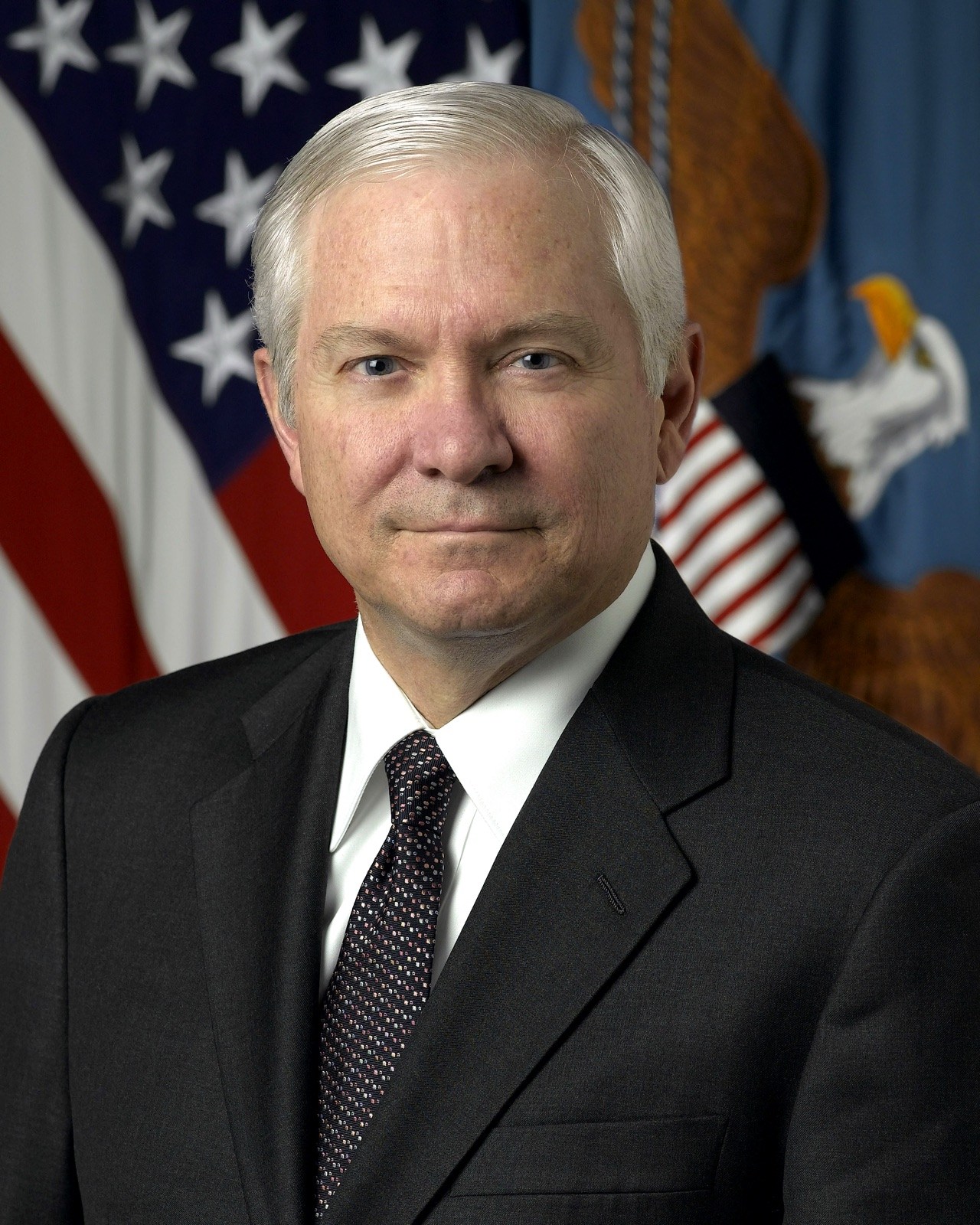
Robert Gates
Robert Gates is a former CIA Director and United States Secretary of Defense who describes current global security challenges as "more perilous than we've probably faced since World War II."
Episode Summary
Former CIA Director and United States Secretary of Defense Robert Gates joins One Decision's Christina Ruffini and former MI6 Chief Sir Richard Dearlove to discuss global security challenges facing the West and its allies. Gates describes the challenges as "more perilous than we've probably faced since World War II." They also discuss what's at stake for the Taiwanese, Russia's strategy in Ukraine, Iran's brittle regime, far-right populism in Europe, and whether America should build an Iron Dome. Plus, Sir Richard shares an anecdote from former UK Prime Minister Margaret Thatcher.
Listen & Subscribe
- Watch on YouTube
- Listen on Apple Podcasts
- Listen on Spotify
Transcript
COLD OPEN
Gates: I think The United States and our allies are facing a global challenge and a global security environment that is more perilous than we've probably faced since World War Two.
INTRODUCTION
Raffini: That was former CIA director and secretary of defense Robert Gates talking about the current state of affairs around the globe. You're listening to One Decision, the podcast that looks at the choices that shape our lives. I'm this week's host correspondent Christina Raffini, and of course, I'm here with former MI6 chief Sir Richard Dearlove. We're gonna talk about Israel, Ukraine, whether The US needs its own Iron Dome, and the popularity of populism. Also, an anecdote about what Margaret Thatcher once said to Sir Richard at an official dinner. Let's get right to it. Secretary Gates, thank you so much for being with us today. The first thing I wanted to ask you is just as you look at the world of global security issues right now, is there one issue that concerns you the most? Or is the big picture in and of itself most concerning?
INTERVIEW
Gates: I think it's the big picture that's actually the most worrying of all. We have large, aggressive adversaries in Russia and in China, in Iran, in North Korea, three of the four have substantial nuclear capabilities and are building more. We're facing the potential for the first time since Korea of facing an adversary in Europe, and also one in Asia at the same time. So I think it's a very dangerous time. And frankly, I think while the rhetoric in Washington is very tough in terms of rebuilding or building our military strength, the actions that are taking place are not commensurate with the threats that we face.
Dearlove: Bob, of the four countries you mentioned, do you think this is an alliance or is it more an alignment of convenience between these nations?
Gates: I think it's more the latter, Richard. I mean, the Soviets occupied Northern Iran in World War Two, there's no love lost historically between Russia and China. Russians are pretty racist in all frankness. And I think it's got to make Putin very nervous to watch Chinese particularly economic activities in Central Asia, and in places that the Russians have long thought of as being sort of their province, if you will. And in fact, were part of the Soviet Union. It's not that long ago, Richard, you and I can remember when the Russians, the Soviets had a million troops on the Chinese border and actually were in a fairly substantial conflict in 1968, 1969. It is indeed an alliance of convenience. I have to wonder if Xi Jinping occasionally wonders if he's hitched his wagon to a, that he's made a big mistake in hitching China to this unpredictable guy in Moscow.
Raffini: Do you think it was a strategic error? Do you think it was a mistake on his part?
Gates: No, because I think at this point, they do have one thing in common, and that is the desire to damage The United States and its allies as much as possible to discredit democratic governments. So they have, I mean, it is an alliance of convenience, but it is an alliance also of agreed-on states of wanting to see a dramatic weakening of democracies, but also essentially an end to The US and allied creation of institution, economic and political institutions after World War Two, and overturning that whole system that was created, what we politely refer to as the rules based environment. For Iran, it's basically a way out of their isolation. It's a source of income. I think that they're getting a lot of help from the Russians. I worry a lot. I don't have access to classified information. But I would be stunned if the North Koreans aren't getting missile, nuclear and other kinds of technologies, satellite technologies from the Russians in exchange for their support and their help to the Russians.
Dearlove: Bob, I was at a roundtable in Cambridge over the weekend, and obviously China was one of the topics of discussion. And it's quite clear from listening to some of the academic experts who are pretty strong on analysis that Xi's got some really frightful economic problems. Okay. They're slow burn at the moment, but he's facing some really severe internal headwinds. So as far as China's concerned, not everything is going quite as it appears when you, as it were, watch the power of China outside the country. I think the leaders sitting down on the fishing platform are really quite concerned every morning about Chinese social problems, Chinese difficulties regionally, and the economy as it looks at the moment isn't helping them. All they're doing is pumping in liquidity. They're not doing anything about structural reform.
Gates: I think all of that is true. And I think the real message came through at the Party Congress last October that the economy as far as Xi Jinping is concerned, the economy will take a back seat to the security and power of the party in China, and that he will not do anything that undermines the power of the party. And that means the kind of reforms that took place under Deng Xiaoping and his successors, Jiang Zemin, Hu Jintao, in terms of encouraging entrepreneurs, encouraging the private sector, encouraging the market economy are all taking a backseat. And the Congress was quite explicit about all of this. And then the Third Plenum that just concluded a few weeks ago, essentially reinforced that by underscoring that there's really not going to be any economic reform of any substantial kind. And both the Congress and the plenum have underscored that the emphasis is going to continue to be referring back to the state owned enterprises as the main engines of growth. And if that's the approach you're going to take, then none of the structural problems that you described, Richard, and the demographics, the economic issues, young people, the unemployment among young people, the lie flat movement of young people who've just given up, if you will, those are all real problems and they will continue to be. Xi seems to have decided that the solution is not reform, but to maximize China's manufacturing capabilities in a variety of areas, whether it's electric vehicles or batteries or a host of other things, and then flood the world markets with it. And you're seeing the consequences of that, where even both of our candidates are talking about tariffs on China, more tariffs on Chinese goods. But now you have the EU talking about exactly the same thing against the dumping practices of the Chinese, and particularly when it comes to a lot of the green technologies where they have huge manufacturing capabilities, and they're trying to dump this stuff in The United States and in Europe. So I think you're right, they face some very serious problems. By the same token, this is still a very powerful economy. It's still a very powerful country, and a country that is very aggressive, particularly militarily in the South China Sea, economically, strategic communications, and other areas worldwide.
Raffini: There were some reports out of Japan this week that two Chinese drones were seen scoping out the waters around Taiwan, and that sent up some flags for obvious reasons. If you were a betting man, given the momentum of where you're seeing things going, do you think China takes action in Taiwan? Do you think they do it in the next five years?
Gates: I think that an open Chinese invasion of Taiwan, if you will, I think is a pretty low probability for the foreseeable future. And mainly because I think Xi Jinping has a variety of other tools at his disposal that are a lot less risky. So whether it's cyber or economic pressures, or cutting cross-channel ties between Taiwan and China and so on. But I think one of the most powerful tools that he has is actually a military tool that he has used before. And that is what he did after Speaker Pelosi's visit, when he declared exercises around Taiwan, that for all practical purposes, closed off both air and maritime commercial corridors into Taiwan for a period of a week to ten days, and really significantly disrupted commercial traffic into and out of Taiwan. He can declare those exercise areas anytime he wants for any period he wants and neither The United States nor Taiwan are going to go to war over these exercise areas. So he has a lot of mechanisms and tools at his disposal that I think pose a lot less risk to China than an all out invasion of Taiwan.
UKRAINE
Dearlove: Bob, how do you see the balance now of forces in Ukraine? I mean, we've got this extraordinary Ukrainian occupation of Russian territory with the Russians really at the moment looking incapable of pushing back. But in the south, you've got a pretty serious advance in the Donetsk area, which is clearly, you know, threatening some of Ukraine's important communication lines along the whole of the southern front.
Gates: I think that the Ukrainian incursion of Russia is a morale builder for the Ukrainians. I think it is a humiliation for Putin, an embarrassment for Russia. But I think all you have to do is look at a map of Russia to see what a tiny part of Russia Ukraine is occupying in the Kursk area. And, you know, just given the vast expanse of Russia, this is just a little incursion on that border in terms of overall space, and there are no sensitive military facilities in that area where the Ukrainians are operating. So the Russians for centuries have traded space for time. And I think Putin is actually keeping his eye on the ball. To your point, Richard, they're focused on their opportunities in the Donbas right now, and particularly going after Pokrovsk and these other areas that are key hubs in terms of logistical support and supply of troops and communications and so on for the Ukrainians. So I think ultimately, the Russians will bring their mass to bear and go after the Ukrainians in Kursk. But I think they're keeping their eye on the ball that the real opportunity for them right now is in Eastern Ukraine. And I don't think they've been distracted from that by this incursion.
Dearlove: Should we let them off the leash in terms of use of ATACMS and HIMARS on Russian territory?
Gates: I think if we could get agreement on the use against military facilities that are being used to support the war in Ukraine, and avoid attacks on cities like Moscow, well, on the cities, I think to that extent we should certainly loosen the leash. I don't know why we should allow Russian aircraft to take off from bases in Russia to attack Ukraine and allow those bases to be sacrosanct or immune from counter from the Ukrainians. So I think if we could reach agreement on the nature of the targets that are permissible, then yes, I think that the leash ought to be significantly loosened.
Raffini: Can I ask why hold on to the leash at all? I mean, Russia isn't putting any limits on what it can hit. Why constrain Ukraine to a higher level than its opponent?
Gates: Particularly over the last year or year and a half, the US administration I think has been overly concerned with Putin's red lines. But that's not to say there aren't any. And if you start launching American made long range missiles into St. Petersburg or into Moscow, I think you got a problem of a different sort on your hands. That may be the actual red line. You know, in a way, it's the same red line that the Israelis have made to the Iranians. When they killed Haniyeh, the message that the Israelis were sending to the Iranians is you better not hit any civilian targets if you retaliate. And in a way, I think that may be applicable in Russia as well. Except I would draw the distinction with the bridge to Crimea. I'd take that sucker out in a heartbeat.
Raffini: We'll pass along the message.
ISRAEL, HEZBOLLAH AND IRAN
Dearlove: It looks as though the northern border issue with Iran, Hezbollah, and Israel is not likely to escalate. I think maybe you and I have both been predicting there is strong reason on both sides for restraint, although there's a formulaic need for both sides to respond when there's an attack. But do you see that breaking down? It's certainly gonna be tough for Israel if they've got to fight a full scale conflict on the northern border as well.
Gates: I think that the most reassuring aspect of that situation is Nasrallah's statements in effect, to sort of do this and say, we're done. We have appropriately retaliated. And I think one thing that has kept it limited was the Israelis, after some pretty disastrous Israeli intelligence failures beginning on October 7. They had a very good intelligence success with this offensive by Hezbollah, and were able to preempt a good bit of it, it seems to me, and thereby limit pretty significantly the damage done to Israel, but Hezbollah fired enough rockets that the leader was able to say, okay, we're done with our part of it. And the Iranians seem to be saying on their part that, you know, we're gonna wait, we're not going to do anything as long as this potential ceasefire in Gaza is still on the table. I think there's also a lot of reasons, Richard, for the Iranians to be very careful. We talked a little bit about China's economic problems. The Iranians have really serious economic problems. And I thought it was very telling that the supreme leader came out a few days ago, talking about it's okay to talk with the Americans about the nuclear program again. You can't trust them, but I don't mind if you talk to them. I think that the last thing that the Iranians need is the Israelis going after particularly sensitive economic targets in Iran, whether it's the oil fields and refineries or the electrical grid or something like that. I think the domestic situation in Iran is pretty fragile for the regime. And I think that's one of the reasons for the Supreme Leader's statements on the nuclear program. I think they really need relief on the economic sanctions. And one of the things that I don't think makes it much into the headlines is that things really changed a lot in Iran, it seems to me. I think it was in January 2018, when for the longest time after the 1979 revolution, most of the demonstrations and anti-regime activities took place in Tehran, and they were from the University of Tehran and so on. But beginning in January 2018, you began to see demonstrations all across Iran in areas where the regime, if you will, considered its base of very conservative areas, but in dozens of cities, large and small, and that has continued to be the case when there have been public discontent. And so given the economic problems and so on, I think this is a pretty fragile regime, and I think they are eager to figure out a way to relieve some of the economic pressures on them. Yeah. And they have a succession problem.
Raffini: Do you think any of this change, I don't wanna say a change, but this softening of the rhetoric from Khamenei has to do with the influence of this new allegedly more moderate Iranian president, or is he still just completely beholden to the powers that be? Do you think he'll be able to meter the influence of the IRGC or the supreme leader?
Gates: I was in the White House working for Zbig Brzezinski at the time of the Iranian revolution, and actually was the notetaker in the first meeting between a senior American official and the new revolutionary government of Iran in Algiers. They actually asked to see Brzezinski, who was the prime minister, the foreign minister, and the defense minister. And they basically wanted us to return the Shah to them. Anyway, the point is, as I like to tell people, I'm now thirty five years into the search for the elusive Iranian moderate. When there is talk of moderates in Iran, it almost always has to do with domestic affairs. Are you gonna loosen the garment requirements? Are you gonna let young people see? Are you gonna lighten the pressures internally? I've never found a moderate when it comes to the relationship with The United States, or frankly, in foreign policy more generally. I think this president has zero flexibility and power when it comes to national security issues. You know, what we've seen internally in Iran, as well as in the external policies is a rise or a strengthening of the hand of the hardliners, the IRGC and so on, over the last two or three years. And that's where I think the real power is when it comes to these issues.
Raffini: Do you think US policy, I mean, I'm not sure what the alternative would have been, but sanctions, US pushback has been the cause of that. Just to make a terrible analogy, my family's Italian, we all scream at each other all the time. But if you insult one of us, we close ranks and we're the most pro family people ever. I always think about that when it comes to sanctions and places like Iran. Do you think it makes it harder for moderates to have a voice when there is this constant, what they see as being put upon by The US? Do you think US policy has been productive in Iran?
Gates: I think that the pressures have created problems for the Iranian regime. As I said, I believe that the situation internally is fairly fragile. And I think that in turn impacts the policies of the leadership to some degree. And my view is that loosening the sanctions does very little to empower or strengthen the role of those who would like at least a more moderate regime at home. One of the things that I have not understood, particularly in recent years, is why The US and its allies have not been more aggressive in trying to support and help opposition groups inside Iran. No, I'm not talking about trying to prompt a coup or something like that. I'm talking about if you have a generally discontented population, why not do everything you can to provide arenas for that discontent to express itself inside Iran and opportunities to promote that discontent. And you know, Richard will remember vividly, I mean, we had some pretty aggressive programs in Eastern Europe and The Soviet Union during the Cold War. I've never figured out why we haven't. And frankly, I would extend this to both Russia and China today. You know, they're all busy interfering in our internal affairs. And I don't understand the loathing of what's good for the goose is good for the gander. You know, if you want to play that game, we can do that too. And we actually have some pretty effective tools.
Dearlove: It's still the myth in Iran that MI6 controls the weather there.
MISSILE DEFENSE AND THE IRON DOME
Dearlove: Bob, one of the issues now that's coming up again, having watched these exchanges of missiles between Iran and Israel, the attacks on Ukraine, is missile defense, and we've got Trump talking about an Iron Dome.
Trump: And I will build an Iron Dome over our country, a state of the art missile defense shield made in The USA. We do it for other countries. We help other countries. We build, we don't do it for ourselves. We need it too. You know, Reagan proposed that many years ago, Star Wars. He proposed it many, many years ago, but at that time, there was no technology. It just looked good.
Dearlove: I think my question is, without getting political, is it feasible? Is it affordable? Is it practical?
Gates: It is if you have a pretty limited geographic area to cover. So it works really well for Israel, we helped them develop Iron Dome, we helped them develop David's Sling, and the Arrow program and David's Sling. So we've helped them develop a lot of this. And yes, it works. We've seen how it works. But you're also talking about an area that's a fraction the size of New Jersey. So the truth is, I think you could develop an area defense of major American cities like Washington DC or New York or LA or, you know, take your pick. But the notion of a national defense against a massive strike, I think is unrealistic. I mean, our missile defense system now has 100 launchers. And it's in California and Alaska. And it's designed essentially to deal with a very limited attack by North Korea, or an errant missile fired either by accident or mistake or some terrible thing that only involves a handful of missiles from Russia or China. And so it has very little national missile defense capability. And frankly, maybe technically we could do it, but the cost would be staggering. So I think to say we'll have an Iron Dome for The United States is unrealistic. But you could build a better area defense for some of our cities. The other thing to understand about Iron Dome as an example, is it's much harder to hit an incoming intercontinental range ballistic missile than it is a short range ballistic missile. So the Israeli Iron Dome system is very effective against this kind of short and medium range missiles that are launched against it. But a number of the longer range ballistic missiles were the ones that actually got through in the original Iranian targeting set against Israel. The nine that got through were ballistic missiles. And had they only launched a couple 300. Had they launched 1,000, the system probably wouldn't have been able to take care of it.
UK ARMS TO ISRAEL
Raffini: I also wanted to ask you, the UK has announced that it's going to limit some weapon shipments to Israel because they said they can't guarantee it's not going to be used to commit human rights violations in Gaza. Tactically, it's probably not significant. But what do you think the impact of that announcement is diplomatically?
Gates: Well, I think it probably is not very helpful. I don't think there's much practical effect of it. I personally thought that there was some merit in withholding the 2,000 pound dumb bombs that the administration withheld, because they're basically designed to just flatten buildings. And a lot of the tunnels, some people say, well, they're very useful against the tunnels. Well, the fact is, as deep as some of those tunnels are, those 2,000 pound bombs won't get there. If you were using the American Massive Ordnance Penetrator, which is a 30,000 pound bomb, not a 2,000 pound bomb, you might have some effect against deeply buried tunnels. So that basically was for flattening buildings. And let's just say, that's not the kind of precision targeting that either the Israelis were claiming or that we were advocating. But the other weapons, you know, when this war comes to an end is essentially now a political decision. And we've all seen kind of the impasse that we're at. I've kind of felt for several months now that these negotiators, particularly those who are fostering the negotiations like our negotiators, Brett McGurk and Tony Blinken and so on, they remind me of Sisyphus, rolling that rock up the hill, get it almost to the top and it rolls right back down on them. They've been doing that now for months. And they kind of say, well, we're almost there. We're just this close. And then the rock comes back down on them. So I'm not sure that it is either in Netanyahu's interest, or that Netanyahu or Sinwar are interested in actually having a ceasefire.
Dearlove: Well, I think the explanation is much more to do with domestic politics in The UK. You've got a new Labour government with a strident left wing that is much more sympathetic to the Palestinians and also by extension to Hamas, remember Jeremy Corbyn's attitude to Hamas. You've got also a group of Muslim MPs which are all Labour MPs who have made quite provocative statements against Israel. So I think I would interpret this through the optic of what's happening in the Labour Party and the need for a new government to appease its left wing without actually doing very much. I don't think Starmer, the Prime Minister, has essentially changed his ground in supporting Israel, but he's been able to make a gesture, let's put it like that. And actually, given the quantity of material that we supply to the Israelis, it's pretty insignificant.
THE RISE OF POPULISM
Raffini: I mean, we're very, very minor suppliers to the Israelis. Alright. Well, I wanted to ask you both about Germany now. So speaking of political divides, in the recent German election, the far left and the far right made gains, but there seems to be this degradation not just in Germany, but in France and The US and The UK of centrist politics. Secretary Gates, you worked for both a Republican and a Democratic administration. I'm curious to get your take as to why you think that is, why we're seeing it kind of everywhere, what that means for all of us, I guess.
Gates: I think that The United States as a country remains essentially a center right country. And I think that the structure of our political parties has made both parties more ideological and more extreme than most American voters are, but they have no place to go. And I get asked the question, how do we end up with these two candidates or whatever? And my question to both conservative and liberal audiences is, well, were you participating in the party caucuses in February? Did you vote in the primaries in February or March? And the answer in most cases is no. Because the problem that moderates have is that it's very hard to set moderates' hair on fire about issues.
Raffini: That's why they're moderate. They're less, you know, yeah. Exactly.
Gates: And it's the ardent believers that show up at the caucuses and the party meetings where candidates get chosen. And you're basically seeing both candidates now that they have the nominations are peddling a little toward the center, because that's where most American voters are, especially in swing states. So it's Kamala Harris on fracking and it's Trump on IVF and so on and so forth. And abortion. Yeah. But this is a problem that all the democracies, especially the democracies in Europe and in The US, have. And there's another facet to this. That's just my personal opinion. I think there is also a deep discontent among the broad populace with political parties in general, and elites in general, that they feel like a lot of people feel like their interests have been neglected for a long time, in this country, by both Democrats and Republicans. And it's the elites enriching themselves and after power and so on. And they forget the average citizen. And I think there's a lot of resentment across the political spectrum in that regard. And, you know, that's one of the motivating elements behind the rise of sort of populist politicians, it's you and me against all of them, the establishment. So I think that's a problem that in this country, both parties have in terms of credibility with a very broad range of voters. You know, in a way, and I'm gonna take an extreme example here. People forget that Hugo Chavez was first elected in a genuinely honest Venezuelan election. And he was elected because of disgust across the entire political spectrum with the leaders that had been in power for forty to forty five years, where the two parties basically exchanged places every few years, but ignored the average people. So the middle class peaked in Venezuela in 1958. And it was the disgust with all existing politicians that led to the election of Hugo Chavez and everything that's happened since then. So there needs to be a reestablishment of credibility, it seems to me. If you're gonna figure out how to move these countries forward in a way that brings most of the population along, the parties need to figure out a way better to reach the average citizen and make clear that they have the interests of the average citizen in mind. And here's the challenge, particularly in today's fragmented media environment, that doesn't mean necessarily pandering to them and giving them everything they think they want. It means saying, here's what we need to do to move the country forward. Here's what we need to do for you. So you can play your part in helping move the country forward. And so you're winning as everybody else is winning.
Dearlove: I think unquestionably in Europe, there's a fear of what I would call cultural dilution. Immigration, of course, is a big problem, particularly in areas where you have local populations that feel entitled and feel that the politicians are ignoring their interests in favor of, as it were, new incomers. So whether this perception is correct or not, doesn't matter. It's a perception that actually influences the political outlook. And I think it's no surprise that you've got this election of the AfD in Thuringia, in former East Germany, which is probably one of the most deprived and problematic parts of a unified Germany. So it's not surprising at all. You've got a similar phenomenon happening in bits of France. And in England, where was the Reform Party strongest? Exactly in areas of economic deprivation and where you've got the sort of immigrant populations that aren't particularly well absorbed into society. So there's definitely a commonality across Europe. I think maybe that's a European nuance which is somewhat different from The United States because of course you have a much more mixed population which is wholly immigrant in its origins. So a rather different political issue. Let me just finish with a little anecdote, having dinner with Margaret Thatcher. After she had just retired as Prime Minister, she had definitely let the handbrake off, if you see what I mean, and admittedly she was talking in private, but she said, quote unquote, we will all live to regret the unification of Germany.
Raffini: That's it for One Decision. My thanks to former CIA Director Robert Gates and of course, co-host Sir Richard Dearlove. You can sign up on our website, onedecision.com, for access to exclusive episodes and articles and real time updates on the latest news and global affairs. Stay connected with us at onedecision.com, and we'll see you next week. Thanks for listening.