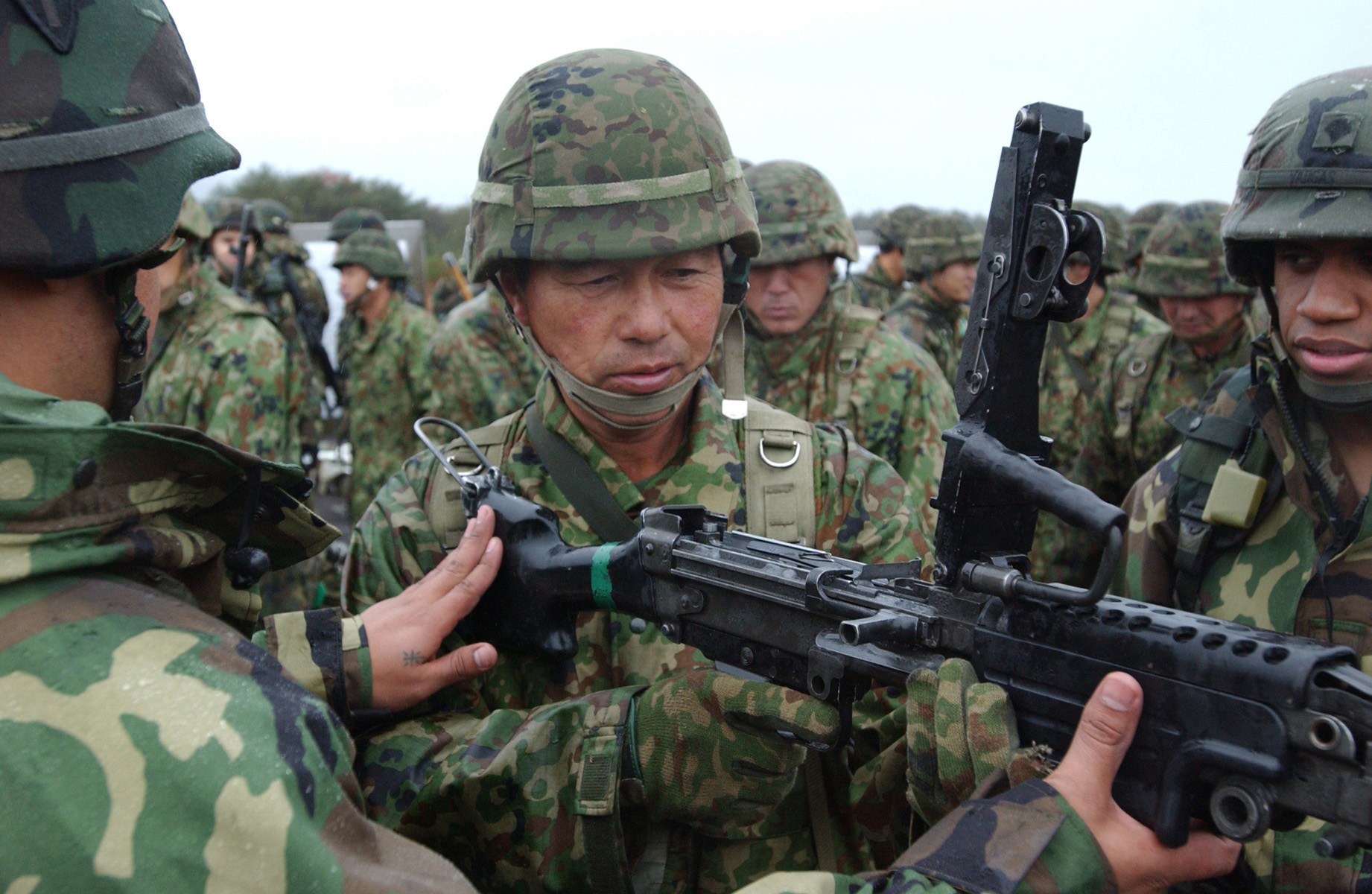
On May 4, 2026, Japan’s 2nd Amphibious Rapid Deployment Regiment was holding a line of dunes facing the South China Sea. Two amphibious landing vehicles resembling Chinese People’s Liberation Army troop carriers and a maritime drone boat approached through the surf. The Japanese soldiers engaged the targets with anti-tank rounds while nearby heavy machine gun bursts raked the boat until it exploded. Soon after, a Japanese anti-ship missile defense battery struck an enemy corvette about 45 miles off the coast.
This was just a military exercise, code-named Balikatan, involving militaries from the U.S. and the Philippines — and, for the first time, Japan. Until recently, the involvement of Japanese combat troops in such operations, even fake ones, would have been unthinkable, if not illegal. Japanese soldiers had last set foot on Philippine soil in World War II, when they invaded and occupied the country. Within a few years, the Japanese were the invaded and occupied. A strong current of pacifism took hold. And under Article 9 of its U.S.-imposed constitution, Japan gave up the right to maintain land, sea, and air forces.
But under the weight of new geopolitical realities, Japan has been forced to rethink its security stance. Its main supporter, the United States, is at best unpredictable while its adversary, China, is hostile; North Korea regularly test-fires rockets that splash down in the Sea of Japan. In response, the country’s leaders have pushed for more offensive capabilities — arms shipments, a major military build-up, even the country’s first centralized intelligence agency — that were once taboo.
Pivot from Pacifism
“We’re seeing the end of Pax Americana,” journalist and historian Ian Buruma said on the One Decision podcast in October. “Japan was not supposed to have any kind of army. And the Japanese were perfectly happy with that — most were sick and tired of war. But a compromise was struck.”
During the Korean War, Japan — reluctantly and with much U.S. prodding — created its 75,000-man National Police Reserve, which then evolved into the Self-Defense Force, but banned it from fighting abroad. Japanese soldiers have since participated in disaster relief, reconstruction, and peacekeeping missions. For a long time, Buruma noted, the Japanese armed forces could “do little…more than just provide blankets.”
They have never deployed in a foreign war. Then, in 2014, Prime Minister Shinzo Abe’s government reinterpreted Article 9 to allow both limited collective self-defense if an ally were attacked and some limited exports – trainer aircraft, radar systems – under strict conditions. The changes still provoked furious protests, but in 2022, Fumio Kishida’s government approved new National Security Strategy documents, which, according to the International Crisis Group, were “widely regarded as a watershed in Japan’s defence policy.” The shift was twofold: military spending was raised to 2 percent of GDP by 2027, abandoning a previously informal 1 percent cap. Kishida's security doctrine also called for acquiring “counterstrike” missiles capable of hitting targets on the Asian mainland, further stretching the broadly understood meaning of Article 9.
Prime Minister Sanae Takaichi – a hawkish Abe protégé – has gone furthest. In April, she scrapped the rule limiting Japanese defense exports to non-combat categories, opening the way to sell warships and aircraft. She has also moved to revise the country’s core National Security Strategy documents, which could bring higher defense spending, a push into drones and AI-driven warfare, and even further expansion of arms exports. Most controversially, she has not ruled out revisiting Japan’s ban on nuclear weapons — a politically fraught issue in the only country ever attacked with atomic bombs.
“The majority of the Japanese population until not so long ago felt that it was right for Japan to have a pacifist constitution and never go to war again because of their war guilt,” Buruma said. “If you look at the attitudes in polls to constitutional revision, people who are most vehemently opposed tend to be the older generation. The young are more sympathetic to it.” He added, “Changing the constitution so that they can have their own nuclear bomb is by no means unthinkable. And they could probably make it by tomorrow if they wanted.”
Military Buildup
What is changing fastest is the hardware, and Buruma believes Takaichi is driven as much by ideology as by doubt about Washington. “I’m sure the Prime Minister, when she expresses herself in rather forceful ways about China, is not doing so only because she’s a conservative hawk — I think she’s doing it fully conscious of the fact that they can’t rely on the Americans anymore.”
Japan’s primary strategy involves countering China with new long-range offensive capabilities. A newly developed Type 25 truck-mounted anti-ship missile can fly roughly 620 miles — far enough to threaten Chinese ships and coastal targets. A companion weapon, the hypervelocity gliding projectile, is designed to strike warships and landing forces assaulting Japan's remote coastal islands. Under a program called SHIELD, the country's military is also assembling a networked force of aerial, surface, and underwater drones meant to find and strike an invading force, scout beyond the horizon for destroyers, and overwhelm an enemy’s defenses.
Japan is also working to forge closer ties with Australia – including arms deals and expanded joint military exercises – and South Korea, though the legacy of colonial rule remains an obstacle. In June, South Korean President Lee Jae Myung ruled out a logistics pact that would let the two militaries share fuel, ammunition, and transport during a conflict, saying historical grievances would have to be resolved first.
Arms Exports
Until recently, Japan largely limited defense exports to non-lethal equipment in five categories: rescue, transport, warning, surveillance, and minesweeping. In April, Prime Minister Takaichi dropped the limit, and Japan can now export fighter jets, missiles, warships, and drones to the United States and 16 other security partners. It recently signed a $6.5 billion deal to sell Australia upgraded Mogami-class warships built to hunt submarines, clear mines, and fire anti-ship missiles. Takaichi’s government is also in talks to sell Abukuma-class destroyer escorts, and possibly medium-range surface-to-air missiles, to the Philippines. To replace its aging fleet of F-2 jets, Japan is developing a sixth-generation stealth fighter, with Britain and Italy, which has been cleared for sale to partner countries.
Such deals, however, continue to meet strong resistance at home. According to recent polls, between 48 and 67 percent of Japanese still oppose exporting lethal equipment abroad. Many see the shift as a threat to Japan’s identity as a peace-loving nation, and fear it could draw the country into foreign conflicts. Another constraint is the country's industrial base, which can produce sophisticated missile and electronic warfare systems, but remains “limited in scale” according to a recent analysis from the Stimson Center. Longstanding export restrictions have confined defense firms to the Japanese government and joint production with the United States, while keeping new companies out of the market.
The National Intelligence Bureau
Japanese companies have been building major international footprints since the 1970s, but the government has not followed suit. Despite clear commercial interests overseas, Japan has largely lacked eyes and ears abroad. But this, too, is changing.
“Japan was really, in intelligence terms, almost a protectorate,” Sir Richard Dearlove, the former head of MI6 and One Decision co-host, said on the podcast. “They leaned heavily on the CIA and to an extent on the UK and other Europeans.”
The new National Intelligence Bureau (NIB) is the country’s first centralized intelligence agency since World War II. Led by a former top police officer named Kazuya Hara, the NIB has about 730 staff and is meant to pull together information that had been scattered among the foreign, defense, and police agencies. It reports to a new National Intelligence Council, chaired by the prime minister, that will focus on terrorism and “foreign influence operations.”
Prime Minister Takaichi has also promised to quickly draft a new espionage law that would make it more difficult for spies to operate inside Japan and, in the future, create a CIA-like agency to gather intelligence about adversaries.
“It’s hugely important to the West that Japan should have an effective intelligence organization because of its geopolitical position, because of its alliance with the West, because of the intelligence opportunities that Japan, as an important global power, has, particularly with regard to China and North Korea,” Dearlove said.