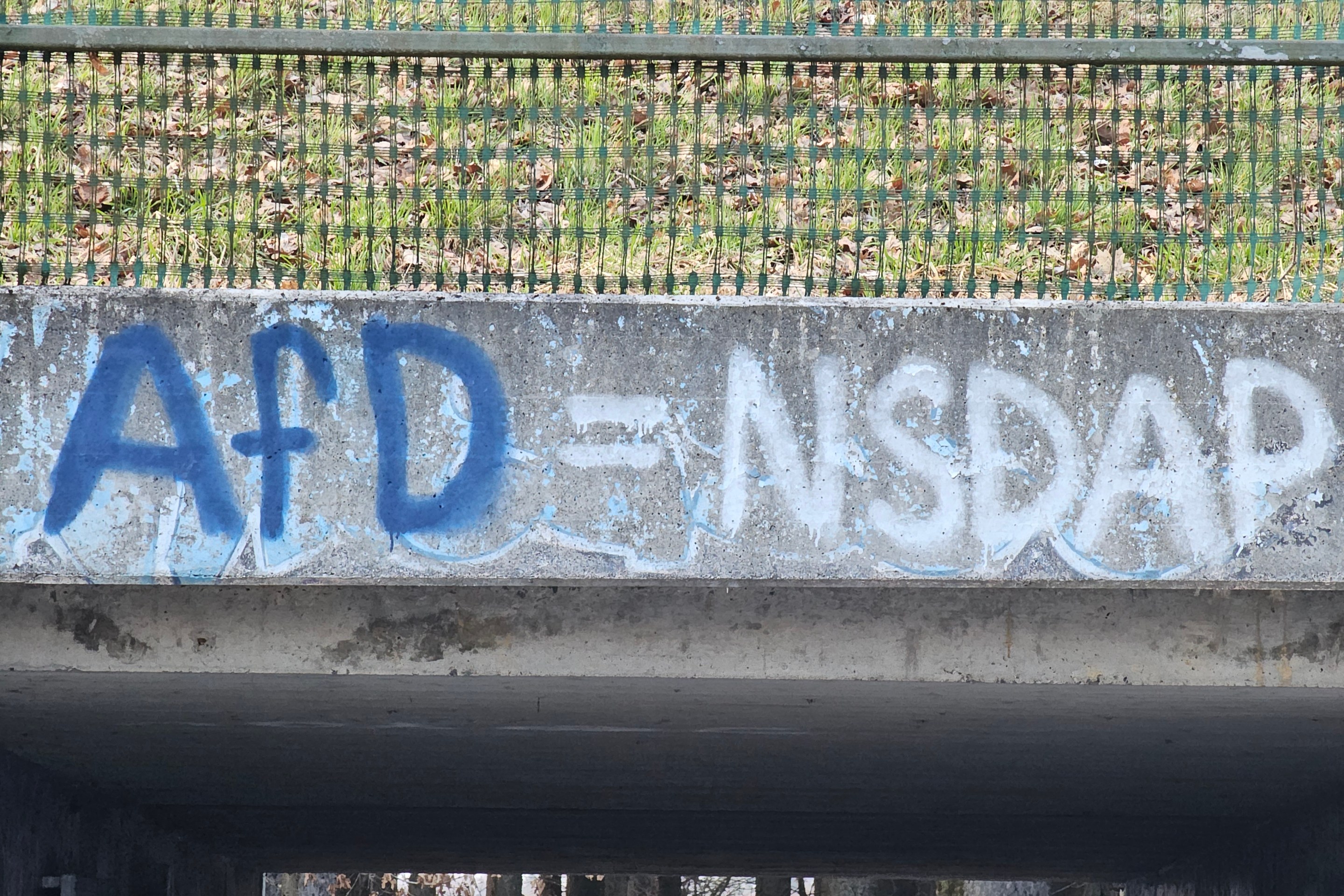
“Never again” has sometimes seemed to verge on a national motto in Germany, which has taken a rueful pride in its commitment to dealing with its thorny 20th-century history of ideological extremism and militarism.
Manifestations of this attitude towards the country's World War II-era past include legal prohibitions on displaying the swastika or denying the Holocaust. Less formally, there has also been the Brandmauer, or “firewall”: the expectation that mainstream political parties of all stripes will eschew cooperation with extremists, consigning them permanently to the political wilderness to prevent a repetition of the Nazi ascension.
As Germany is learning, however, fires are unpredictable things. Small sparks smolder to become conflagrations that can jump trenches and feed on the wind. Germany’s political tinder has been accumulating, and the dramatic rise of the AfD – including the government’s reliance on the party to pass key legislation – shows that the Brandmauer is no longer the barrier to mainstream political breakthrough that it once was.
Worse still for Chancellor Friedrich Merz, the far-right party’s taboo-shattering rise risks complicating the government’s own effort to radically depart from post-war convention. Motivated by the Russian invasion of Ukraine and declining trust in the US security umbrella, Merz has launched a buildup of Germany’s security forces that breaks with more than 70 years of military self-restraint grounded in a sense of historical guilt. The AfD, while not opposed to an expansion of German hard power, has rejected the idea of Russia as a threat. What is more, the possibility that continued breakthroughs could embed the party within the country’s governing institutions opens the prospect of a rearmed Germany that is a threat rather than an asset to Western security.
Dry Tinder
In 2024, a Syrian immigrant in the German town of Solingen carried out a stabbing spree that left three dead and eight wounded. In January 2025, a rejected Afghan asylum seeker killed a two-year-old boy and a 41-year-old man. Both attacks fed a long-smoldering argument over immigration and national security.
A week after the second incident, Friedrich Merz, then leader of the opposition Christian Democratic Union (CDU) and soon to be chancellor, brought a resolution to the Bundestag calling, among other measures, for border guards to turn back migrants, including asylum seekers. Shockingly, the resolution, though non-binding, passed 348 to 345 — and only with votes from the far-right AfD. The Brandmauer, according to the BBC, appeared to have cracked.
The AfD is strongest in eastern Germany, where population loss and a dwindling, aging workforce have deepened a collective feeling of second-class citizenship. This September, the AfD won two of the three state elections it contested and made big gains in the third. In Saxony-Anhalt, the party took 43.8% of the vote and 39 of the 83 seats in the state parliament, three short of a majority. Two weeks later, in Mecklenburg-Vorpommern, it won 38.2% while Merz’s CDU was shut out of a state legislature for the first time in its history. (In Berlin the AfD finished third but gained about seven points, to 16.3%.) Then, on October 6, Saxony-Anhalt’s new parliament elected the AfD’s Tobias Rausch as its president, the first time an AfD lawmaker has held that office in any German state.
“The dilemma in Germany politically is that you can have a firewall, but if the party that you don’t want to have in government becomes too big and you simply gang up on them every time, that could make the political situation even worse,” author and historian Ian Buruma told the One Decision podcast.
History on the Ballot
The prospect of AfD power challenges two long-standing assumptions in Germany: that a nationalist, anti-immigrant party with such fraught historical echoes would be kept from governing, and that Germans broadly agree on how to remember and reckon with the Nazi past.
Germany’s intelligence agencies have labeled several of the AfD’s state branches, including Saxony-Anhalt’s, as right-wing extremist, and in 2025 the federal agency applied the label to the whole party. (A court has suspended the national designation while it hears the case.) The party has called for closing Germany’s borders and carrying out mass deportations. Some of its leaders want to ban minarets and public calls to prayer, and its 2025 election manifesto called for Germany to leave the EU. The AfD is also an unusual German right-wing party: it has tapped nostalgia for East German communism and is openly sympathetic to Russia, whereas the far right was historically tied to Nazism and hostile to Moscow. But the party’s most ambitious effort, critics would say a dangerous one, is to change how Germans grapple with the horrors of the Nazi era. AfD leaders have called for an end to the Schuldkult, or “Guilt Cult,” and for a “180-degree turn in memory policy.”
“They’re very consciously promoting the notion that Germans should be proud of their history. One of them, I think, said the Holocaust was just a speck of bird droppings in a long and proud and glorious history,” Buruma said. “There is a strong sense of humiliation. Humiliation is the most dangerous ground for politics anywhere. It leads to resentment, to a thirst for revenge. We know that from the aftermath in Germany of World War I. And I think that is being exploited by the AfD very effectively.”
Strengthened Ally or Potential Threat
The consequences of the AfD’s rise could reach far beyond Germany’s borders. Chancellor Merz has said he wants the strongest conventional army in Europe. Spurred by warnings from German military leaders that Russia could attack NATO by 2029, and by doubts about America’s reliability under President Trump, the country is departing sharply from decades of military restraint. Its defense budget this year is about €108 billion ($121 billion), funding purchases of Patriot missiles, F-35 stealth fighters, long-range Tomahawk cruise missiles, and other equipment. The armed forces have set a target of 260,000 active-duty soldiers and 200,000 reservists by 2035, up from about 186,000 today.
But the AfD, which currently leads in national polling, opposes arms for Ukraine, wants sanctions on Russia lifted, and could one day inherit control of the expanding armed forces and intelligence service.
“If the firewall in German politics were to break down, and the AfD were to become so large that it forms the government, the whole question of German rearmament then takes on a rather different aspect if you view Germany within a European context,” Sir Richard Dearlove, the former head of MI6 and host of One Decision, said in October. “You could have a Rassemblement National [France’s far-right National Rally], Le Pen, AfD axis in Europe, which would make politically and militarily a very different-looking Europe at a crucial time for European security including UK security. I think that is a worrying scenario.” He added: “You’re looking at an almost complete realignment of international security if you follow that through to its logic.”
The Next Test
Currently, only about one in 10 Germans say they are satisfied with Merz. Recent national polls put the AfD at about 28 percent on average, roughly 8 points ahead of the CDU/CSU. The party’s nearest chance to govern comes in December, when Ulrich Siegmund, its lead candidate in Saxony-Anhalt, stands for minister-president. Because the vote is a secret ballot, lawmakers from other parties could back him unseen.
The contest then moves west. Five states (Saarland, Schleswig-Holstein, North Rhine-Westphalia, Bremen, and Lower Saxony) vote in 2027, beginning in April — a test of whether the AfD can break through outside its historic stronghold. Further out lies the next federal election in 2029.
Analysts at the Center for Strategic and International Studies warn that the AfD’s rise leaves the mainstream few ways to govern without it: a coalition excluding the party would probably need three partners. If such a coalition forms and then stalls over ideological differences, they say, the following elections could bring an AfD-majority government or the collapse of the firewall.