Canada is leading a new “Middle-Power” push to rebuild the world’s crumbling multilateral order. Shared unease with US and Chinese leadership may not be enough to construct an alternative.
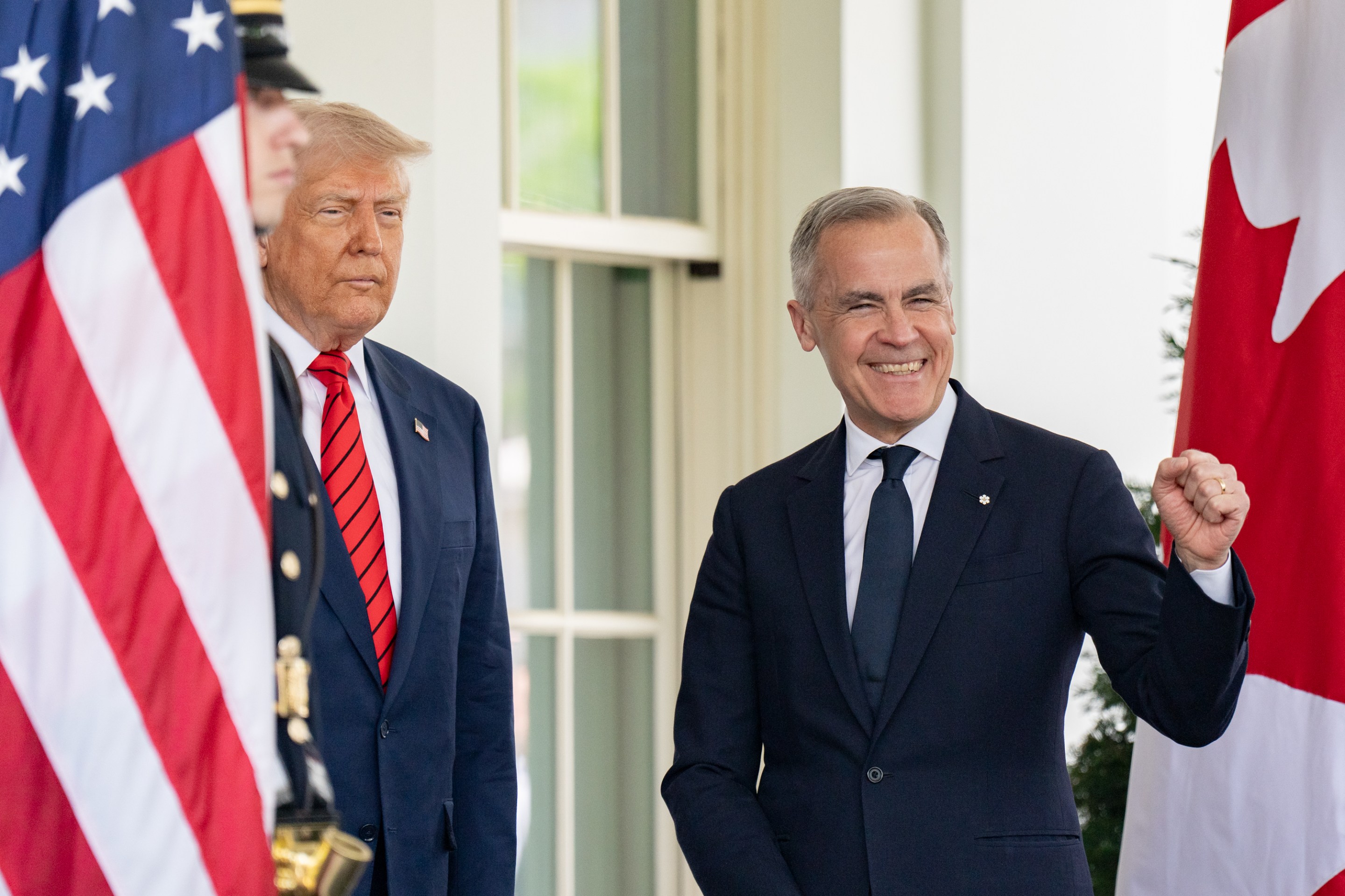
Financial shocks ripple through markets in hours. A pandemic crosses continents in weeks. A war in the Strait of Hormuz chokes supply chains on the other side of the planet. Sudden, violent shocks, combined with America’s retreat as a global security leader, have begun unraveling decades of multilateralism built for exactly such moments. Facing deep uncertainty, countries like Canada are searching for new blueprints. “If we’re not at the table, we’re on the menu,” Prime Minister Mark Carney told the World Economic Forum in January, urging middle powers with shared interests — and threats — to band together.
What the middle powers object to is clear. They do not want a world in which they are pawns caught between the US and China. But what they are aiming for remains vague.
In September, Carney and the leaders of a half-dozen countries took that pitch to the United Nations, launching a new initiative called Partners for Multilateralism, or P4M. In an accompanying op-ed, they describe it as a “flexible, open framework” for different countries with different political traditions to work across divides. Their proposed fix for unregulated Artificial Intelligence, accelerating climate change, and a surge in armed conflict? Make the UN and other multilateral institutions more effective, deepen cooperation among regional organizations, and “contribute to peace and security.”
Mohamed El-Erian, chief economic adviser at Allianz and co-author of the book Permacrisis, placed the effort in context on the One Decision podcast, describing three approaches to global order on offer at the United Nations’ annual General Assembly. The US, he said, “can be the conductor, if you like, of the global orchestra.” China could “become the guardian of multilateralism.” And the third was “the middle power alternative: the world of flexible coalitions of the willing that come together and solve these issues.”
In its general contours, at least, that last idea looks familiar.
BRIEF HISTORY OF AN IDEA
The middle-power model is an upgrade to an older concept. “Minilateralism,” an idea popularized by Moisés Naím, then editor in chief of Foreign Policy, in 2009, called for the smallest possible number of countries to come together to have the biggest possible impact on problems such as nuclear proliferation, poverty, and disease. The world’s nearly 200 countries would never agree on much, he argued, and large consensus bodies like the UN often gridlocked to the point of failure. The P4M-style coalition differs in three ways: it is open to anyone; its mandate covers everything from AI to UN reform rather than one problem; and it intends to strengthen the United Nations, not work around it.
Whether those differences make P4M any more durable than its predecessors is an open question.
MIKTA, the group of Mexico, Indonesia, South Korea, Türkiye, and Australia that launched in 2013, has been criticized as “a forum in search of a mission.” A 2019 French-German “Alliance for Multilateralism” drew about 40 countries to its launch but ultimately flopped. BRICS, which began with Brazil, Russia, India, China, and South Africa and now includes members such as Iran and the UAE, has had measurable successes through its New Development Bank, including a rapid-rail corridor in India and port projects in Brazil. But this May, foreign ministers who gathered in New Delhi with an ambitious agenda to tackle energy and food security, conflict, and other critical issues left without a joint statement amid clashes over the US-Israeli war on Iran.
In a May Foreign Affairs essay, the Tufts University political scientist Michael Beckley noted that the 13 countries Harvard’s Belfer Center designates as middle powers together account for less than half of US GDP and about a quarter of US military spending. He also described BRICS as a “grievance caucus.”
Even analysts who see promise in the middle-power concept sound notes of caution. Stewart Patrick, a senior fellow at the Carnegie Endowment for International Peace, recently argued that coalitions could help stabilize a fraying world order, both inside institutions like the UN and, as Naím argued, through small groups aimed at specific problems. Patrick points to the Financial Action Task Force, which began as a G7 effort targeting money laundering and grew into a 40-member standard-setter. The trouble, he writes, is that middle powers are too varied to present a united front and often act from self-interest more than altruism, which complicates the hardest questions, from filling the funding hole left by US cuts to the UN to governing AI amid a US-China race.
MIDDLE WAY OR MINEFIELD
The current American president’s hostility to global governing bodies like the UN — and to Carney in particular — is well documented, and any push that strengthens both risks his ire. Hours after the Nobel committee awarded its Peace Prize this month to Navi Pillay, a former UN human rights chief and International Criminal Court judge, the Trump administration announced sweeping sanctions on the court.
In a post on X this summer, a top Trump official at the Pentagon, Elbridge Colby, dismissed all the “hubbub” about middle-power coalitions. “We are not concerned that this is a serious possibility,” he wrote. “Rather, we are more concerned that a few allies and partners will think it is and waste valuable time, money, and political capital on a distraction.”
Beckley, whose essay is titled “The Middle Power Delusion,” argues that middle powers are poorly placed to confront most major geopolitical challenges on their own, or as a stand-alone bloc. The newfound popularity of the middle-power concept reflects exposure, not strength: Washington and Beijing will eventually make them choose sides with tariffs, coercion, or military threats. The better course is to pick the great power that offers the safest harbor and bargain for influence from inside its camp. The middle, as he puts it, “is not an open marketplace. It is a minefield.”
A WORLD OF BLOCS
The World Economic Forum recently ranked geoeconomic confrontation, from export bans to fights over critical resources, as the top global risk of 2026, ahead of armed conflict. Without a new multilateral order, the global economy tilts more and more toward what economists call fragmentation: rival powers splitting into competing blocs that mostly trade, invest, and share technology within their own camps. Anyone outside a bloc gets left out, cut off from its markets, capital, and expertise. And the downstream effects could prove disastrous: conflicts over water, which has no global treaty; more energy shocks like this spring’s Hormuz disruption; and food shortages, if fertilizer export curbs ripple through global agriculture.
A world split into competing blocs would also produce about 5 percent less by 2050 than it would otherwise, the World Trade Organization’s latest annual report estimates, with the poorest countries hit hardest. Even well-off countries like Canada would suffer in a severe scenario in which the US abandons the continental trade pact, with a 35 percent US tariff on most of its goods and a likely recession in the first half of 2027. Fragmentation, UN Trade and Development Secretary-General Rebeca Grynspan said at Davos this year, makes the global economy more fragile for everyone.
During the era of globalization, the countries that benefited most were small, nimble, and plugged into world trade. They could sell to every market and borrow technology from every source, turbocharging their growth without having to pick a side. Amid fragmentation, though, the rules for success change. Scale and self-sufficiency count for more than agility. Small, open economies like South Korea, Taiwan, Hong Kong, and Singapore are no longer safe bets, because they depend on open markets and steady energy supplies that fragmentation puts at risk. Larger countries with huge domestic markets, energy security, and an entrepreneurial private sector are better insulated. “In that old world you wanted to be Singapore,” El-Erian said. “In this new world of fragmentation, of energy uncertainty, of changing trading relationships, of tariff volatility — you want to be the US.”