When US and Israeli forces killed Supreme Leader Ali Khamenei in the opening weeks of the Iran war, the assumption in many quarters was that the regime would fracture. Remove or directly threaten the existence of leaders already estranged from much of their population, the logic ran, and the whole system would come crashing down. So far, it hasn't. The Islamic Revolutionary Guard Corps has filled the vacuum, absorbing the shock and prosecuting the war with a coherence that has caught many off guard.
This misreading appears to stem in part from an underappreciation of the revolutionary character of the regime. Western governments focus on Iran's economic deterioration, its diplomatic isolation, and the erosion of popular support. What they — the US government in particular — lose sight of is the nature of the regime itself: a revolutionary state whose identity is rooted in resistance to external interference, and whose organizational structures were built specifically to sustain that resistance.
The same dynamic may now be playing out in Cuba, where Washington is contemplating military action against a regime that has also outlasted repeated predictions of its collapse. The contexts differ significantly — Cuba's revolution is economically exhausted in ways Iran's was not, and an even greater proportion of its population has lost all faith in the revolutionary project. But the organizational core that sustains the Cuban state may prove no less resistant to external pressure than the IRGC has in Iran.
The Architecture of Resistance
In the eyes of some analysts, the Iran war has exposed Western governments’ loss of understanding of revolutionary regimes — a field of expertise that was front and center during the twilight of empire and the ideological struggles of the Cold War.
John Raine, a senior adviser at the International Institute for Strategic Studies and a former British diplomat who served across the Middle East, identified the problem precisely on the One Decision podcast in May. "There was a time where diplomats and intelligence officials all over the world did a lot of dealing with, or working against, revolutionary regimes, and understanding the psyche and structure of such regimes was quite widespread," he said. "I think we slightly lost that."
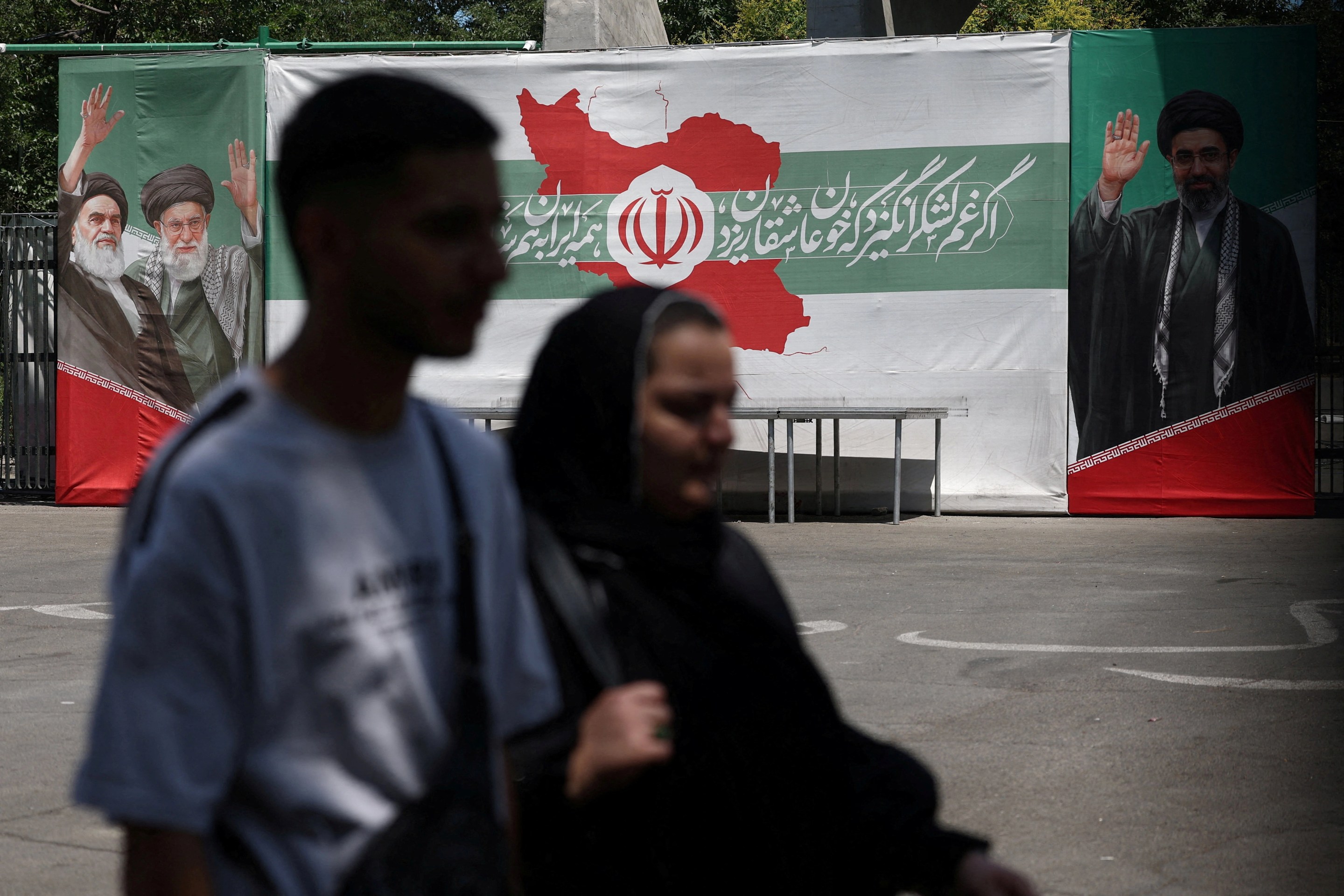
Given the revolutionary nature of Iran's regime, military pressure, rather than dissolving its internal cohesion, gave the resistance narrative what Raine called "a curious sort of lease of life." Iran's revolution was itself a revolution against a US-backed government, and forty-seven years of American enmity have since become central to the regime's identity. The propaganda poster that emerged during the war — a fist grasping the Strait of Hormuz above the caption "the strait will always be in the hand of Iran" — did not appear from nowhere.
Trita Parsi, executive vice president of the Quincy Institute for Responsible Statecraft, told the One Decision podcast in March that the administration "expected a regime implosion, their 'Venezuela moment'" — a rapid collapse on the model of what had unfolded in Caracas. "By Monday morning when the markets opened, everything would be fine." What planners appear to have missed — and what US and Israeli intelligence assessments apparently misjudged — was the degree to which the Islamic Republic had been designed for precisely this scenario.
"The IRGC was deliberately created because the revolutionaries did not trust the Iranian army," Parsi said. "This is a revolutionary system built to withstand counterrevolution. Redundancy, parallel structures — all of that is built in, precisely to withstand regime change efforts from outside or inside." Iran had prepared up to five replacements for every key command position before the war began, and had decentralized decision-making so that even the assassination of the Supreme Leader did not meaningfully slow military operations.
Parsi put it simply: "The theocracy did not fear the aircraft carrier. It did not fear war. It feared surrender. Surrender would be far more dangerous to their survival than war. They believe they can survive war. They cannot survive surrender."
When the Revolution Fails But the State Does Not
The experience in Iran, analysts say, suggests the US may be about to make the same mistake in Cuba. In both cases, Washington appears to have read the visible decay of the revolutionary project — the failed economy, the international isolation, the loss of allied support — as evidence that the regime itself is close to breaking. What the Iranian case has shown instead is that a revolutionary state's security apparatus can remain formidable long after everything else has collapsed, sustained not by ideology but by the imperatives of survival.
Unlike in Iran, where the resistance narrative still carries genuine popular resonance, there is little ideological conviction sustaining the Cuban regime from below. Cubans across the island have largely concluded that the revolutionary model has failed — two million people, out of a population of roughly ten million, left during and after COVID. But Ricardo Zúñiga, who led the secret negotiations that produced the Obama-era normalization of US-Cuban relations, cautions against mistaking that disillusionment for fragility. Speaking on the One Decision podcast this month, he noted that the regime retains precisely the capacity that matters in a crisis: "The Cuban state's repressive capacity remains strong." What keeps the state standing is not belief but control.
In Venezuela, fractures within the elite gave external pressure somewhere to work. In Cuba, those fractures are not visible. There are no organized factions, no opposition with institutional standing. The Communist Party, the intelligence services, and the armed forces have held power uninterrupted for sixty-seven years. "Cuba is a much more consolidated state," Zúñiga said. "It is a much more organized state." Like Iran's, Cuba's revolution was born against a US-backed government, and decades of American hostility have become part of the state's identity — a permanent external threat that keeps internal loyalty organized around resistance. Cuba's President Díaz-Canel has warned that US military action would trigger a "bloodbath with incalculable consequences".
Zúñiga was explicit that the Iran experience should inform US thinking. "They've also miscalculated the responses from their adversaries," he said. "Iran is a good example." Cuba's leaders, he added, see no viable path to negotiation: "Essentially what the Cuban leadership is presented with is the option of resisting and staying in power or being eliminated completely — perhaps physically." A CSIS analysis of US military options published this month warned that in a worst-case scenario, the United States could find itself drawn into a confrontation "with no clear path to democratization or economic recovery."
The Revolutionary in Chief
In his own way, Donald Trump is a revolutionary leader too — one who came to power explicitly to overthrow an existing elite and dismantle a settled way of governing, and whose hold on his movement has only intensified under pressure. He survived impeachments and criminal indictments and returned to the White House stronger for it. He survived an assassin's bullet, rose from the stage with his fist raised, and has built a political identity defined by defiance of an established order. The regimes he has taken on were built on the same raw material and are showing similar defiance.