In early 2024, Israel’s intelligence service, Mossad, found an unlikely cover in Budapest: a climate conference at Ludovika University. A senior Hungarian official had asked the university’s rector to host the event and invite a most unusual guest — Mahmoud Ahmadinejad, Iran’s former president — for secret talks with Israeli intelligence operatives.
The operation was risky, audacious, and, according to the New York Times reporters who broke the story, planned without serious consideration of the consequences by leaders on both sides of the Atlantic. Within days of the start of the U.S.-Iran war, when an asset of Ahmadinejad’s stature would have been most useful, the plan fell apart — or appeared to. Analysts and intelligence practitioners now question whether Ahmadinejad’s “defection” was ever anything more than an Iranian intelligence probe of its chief adversary.
And that defeat, if it is one, is not an isolated case. While the two recent wars have showcased Mossad’s reach, they also set off a brutal regime crackdown — executions, mass arrests, reports of torture — that may have burned some of Mossad’s best sources inside Iran.
THE AHMADINEJAD PLOT
The target was as daring as it was unlikely. A well-known hardliner, Ahmadinejad had publicly called for Israel to be wiped off the map, denied the Holocaust, and presided over the restart of Iran’s uranium enrichment program. In the years since he left office, however, the former president appeared to have moderated his tone. He gave frequent interviews criticizing violent crackdowns by Iran’s security forces and accused the ruling class of corruption — a dangerous proposition under a regime that ruthlessly and unhesitatingly executes dissidents. Though disqualified several times from running for president again, he seemed to nurse hopes of one day returning to power. He was, according to the Times investigation, ripe for recruitment.
“Bitter, frustrated, kept away from the Supreme Leader who was like a sort of a father figure for him — all of that makes a perfect candidate,” Ronen Bergman, who co-reported the investigation, told the One Decision podcast.
Israel’s goal, part of a years-long effort, was to turn the former president into a prized intelligence asset. Mossad secretly paid for Ahmadinejad’s housing and travel, and its operatives met him abroad on several occasions, including during his trips to Budapest in 2024 and again in June 2025, just days before Israel launched its 12-day war on Iran. “During these trips is when Mossad convinced him to become an asset,” Mark Mazzetti, who co-wrote the investigation, told One Decision. “This was before there was really even a plan in place to install him, because there was no real opportunity for regime change until the Trump administration came along.”
That opportunity arrived on February 28, 2026, the first day of a second U.S.-Israeli war on Iran. A barrage of long-range missiles killed Ayatollah Ali Khamenei, the country’s supreme leader of nearly four decades. Hours later, an Israeli airstrike hit Ahmadinejad’s compound, targeting both the building where his bodyguards were housed and his armored vehicle. A black Peugeot, driven by Mossad agents, quickly whisked him to a safe house. Israel’s goal had evolved dramatically: Ahmadinejad, rather than a mere asset, would be installed as Iran’s new leader once the regime collapsed.
TURNABOUT IS FAIR PLAY
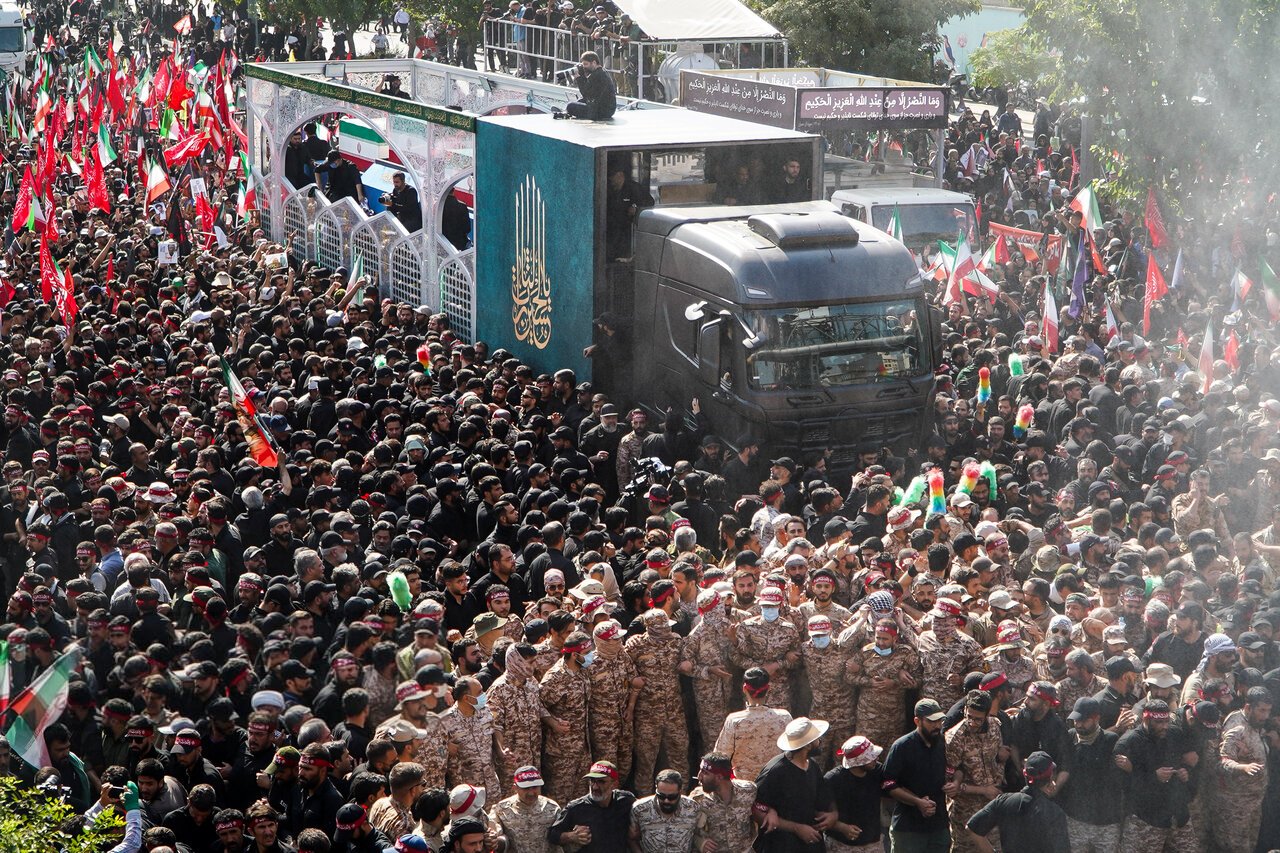
Sometime after Mossad operatives rushed Ahmadinejad to a safe house, he disappeared. Where he went, and why, is unclear. He did not reappear in public until July 6, when he turned up, flanked by what looked like guards, in the funeral procession for Khamenei.
The Times reported that Ahmadinejad was upset by the “frantic” extraction and grew disillusioned with the Israeli plan. But the timing of his disappearance also raises a darker possibility: that he was dangled by Iranian counterintelligence to learn what Israel was planning.
“As a former professional intelligence officer, I find it hard to accept that the IRGC [Islamic Revolutionary Guard Corps] aren’t consciously on the other end of this,” Sir Richard Dearlove, the former head of MI6 and host of One Decision, said. Iranian counterintelligence, he added, may have been “gambling and seeing what they could get out of it.”
Ali Vaez, Iran project director at the International Crisis Group, told One Decision that he concurs. “The very fact that [Ahmadinejad] is still living, walking the streets of Iran, going to official ceremonies…tells you…that probably the Iranians also figured out what Israel was trying to do and turned [him] into a double agent.”
PENETRATION
Israel and Iran were not always enemies. Under Shah Mohammad Reza Pahlavi, installed via a joint CIA-MI6 coup in 1953, the two countries were quiet partners. Prime Minister David Ben-Gurion’s “periphery doctrine” courted non-Arab states and minorities on the Middle East’s edges, and relations stayed amicable until the Shah fell during Iran’s 1979 revolution. What followed was a “shadow war,” fought first through proxies like the Iran-backed Hezbollah militia in Lebanon, and, increasingly, through spies.
After Saddam Hussein invaded Iran in September 1980, Israel secretly supplied Ayatollah Ruhollah Khomeini’s regime with arms, partly to keep Iraq’s military tied up and partly, according to one report, to “cultivate intelligence ties with Iranian officials.” Starting in the early 1980s, Mossad also ran a network that smuggled thousands of Jews out of Iran through the country’s southeastern border with Pakistan. Then, in the early 2000s, Mossad discovered that Iran was secretly building an enrichment plant near Natanz. Operatives — likely Israelis posing as European technicians servicing equipment — later walked the site in double-soled shoes that collected dust and soil. Subsequent testing showed that Iran’s centrifuges were enriching uranium well beyond the 5 percent needed for a power plant.
More recently, Oded Ailam, who served 24 years in the Mossad, claimed that Iran’s ethnic minorities — Kurds, Baluchis, Azeris, Turkmen — can be recruited to turn on the regime. The agency has also targeted Iran’s 2 million Afghan refugees for recruitment as low-level informants. They are paid about $200 a month, one former CIA officer claimed, in exchange for the addresses and phone numbers of Iranian generals and scientists. Some of those targets presumably end up on Israel’s version of a “kill chain,” or tactical targeting cycle.
Mossad’s highly successful collection efforts, according to experts, are due to a mix of Israeli skill and Iranian dysfunction. Steven Ward, a former CIA analyst, credits the agency’s “superior organization, advanced technology, and a focused, adaptive, and creative approach.” A 2026 study in the journal Small Wars & Insurgencies describes a patient strategy built on cultivating human sources combined with compromising technology, such as the Stuxnet virus, which sabotaged Iran’s centrifuges, and a remote-controlled machine gun that killed one of the country’s top nuclear scientists. At the same time, Iran’s counterintelligence agencies, including the IRGC, have been stretched thin by operations abroad and by policing internal dissent.
COVERT OPERATIONS
Mossad’s modern campaign of what it calls “special tasks” against Iran took shape in the early 2000s, when Prime Minister Ariel Sharon brought in Meir Dagan to revive the agency, which had suffered serious setbacks in the 1980s and 1990s. Dagan favored covert, surgical operations over big military strikes, and during his tenure Mossad agents assassinated Iranian scientists linked to the nuclear program and successfully sabotaged critical equipment bound for it, from computers to industrial components. Between 2010 and 2012, Mossad agents killed at least four scientists using a bomb-rigged motorcycle, magnetic bombs attached to their cars, and gunmen on motorcycles.
Since then, Mossad’s operations targeting Iran’s nuclear program have expanded in scale and scope. Around 2010, Stuxnet, a computer worm widely attributed to the U.S. and Israel, reportedly disabled about 1,000 of the 5,000 centrifuges at Natanz. In January 2018, Mossad agents — some of them Iranian — breached a nondescript warehouse on the outskirts of Tehran and, in less than seven hours, disabled alarms, cut through dozens of safes, and made off with a half ton of documents purportedly detailing Iran’s secret effort to build nuclear weapons. Two years later, Mohsen Fakhrizadeh, the head of the country’s nuclear weapons effort, was shot and killed by a remote-controlled machine gun mounted on a pickup truck and operated by a sniper more than 1,000 miles away.
Israeli-born operatives — known in the agency as “blue and white” — largely stopped working on Iranian soil around 2010, as Mossad shifted toward recruiting Iranians and other foreigners to lessen the risk to its own officers. Some operations are now run remotely, while others, like the machine gun attack on Fakhrizadeh, rely on recruited local agents. The 12-day war in June 2025 showed how far that model had come. Three days before Israel launched its first airstrikes, dozens of Mossad-trained commandos slipped into Iran, where dozens more local agents were already waiting with vehicles, safe houses, and communications gear. The teams then assembled and launched drones to disable air defenses, helped assassinate scientists, and fed real-time intelligence to the Israeli Air Force as its jets pounded nuclear sites, missile launchers, and military leaders.
After the 12-day war, Iran’s security agencies, shocked by the depth of Israel’s penetration of its military and intelligence services, launched a bloody counterintelligence campaign that swept up thousands of people and sent at least 10 alleged spies to the gallows. A former IRGC intelligence chief named Hossein Taeb, ousted in 2022 after a string of security failures, now runs the country’s Basij militia, which is in charge of domestic security. “The new Supreme Leader wants him to merge this internal militia with an internal security organization so that the Basij does more than just enforcing social norms, but it actually does even intelligence collection on the citizenry,” Vaez said. That plan, he added, would “turn Iran into another East German kind of society.”
THE FALLOUT
Since the second war began in February, Iran has sealed itself off with a near-total internet blackout that lasted 88 days, arrested thousands, and accelerated executions. The rights group HRANA documented at least 4,023 war-related arrests between February 28 and May 9. Iran’s intelligence ministry also claimed to have arrested 97 people it called “soldiers of Israel,” and the chief of Iran’s judiciary ordered accelerated trials for anyone accused of collaborating with the United States and Israel, calling them “ground soldiers of the enemy.” Iran’s Afghan population has been one of the most visible casualties of the crackdown. According to the UN refugee agency, Iran was deporting about 2,000 Afghans a day before the 12-day war; during the war, the number rose to more than 30,000.
“Israel has extraordinary intelligence about Iran. But intelligence is not the same as comprehension,” Vaez said on the podcast. “Now it’s actually harder, because without any doubt, when you have two major conflicts in which you draw a lot from your sources within the Iranian system and society, by definition you burn a lot of them. It would take some time for [Israel] to find new ways, develop new assets, and so on. The Iranian regime has its guards up and it’s probably not going to bring them down anytime soon.”