Episode Info
- Season26
- Episode6
Hosted by Christina Ruffini and Sir Richard Dearlove
Guest
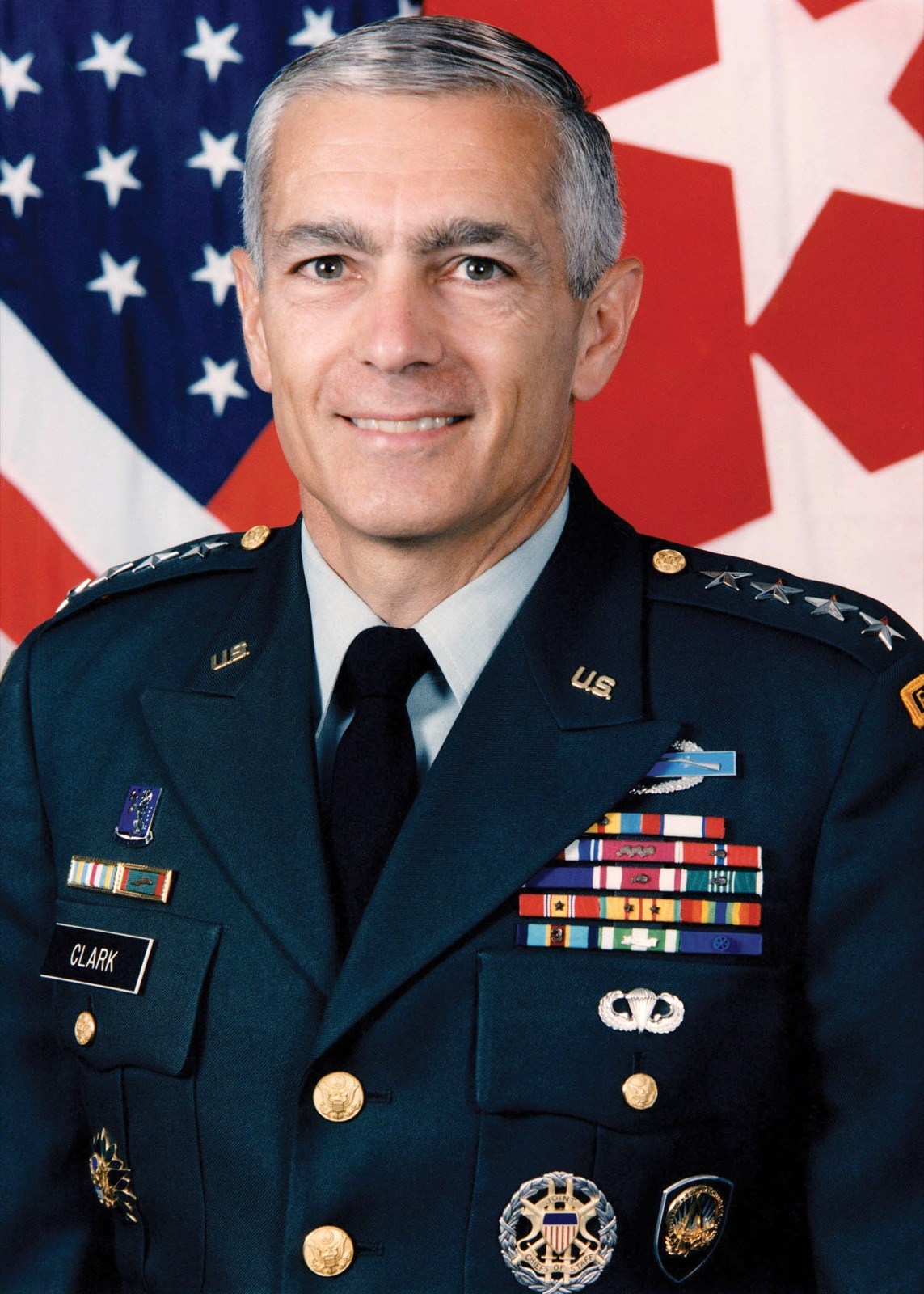
General Wesley Clark
General Wesley Clark served as NATO's Supreme Allied Commander during the Yugoslav wars and ran as a Democratic Presidential candidate in 2003; Clark discusses the veteran vote and the 2024 election.
Episode Summary
General Wesley Clark served as NATO’s Supreme Allied Commander during the Yugoslav wars. After a career spanning more than three decades of military service, Clark ran as a Democratic Presidential candidate in 2003–before endorsing John Kerry. One Decision’s Julia Macfarlane and former MI6 Chief Sir Richard Dearlove spoke to him about the veteran vote, his thoughts on the 2024 election, and, crucially, how the likely nominees, Donald Trump and Kamala Harris, might choose to direct America’s foreign policy at a time of war.
Listen & Subscribe
- Watch on YouTube
- Listen on Apple Podcasts
- Listen on Spotify
Transcript
COLD OPEN
Clark: We have to recognize that the era of peaceful coexistence is over. This is not peaceful coexistence. You have the largest land war in Europe since World War Two, and there's no sign that Putin, even if he got a ceasefire, would change his strategic objectives. He wants all of Ukraine. He wants the Baltics. He wants control.
INTRODUCTION
Mcfarlane: That was General Wesley Clark, the former NATO Supreme Allied Commander Europe, former Democratic presidential candidate, and Presidential Medal of Freedom holder after commanding NATO's forces during the Yugoslav Wars. You're listening to One Decision, the podcast that looks at the choices made that shape our world. I'm your host, Julia McFarlane. And together with Sir Richard Dearlove, the former chief of Britain's MI6 and my co-host on this podcast, we've been looking this week at one of the most consequential decisions coming right up that may impact all of our lives. However, it's a choice that only American citizens will be able to take. In November this year, of course, we'll learn who will be the next US president, and where the president takes the conflicts in Ukraine and the Middle East may very well be different depending on who wins. So we decided to call General Wesley, who's known Sir Richard a good many years, for his reflection on the 2024 election and what the next president needs to do regarding Russia, China, and the Middle East. I started first by asking him about the lead up to President Biden announcing he would withdraw from the race.
INTERVIEW WITH GENERAL WESLEY CLARK
Clark: I was sitting in the NATO introductory meeting where he introduced Ukrainian President Zelenskyy by saying Putin and people were, you know, we were all pulling for him. We all felt terrible about it. He couldn't do anything about it. He tried to shrug it off. But I think behind the scenes, people who've been working closely with him had seen a certain decline, a certain lack of energy. And, you know, politics is all about energy. Nobody thought he doesn't have good judgment. He's got great judgment. He's got tremendous experience. We've never had a president who's had so much experience as President Biden, especially in the foreign policy area. I mean, years and years back when I was NATO commander, he was all over foreign policy. And when I ran in 2003, 2004, he was the last person I talked to. I got advice from him and he encouraged me to run. He said, you got a 30% chance of getting the Democratic nomination. And if you get it, you'll beat George W. Bush. I was kinda disappointed. He only gave me a 30% chance, but turned out he was right. It's a very hard thing to win the Democratic nomination, especially if you're coming in cold and you've never been in political office, and as a Democrat, if you're a former military officer, because they're not as keen on the armed services, let's say, as the Republicans might be. So I've watched him over the years. I've always thought he's got excellent political judgment. Very bright guy. And it was just a real tragedy. But I think the way he has stepped out and turned it over to the party has been brilliant. It's been magnanimous. It's been heroic. This is a man who spent his entire time from the age of 30 on rising in public office. Very unusual career pattern. Not many people can do it for that long, unlike, let's say, a British parliamentary system. In the American system, you have to be reelected. The party doesn't help you. I mean, it doesn't help you if you're not elected. If you're out, you're out. And he's never lost an election in his entire political career. So he's been a remarkable political leader. Now it's up to Kamala Harris.
Dearlove: She's come out of the blocks fighting. She's made a couple of very impressive speeches, and I thought she would be displaced as the Democratic candidate, but that's clearly not going to happen. It looks as if everyone's rallied behind her. And I'm beginning to think, well, maybe she'll be impressive. She'll do a good job. Maybe she can beat Trump. I mean, for me, when I look at an American election, I'm not worrying so much about domestic issues, which I know most Americans are thinking hard about. I'm thinking about foreign policy issues and issues like China and Ukraine. And the idea of Trump coming back in charge of US foreign policy terrifies me at the moment, particularly when I speak to someone like John Bolton, who was his national security adviser, who actually says in words of one syllable, you know, he mustn't be allowed to touch foreign policy again. So, you know, well, I'm interested in Wes' reactions to those comments.
Clark: I don't think anybody who works for Trump has ever recommended him. Not John Bolton, not John Kelly, the retired Marine general who was the chief of staff, not Jim Mattis, who resigned as secretary of defense under Trump. No. I don't think people who've worked for him have any respect for his ability. But here's the thing about Trump. He works really hard. He's very clever. He is charismatic. He can be very charming. And so Democrats and people who are on the outside have a tendency to underestimate him because he has misspellings in his tweets and he's very emotional and he doesn't know anything about policies. But he does touch a chord in the American public, a chord of grievance, a chord of concern, a chord that goes back really to the aftermath of the war in Vietnam, which he didn't fight in, by the way, in which he escaped with a spurious bone spur claim from a doctor. But the point is, he's not to be underestimated as a politician. I think a lot of the problems that President Biden had are traceable to Donald Trump. Foreign policy, I'm talking about. The Afghanistan, for example, Trump is a man who said that the Americans couldn't go out on patrols with the Afghans. So we lost our direct intel. Trump's a guy who told our emissary, Zalmay Khalilzad, just get me an agreement, and we're gonna pull out completely. So President Biden came into office saddled with that problem of Afghanistan. It was President Trump who conspired or enabled his subordinates to conspire with Russia during his election. And who knows what other things he's done and given away?
Mcfarlane: If I may, General, I totally take your point on Afghanistan. But, you know, there are many people who say that, yes, the pullout was a legacy from President Trump, but President Biden did choose to continue. He could have changed it if he wanted to. He had that ability as president. And when it came to the withdrawal of troops from Syria, Trump announced that he was pulling out entirely from Syria, but he was bent into taking advice from his military advisers who persuaded him to keep small contingents in certain parts in Syria to maintain stability and order. And there's no way of telling if maybe if he had won, he would not have gone through with the total pullout of Afghanistan. We will never know. But I mean, the pullout of Afghanistan is widely seen by the international community as a fiasco. And, you know, there were those pictures of the withdrawal of the embassies being juxtaposed with positions of that infamous photo of the helicopters evacuating US embassy staffers out of Vietnam. I mean, it was widely seen as a disaster by foreign policy experts outside of the US.
Clark: Yes. But the point you're making is maybe Biden could have prevented this. Maybe he could have. But their assessment was that they would have had to fend off the Taliban had they broken the agreement, that the agreement was well underway, and that it wasn't, let's say, it wasn't in the interest of the United States at that point to reengage, put more troops back into Afghanistan, and go back again into another war. When from the beginning, really, from 2001, when we went in there, we never put in the forces that were required. We never had a winning strategy for Afghanistan. It was always economy of force theater. Let's get on to the main event, Iraq. And, of course, that was, in my view, and I've said often that that was one of the greatest strategic blunders in American history, was to invade Iraq. So the point is, you know, foreign policy, a president gets what he gets when he gets into office. It's never easy. It's never what you want. And there's almost always an imminent crisis within the first year that embarrasses, looks terrible, and so forth. And for President Biden, it was Afghanistan.
Mcfarlane: General, as a military man, as someone who's got a long history serving with the US military, I don't want to paint the picture that veterans and military families are a voting bloc. They are a diverse group of people with different opinions like any other voting bloc or demographic in the US. But do talk to me about what is the veteran vote that both candidates, whoever they end up being, both nominees, will be vying for. And I am interested, particularly given that Donald Trump, while he's certainly courted military veterans, he has also alienated quite a lot of them.
Clark: Well, I think that Trump comes in with an advantage for the veterans vote simply because he's masculine. He doesn't have small hands, and he talks tough. And so a certain number of people will like that. Support among the senior officer corps is maybe 5% or maybe less. Because people who've seen him and worked with him up close have no respect for him whatsoever, or he doesn't care about the facts, doesn't care about the concept, doesn't learn, doesn't listen. Not somebody who can be trusted with national security secrets. He's a security threat, etcetera, etcetera. But you also have divergence in the ranks of veterans because you have a number of African Americans and minority members. I don't think they're gonna be inclined to vote for Mr. Trump. So hard to say, but my guess is the veterans vote on the whole will be maybe 55, 60% against Trump.
Mcfarlane: Do you think the US military is ready for a female commander in chief?
Clark: Sure. There's no problem there.
Mcfarlane: Richard, what do you think the choice of either Kamala Harris or Donald Trump might say about America in 2024?
ANALYSIS WITH SIR RICHARD DEARLOVE
Dearlove: Well, I would be much more confident as an observer of US foreign policy of Kamala following a policy of continuity that Biden has established. So for me, the key issues are twofold. Obviously there's Ukraine, continued support for Ukraine, and I think Wes and I probably have made similar statements on Ukraine over, you know, several years now worrying about European security, about what would happen if Putin were able to claim, I wouldn't say victory, but let's say some degree of success in Ukraine. So there's that issue. And then of course the other issue, and I've been writing about this this morning, you know, the bigger problem in the medium to longer term is definitely China and how you handle China. And if you look back at the documentation of the Twentieth Party Congress, China's made it explicitly clear that its ambition is to displace the United States as the global superpower. And Biden has had, I think, a good clear policy on China, which is to treat it as a trading partner, but on the other hand to control, you know, the strategic relationship and not allow them advantage in industries which have particular applications to defense. I mean, these are really tricky questions. So I feel pretty confident that Kamala will continue the Biden foreign policy team. I mean, if she keeps Blinken, which I hope she does, then they've got someone really competent there. I mean, obviously there are going to be nuances of difference, and you've seen that appear already in relation to Israel. She maybe is more on the humanitarian issue in Gaza than Biden has been hitherto. So I'm not saying she'll be exactly the same. But I mean, as far as I'm concerned, you know, this is a global choice if you're looking at the US election, the danger of Trump coming in. And Kamala, surprising to me because I wasn't naturally impressed by her or a supporter of her, but it looks as though she might deliver a reasonable foreign policy as a US president, which the West will or could feel comfortable with. And I'm dead keen to hear what Wes has got to say on this because it's such an important issue.
Clark: I don't think we want a war with China. And so if you wanna manage China successfully, hold on to the international institutions roughly as they are, uphold the rule of law and anti-corruption and so forth as best you can, then you must have Europe as a very close integrated partner with the United States. You can't simply turn your back on Europe, pivot away from it and say, well, we're going to leave Europe to the Europeans. We're going to really worry about the Pacific. So I think there was a little overreaction during the Obama years in this direction. And I think that President Biden has done a lot to correct that. NATO is the essential institution, at least overt institution, Richard. I don't wanna talk about covert institutions, but it's the overt institution that binds the United States and Europe together in terms of security. And I think it's been very, very well strengthened by President Biden as a result of Mr. Putin's invasion of Ukraine. So I think that bodes well for managing China in the years ahead. The fact that China was mentioned in the NATO communique at the summit, that's an important step. Now, of course, Mr. Putin and Xi are counter-organizing and trying to bring together their own coalition. But they lack the industrial strength. They lack the moral convictions and international law and the legacy, I think, to do this successfully. We know that ultimately, Putin's greatest fear — he has nothing to fear from NATO, really. His greatest fear is Chinese expansionism in East Asia. But for him to do something about it, he thinks he has to have Ukraine and the Baltics and control over as much of Europe as he can get so he can turn around and face the Chinese tiger. And President Xi knows all this. So theirs is an alliance not of values, but simply of convenience. And Xi is — despite it's a, they say it's an unlimited alliance, but it's been closely limited. And both sides are watching the other. Which technology from Russia goes to China? What assistance comes from China to Russia? Which technologies, which commodities, what the value is. It's very dynamic tension between the two underneath.
Mcfarlane: The Biden administration has really touted things like the reestablishment of military to military communications with the Chinese. That has been very important, something that we didn't have for a number of years after tensions flaring in the Pacific. By that, I mean, you know, particularly the Gulf, former American allies such as the UAE and Saudi Arabia who are very disappointed with how the Biden administration reacted to things like Houthi attacks on their territory. We saw that President Xi was very central in recent detente between Iran and Saudi Arabia. Xi is now getting involved in the Israeli-Palestinian conflict by trying to consolidate different Palestinian factions. Is that a failure of the Biden administration? Is that a weakness of China that the US needs to step up on? I'd love to hear what Richard says about this.
Clark: Because after all, it was the UK that came back and pulled back from East of Aden and then all the way out that left us in the 1960s, suddenly the power in the Gulf.
Mcfarlane: Touche, General. Touche. That's a sore point in British history. We don't like to talk about it very much.
Clark: The truth of this is that the germ of the problem was the effort to deal with Iran. And early on in the Obama administration, there was a lot of upheaval in Iran, and they were asking for Western support. And President Obama, rightly or wrongly, said, don't do stupid stuff. I'm not getting in another problem in the Middle East where I've got Iraq right there. So he did nothing. And then they thought, well, let's try to bring Iran in from the cold. And so it was this effort meant to be secret, of course, but it wasn't, that really alienated and concerned our allies, the Saudis, the Emiratis. Now, all that having been said, of course, Oman, the Emirates, Kuwait, they're all happy to coexist with Iran, Qatar. They trade, they talk, there's commerce back and forth, but they wanted us as a strong backstop and suddenly we weren't. And it sort of undercut their position. And so they see the ambivalence. They were more comfortable, I think, with the Trump administration getting rid of the Joint Comprehensive Plan of Action, the nuclear agreement. And then when Biden came back in, the people who negotiated said, well, let's try to get it back. But this further undercut the strength of the relationship. So I think there's an increasing awareness on the part of those in the Gulf that they have to kind of stand more on their own two feet. The 1960s, the 1970s, the days when an aircraft carrier could go into the Gulf and people would say, oh my goodness, it's the most amazing thing. Those days are pretty much over. And so it's up to the United States leadership to pull together this nascent arrangement between Israel and our friends in the Gulf into something that's more of a strategic alliance, something that stands up to the Iranian threat. Iran's gonna be nuclear within a year for sure. They could be nuclear right now. Some of my friends tell me they've already got five or six nuclear weapons. They're just waiting to test. They have to make a decision because when they do test, there'll be other challenges that they may face. And so this is gonna be probably the first crisis that President Kamala Harris has to face when she comes into office.
Mcfarlane: Richard, have the Dems dropped the ball with Iran? Should they have been more hawkish?
Dearlove: Well, there are aspects of Trump's foreign policy like the Abraham Accords which have had a degree of success, so you have to recognize that. I've always been an opponent of the JCPOA because I think it gave Iran a green light to misbehave in the Middle East. I mean they felt that if they had signed up to the JCPOA they could then do what the hell they liked. And I think that was a miscalculation. I mean I agree with Wes that the problem that we face in the Middle East is largely the destabilization of the Middle East by Iran's interventions, and the latest being of course their, I would say, puppeting of Hamas in producing this huge crisis in Gaza, which is now of course destabilizing the whole area. And okay, those opportunities have let the Chinese in to an extent, and I agree also with what Wes is saying, that there's an expectation that the Middle East has got to stand more on its own feet and rely less on assistance, particularly from the West, than from the United States. But, I mean, if you look across the Middle East and deal with the leadership there, I don't think they have that much empathy for China. They see China as a convenient sort of short term, I wouldn't even say ally, which they can use as a bargaining chip. Most of the Middle Eastern rulers actually look towards the West and towards London culturally. They look towards it economically, okay with interventions from the Chinese, which are sometimes strategic, sometimes not. But overall, I think we're still the West, still generally the United States, is the key player. But if you take a longer term view, the idea that, you know, the Middle East will be a central issue for US foreign policy, I think that's in decline. I mean, Wes has already pointed out the importance of China at the moment, the importance of Europe. There'll come a point, you know, where the Middle East is no longer the primary supplier of energy. I mean, the US is already the world's largest energy exporter, so there's strategic things going on which are changing the balance of these relationships we've all become accustomed to. As Wes says, going back to the 60s and the 70s, you know, when you put a couple of aircraft carriers into the Indian Ocean and everybody gasped. Those days are over. I mean look at the difficulty we have in punishing the Houthis for mucking up western shipping going up through the Gulf. I mean it's a problem. Even today it's a problem.
VENEZUELA AND THE WESTERN HEMISPHERE
Mcfarlane: General, you have your own consulting firm now in your name and you do some business in Latin America. And so I have to ask you just for your thoughts on what's happening in Venezuela at the moment. A lot of people are saying that the same thing is happening as it has done for more than thirty years now. Maduro was clearly not letting go of power that easily. There were plenty of indications that the Venezuelan electorate, they were ready for a change. And there have been a lot of allegations of interference. People have been unable to vote. Fears that an election result may not accurately reflect the sentiments of the people of Venezuela.
Clark: I was down in Guyana in December. Of course, Venezuela would like to have access to the offshore reserves that Guyana is going to exploit for a lot of money, and Guyana does not have the means to defend itself. When I was there, it just so happened, Maduro flew off to see Putin. So, you know, Russia and China are very much involved in this. I had no expectation that this was gonna be a free and fair election. The United States gave him a chance. We lifted sanctions on oil temporarily, and then he disqualified his principal opponent. And so the sanctions have been reimposed. But, you know, this is a case where there's not much that the United States actually is going to do in this case, provided that it doesn't become a more direct security problem. In this hemisphere, we're worried about Haiti, which is a terrible set of failures of governance, corruption, gang warfare, drug smuggling, and so forth, that there are other countries in Central America which also need urgent attention. Colombia has been very hard pressed to deal with the Venezuelan refugees. There are problems with drug smuggling and what that's done to the country of Ecuador. The United States likes to look east and west. That's traditionally what we've done, and we discount problems to the south, that we're going to have to deal with these problems, put them more front and center. They're not necessarily amenable to the use of the military, but they've got to be dealt with through other measures. I'm not gonna be surprised if it turns out that the Venezuelan election was massively cheating on and the people that were there that voted, their votes were thrown out and so forth. That's what the episodic reporting is now. I don't know if we've got any way to really confirm that, but Maduro's continuing presence — eventually, the people in Venezuela will either overthrow him or leave. What we have to do is be prepared to assist those people who get out with something other than an arduous migration into the United States.
Mcfarlane: That is, of course, the domestic ramification of these crises not too far from home.
Dearlove: I'm really worried about the Venezuelan claim to the Essequibo region of Guyana, and if you look at this historically — somebody just sent me a paper about that — the Russians have been hugely involved in encouraging Maduro to claim the Essequibo region, which because of, you know, resources is largely undefended. I mean, you've got the Venezuelan army, which is quite large, sitting on the border there. And I take this as a view of, you know, Putin opening up another front of crisis in America's own region. So I think, you know, quite apart from the farcical election that is being, as it were, announced or the results are being announced at the moment, I mean it's absolutely clear, I think from all the available evidence so far, that Maduro lost heavily and is standing up claiming a 51% victory. But, you know, there is a strategic dimension to this, which is the Essequibo and that claim to the Guyanese oil fields, which I think is a serious business and has global implications.
UKRAINE, RUSSIA AND THE ROAD TO NOVEMBER
Mcfarlane: What a surprise to hear that in yet another global crisis, there are traces of Russian involvement, even if they are on the opposite side of the planet. I mean, General, obviously, what to do about Putin, how to handle the Ukraine war? That is, you know, depending on the day, I guess, either the first or the second foreign policy top priority in any president's intro, whether it's going to be Donald Trump or Kamala Harris in January 2025. This week, we did get an announcement from Washington that President Biden had signed off another package to help support Ukraine. Two US military aid packages totaling $1.7 billion. We had President Zelenskyy thanking America for its continued support. If President Trump were to be reelected, that obviously changes things and changes potentially the calculus for Ukraine. Trump has said that he wants Ukraine to go to the table. He wants to negotiate a settlement as soon as possible. And in all likelihood, what he's probably gonna push Ukraine to do is to cede the territory it's lost in the Donbas to Russia and redraw its boundaries in exchange for a ceasefire. At what stage do you think we are in the war with Ukraine at the moment now as we tiptoe closer to that general election?
Clark: Well, I think you're right that the pressures are on for something before the November election, some kind of a ceasefire, some kind of agreement. Putin's playing tough on this. But behind the scenes, there are signs of movement from Zelensky. And I'm sure the White House would welcome the ability to say, you see, we've headed off this crisis. But just from a national security perspective, we have to recognize that the era of peaceful coexistence is over. This is not peaceful coexistence. You have the largest land war in Europe since World War Two, and there's no sign that Putin, even if he got a ceasefire, would change his strategic objectives. He wants all of Ukraine. He wants the Baltics. He wants control. He wants NATO rolled back. And more than that, with social media and international travel, he has attack surfaces and opportunities that his Cold War predecessors never had. So it's very difficult for politicians and leaders in democratic countries to face this kind of reality. This is hybrid warfare underway right now with sabotage, with election interference, with attacks or threats to attack utilities. We're in a volatile geostrategic relationship with Russia, and we have to recognize that this is more than Putin. This is three centuries of historic Russian imperialism. It's like the Bulgarian foreign minister told me in 1997. She said, right now, Russia's weak, but someday it will be strong. And before then, we must be in NATO to be protected. That was a hard message for the West to appreciate in the 1990s when Boris Yeltsin was there and there was the possibility of a democracy in Russia emerging. It's not a hard message now. And so this is a problem first for Europe to pull its socks up, put the resources into the defense sector that are necessary. Some nations are relooking conscription and, well, they should. Because if the situation in Ukraine were to collapse, there'd be an immediate requirement not only for more production for military industries, but for more forces to go on those flanks. And it's a problem for the United States. So, yeah, I think the near term prospect would be maybe sixty-forty that this fighting might get stopped, but it's 0% likelihood that that kind of a ceasefire would bring any meaningful security to Europe.
Dearlove: We're in a hybrid state of war, and the Russians think they're at war with the West. We may not think that, but, you know, the experts, the defense experts, the people with Wes' military background, with my intelligence background, understand precisely the nature of this problem. It's really, really serious. I mean the big example, the great example in Europe is Poland. Poland's already up, I don't know, four or 5% of GDP. They say they're going to go up to seven or 8% of GDP. They'll have the largest army in Europe. If they continue to spend at that rate, they train and they equip, which is great. We need them badly. But Germany is at the hub. The UK at the moment is a laggard. And, you know, I've been very critical of the Labour government for not increasing defense expenditure immediately. They said they want to have this review first. They didn't need a review. They just need to get on with it. Anyway, that's, you know, beside the point. But you can see the issues. They crystallize very clearly around the speed at which GDP, two-plus percent, 3% of GDP is devoted to this crucial area.
Mcfarlane: General, we're at a really interesting point in the Ukraine-Russian conflict. We don't tend to check in with it so much these days because it has turned largely into a kind of war of attrition. But there have been interesting developments. Both sides are really starting to run out of fighting age men to throw at the meat grinder, and that is certainly taking its toll. And although it is a slow moving war, we've also seen big changes in some of the diplomatic language and some of the posturing around this, particularly when it comes to Ukrainian allies shifting ever so slightly but meaningfully on the question of whether the Ukrainians are allowed to strike within Russian territory. It was seen as something a bit of a red line in the first year of the war, but increasingly, allies have been changing their stance on this. Can things still end up in Ukraine's favor? Is victory for Putin still set in stone?
Clark: Let's look at it from the Russian perspective. Here's the way Putin wins. There's a ceasefire in November. Everybody understands it's hollow. And politicians in Eastern Europe begin to get shaky, because the United States takes too much credit for the ceasefire, which people know is not real. And they say, well, we're gonna have to make our own arrangements. Now the Baltic states may not be able to make those arrangements, but already they're being made in places like Slovakia. And Putin's whole idea for victory is to undercut NATO. So there is no NATO. There's no NATO consensus, no NATO ability to make decisions, no ability to provide a meaningful military resistance, and internal politics in these East European countries deteriorates to the extent that they say, well, look, we're just gonna have to get along with Russia. And that's Putin's win. Then NATO may exist on paper. It'll never mean anything. How does Ukraine win? Ukraine has to provide a concept for military success. It hasn't yet provided that concept. It doesn't have a concept for itself. For Ukraine, a concept of victory might be the equivalent of Operation Overlord. You might have to take two years, build the forces, understand the opposition, work on the flanks, build new technologies, be prepared to go deep. And if you create that concept and it drives the requirements and those requirements are met, you may persuade Mr. Putin that he needs to pull back without having to go through it. So there's the military and then there's the military shadow that moves in front of the operation. But if you don't have a military concept asking for more and more and more, give me more of this, I wanna strike deep, let me hit this airfield. That's not adequate for guaranteeing the resourcing that's needed. Got to have a concept. And it hasn't been presented publicly. I don't believe it's there privately. You know, in 1942, the allies were pushed by Stalin to open a Western front. Open a Western front. Open a Western front. So we charged across the channel to Dieppe. Should have been easy. Guys, it's a French town. 60 miles across the channel. It's no big deal. Put a Canadian brigade in there at six hours. Half the brigade was killed, wounded, or captured. A 100 aircraft were shot down. A destroyer was sunk, and it took two years after that. This is very much the analogous situation. If we really believe that national borders are sacrosanct, that in the twenty-first century, you can't overrun a country by force and take its pieces, then as Richard says, we've got to organize for that. We've got to equip for that. We've got to gird ourselves emotionally for this. And, yes, there's a way to do this, but it's gonna take leadership, statesmanship, and resolve.
Mcfarlane: It was a pleasure to have you, General. That's it for this week's episode of One Decision. We drop new episodes every Thursday. Like and subscribe so you never miss an episode. From me and the team, thank you for listening, and see you next time.