Hosted by Christina Ruffini and Sir Richard Dearlove
Guest
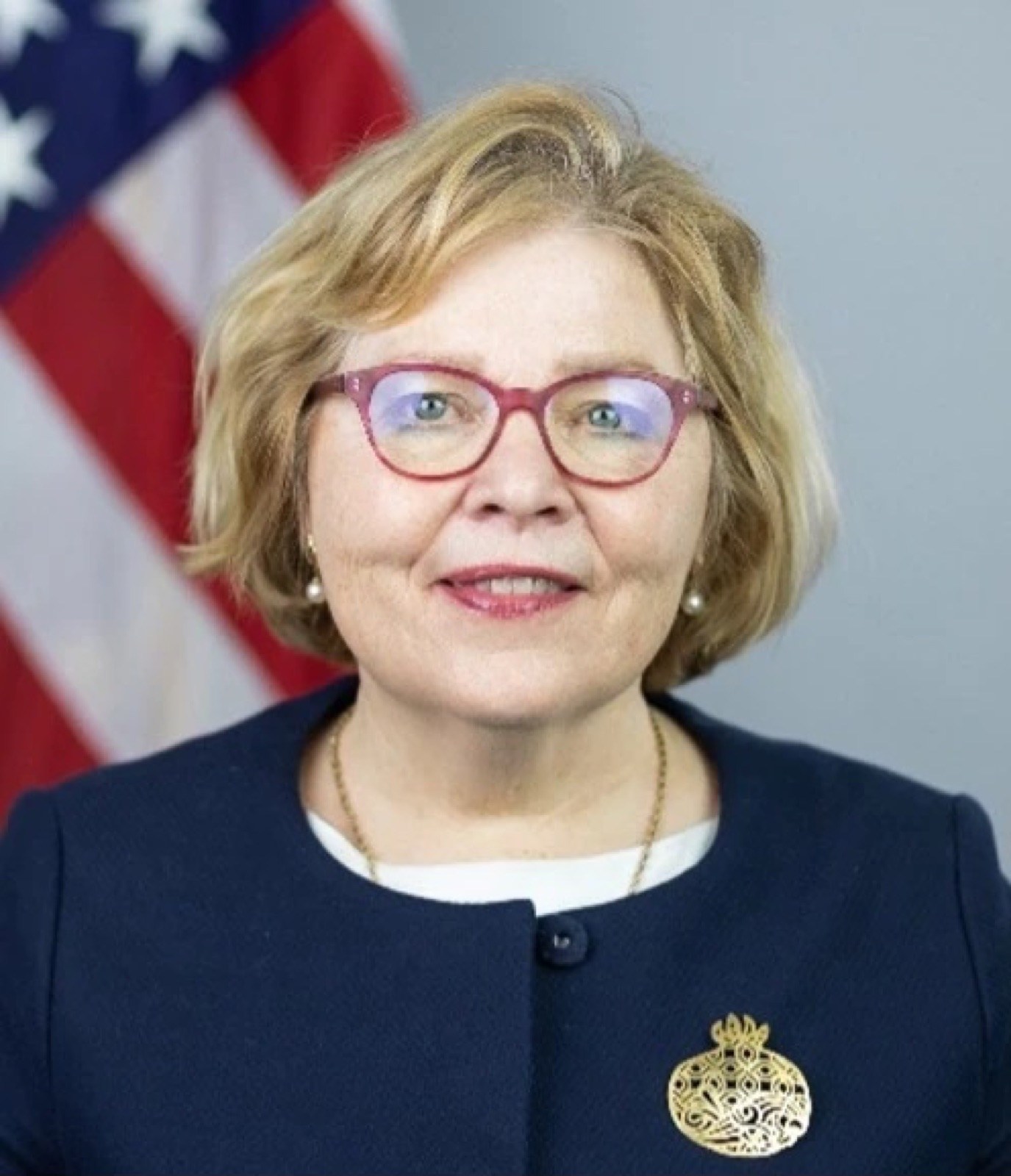
Barbara Leaf
Barbara Leaf is a former United States Ambassador to the United Arab Emirates, previously Deputy Assistant Secretary of State for the Arabian Peninsula in the Bureau of Near Eastern Affairs and Deputy Assistant Secretary for Iraq, and discusses Barbara Leaf's role in ceasefire negotiations between Israel and Hamas.
Episode Summary
In this week’s episode, correspondent Christina Ruffini and co-host former Secretary of Defense and CIA Director Leon Panetta sit down with former United States Ambassador to the United Arab Emirates, Barbara Leaf, who was also previously Deputy Assistant Secretary of State for the Arabian Peninsula in the Bureau of Near Eastern Affairs and Deputy Assistant Secretary for Iraq. They discuss Leaf’s role in the ceasefire negotiations between Israel and Hamas, President Donald Trump’s plans for Gaza, and how the Arab world has reacted. Leaf also shares behind-the-scenes diplomatic stories from the dramatic fall of the Assad regime and recounts an afternoon spent with Syria’s new interim president, Ahmed al-Sharaa, and his plans for a new Syria and relations with Israel. Plus, how the nation is battling emerging Assad supporters.
Episode produced by Situation Room Studios. Original music composed and produced by Leo Sidran.
Listen & Subscribe
- Watch on YouTube
- Listen on Apple Podcasts
- Listen on Spotify
Transcript
COLD OPEN
Leaf: President Trump's shocking proposal did in fact goose our Arab partners into doing something, which we had not been able to get them to do.
INTRODUCTION
Raffini: Welcome to One Decision. I'm Christina Raffini. This week, as seems to be the usual now, we've got a lot of news coming at us from the US, Ukraine, the Middle East, and pretty much all directions. We're gonna go ahead and dive right into the episode with my co-host, of course, former SecDef and CIA director Leon Panetta joining us from sunny California, and this week's guest joining us from Virginia, Ambassador Barbara Leaf. Leaf was most recently Assistant Secretary of State for NEA, that's Near East Asia for those non-State Department nerds among us. She also served in Iraq, UAE, Serbia, Egypt, and several other key posts, as well as speaking French, Arabic, Serbo-Croatian, and Italian. We wanted to invite her on to talk about the state of the Middle East, American diplomacy, and, and of course dig into some of the more memorable decisions she's made during her time, during her career. Ambassador, bonjour, buongiorno, salam, and I'm sorry, but I've got nothing when it comes to Serbo-Croatian, but we're very happy to have you on the podcast.
INTERVIEW
Raffini: Look, I want to start this week with what's going on in Doha. We've got teams from Hamas and Israel, as well as the US Mideast Envoy for the Trump administration, Steve Witkoff. They've all arrived. They're trying to hash out, depending on who you ask, either a second phase of the ceasefire deal or an extension to phase one of the ceasefire deal. Ambassador, you have so much experience with this particular negotiation and in the region. I'm wondering which of those outcomes, if either, seems more likely to you at this point given the situation on the ground.
Leaf: Well, I have to say that, unfortunately, I'm normally an optimist, notwithstanding my years of toil in the gardens of the Middle East. I'm not very optimistic these days about the prospect either for the return of all the hostages or for the transition fully into phase two, which is by the way, supposed to be according to the terms of the original agreement, supposed to be the glide path towards the enduring end of the conflict. But there are so many tricky issues — tricky is a euphemism here — so many issues to be settled in. I spent fifteen months of my life that I'll never get back again working those issues. It's not rocket science. It's the post-conflict security, governance, and reconstruction arrangements, but the devil is very much in in the details of all of that.
Raffini: Mister secretary, what stands out to you when you look at this negotiation? What could work and what seems like it's a nonstarter from the beginning?
Panetta: As the secretary has pointed out, these issues are intractable, and they're very difficult to be able to confront in any kind of honest and frank way. There, there, you know, there's a lot of politics here in the Middle East. There's a lot of bad feelings coming out of the war that we just went through. The sides are still very much divided. And the problem, as we all know, in the Middle East is that it's very difficult to move from war to an enduring peace. The parties have been fighting each other, killing each other, and to kind of move beyond that and try to now sit down and try to see if there's a way to kind of resolve the issues that are pending and try to arrive at some kind of permanent peace, which is obviously the goal that everybody has in mind, it's just not gonna be easy to do. And I think the administration is probably having a tough time. I know they're trying to meet with Hamas. Israel is, is obviously continuing to put pressure on the situation. I think what we went through with, you know, the conversation about what would happen with Gaza hasn't helped and everybody is suspicious of one another. And it just is going to be a very difficult situation in order to have both parties arrive at some kind of consensus. It's, it's, this is gonna be a real challenge.
Leaf: That first point about Palestinian politics. Who are the parties here? Well, the parties, unfortunately, to my thinking, are Hamas and Israel, not the Palestinian Authority. It shouldn't be Hamas that is deciding this. It should be the Palestinian Authority as weak and and, tattered and, an organization and corrupt, an organization as it is. And and indeed, I've been wondering where they've been in this picture. They've been MIA, and they spoke up for the first time this week and said, why is the administration speaking to Hamas? Why aren't they bringing us into the picture? We know why the the Israeli prime minister isn't bringing them in, but it's, it's a fair point.
Raffini: But I know during the negotiations, habitually one of the problems was Israel and Netanyahu specifically was saying the goal of this conflict, they're going to keep fighting until Hamas is eradicated. Well, Hamas — more than Hamas is an idea as well, right? Like it's trying to eradicate an idea. The US has tried that a lot of places. It does not work well. And now you have the person who is negotiating with this group saying that the end goal of these negotiations is the eradication of the group itself. Like that's just not going to work.
Leaf: That's right. And, you know, we heard there was quite a bit of a sort of brouhaha this week over the the revelation to the Israelis and to the wider public that the president's envoy for hostage affairs was speaking directly with Khalil al-Hayya, a senior Hamas figure in Doha. On the one hand, that's not out of bounds in diplomatic terms. You do speak to adversaries and foreign terrorist organizations and so forth. We've done that. We've all done that if you're going to pursue the national interests. But the question is, why is Hamas going to be the one to decide things? Where is Ramallah?
Panetta: To some extent, these negotiations are establishing their legitimacy. I just don't see how that is going to be able to work itself out. Now, you know, everybody may be very tired of war. They may find a way to try to continue the ceasefire in some way in order to give themselves more time. But the bottom line, I do not see how Israel can accept Hamas again controlling Gaza. That's just a non-starter.
Leaf: That's right, but it offers thus the prospect of an endless kind of cycle of conflict and really insecurity every bit as much for the Israeli public and Israel as there is for the Palestinians who have the misfortune of being caught in the middle of this. And as you, as you noted, it empowers, it further normalizes, if you will, a terrorist organization, an organization that is itself fully committed to violent resistance. It offers the Palestinians in Gaza no alternative. What you really want is to allow the alternatives to flourish — the other factions, be it Fatah or any other faction that develops in the Palestinian political community, are committed to the Oslo principles, to the principles of recognition of Israel, non-violent resistance. But right now you're essentially empowering, or further providing political brisk for, Hamas's self-acclaimed role to represent the Palestinians of Gaza.
Panetta: The only way you're ultimately going to resolve those issues is, I think, if you can get the other moderate Arab countries in the region. You know, the hope was frankly that we would have an extension of the Abraham Accords, that Saudi Arabia would become part of of the Abraham Accords, and then that they would kind of bring their authority to the table and try to see if, if they can help provide Gaza with the kind of Palestinian leadership that ultimately could control Gaza along with the security that is needed to protect Gaza in the future as well. You know, it reminds me of negotiating with the Taliban and not having the government at the table and basically cutting a deal with the bad guys, which ultimately resulted in disaster. And I, and I think that could happen here.
Raffini: So to that end, ambassador, you know, you were negotiating this deal, and my understanding is what ended up getting signed in December is very close to what the Biden administration had worked out in the spring. When you were working out that deal, why didn't you all do more to try to include the Palestinian Authority, to try to include the Saudis, to try to include someone who could step up on this day one and help rebuild or figure out who was gonna run Gaza?
Leaf: There's sort of two different worlds that were, of course, not disconnected. There was the sort of the three-phase construct for getting hostages released and in trade for a whole set of things, right? But what was supposed to happen was roundabout day 22, if I recall correctly, you start the negotiations for phase two, but phase two was to itself set the conditions of enduring peace, right? The negotiators would continue, and the six-week ceasefire of phase one would continue as long as the negotiations, negotiators were operating in good faith and continuing, right? Well, unfortunately, in this first phase, they never got to that. So now they're haggling over how to begin the negotiations. You've asked a different question, is that other galaxy of issues, which are the actual post-conflict details. Those ostensibly were going to be argued around the table with Hamas and Israel through the mediators, including the US, but what we did under Secretary Blinken's direction, and of course, in close coordination with our colleagues at NSC, was to begin those detailed discussions, break them out. We first tried having them with the Israelis, but we then took them out to what we call the Arab Quint, and essentially the same group of Arab countries that are very involved right now in the so-called Egypt plan for Gaza. So Egypt, Jordan, Saudi Arabia, UAE, Qatar, and of course the PA was included in those discussions. We could not get our partners to take on the same sense of urgency that we did, but that we had about defining the post-conflict arrangements. And we started discussing this in house and then eventually with them in November. I mean, very early.
Raffini: Partners being the quintet? Is this who we're talking —
Leaf: Exactly, exactly. But they had a different set of problems. Gaza was burning. So their problem at their front doorsteps for all of them, especially Jordan and Egypt, was, we can't, we can't be seen to be talking to you people about the day after, many days later, two months from now. Our problem is we need to show our people that we're getting you to stop the fighting now. So there was a real disconnect. That's why I say fifteen months of my life, beating my head against the wall. But over time, some of the ideas took traction, but there was an essential problem still connected to that original construct, which is Hamas being the discussant at the table for phase two. Part of the problem was Israeli. A large part of the problem was Israeli. The problem was our Arab partners and their political problems, the divisions of the Palestinian Authority, its weakened state. The Israelis would not deal with the Palestinian Authority except in security terms on the West Bank. And as they frequently said to me, why am I their partner on the West Bank, but I can't be their partner in Gaza? And there's no good answer for that, at least no good legitimate answer for that. Look, they went into the war with no phase four planning. Our military and we diplomats, policymakers, we all were on them from the first opening days of the ground campaign. What's your end game look like? What are your objectives? Oh, those don't look like they're achievable by military means, but okay, those are your objectives, but like what are you aiming for at the end of this conflict? What's your phase four post-conflict vision and what are you doing to achieve it? We had some very quiet discussions with the Israeli military and intelligence services, but they were essentially shut down by the Israeli government eventually, and it was stovepiped into very strict channels. We had with great difficulty the effort to get that articulated. Until now, I would argue you still don't have that, that vision articulated by the prime minister. You have some crazy visions articulated by some members of his coalition.
Raffini: There was also that great AI-generated video that President Trump tweeted out. I mean, that was, that was a vision.
Leaf: It was a vision. Yes. So I've said this repeatedly, and I continue to believe it. I don't think when he threw that out there as a gambit and kept coming back to it. I don't actually think he's serious because I think he and certainly his senior people know it's completely unachievable in operational terms. You would have to compel people to leave and nobody's going to do that. The US Army is not going to do that. The IDF has not been able to do it, so nobody's going to do that, and it will not organically occur. It was sort of a brutish effort to get to shock people into coming up with a counter offer, a counter plan, which is what the Egyptians did last week. President Trump's shocking proposal did in fact goose our Arab partners into doing something, which we had not been able to get them to do. Would it have been really great, if in the first instance, Ramallah and Jerusalem could have had even just back channel intel discussions, then bring them into the sort of the political realm, bring us in to help get over problems and so forth. But that's been the lacking piece all the way through.
Panetta: So what you have are, are a bunch of these efforts to try to cut little deals. I mean, that's why we're now talking to Hamas, others are talking to others. And so there are these different pieces and the hope is that somehow if you can then take those little pieces and try to bring them to the parties and try to get them to put their arms around it that you might get something done. So that's the, that's the challenge right now. If you can't put everybody in the room and agree as to where you're going, which is the best way to do it. But in the absence of that, you're going to have a series of different negotiations going on and you kind of keep your fingers crossed and hope that one of those ultimately can kind of break through and the parties can embrace it. So it's just process. And I, and I think in the interim, the real challenge is gonna be how do you refrain both sides from going back to war.
Raffini: Diplomats I've talked to who were in the room for some of these negotiations — in this issue we're talking about the reliability. Ambassador, you touched on this a little bit of, you know, whether the participants are reliable partners. And one of the things I was hearing is the the difference between negotiating with Mossad and negotiating with Tel Aviv. And what I was hearing is the head of the Israeli intelligence agency was a reliable actor and an honest broker — where it broke down was getting him from Doha back to Tel Aviv, and then it would all fall apart. Can you walk us through just a couple of those meetings and how it went down and talk about the role the intelligence apparatus plays in negotiations like this?
Leaf: It's true. Barnea, head of Mossad, Ronen Bar, head of Shin Bet, they're terrific partners of ours. They have been terrific partners, of course, in this whole saga, and highly reliable and highly creative, pragmatic, really understand the terrain, especially Shin Bet, highly pragmatic cast of mind, really understand the terrain of both Gaza and the West Bank, even though they haven't been in Gaza in years. They would get instructions, they would go out to Doha or sometimes Cairo, get a sort of a set of agreements, and then run into kind of a brick wall when it got back to the cabinet or the security cabinet. Of course, over time, you had just a lot of volatility in Israeli coalition politics and Israeli politics generally when you consider how many governments we've seen in the last four years. But within this period of time, of course, you had Gadi Eisenkot and Benny Gantz come into the cabinet, and there was a formation of a security, a smaller group of people who had the ability to say yay or nay on decisions, typically that the Prime Minister would not take solo decisions, sometimes he wouldn't take decisions, and he would kick it to, always kick it to the security cabinet. But sometimes you had Ben Gvir and Smotrich clamoring on the outside demanding to be privy to those discussions. So a very unwieldy decision-making and decision-execution process. Now you've heard, especially towards the end of the Biden administration, Secretary Blinken and Jake Sullivan and others repeatedly stipulate that Hamas was the proximate or the specific problem piece in it. At other times, it Israeli foot-dragging or Israeli reversal of course. But it is true, towards the end, it was very much Hamas becoming a block on things. And then you had the entry of Steve Witkoff and the, and the prospect of Donald Trump coming back in, and that energized everything to push things forward.
Raffini: And how did that work? Are you all just, like, at the same hotel bar with the incoming administration having just had your butts kicked in the election and all trying to — I mean —
Leaf: Well, at this point a little bit awkward. Yeah. At this point, I'm out in Damascus. So then Brett is in Doha. And yes. But, I mean, once the election occurred, you know, NSC did the outreach to incoming, to Mike Waltz and to Steve Witkoff. And it was not just Gaza, there were a host of issues that Jake wanted to make sure there was a very, as much as possible, seamless handoff of the baton, and given where things were on the hostage negotiations, and Trump was saying constantly, I want this done. Now, not Gaza over, but the starting point, you know, completed. So Brett and Witkoff worked very closely together, and it wasn't awkward. I mean, this was, well, I leave it to Brett to say whether it was awkward, from what I've heard from him and what he said publicly, no. I think it was very much a common effort to use all the knowledge that Brett and Bill and the team had of this laborious ins and outs, the impending, the swinging of the wrecking ball coming if this didn't happen. Hamas was finally galvanized and pushed by all of these forces. The commonality, rare commonality of purpose and action between the outgoing and incoming NSC. And as I say, I was out in Damascus applauding it all, but we had a whole another set of issues that we were trying to grapple with at the same time because yet another black swan flapped into view.
Panetta: The problem is that all of that work and intelligence runs into a wall of politics. When it hits that wall, there's no way to kind of break through. I think Netanyahu obviously when Trump did get elected felt like he was basically the United States was going to do what he wanted them to do and that kind of inhibits some of the negotiating process as well. I mean to the credit of the administration, at least the incoming administration, they were willing to kind of seek out at least what were the pieces that they needed to get something done and they cooperated in that effort to their credit.
Leaf: In the spring, as the Israelis were maneuvering and speaking publicly and privately about the plans to go in big and take Rafah, it was a point of, shall we say, very intensive discussion between our two governments. And when the IDF moved, they snatched the Rafah border crossing and shut it down, and they basically gave the Egyptian, their Egyptian counterparts, you know, a phone call with about, I don't know, two hours' notice, hey, we're coming in, and they closed it down, which of course enraged and embarrassed the Egyptians, not just the military, but obviously President Sisi, but it also cut off this vital transport point for passenger traffic and for wounded, those who were going to hospital in Egypt or out through Egypt. And at that point, the flow of humanitarian assistance was very unstable. And so when you at one go shut something down like that, the border crossing, especially when it means people traffic, it was really devastating and it was politically explosive. And, you know, I sort of felt like the Egyptian-Israeli peace agreement was beginning to shake a bit, not that anybody was making any threats of military action, but, but what followed very quickly were Israeli statements that Rafah was closed for good. We worked rapidly to see if we could come up with a fix to to begin, you know, reopen, get some something going. And I was on the phone, Brett was on the phone with Shin Bet, who were in charge of this alongside the IDF. We could not get what was just the common sense obvious thing to do, which was to get the PA security forces in there to have some sort of presence. The IDF could be some ways back from them inside Gaza, but put the Palestinians front and center, but not Hamas, you know, put PA security forces. And we went through the struggles of the damned to come up with something that was politically feasible, which meant the PA security forces not wearing their uniforms, not having insignia, calling themselves some confection of names, anything to deny that it was who they were, PA security forces. And to my mind, it would have been a great first test of their sort of political will and capability to begin coming into Gaza and doing some security tasks. You know, a year later, they've done that.
THE FALL OF ASSAD AND SYRIA
Raffini: Ambassador, you went on this really remarkable envoy trip, to meet the new self-proclaimed head of Syria.
Leaf: Yes. Twelve days after Bashar al-Assad's flight, ignominious flight into exile.
Raffini: But, I mean, you are very familiar with this country, this conflict. Talk to us about how it's — it's HTS, right, his Al Qaeda franchise. How did this happen? Where did he come from? And then just personally, can you tell us about even, like, the decision to get on the plane, what it was like getting off the plane?
Leaf: Yeah. So there's no plane, first of all. I — we, we drove overland from Jordan. I went to the Manama Dialogue and wake up on Sunday morning, and of course the news had gotten more explosive through the weekend. Sunday morning, December 8, oh my god, Damascus is falling. In any case, Assad's gone. Who's taking Damascus? Oh, HTS isn't even there yet. It's gonna be the southern militia. So I got a plane, went to Jordan. I was meeting up with John Bass, the Undersecretary for Political Affairs, and we were going to go on to Iraq. He gets there and I said, hey, John, we better go to Türkiye, because the Turks obviously have had a big role in all of this. Then the next thing we knew, the secretary was calling and he was like, well, I think I better come out. We're like, yeah, you better, because this thing is moving fast. We better get our Arab partners together and do a quick huddle and kind of figure out what we're gonna do. So he ended up, we all met in Ankara, John and I had gone to Baghdad, and let me tell you, the Iraqis were freaked. The Iraqi militias were flooding back into Baghdad from Syria, things were in a churn, they were just sort of not paralyzed, but their worst fear was, oh my God, this guy once upon a time was a fellow traveler with Abu Musab al-Zarqawi, the founder of AQI that became ISIS, like, oh my God, has ISIS just taken over Damascus? Was kind of their question. So we met up with the secretary. He and I then flew back to Baghdad. But in the meantime, we were stitching together with the Jordanians just a get-together, which the king ended up hosting in Aqaba. And we had the Arab Quint plus plus plus. We had the Turks there, EU came. I will say that in all my years, thirty-five-plus years of diplomacy and wrangling people, even it was like a land speed record for reaching consensus on what was a rapidly evolving situation, something that no one had seen coming a month, two months earlier. There was this spectrum of anxiety in the room, but there was at the same time, I would say a complete consensus on the need to immediately start engaging with al-Sharaa and to figure out how to best use our collective efforts in a common goal. So if you look at the communique was issued in Aqaba, it was first and foremost expressing support for the people of Syria and also laying down a series of expectations on the new powers in terms of what we expected of them in the new Syria, Syria as a neighbor to all these countries or to Syria in terms of its counterterrorism fight and so on and so forth. So the secretary left Aqaba on Saturday the fourteenth and left me behind at my request because I said I need to go to Damascus. And he said, yes, I completely agree. Let me go back to Washington. We're going to talk it through and then we'll come back to you with instructions. So he left and I basically camped in Jordan in Amman, and I was grimly determined I wasn't leaving until Washington agreed that I would go. And I was joined in that quest by, of course, Roger Carstens, who is a force of nature himself, a special presidential envoy for hostage affairs, and an FBI team in the quest to find either find Austin Tice or definitively determine what had happened to him and to several other Americans. And then we also had us along for the ride Daniel Rubinstein, had been an envoy on Syria some years earlier, who we dragged into the picture for some follow-up work, and Jumana Khadour, one of my staff, Syrian American from Homs. So we took off on a road trip on the twentieth from Amman, and with the arrangements that HTS would meet us at the border and provide us escorts. That was pretty fun. We had a mix of military and other security elements, including DS, diplomatic security, convoy of five or six cars. And then we had our HTS escort and they looked, as you might imagine, those kind of fighters would look, some beards and everything else.
Raffini: Long pickups involved? Toyota pickups?
Leaf: There are always Toyota pickups. So we had arranged a day, we had very strict rules for our day because our security had not been able to do a recce. Normally they would do an advance, maybe two advance trips in, go to all the sites, talk to people, kind of get —
Raffini: Yeah, you're kind of flying blind here, right?
Leaf: Sure. And at that point, everyone was going in through Beirut, but my embassy in Beirut was up to their eyeballs supporting the ceasefire mechanism and all of that, and we knew we could go in fastest through Jordan, so that's what we did. But we, I mean, we had no idea what security was like. We were calling people, contacts across the country, the South, etc, and then it was a wish and a prayer, and we took off. We went first to the site of — we had very good information, credible information about a site where we believed Austin Tice had been held. So Roger and the FBI team went forward to track down that site and looked to see if there was graffiti, if there was anything that might indicate or somebody in the vicinity who might be able to testify to that. I laid a wreath at the site. It was a big compound, a Republican Guard compound, laid a wreath at the site. And then we went to the Four Seasons Hotel, which is ground zero for everyone to meet. It had been —
Raffini: It's always a Four Seasons.
Leaf: Didn't know it's always a Four Seasons. And the irony was it was almost — it was thirty years almost to the day that I had stayed in the Four Seasons as a very junior diplomat in a different age. So anyway, we had a long set of discussions with the White Helmets, with our embassy staff who had loyally stood by all these years taking care of our compound and the ambassador's house and just hoping and praying that we would be back, and then met with a whole group of civil society activists. Then the last event of the day, the penultimate, because I was supposed to do a press conference, went and saw — he was still calling himself Abu Mohammad al-Jolani, but he's now al-Sharaa, is his real name, Ahmed al-Sharaa. So it was just him and the foreign minister, al-Shaibani. It was a couple of reflections. One, it became clear as we got into the discussions that he had basically set the whole afternoon aside, like as long as I could stay he was going to stay. And he was very engaged. He did all the talking until the end when al-Shaibani and I and al-Sharaa had just a smaller discussion. But he was very much, he conveyed very much a sort of a sense of authority, clearly a natural leader. There was nothing overly polished about him, but people ask me, did he seem very counseled and prepared by others, if you will, to talk about?
Raffini: Yeah. Had he had the HTS media training package?
Leaf: He might have had a media training package, but like I had a media training package. I'm not sure that it did me any good, but you know, you kind of learn it and you feel —
Raffini: But he seemed very genuine to you, you think?
Leaf: He did, he did. Like, well, obviously, there's an art to all of these discussions you're conveying. There's, you know, there's diplomatic theater that you're engaging in on both sides. Right? But he just didn't come across as, you know, he wasn't like a blowhard or sort of doing a lot of fulminating about, you know, the great victory, etc. Very measured. He came across as like a civilian leader, not somebody who just fresh off the battlefield, very preoccupied by the state of the economy, the parlous state of the economy in Syria, the need to ingather all of the disparate forces into one national force, the issues of conveying effectively, persuasively to all of Syria's neighbors, the new Syria was no longer going to be a threat to its neighbors. And he mentioned by name Israel several times. We had a back and forth about Israel, but he was entirely non-polemical. That's what came across to me. There were a couple of times when I felt like I almost had to close my eyes and remind myself I'm talking to a Syrian official because there was no Zionist entity and occupation of our holy lands and all of that. It was just very matter of fact, very pragmatic. And he'd obviously put a lot of preparation into the discussion, and he obviously had anticipated pretty much all of my issues of concern, from the fight against ISIS to the disposition of SDF, the issues of governance. So he was very, very well prepared for the discussion, and we had a long back and forth on sanctions, of course, which he conveyed again and again. He regarded as one of the most important obstacles to the ability of Syria to begin to recover.
Panetta: Could Assad's departure have ever happened if it were not for what happened in terms of weakening Iran's proxies as well as the attack on Iran itself and going after them? I mean, even Russia to some extent. Could any of that have happened without those events taken?
Leaf: No, that's right. I don't believe so. So look, I would say there are a couple different actors that help produce the the conditions that, al-Sharaa recognized and sees because he, he, he saw this, he assessed things correctly. If anything, he underestimated how weakened the Syrian army had become. But you have to give credit to President Biden and NATO and the effort they put into helping Ukraine defend itself that drew so much of Russian leadership, bandwidth, resources, military, and other towards that theater and away from Syria. Of course, you had the events around Wagner's implosion, which had its effect as well. No question the IDF, which was its own sort of wrecking ball across the landscape. And again, that is the Biden administration providing the backstopping, the material support, but the backstopping that allowed, even when we might have disagreed at a given moment, is really what you want to do right now, still the cumulative effect of the IDF and Shin Bet's campaign against Hezbollah, IDF, Israeli Air Force, really, responses to the two state-on-state attacks by Iran against Israel and the disarray that that threw the regime into, the disarray that it threw the proxy network into, because it left all of them uncertain. You had Nasrallah taken out, you had all of the top layers of Hezbollah leadership taken out, that really left even the kind of craziest of the Iraqi militia leaders wondering, do I really want to be in the radar, in the target next? So and the strikes that the IDF, the Israeli Air Force, made in Syria itself against targets that were related to the PGM support system and so forth. So cumulatively, that so weakened the players and the the two principal backers of the regime, who also kind of missed just how depleted and enervated and weakened, just seismically weakened, the Syrian army was. So when HTS and its collection of fighters struck Aleppo, it terrorized the army, and it was the old hot knife through butter going down south through Hama and Homs.
Panetta: It didn't take Assad a long time to figure out that he had to get the hell out of town. Yes, yes, record time. Let me ask you also, recently there's been some disruption as a result of some Assad supporters raising hell. How much of a problem is that gonna be?
Leaf: It is. It's a, it's a significant problem. First of all, because it hasn't stopped. There I was looking at reports earlier that there were, again, government-affiliated forces, not HTS, but affiliated with the government who were dragging men out and executing them in the street. Now that kind of stuff is lethal and toxic and explosive in this environment. I mean, the thing I came away from Damascus feeling is, my God, this is a once-in-a-generation change of the whole landscape. And you could feel it was just in the air. The the air was thick with this euphoria that Syrians felt.
Raffini: The videos were incredible. People at bars, people in the streets, you know, people in hijabs, people without hijabs, people drinking, people not drinking, like the the old Damascus that you probably knew when you were there twenty years —
Leaf: That's right. That's right. But the thing is, fifty years of the Assads, Père et Fils, it was a terrible experience for every community of Syrians, including the Alawites, because you had to be Assad's chosen Alawite leaders, and if you weren't, then you were smacked down. And so the Alawite community, as 10% of the population, was not body and soul all part of the superstructure. There were a lot of people who participated in the sort of terror state that the Assads built. What the Assads also did was turn communities against each other. And in the sort of Stalinist way, neighbor against neighbor, families within families, atomize the society. So the degree of trauma, mistrust, anxiety, fear, etcetera, it's really there, very present. And one of the things I felt so strongly about coming out of Damascus that day, because I'd spent a week in Amman looking at videos of all of the crowds breaking into all of these detention facilities, people desperately seeking their lost relatives. The thing that I thought was probably one of the most explosive issues was transitional justice and accountability, or lack thereof. And if the government didn't get on this with a very visible and structured and persuasive mechanism or process or what have you, people would take matters into their own hands. And they would anyway, but you would have to get most of the public persuaded that we've got this, we're going to do it, you leave it to us. And I think what happened in Latakia and the coast, first of all, was triggered by organized pro-Assad regime elements and essentially trying to provoke a response, a reaction. They got it, and there was terrible bloodshed. Much of it perpetrated, it seems, by elements of the Syrian National Army, this Turkish-backed set of militias, three of which we have, we have designated as terrorist organizations, ourselves. So there was a lot of civilian carnage in all of this. Al-Sharaa has done the right things, stepped in, called on everybody to cease and desist, sent in forces to calm things down, set up a commission with members that are not affiliated with HTS to do the necessary work. But it's his first real test, and there will be more. So this is one of the most volatile pieces. And the problem is it's gonna be weaponized by Iran if he is not careful. And I think the Iranians probably had some hand in this perhaps, but it can be weaponized by a lot of different actors.
CLOSING
Raffini: Alright. And on that note, mister secretary, madam ambassador, and again, Serbo-Croatian. Got nothing. Maybe you can help me out. Thank —
Leaf: Thank you.
Raffini: That'll do it for us this week on One Decision. And if you like this episode, please listen to a previous episode we did with Doctor Majid Al Ansari, advisor to the Prime Minister of Qatar and official spokesperson for the government about his perspective on the Israel-Hamas negotiations. This is one way of doing acceptance and tolerance for certain ideas. For more exclusive content, be sure to check out onedecision.com and of course, our YouTube page. Until next week, I'm Christina Raffini. Thanks for listening.