Episode Info
- Season25
- Episode3
Hosted by Christina Ruffini and Sir Richard Dearlove
Guest
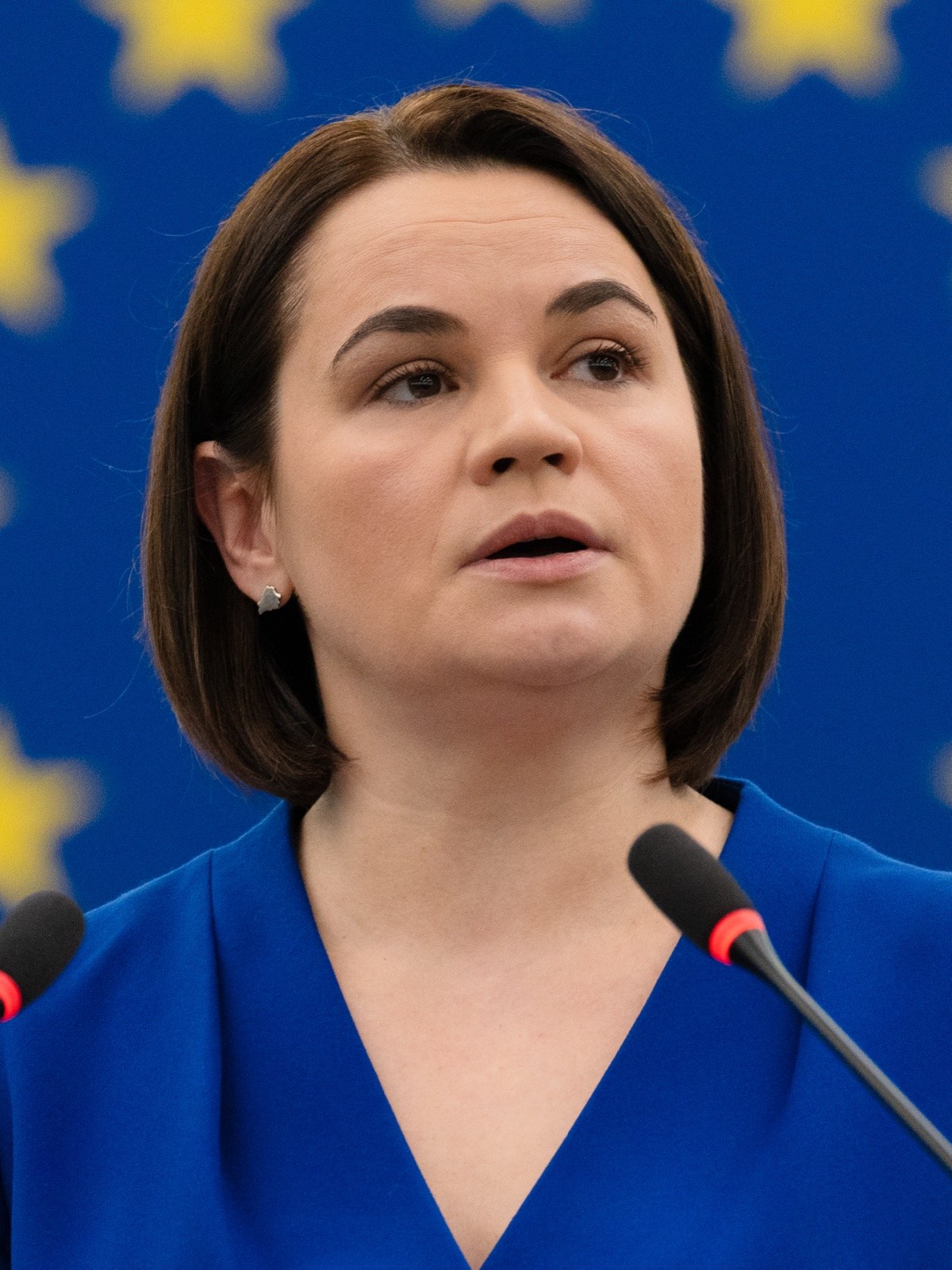
Sviatlana Tsikhanouskaya
Sviatlana Tsikhanouskaya is an exiled Belarusian opposition leader who challenged Lukashenko's rule after the imprisonment of Sviatlana's husband by the regime.
Episode Summary
Belarus has spent the past 30 years under the authoritarian rule of President Alexander Lukashenko. Sviatlana Tsikhanouskaya challenged his rule after her husband was imprisoned by the regime, only two days after he declared his intention to run for office. She is now living as the exiled Belarusian opposition leader and sits down with One Decision’s guest host Kasia Madera and the former MI6 Chief Sir Richard Dearlove, for a discussion on Belarus' struggle for freedom under Lukashenko's iron-fisted rule, the ongoing war in Ukraine, and the need for European countries to step up in the fight against autocracy.
Listen & Subscribe
- Watch on YouTube
- Listen on Apple Podcasts
- Listen on Spotify
Transcript
INTRODUCTION
Madera: You're listening to One Decision, the podcast that looks at the choices that shape our lives. I'm Kasia Madera, a journalist, a broadcaster, and today, I'm your guest host. And I'm Richard Dearlove, former chief of British intelligence,
Dearlove: otherwise known as MI6.
Madera: Each week, we explore some of the biggest choices and issues that have global impact. We hear from the key players and influencers making, informing and shaping the decisions that affect us all. And so Richard, I'm really excited about today's guest, given both of our experiences of life behind the iron curtain. Yeah. She's a seminal figure,
Dearlove: an important personality. And, yeah, you've lived in Poland. I lived in communist Czechoslovakia. So for us, this has a sort of symbolic importance to exchange and hear the views of someone in this situation.
Madera: So our guest is described as a symbol of hope for Belarus, the Eastern European country that was part of the Soviet Union. Since the collapse of communism, Belarus has spent the past thirty years under the authoritarian rule of President Alexander Lukashenko. Svetlana Tsikhanovskaya was thrown into political activism after her husband, Sergei Tikhanovsky, was arrested when he announced he would stand in Belarus' 2020 Presidential Election. Svetlana, you took the decision to take on the role that your husband was prevented from doing. You became the leader of the Belarusian opposition. Describe to us the impact that that has had on you.
INTERVIEW
Tsikhanovskaya: First of all, thank you for this possibility to tell my story and the story of Belarus, Belarusian people, nation fighting for democratic changes in Belarus. My story is rather interesting because I was never interested in politics. And it was my husband actually who only in October 2019 started to be involved in politics. He started to communicate, he was a blogger. He started to communicate with Belarusian people, asking them questions, how they feel in Belarus, what are their salaries, what are their incomes, so on and so forth. And he became so popular that people started asking him to run for president. You know, he's really people's hero. And when he declared about his decision to run for president, he was immediately detained. He was imprisoned and he didn't manage to give his documents for registration for presidential election. And as his wife, you know, just out of love to my husband, I decided to run instead of him. You know, I didn't think about the consequences. I didn't think about uprising. It was really only to show my husband that what he has done or what he was doing is important for me as well. Then I really discovered myself to be the only opponent to Lukashenko and I was joined by other democratic delegates and we ran for campaign for presidency. And according to alternative accounts, I had won elections, but Lukashenko refused to leave power and unleashed the most brutal terror against the Belarusians our country has experienced for all the thirty years of Lukashenko's governing. And since then, four years, I am together with other Belarusians, with our brave heroes are fighting against dictatorship. We are fighting against creeping occupation of our country by Russia. We are trying to help Ukraine, Ukrainian nation in this war. So we have a lot of challenges, but I can't give up. You know, of course, sometimes I'm frustrated. Sometimes I'm exhausted. I'm bringing up, you know, two children. You know, my husband is in jail for four years. But I feel huge responsibility for those people in prisons who sacrificed their freedom. But also I feel responsibility for my country, for the future of my children.
Dearlove: Svetlana, we were all massively inspired by the extent of the sort of demonstrations against the Lukashenko regime in the run up to that fraudulent election. But I mean, looking ahead, how do you think that your country is going to rid itself of this dictator? I mean, how do you envisage the political situation evolving, let's say, over the next three or four years?
Tsikhanovskaya: I understand that we, Belarusian people, are not just fighting for our land. There is a fight between democracy and tyranny. It's a fight between past and future for my country. And we are, as Belarusian people, at a crossroad. Either Belarus becomes a free independent European state or remains in Russian orbit. And in 2020 Belarusians clearly chose freedom and Europe and now we continue to defend this choice. So I actually don't know how the situation will develop, because so many obstacles that might influence situation in Belarus. It's victory of Ukraine that will be a huge blow on Putin who is supporting Lukashenko. Hence, Lukashenko will be weakened. And we will be prepared for the moment of opportunity that will be in Belarus. And our task now is to weaken the regime and to strengthen Belarusian people, Belarusian civil society, Belarusian national identity. So many challenges around us. We see how Russia is trying to erase everything Belarusian from Belarus, erase our nation. They want to subjugate our country. Lukashenko is already there. Lukashenko is already in the hands of Putin, but we need to save our nation, to save our country. Of course, I want our fight to be sprint, you know, but it's already a marathon. And we have to be patient, we have to be creative, we have to be innovative in fighting this old style but brutal dictatorship. I think that we have to keep our strength, to weaken the regime, strengthen ourselves, but also to encourage the democratic world to be with those who are on the front line of this fight against dictatorship. Because now the dictators are fighting in Ukraine, in Belarus, I mean Europe, but if you don't defeat them now, they will knock your doors, doors of democratic countries. So don't look at assistance of the people who are fighting against dictatorship. It's not charity. It's investment into peace and security of the whole Europe, of the whole region, and actually the whole world.
Madera: So when you see Western countries, when you see in The States, for example, a whole conversation about potentially not giving aid towards Ukraine, not giving them arms. How on earth does that make you feel? Because I'm assuming that what you're seeing in Belarus is an echo of what we're seeing in Ukraine as well, a fight against Putin. Of course, Lukashenko is in the hands of Putin. How do Belarusians feel about what is happening in Ukraine?
Tsikhanovskaya: So first of all, I have to say that it's evident that Lukashenko serves Russia, not the Belarusian people. You know Putin supported Lukashenko back in 2020 and Lukashenko pays back with our sovereignty. Piece by piece he is selling Belarus to Russia, to Putin. And Lukashenko dragged our country into the war and he's responsible for this. He's the same war criminal as his partner. And here we have to distinguish Belarusian regime who is part of this war and Belarusian people who are against the war, who are supporting Ukrainians as much as we can. We can't give missiles, you know, and then billions and billions to Ukraine, but we can show our solidarity. When the war has started, Belarusian partisans disrupted railways to slow down Russian equipment going to Ukraine, you know, that was supposed to bomb Kyiv or Bucha, you know. Our military volunteers fighting in Ukraine shoulder to shoulder with Ukrainians. Our Belarusian refugees who fled repressions helped Ukrainian refugees. Because we know what it means, you know, to grab your child, grab some stuff and leave your country, you know, leaving everything behind, not knowing what is waiting for you in the future. So the fate of Belarus and Ukraine are fully intertwined. Without free Ukraine, no chance for Belarus. But without free Belarus, there will be no safe Ukraine. And of course, we ask to help Ukraine with everything it needs. Freezing conflict will remain Belarus in the hands of Lukashenko and Putin, and we mustn't allow it. You know, dictators use any weakness, any divisions, you know, any fatigue. You know, they are trying to find any crack that they can use. We don't have right for fatigue. You know, tell about fatigue to the soldiers in Ukrainian trenches and political prisoners in Belarusian prisons. They can't be tired of resisting, neither should we. If you don't stop Putin now in Belarus and Russia, in Ukraine, he will knock your doors, as I said before. You know, dictators cannot be appeased. Dictators cannot be reeducated. We deal with organized criminal gang. And I want the West to be more decisive in supporting Ukraine and free Belarus. For two years no strong sanctions were imposed, no punishment for crimes against humanity or deportation of Ukrainian kids, half measures only harm. So how Belarusians and I think Ukrainians, perceive the situation that one hand is condemning Lukashenko and Putin, another hand continues dealing and trading with him. So we need international coalition and comprehensive strategy that includes dismantling the regime, taking Belarus out of the war and supporting those democratic and European aspirations, but also full support to Ukraine. They need to get everything. They need to defeat this enemy.
Dearlove: Svetlana, one of the things that worries me, for example, is if you look across Europe, there is still what one might describe as a sort of fifth column of sympathy for Putin. So you've got leaders like Orbán, you've got Serbia. Even amongst the, you know, extreme European right wing, which is gonna do rather well in the European elections, you can see echoes of sympathy and support for, I was gonna say for Russia, but for Putin. So, I mean, the situation is for us quite complex in terms of, as it were, having a completely united front in dealing with this extraordinary threat which has evolved to Western Europe from Putin's regime. We've had this recent problem in Georgia too with the legislation that's been pushed forward about foreign influence, which is copying Russian legislation on the same issue. I mean, it it it does add a dimension of complexity, which is worrying. Fico in Slovakia as well, although, you know, there was this rather extraordinary assassination attempt on him. I mean, what's your commentary, your advice in this general area?
Tsikhanovskaya: In democratic world I want to believe that everything depends on people. And it's obligation of people in the democratic world not to be poisoned by these populist and propagandistic messages, that it's not your business. Why do you have to sacrifice your comfort life to help Ukraine? Of course, the dictators will use these narratives to frustrate people. It's so easy to think that, it's really not my business, why should I interfere, it's not my obligation, it's their problems. It's not their problems, it's all our problems. We have to explain to people who enjoy democracy and think that it is given for granted that democracy had to be fought for. And now if we allow, you know, dictators to prevail, believe me, you will be the next target of these dictators. And dictators of course, you know, they are so easy making coalitions. They don't have to get any agreement with their people. They decide like themselves, personal. And they perceive democracy, democratic world, as a very weak world. They don't respect democracy. When they see this undecisiveness or hesitations, they perceive it as weakness. And they test in the democratic world how far they can go in their brutality, you know, just to cause some reaction. They cross red line after red line, just expecting for some answer. No answer, we go further, we go further. So tomorrow you can wait them just knocking your doors as I have already said. So I think that it's people who shouldn't allow this populists to poison their minds. You know we are waiting for European parliament elections, you know very soon an election in the half of the world is taking place. And some populist or isolationist forces, you know, they might win European parliament elections, especially some people whose purpose or whose narrative is to let's make deal with Russia or stop putting pressure on Lukashenko, you know, it will be a great mistake to believe to these people. So I call on Europeans to support all those who stand with democracy, with Belarus, with Ukraine. Don't vote for pro Russian or pro war politicians. There are no simple solutions in this situation. And if any politician say that I will solve the Ukrainian issue for twenty four hours, believe me it can't happen. Because this crisis is too deep at the moment. And we should always remember that dictators cannot be reeducated. I have very short four years in a political path. And very often I see that some politicians want to close the issue but not to solve the problem. They talk to people with populistic messages, thinking that they will believe. We have very experienced people in modern world. We know how to find truth in this flow of information, how to check, double check information. So don't think that your people are silly and they can easily believe you.
Madera: You touch upon populism and we've got to touch upon a potentially populist future president in The United States, Donald Trump. Friendship openly discussed with Putin. I guess and this is for you as well, Sir Richard, because the intelligence agencies must be terrified and worried and concerned about a potential Trump presidency. You say populism is potentially damaging because it enables these dictators such as Lukashenko to rule and thrive, but people are voting for it.
Tsikhanovskaya: People are voting, you know, because again, they want to believe in simple solutions. It's much easier to close your eyes, close your ears, I don't see anything, I don't want to hear anything, I want to live my comfort life and person who is promising me this comfort life. You know, it's easier to vote for this person and then, I don't know, blame him that something is unsuccessful or I don't know. But not to look deeper into personality. Do I really want, let's take our region, Russia to invade Ukraine? Do I really want to betray the values democracy is based on? You know, I want cheaper prices, you know, I don't want problems in my life and all this wars influence my comfort. But we don't have to be such material. You know, we have to think about something bigger, like personal comfort. Because I think that I know what I'm talking about, because when you live under dictatorship you start to cherish what you gain. Because people are sacrificing their freedom in villas and prisons, people are sacrificing their lives on Ukrainian soil for values you enjoy every day. So we think it's a little bit higher than you. But it's also your world and you want peace in the world. But if you are not contributing to this peace and stability, so believe me, it's very shaken, it's very unstable. And democracy might lose without your personal involvement. It's so easy to think they will decide, you know, let them decide. In our country, our people for thirty years didn't want to decide. Because it was like social contract. Lukashenko gives people small salaries and people don't interfere into politics. It was like politicians know better, let them decide. We don't want to participate in politics. And we see thirty years of dictatorship. So it's easy. It's a very short step from democracy to dictatorship if people stop to be involved in things and think critically.
Dearlove: I'm just going to add on your comment, Kasia. Trump's risk is not a fact yet. So that's the first point. The second point is I think his chances of being elected have diminished since being found guilty as a felon. And there are indications in polling that a lot of Americans are now questioning him as a future president. And the third point I would say, even if he is elected, and we mustn't discount that possibility, his unpredictability is still a major factor in Trump policy. We don't actually know what he's gonna do. And I'm slightly encouraged by the fact that eventually, you know, this subvention of 60,000,000 did go through to Ukraine, which he didn't stop. And in fact, you could argue that he said something to support it. He's actually said some quite positive comments recently about NATO. So it's possible that his ground is shifting. I'm not being complacent about this. I just don't think we should sit there making this assumption that, you know, the world's going to go to hell in a handcart because Trump's going to be elected. It hasn't happened yet. And I don't think it's necessarily going to happen. Let's just say that at the moment. Difficult to predict. But I agree entirely with what Svetlana is saying about, you know, attitude of people. They can't sort of close their eyes. People must go out and vote and understand the risk and the dangers which have arisen around us.
Tsikhanovskaya: Yeah. If I may add to so possible Trump's, you know, election, because we here in Belarus and Ukraine, you know, we we are terrorized with these narratives that if Trump comes, you know, all the support will be restricted. But, you know, I want to say that I hope that there will be people in his team who understand the importance of Ukraine and Belarus and counter Russia. Democracy, the beauty of democracy, it's not about one person. It's about people who are around. And I think that even if there will be some intention to have some deal with Putin, again, these are narratives we hear here, the democratic system will not allow this to happen.
Madera: So you think that people who potentially say that there has to be some kind of negotiation between Volodymyr Zelensky and Putin, it just can't happen, it shouldn't happen?
Tsikhanovskaya: Look, all the wars in the world has ended with negotiations. But these negotiations will be on the terms of conditions of Ukraine. No one piece of land has to be given to invader. No one concessions have to be made. It's the question who is the stronger? Ukraine with all the democratic allies around? Or Russia? Who will be in the strongest position? And I'm sure that Ukraine has to have the strongest positions ever. But also again, I'm representing Belarus here, don't forget about Belarus. Don't let during these possible negotiations to leave Belarus as a consolation prize for Putin. Because this is what Belarusian people are asking me: If there are negotiations, don't you think that Belarus will be betrayed? Because it's such perception at the moment that everything is concentrated on Ukraine, we fully support this. But Belarus is overlooked. Belarus is not perceived as part of the solution of our region. Believe me, without free Belarus, independent Belarus, there will be no peace and security in the region. There will be constant threat to our European neighbors and also to Ukraine. So don't leave Belarusian nation one to one with imperialistic ambitions of Russia.
Madera: How do you change that though? Because you've got elections in Belarus next year in 2025. I'm assuming you can't stand in them. You can't enter into the country. You'll be arrested immediately. You'll end up in prison like your husband. What do you do? It will be another rigged election.
Tsikhanovskaya: What you call elections, you know, has nothing in common with elections in Belarus. Of course it will not be real elections. The so called elections will resemble a military operation. No alternative candidates will be registered. All potential leaders are either in prison or in exile. All trade unions are ruined, all the civil society is like liquidated, you know, frightened. It will be like circus, it will be Soviet style ritual. It will be a process of appointing Lukashenko by Lukashenko. It will not change anything for our country. The solution for Belarus is only free and fair elections. And while Lukashenko is there, we can't talk about free and fair elections. So of course I will not be able to participate. Actually, if we look broad on the picture, Lukashenko doesn't have the right to hold any elections because he lost his mandate in 2020. He refused to go, he suppressed the people, but he is not a legitimate person, legitimate ruler, and the democratic world doesn't recognize him as legitimate. I want to believe that the democratic world will hold consistent policy towards Lukashenko. That after so called elections, after this process in 2025, they will not say: Okay, elections took place, so we start to recognize Lukashenko again. Of course they will not do this, you know, and they recognize legitimacy of democratic forces, agents of democratic forces. So it will not change a lot. Of course we will use this campaign or we will use this event, you know, for anti Lukashenko campaign. Maybe there will be acts of sabotage or some rallies or media campaigns. I don't know how we'll use all our potential. But for sure, you know, these so called elections will not change anything for our country and for Belarusians.
Dearlove: Svetlana, there's a theory in the West that a humiliated and defeated Russia actually becomes a much more dangerous entity as far as European security is concerned, unless the Russian people themselves solve the problem of an autocrat like Putin. And we see no evidence of that at the moment. So in a way, we are faced with a dilemma because you could argue that a compromise, which I certainly don't support, you know, leaves Russia in a position where it becomes more accommodating. But on the other hand, you know, we want to see Russia driven out of the territories that it invaded and took over, and Ukraine restore its sort of territorial integrity. But there is a problem here because, you know, the lesson of World War I, a humiliated and defeated Germany became, you know, the major problem of the middle of the twentieth century. And, you know, one can envisage, I'm not drawing a direct historical parallel, but there is a real problem here. What are your feelings about that? Because in Belarus you are living closer to the problem more intimately than anybody else.
Tsikhanovskaya: You know, I fully agree with the statement that fight against dictatorship, you know, or dictator, it's obligation in my case of Belarusian people. We are not asking democratic world to fight instead of us. It's our duty. But we need support. We can't do it alone. No one war, no one fight in the world was won without allies. We need energy to continue this fight. We need assistance to build structures, to strengthen our media. We need solidarity. I'm talking about Belarus at the moment. We want to be part of European family of countries. Show us perspective. Don't push our nation, our people to Russian hands. Open your doors for us. And honestly speaking, you know, I can't say on behalf of the Russians, you know, it's also their obligation to fight for their country. If now there are more pro war people or anti Ukrainian people, the changes maybe will take long, long, long times. But in Belarus, I see the changes very close. But we need some push, some pressure on the regime. You know, we can't restrict Lukashenko economically, we can't empty his personal pockets. But you can help us to do this. Help us to deprive him of resources, to punish people who detain people, torture people, stop him from helping Russia in this war. He made Belarus a military base, you know, like assembly shop for Russia. Why still this trade is taking place? Help us to strengthen ourselves. Like Belarusian people who are fighting for four years already in a row, it's very difficult, we have a lot of challenges. We need to charge our battery every day with small positive messages, with small decisions, pro-Belarusian decisions or anti-Lukashenko decisions, we recharge our battery and we can keep strong. So be with us, show our perspectives, show alternative to Russkiy Mir. I have to say that for the first time, for thirty years of Lukashenko's governing, more Belarusian students went to study to Russian universities than to European. It's not because they like the Russian world, but because borders are closed, visas are not given to Belarusian people, less scholarships for Belarusians because some countries, some politicians are still putting Belarusians and Russians into one basket after the beginning of the war. So don't do this. Welcome Belarusians. You know, to feel democracy and to learn democracy we have to breathe this free air, we have to understand how free society is working, we have to study in European universities, in order not to be poisoned by Russian narratives in Russian universities. We need to see our relatives. We need to strengthen people to people ties. Lukashenko is already in the hands of Putin. We have to isolate him because we will not be able to reeducate him, but save people, help us to be more European, more pro democratic.
Madera: Do you feel that there's an underestimation in the West about what Lukashenko is doing? That he's simply a puppet of Putin, therefore he can be disregarded. I think there was an element of the West only really realizing just how strong he is when we saw that weaponization of migrants, when he was giving visas to people from the Middle East, bringing them to Minsk, busing them to the borders with Poland, and we saw that awful situation with people dying on the Belarusian Polish border. Has the West just disregarded and not really understood what is happening in Belarus?
Tsikhanovskaya: You know, we are working hard to rediscover Belarus to the world. For many, many years it was perceived as appendix, as satellite of Russia. And nobody never perceived us as a unique, separate nation. And it's because of the policy of Lukashenko. The Belarusian voice wasn't heard. And now we as democratic forces, we are strong enough and we are supported by the democratic world and we can explain the Belarusian situation. And of course we explained that Lukashenko is puppet of Putin. But Lukashenko and Putin have symbiotic relationship. Like they might hate each other but they need each other. You know, for Putin, Lukashenko has the possibility to control Belarus and use it for military purposes. For Lukashenko, Putin is the guarantee to stay in power. So we must see and treat them as one. Meanwhile, we must separate the regime and people. Because people of Belarus, they don't want war, they don't want Russia. The Belarusians fight for their freedom, same as Ukrainians fight for their country against Russian oppression. So and Russia, of course, they perceived Belarus and Ukraine as naughty children. They decided to go into their separate future. And Russia said, no, no, no, you have to be with me. Like, I don't let you go. What's right? Do you have not allowed countries to choose their future by themselves? They want to restore the Soviet empire. We don't want this. We, European nations, we want to return to our real family of countries. But, of course, Lukashenko has to be treated the same as Putin. That's why we are trying to persuade our international justice systems to launch special investigations against Lukashenko for his crimes. Crimes against humanity, dragging our country into the war, hijacking of airplane, orchestrating of migration crisis, of course, for abduction of Ukrainian children. And this is again, the indecisiveness or lack of political will of the democratic world, why this investigation hasn't started. You have all the tools. It's again about how people who are fighting for democracy perceive you. So yeah, we shouldn't allow dictators to feel impunity for their actions and their crimes.
Dearlove: Svetlana, is there a significant partisan problem in Belarus at the moment, I mean, in support of Ukraine? I mean, we know that Lukashenko has raised a battalion or a military unit that volunteers to fight with Russia. But is the opposite thing happening? Are there, you know, significant groups who are operating? I mean, I'm not asking you to reveal anything sensitive. I mean, just a general comment as to whether this sort of actual military opposition or, let's say, partisan opposition exists at the moment.
Tsikhanovskaya: So in Belarus, we have underground partisans who disrupted railways when the war has started. Then there were some extra sabotage. Some partisans blew up very expensive Russian surveillance airplane in Minsk Airport without victims. So we have small groups inside the country. They can't act now and there is no necessity to act now because it's not like proper moment. But on the Ukrainian side, there are hundreds of Belarusian military volunteers who are fighting shoulder to shoulder with Ukrainians, who are sharing the same trenches with them. Belarusian regiment is the biggest international regiment that is fighting in Ukraine, because we understand that fighting for Ukraine, we are fighting for Belarus as well. So it's our obligation also to help Ukraine as much as we can. And we can't do a lot, you know, but we do what we can.
Madera: Everything that you're doing is coming at a huge personal cost. When we first met at the Warsaw Security Forum a couple of years ago, you said you were a housewife who's been put in this situation. How is your husband doing? Because I know you hear often some of the worst rumors about his condition. Do you have any contact with him at all?
Tsikhanovskaya: Of course, my husband is my personal pain and I'm waking up and going to bed with the thoughts precisely about him. But we have thousands of my husbands in Belarus and prisons. We have thousands of men and women and minors and we're experiencing this full pain for these people. Thousands of separated families, broken families, thousands of children like mine who haven't seen their daddies or mothers for years. As for me personally, we have to learn new words for us, incommunicado mode. It's a type of torturing people. It means that people are held in full isolation. I haven't heard about my husband since March 2023, more than one year, nothing at all. I don't know if he's alive. I don't know in what health condition he is. We write in letters to him, we never got any answers. So I don't know anything. I think that with this incommunicado mode, of course, it's a huge burden on us. You know, we are constantly thinking about our beloved. But I think that the aim of this incommunicado mode is to ruin people inside the country. To make them believe that they are abandoned, that nobody is taking care of. Look, lawyer is not allowed to visit you, lawyer is not coming, no letters from anybody, people forgot about you. Your sacrifice was in vain, you made a mistake. And I want to believe that our friends, our relatives, our beloved in jails, they know that we continue to fight. They know that we are not giving up because their sacrifice matters. Their sacrifice gives us strength to continue to fight. For example, I transform my pain and my anger of the situation to energy to continue this fight, because I have no other choice. I see my children asking me every day, Where is our daddy? When we are going to see him? They know that he is in jail, and they know that their daddy is a hero, But they don't feel him. And I want normal childhood for my children with daddy in normal country. And I know that other Belarusians also are not giving up for these reasons. Not only now for our personal comfort, but for some higher purposes, for independence, for sovereignty, for democracy. Of course sometimes I am exhausted, of course I am frustrated. Of course when I see that the instruments the democratic world has is not fulfilled in full, when I see some hesitation or undersizing, of course, it's frustrating me. I have a rather short, I said already four years career, and it was very unexpected. And I immediately started to meet with many politicians, with prime ministers, ministers, because everything was so unnatural for me. But what is the most painful for me during all these visits and meetings was to see emptiness in the eyes of politicians, when I understand that this particular person somehow can help, can energize my people, maybe can release one or two political prisoners, but he or she is not interested, because it's not my business. This is the most painful, but I still believe in democracy, I believe in people, I know that there are better people who are on the good side of this world, there are much more such people. I'm trying to encourage Belarusians also not to give up. It's also easy to give up when you're constantly in pain, in constant challenges, legalization, like no visas, no seeing relatives, you know, this war. It's again about obligation, it's again about responsibility. If not you, who then? So you one drop, he one drop, but we are sea and we are ocean. I'm learning how to talk to people and to politicians and to the highest persons. But I also need energy and understanding that we are not alone, that many democratic countries are trying to help us to strengthen our national identity, understand our pain, our problems, and, of course, understand Ukraine. It gives me energy to continue. I know that I'm not abandoned, I'm not forgotten, and Belarus is on agenda.
Dearlove: Svetlana, can I say that I'm sure that the listeners to this podcast will share our impression of your courage, your commitment, your humanity, and your leadership? You are inspirational.
Tsikhanovskaya: Thank you. Thank you for attention to our country.
Madera: Svetlana, thank you so much for talking to us. Thank you. Thank you for your time. It is inspirational to hear how much optimism Svetlana Tsikhanovskaya has and how high expectations she has for the West to get involved to do something.
ANALYSIS WITH SIR RICHARD DEARLOVE
Dearlove: Absolutely agree. I think the West has a massive responsibility to respond to her message and to take a clear note of what she's saying. She is not intimidated and she understands the fundamental problem which her country is facing, but of course she is projecting that in a more general sense and saying if you don't stand behind us and stand behind Ukraine and deal with this problem, you know, the cards are going to fall over in other countries or going to be pushed over by these dictators. So, it's extraordinary. And I must say to hear someone who four or five years ago was a mother and a school teacher, her development, her passage into politics and into this extraordinary position of danger, exposure. I mean, she's, you know, facing the most difficult task, but her message is clear. It's positive. And it's not expressed with any doubt. You know, her convictions are overwhelming. I must say I'm really, she is inspirational.
Madera: Yes, really. And just the way she emphasizes that Lukashenko is not the Belarusian people. It's really important to remember that going forward.
Dearlove: Well, I mean, I think the fate of Belarus, you know, we've all been so worried about the war in Ukraine, about the Russians opening a new front. You sort of neglect this aspect of the problem. And one, I wouldn't say is forgotten, but one is just pushing aside that whole business of the pre-presidential demonstrations and the way people came out on the streets. And then that was very much suppressed with Russian assistance and help. It's an incredible passage. But of course she's quite right, you know, Belarus has its own identity, it has its own problems, and you know we need to factor that in to our consideration of this Central European crisis, which is what it is.
Madera: Well, on that note, that is it for this week's episode of One Decision. We drop new episodes every Thursday. Do like and subscribe so that you never miss an episode. Drop us a line as well. Tell us your thoughts, what decisions have impacted you, where you live. You can write to us. Our email is 1decision@1decisionpodcast.com. From me, from Sir Richard and the team, thank you so much for listening. See you next time.