Hosted by Christina Ruffini and Sir Richard Dearlove
Guest
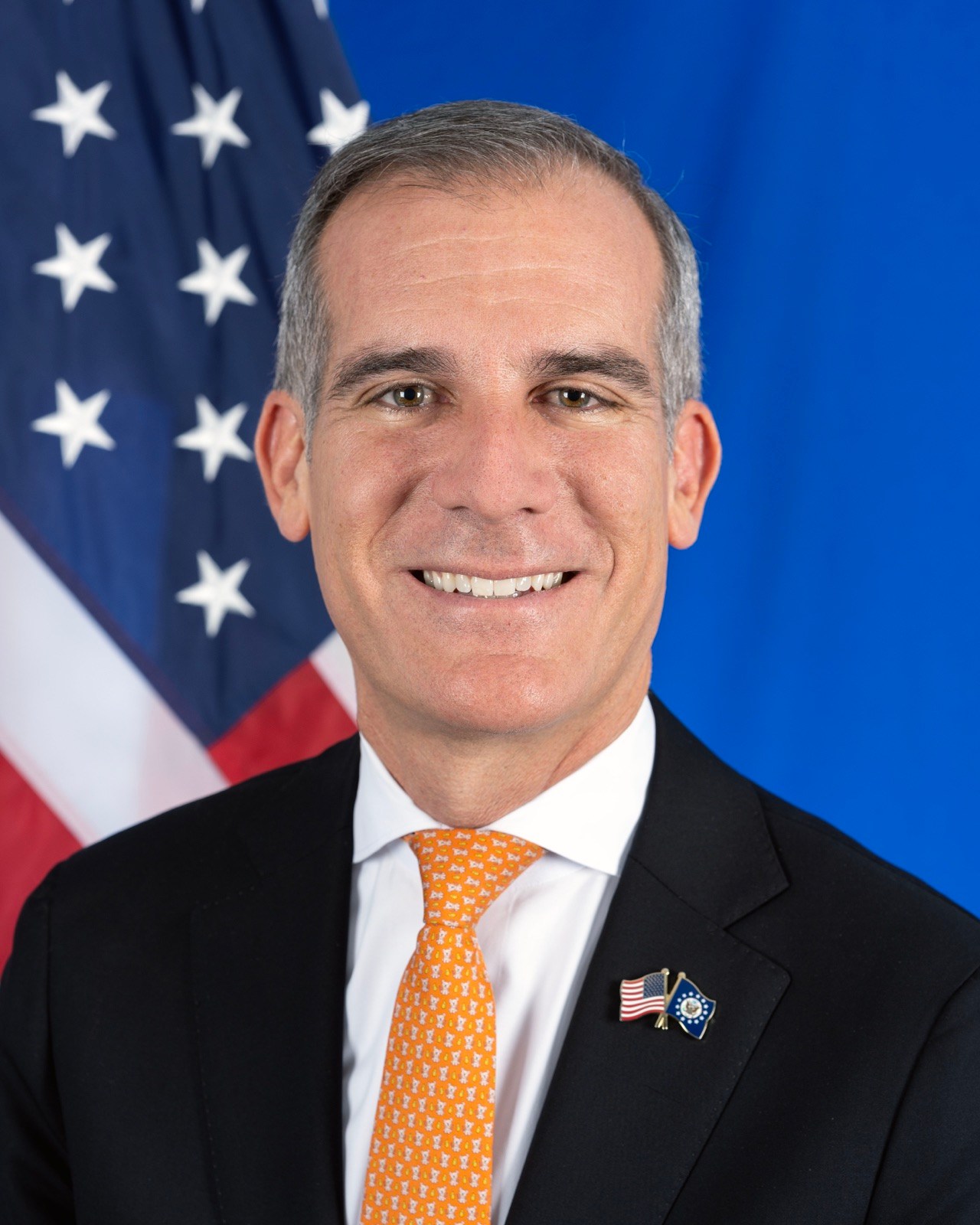
Eric Garcetti
Eric Garcetti is a former Los Angeles Mayor and U.S. Ambassador to India and Ambassador for Global Climate Diplomacy at C40 Cities.
Episode Summary
In this week’s episode One Decision, hosts Christina Ruffini and former MI6 Chief Sir Richard Dearlove sit down with former Los Angeles Mayor and U.S. Ambassador to India Eric Garcetti. Garcetti reflects on his tenure in New Delhi—what he calls America’s “most complex and consequential” diplomatic post—and how the U.S.–India relationship has evolved through conflict, trade wars, and global realignments. From navigating the Trump administration’s tariffs and sanctions to confronting a “murder-for-hire” plot that tested Washington’s trust in New Delhi, Garcetti explains how the two largest democracies can still find common purpose. Plus, Garcetti, who serves as an Ambassador for Global Climate Diplomacy at C40 Cities, argues why the future of global climate action may depend less on nations—and more on cities.
Episode produced by Situation Room Studios. Original music composed and produced by Leo Sidran.
Listen & Subscribe
- Watch on YouTube
- Listen on Apple Podcasts
- Listen on Spotify
Transcript
COLD OPEN
Garcetti: Was a personal rapport. There was a real bromance there. But I said, you know, I think one of the things that President Trump kind of is characterized by, as we've all seen, is sometimes if you're close and a friend, don't be surprised if there's pushback. And if you're an enemy, don't be surprised if there's a hand or even a hug offered. And I think that's what's played out.
INTRODUCTION
Raffini: Hello, welcome to this week's episode of One Decision. I'm Christina Raffini, joined, of course, by my co-host Richard Dearlove. And today, we're gonna be talking to Eric Garcetti, former LA mayor and former US ambassador to India and current C40 ambassador for global climate policy and diplomacy. Mister mayor, mister ambassador, I don't know which of your titles you'd like us call you, but thanks so much for joining us, and thank you both for spanning multiple time zones. So I think we've got LA, DC, and the UK today.
Garcetti: Absolutely. All we're missing is Delhi, but you can call me Eric. It's great to be with you. Thank you so much, Christina and Sir Richard.
INTERVIEW
Dearlove: I well, I'm I'm very interested that I would have thought of of any country you could have chosen to be ambassador. Despite the attractions of India, I did find — maybe this is a bit of a postcolonial comment coming from a Brit — but India was particularly tricky and difficult. I mean, the Indians were not straightforward to deal with. I mean, they were very sensitive about their own, let's say, diplomatic and foreign policy identity, and you really had to struggle to get that right in order to have a fruitful relationship. Ambassador — would you, I'm Eric, sorry — would you agree with that?
Garcetti: It's a great comment, Richard. I think that, you know, one of the things when — because before those three kind of big countries, the President's people reached out and said, hey, do you want to do some other things, some multilateral ambassadorships, anything in Europe? And I talked to a friend who was a long time diplomat. They said, look, you know, it's amazing to be able to be an ambassador in a big European capital, but those are also seen by folks who are foreign policy professionals right now as pretty stable relationships to maintain, to share. They're interesting, but they're not as challenging. And if you want to prove yourself not just as somebody who got a political reward, but actually who could do diplomacy, there was no bigger, better post than Delhi, that it was because of those complexities. Indians are incredible negotiators. You're right. There's the complex kind of echoes of history, colonialism, of the US having supported independence, but then kind of being seen as unreliable in the seventies and eighties, the turnaround in the nineties, and this bipartisan growth that had happened, but still unrealized. They said, look, it's gonna be a place that is challenging to live, challenging to negotiate, challenging to understand. On the flip side, if you do a decent job there, people will understand that this is something that you can do. You can prove yourself, and more than proving yourself, you can do something really important for the world. It's not about just a bilateral relationship between these two large democracies. It is about what they can do together in regional and global relations. And I certainly found that to be such a rewarding part of this job. A third of it maybe was bilateral work, a third of it was regional work, and a third of it was really the US and India working together in the world. And I think that's an evolution from the time maybe when you visited there, to more recently. India is interested in its place in the world. Back then, they were trying to, you know, really stand up the country economically, trying to survive political and material challenges. Now they're seeing themselves really dip their toes into things like the Indian Ocean to protect the freedom of navigation, looking at development work in Africa and Southeast Asia together with the United States when we were there. So I found it to be an amazing kind of evolution, and lastly, a place that America was waking up to. I mean, we had a state dinner for Modi at the White House. We had a visit from the president during G20. We had — it was the number one country that our secretary of treasury went to my first year there. Four times, three times secretary of state, twice our secretary of defense, our intelligence leaders, but also cabinet secretaries like from health and human services, from our highways. I mean, was the hottest place to be. And somebody said, look, if you get one state dinner or a visit from your head of state, your president, during the entire time you are ambassador, that's a good, good run. I had both in the first three months. So it was an amazing moment in history and still is this, I think, incredible springboard that is bigger than the US plus India. I always say it's really a multiplicative relationship if we get this right. It's US times India.
Raffini: Wondering how you see India's place in the world now, even versus four years ago. Because, look, I covered the first Trump administration. I remember Pompeo meeting with his Indian counterparts. I went to India with Pompeo at the tail end of COVID when the city was mostly shut down, but we went anyway. They did see it as an important ally. And, you know, Trump has said flattering things about Modi. I feel like that relationship throughout the Biden administration, they were really trying to make inroads with India. And then all of a sudden, the impact of these tariffs on India have really changed the mindset and all of a sudden it seems they are either vulnerable or interested in maybe allying themselves with some of those other big countries you maybe could have ended up ambassador at, including we are now seeing a closer alliance with China. And I'm wondering what that relationship was like when you were there and how you evaluate it now, because the thing that, you know, it's complicated. They're rivals, but they also can help each other. Tell me how you take that and where you think that relationship is at.
Garcetti: Yeah. I would hesitate to say allies. I think, first of all, India doesn't like the word ally about anybody. Although, maybe that could change in the future, and I think that's a real consideration. But I always said India loves being the prettiest guy, prettiest gal at the dance. Like, everybody wants to dance with us, maybe with the exception of one or two, Pakistan and sometimes China, but, you know, they're very proud of their multilateralism. They work very hard at it and they can open up doors, quite frankly, sometimes we can't, as we can do sometimes with them. And I always say the US and India together can open up basically any door in the world diplomatically. On our own, we can't always do that. But when it comes to the last five or six months — really twenty five years of steady, dramatic bipartisan, bicameral, by-branch consensus in Washington that this was a good thing to deepen our relationship — has hit its first big speed bump. I mean, we had a good opening. We advocated for India's independence. We helped them enact the green revolution to feed their people, establish their research universities, everything until the pivot towards China of Nixon and Kissinger, and then we are really seen as unreliable, even meddling against India, push them towards the Soviet Union for the kind of years from the early seventies until the late nineties. But now, 25, it's gone from Clinton to Bush, from Obama to Trump one to Biden. Trump two, though, is different, and, you know, I remember meeting with prime minister Modi on the way out, and he was very grateful for the personal relationship he had with president Biden, but he also was confident of the relationship he had with Donald Trump, and he was rational to think that good one. I mean, it's the thing that nobody wants to say, but the rhetoric was different. But the foreign policy between Trump one and Biden were just not that different in a lot of places, and I feel like India was one of those places that was pretty consistent. Yeah. And I think it was a personal rapport. There was a real bromance there. Huge rally, you know, in Texas, a huge rally in Gujarat that were record breaking size. But I said, you know, I think one of the things that president Trump kind of is characterized by, as we've all seen, is sometimes if you're close and a friend, don't be surprised if there's pushback. And if you're an enemy, don't be surprised if there's a hand or even a hug offered. And I think that's what's played out around trade, kind of some security issues, the India-Pakistan, you know, most recent border dispute, and then who's claiming credit for having brought about the ceasefire, in this case it was the president, and that's really rankled the Indians who say that this was done in a bilateral way between India-Pakistan, full stop, and so they're kind of under each other's skin. Now I think long term, we are too aligned to not see this progress continue, and I'm optimistic that we can get even a trade deal, that we can kind of see these two leaders come back together. But, you know, Indians like conflict to be primarily done privately, resolved privately, and they're not used to somebody negotiating, in some ways, almost like the Indian government has, where, okay, once there's a deal, I want two more things. And that's what, you know, Trump is, you know, I think very focused on, opening up markets, dealing with the trade deficit between our countries. We're the largest trade partner for India, but for us, you know, India is in the, you know, seventh, eighth, quite far down for us, and we see this deficit, which is mostly from the services that our companies in many ways export to India. But this is a low moment, and when I talk to my friends in India right now in Delhi, people are rankled, people are upset, people are confused. Now that we have an ambassador coming in, Sergio Gor, my successor, who's very close with president Trump, I hope that we can see those waters calm, that we can deal with the issues that have been underneath our growing friendship that have been the tough ones to address, many of which we did with the Biden administration, and reestablish it. It's too important to lose this moment. And the last thing I'll say is with China, I just think that, yes, of course, Modi will go and shake the hand of Xi, but, you know, they lost soldiers in 2019 on the border. They fought three or four border wars with China. There will need to be kind of some cooperation, but they banned TikTok. They were attacked from Chinese actors on their energy infrastructure. So there's a lot of more deep suspicion and I think long term non kind of coordination, non alliance between India and China. They'll look for places to work together, but we're much more aligned for even potentially an alliance in the future.
Dearlove: But, Eric, going for secondary sanctions on India, you know, has been a pretty extreme move on Trump's part, and particularly not doing it simultaneously with China. So, you know, you've got that complex bilateral relationship between China and India, and you pick your friend, as it were, for secondary sanctions. I do think that that is a little bit anomalous. And, I mean, for Modi, it must be very hard for him to explain politically.
Garcetti: Not only anomalous, I think, a self-inflicted wound and a mistake. You know, the — wasn't just the US, but Europe and everybody else — to minimize Russian war profits didn't forbid the buying of Russian oil. We tried to develop a regime in which they would cap the price on that, and that's what India has abided by. So it did what Europe, what the US has asked, only for this president to pull the rug out and say, you're funding the Russian war machine, which was curious from one of Putin's biggest supporters in this country, certainly, and somebody who I think at the time, my read was he was pissed off that Putin kept kind of giving him nothing, so this was a way of getting Putin and also dealing with the ongoing trade negotiations that he wasn't completely satisfied with with India. But it's a self-inflicted wound because it does drive India away, not just leadership, but the Indian street. And one thing I always said was, you know, it went back and forth between Poland and India, sometimes Israel, but the population that was the most pro-US in the world, in poll after poll, is India. And so we have this tremendous goodwill of 1.4 billion people who admire us, who maybe embody — I always said the Indian dream today is kind of what the American dream was once and maybe could be again. We have kind of that same aspirational, make sure your daughter, your son does well, studies hard, you know, it's entrepreneurial. It's channeling the difficulties, but also the, I think, superiority of a democracy and a diverse population. So we have so much in common. Why would we take a gun out, not point it at a friend, but actually point it at our own foot and fire? And that's what I do think these sanctions are, and people are confused. You know, why does China get such good numbers, such a low tariff, and India, who's only been a friend led by a friend of this president, gets, you know, a 50% tariff. That's beguiling to people, I think, on both sides of Indo-Pacific.
Raffini: It's also interesting, I mean, the pushback, which seems like a direct response to that, and this meeting that they had with Putin, leaders of North Korea, Iran, and Modi in this kind of, I guess you call it, like, the anti-quad. Right? Trump said he wasn't going to the quad this year, and instead, you have these four other leaders. What is your assessment of kind of multilateralism in that region? Is the US stepping — if the US continues to step away, we talked about China and India are not allies, but they are the two other largest economies. And although there's not a lot that India makes that China needs, there's a big trade deficit there as well. If they feel like the US is not a reliable ally, either diplomatically or economically, what — you said it's a self-inflicted wound. What do you think the odds are that those two could forge a closer relationship, in lack of help from the US?
Garcetti: Well, you know, I think that it would take a lot of changes, fundamental changes, in the outlook of China, who I think Indians always feel have looked down on India. I mean, literally published maps of Indian states with all Chinese names of the villages. I mean, this is much deeper than just a thawing of relationships and suddenly we're friends. There are territorial claims that go back from, you know, in the Chinese mind that were unfairly drawn, but in the Indian mind have always been Indian, and they don't understand why China — because India really isn't an expansionist power, it's not seeking to conquer new areas or to go global, they want to have what they believe they deserve and should deserve — and don't understand why China not only claims them, but sometimes, you know, violently enacts those assertions on its border and with its people.
Raffini: Wasn't one of those while you were there — wasn't the most latest flare-up cross-border?
Garcetti: No, just before 2019, just before COVID. Yeah. That happened up towards the border between — on the, what I call the east part of what used to be Jammu and Kashmir and has now been split into Ladakh, and now that Ladakh border with Tibet, that's where that flared up. And, you know, nobody fires guns because they know if one side starts firing guns, there will be an all-out war. So it was a brutal physical conflict with clubs and knives and fists and people got beat to death. We don't know how many on both sides. Some say China underplayed its casualties, but there certainly were more than a dozen deaths of Indian soldiers. Wow. I think it'll be some time. I think one thing for India to consider though is how much do they want to reopen their economy to Chinese companies and investment. In the same way that China did with the US in order to understand and learn about the technology, I think a lot of Indian thinkers now are saying, well, they're not our friends, but we shouldn't make them our strict enemies and we should allow that investment to come in. Yes, there's national security concerns, but how are we ever? For instance, India can now make solar panels at a price competitive with China, but all the machines to make solar panels are still predominantly coming out of China and China can throttle that and stop that. So in order to get that, that might mean Chinese companies coming in, solar companies, to establish factories in India. But the benefit would be India would understand how those machines are made, be able to in the future, just as China has done now with cars and other things, have their own domestic technology move forward. So, you know, they always want technology and Indians are incredible with technology in so many ways, but right now the hard manufacturing technology, you know, iPhones have shown — Apple right now is showing just how great a country can be for manufacturing — but that's really assemblage of things that are primarily still manufactured outside of India. And I think it's in all of our interests, US, Europe, the world, to build up a supply chain that is much more diverse than China, and there's no place like India. I mean, when you think about Vietnam, which has done a marvelous job joining those global supply chains, Tamil Nadu, not even one of the biggest and most populous provinces in the south of India, is the same population of all of Vietnam. You know, Uttar Pradesh, which is next to the capital, the largest, most populous, I should say, state, is 230 million people and something a third the size of Texas. So when you're looking at scale, this is a collection in our minds of the populations of many different countries, all in one kind of — they call it a subcontinent, but I always said, imagine if Europe with all of its linguistic, cultural, religious, culinary diversity became a single unitary state and then doubled its population. That is India today. And people say, you mean Western Europe? And I say, the entire population of Europe doubled is India today.
Dearlove: Eric, the other issue which obviously deeply affects India's international relations, you know, is the nuclear issue and the balance between India and Pakistan. I know this is a sort of sensitive subject, but obviously someone with my background spent a lot of time having to worry and think about this problem, both countries not being NPT signatories. And one of the things that we in the UK certainly worried about quite a lot was the fact that in my period in office, you know, Pakistan certainly was in advance of India in terms of their nuclear weapons technology. I suppose my question now, without, you know, going into really sensitive areas, is do you feel that this issue now is sort of balanced and that there is less risk of a nuclear conflict in terms of an escalation if there were another war between India and Pakistan? Because it certainly used to be that Pakistan really had a first strike policy, you know, which was incredibly worrying. I don't think that is the case now. I mean, I'm not as up to date as I used to be, but I think, you know, you don't hear this much discussed internationally at the moment because, you know, we're covering these other issues which are so important. But it's still there in the background, and it's like a sort of massive undiscussed issue which has slightly been pushed to one side.
Garcetti: Well, I'm glad you brought it up because it certainly is a big issue and one that, not only for security, but on the civilian side, nuclear power, which was part of the accords that really changed our diplomatic relationships with India by allowing them to kind of come into the international regime and be a nuclear power, that was a turning point diplomatically. But certainly strategically. My sense is that on both sides of the border that they exercise extreme caution on the nuclear side, that it is for both sides a strong deterrent, and so much has changed too, just the size of the countries, I think the economic power of the countries. India has really taken off, it's stable, its currency is stable, its inflation is stable, and Pakistan has had real challenges. I mean, at certain times, some have said even on the edge of kind of economic and fiscal collapse, so that would be something worrying over on the other side of the border and why I think stability in Pakistan is in everyone's interest, including India's, which was always a tough pill for them to swallow. Why do you still talk to Pakistan? Why are you still friendly with Pakistan? Look, regardless of your feelings of Pakistan in India, I think you of all countries want a stable Pakistan first and foremost because it's a nuclear power right there on your border. And the recent conflict shows, I think, the desire on both sides when we do see violence erupt, how quickly it can be brought down. But you have also on both sides, on the Pakistan side, you know, desperate economic conditions right now, and on the Indian side, very strong, you know, nationalist ideologies that won't allow people to always ratchet down quickly and say, okay, India felt after the terrorist attacks in Kashmir recently that they had to go to what they believed were the sources on the other side of the border. That was with, you know, planes, with missiles, with drones. And those moments are always and should always be scary for the world because of the potential on both sides for there to be nuclear weapons involved. But I think on both sides, you would have to see so much more of a ratcheting up of conflict. And in many ways, it reflects just how stable that relationship has become with the exception of these flare-ups. Now the bigger question is for Modi and I think for Pakistan as well, is there ever a moment to have any sort of rapprochement? And in the early days, Modi, remember, went to Pakistan, there's very few tools left anymore. Trade has been cut off. You know, they're even talking about cutting off water from the Indus River, which I think is logistically quite challenging. It would take years, but that's not the way to win hearts and minds in Pakistan of the people there, certainly from the Indian side. But what can we do to have the folks who really culturally are much more aligned than sometimes they admit — a region that is growing and has such great potential if Pakistan is incorporated into some of the economic growth — and the payoff for India to have a stable border and to finally resolve some of the, you know, lingering terrorist issues that have always been so much more than an irritant, but such a kind of cut to the core of who they are. I would hope that with this peace, with this ceasefire, that this might be a moment of opening up, not a further closing off, because there's really not much more to close off. And in those moments, that's when conflict can become dangerous, nuclear or non.
Raffini: I'm curious, what's your take on Modi? I mean, when was the first time you guys met? I imagine you had to deal with him quite a bit, and I'm just — what kind of a person is he? What do you make of his relationship with Putin? What do you make of his relationship with Trump? Just, like, give us the insider lowdown there.
Garcetti: So the first time I met him, I actually had just been nominated, and I was at the Glasgow COP, the conference of parties for the UN climate conference. And I had been invited as one of three non-national leaders on the stage the first two days to make — when every country was making its pledges. And I was representing the world cities and had built, as chair of C40, the organization I'm still affiliated with, a thousand cities that were pledging to get to net zero by 2050, and that was the equivalent of the fifth largest country in the world making that pledge. Coincidentally, he spoke on stage like two speakers before me. Nobody really was in the halls anymore. It was late COVID, but still COVID. And I just went up to him and in Hindi introduced myself. And I said, I'm Eric Garcetti, and I'm gonna be the next ambassador from the United States. And we had a great interaction. You know? You never know.
Raffini: Wait. Can we hear it in Hindi? I wanna hear it in Hindi.
Garcetti: I said, which is, you know, my name is Eric Garcetti and I'm an American ambassador. And he kind of had this look of like, oh, okay. Yeah. You're that guy. And then I didn't see him, you know, till I got on the ground a little while later. I interacted with him quite a bit often, you know, with president Biden, with, you know, our intelligence or foreign policy or defense leaders. He's somebody who has a real in-person skill at being very warm, at being kind of humble and telling you what you're doing great, you know, focusing on one's family. So he kind of has those natural political skills that you can understand why so many Indians embrace him kind of as his father figure. I think he's, you know, somebody who always likes having a bright new idea that's different, so he's not kind of programmable. I think he's one of those politicians who's like, I got here on my own when people never would have thought I would have. I came from a humble background. He and president Biden, I think, bonded on that. They both came from very working class backgrounds. You know, on the other hand, you can see some of the policies that he has done that have made it more difficult for some of the minority groups, especially Muslims in India. There was a check on, I think, the success he's had recently in this last election where he lost a clear majority from his party.
Raffini: Even some of his grassroots, since he came to office, right, that they don't have the majority?
Garcetti: And some of his own grassroots supporters were like, let's cut the anti-Muslim rhetoric. It's not working. That's not what you should do. And, you know, they've been very effective at kind of consolidating power using that, a lot less freedom of the press, you know, rankling. And I think, Sir Richard, you alluded to this, Indians have never loved criticism from the outside in or the inside out. And I often would say to my Indian friends, like, it's okay. I was mayor. I got criticized all the time. And you have to deal with it. That's part of democracy and don't take it personally and keep going forward and show through actions how you can lead a constituency. And I do think that there is really a desire to have fewer voices of dissent, fewer voices of opposition, but I would never bet against Indian democracy. As charming as Modi is, popular as he is to the average Indian, Indians — you take their democracy seriously. They don't just blindly, you know, ally themselves with one party. They might have voted last week for one party, but this election, they say, tell me what each party you're gonna do. So they really are small-d democrats in the truest sense. They're transactional in a good way because that's what democracy should be, not just fighting one team always blindly, but really saying this is what I want. And so Modi has to contend with that. BJP has to contend with that. A post-Modi era one day will be able to rely, I think, on the skills that he has, but will have to be about the material improvements. And you see democracy alive and well, a lot of opposition parties running states that are the size of countries. And so those narratives that say Indian democracy is going down the tube — I think there are strong human rights concerns we should all look at, but that's really for Indians to change. But on the other hand, it is not going to become some sort of dictatorship either. It is a place that democracy is embraced at the village level, at the state level, and at the national level by so many.
Dearlove: Given the situation now bilaterally with the Trump administration, do you think that the relationship with RAW, the research and analysis wing, and the IB, which are the two primary agencies — which I think my understanding was that the US got on extremely well in these areas of India, generally speaking. I mean, I would imagine now that's become pretty stressed and difficult, or would it have survived anyway?
Garcetti: Yeah. So, you know, the last 25 have included, I think, real growth in collaboration, cooperation, intelligence sharing, as has been reported between our countries, in moments of conflict, such as when we had that conflict in Ladakh, Galwan conflict between China and India, in looking at global relations, everything from, you know, what happens in the region or even dealing with things like the Ukraine conflict or Gaza or Iran. I think there's a willingness to really look at where we're aligned and try to share information in a positive way to move resolutions forward. I think that there is more military cooperation. Now India's number one military partner for exercises is the United States. We've gone from zero in kind of military sales to billions, tens of billions of dollars in integration of technologies and space and other areas as well. But I think the intelligence, the human side of things, witnessed a very close relationship between the major players. It was uncovered that there was a murder-for-hire contract put out on an American citizen by somebody that then was found to be linked to a RAW officer, and that trial is going on right now in New York. And I think that was a little bit of a shock to the system. I always said it was an amazing metaphor. I think this was in the middle — it was just after the visit of prime minister Modi to Washington that we learned about the potential link to a RAW officer who was directing this individual to try to murder a US citizen who was critical of India, was a nationalist, a Sikh nationalist who often kind of provokes Indian leaders. And remember in Canada, there had been somebody who was murdered and the Canadians have accused Indian intelligence of being involved in that separate matter, which I'm not speaking about specifically. And I think that was really challenging because here, then we had the president visiting and it was clear to us from the president on down, this was a red line that cannot be crossed. The idea — you know, if a Russia or somebody was trying to assassinate somebody on American soil, it would be abhorrent, but not surprising. When it comes from a friend like India, whether it was a rogue agent or whether it was connected to something higher up, that was a red line that was absolutely unacceptable. We thwarted it luckily, so this individual is still alive. But also, we wanna make sure there's accountability that this would never happen again, and that this didn't threaten the relationship we have on so many other important fronts. And I always say, like, the test of a marriage isn't whether you love each other, but can you get through the first big fight? And in many ways, this was one of the first big fights in this growing relationship. And I think it was handled appropriately. The Indians, you know, so far had cooperated in the investigation and said that there would be accountability for this. You know, whether that will happen or not will remain in the courts and also in the Indian system itself, but it was also a test of our resilience, and I think the resilience really shone through that Indians, many who were upset when they found out about this, leaders I talked to and weren't involved in any way said, this is a stupid thing for us to do, off the record, to even think about doing, and for Americans, this was a moment of saying, look, this could be a moment when we cut everything off, but there's too much important work that we're doing, so we're not gonna lose our values, we're gonna push forward accountability, but simultaneously we're not going to lose the momentum in everything else that we're doing. And I think that reflects where we are in our intelligence agencies, in our kind of diplomacy, and also how to deal with a thorny problem that I think for most people, when a nation does something that another nation doesn't like, they think there's only a unitary response. And this showed us a way of being able to be accountable there, but also to not stop our work on climate together, not stop our work on developing vaccines that will save lives in Africa together, not stop our work on developing new energy technologies that are critical and working on supply chain. If we held one hostage, or one thing held all those hostage, it would hurt the entire world. It would hurt the US. It would hurt India. And I'm glad that we got through this so far. Of course, some more steps to go.
CLIMATE AND ENERGY
Raffini: Alright. So speaking about climate and climate change. You know, I feel like it was all-encompassing. It was everywhere. It was all everybody was talking about. And I sometimes forget how influential the leadership of the US is on an issue like this. Because in with the lack of leadership coming out of Washington, I've noticed it just kind of dim and, like, lose momentum. Is that true other places? Or is it harder to get funding? Is it harder to get attention? Because I just was listening, because I'm a giant nerd, to a deep dive on energy this morning, and they were talking about how China and India are now getting more energy from renewables than from coal, and the US and Europe are actually the only places that are still getting most of their energy from fossil fuels, from coal. What does that say to you about where this conversation is going? Has the US and Europe kind of lost momentum, and do you think Asia will pick it up?
Garcetti: Well, climate is not the prettiest girl or guy at the dance anymore, politically, but I think that it's inevitable, the march forward of where we need to be, and it's up to the United States leadership right now — for Europe as well — to decide whether not only will that progress continue and be accelerated, but also will the green jobs of the future be in Europe, be in the United States, or will they be solely in China and maybe even in India? You know, it's like giving away tomorrow's oil because today we can't see past our noses. And I would say in the United States, climate work is very much alive. Here in California, my state, for instance, last summer, we had for the first time a 100% renewable energy for our grid. Not only was solar the number one source, number two was energy storage. Battery storage was the number two above, you know, obviously coal, which we don't have anymore in the state, but above natural gas, above nuclear and anything else. So I think it's inevitable, the progress, but my message as ambassador representing all the cities of the world and working together with the states and regions of the world to represent that subnational level is nations are primarily kind of failing to meet their own science and their own commitments. The Paris science demands, you know, certain progress, and only one country is on track to meet those benchmarks, Denmark. But when you look at the 100 largest cities, who are part of C40, ninety-seven cities to be exact right now, over three quarters of them are not only ahead of their nations, over three quarters of them are on track to meet the science of Paris. So if you're thinking the world is failing, just look to the cities of the world where you'll be inspired and trust me, cities are as complex as nations. I had to run my own electricity grid. We own the largest municipal utility in Los Angeles when I was mayor. We see people who run transportation networks, do building codes for green buildings or not green buildings. We look at the way that people emit by the zoning of the sorts of factories and the power that powers those factories around the world. And we represent about 24% of the GDP of the world, just those — sorry, 100 cities. And if we can get there and be even ahead of schedule, my message is not only is it alive and well in America, it's alive and well globally. Where there is failure is communicating any victories, and we're only halfway there. If we think we're going to coast to victory, that's not going to happen. And by the way, in America, it's not just blue states. The most wind is coming out of Iowa as a percentage. Right now, one of the largest oil basins in the world in Texas is being decarbonized by Republican leaders primarily through solar power. The question is do we want those solar cells only to come from one country, China, or will America and other countries invest in diversifying that? You look at electric cars — I've been an EV driver since 1998 — that are the future, will be the future, and you can put your head in the sand and say, I'm gonna have a gas car for the next fifty years, but that just simply isn't the truth and you won't have any auto workers in a couple decades. So my message is get with this program, America is absolutely still in. But you're right to say there's a lot of people who are retreating from talking about it, retreating from investing in it, and at the same time when that happens, there are plenty of other people in the world who will make those investments, and the future, let's not let them.
Dearlove: Can I briefly push back a little bit? Because, you know, we are an important zero carbon country in the UK with a lot of renewables, or with a very ambitious program. But on the other hand, the short term or medium term effect is that we have the highest electricity prices, certainly in Europe, and I think amongst the highest in the world. There are very big problems. If you look at renewables as you've spoken about them — I agree with everything you said, it looks phenomenally attractive. When you get down to the practical questions, for example, we're paying energy companies not to put renewables into the grid when there's an excess because of the problems of distribution through the grid. So here in the UK, there really is a massive expense being carried by the consumer to accelerate this journey to zero carbon. You know, we're heading for a really 2030 date, which to many of us seems not really practical. It's too early. I mean, do you — does this sort of debate affect your city alliance? Or, I mean, I think in California, for example, you have many advantages because the sun shines a lot longer and there are, you know, various other issues.
Garcetti: Absolutely. Look, there's a short term cost and the long term costs have to both be assessed. There is a long term cost of living cheaply in the short term. I do think politicians need to figure out a way to help the average person get through that transition, need to directly subsidize bills that can bring down and not shock a family barely surviving. That family will pay more and their kids and their children will pay more, not just in health costs, but ultimately in energy costs, if this transition isn't made. Jobs will be left on the table. They won't even have jobs to go to. There won't be the sort of, you know, manufacturing and energy and other related jobs, auto manufacturing, etcetera, if we don't make those transitions. But you're right. You've, you know — in California, there was a lot of talk like this about ten, fifteen years ago. We can't afford this. And now when I was at the UN, for New York Climate Week a couple weeks ago, a great line was said by somebody. There's not a single country that has looked back and went too fast. When you look at the winners right now, it's everybody who went faster and that future is there to be claimed. So absolutely you can make a short term cost analysis and say, it is hurting people today. And then you have to answer ten and twenty years from now why my country has no jobs, why the health concerns are there, and why we lost that future when we could have won it. And so to me, it's more of a micro issue of figuring out within budgets how to help people during this transition. And we're seeing time and time again that this energy is cheaper. It is cheaper than the legacy fossil fuels. I mean, the cleanup of a single — here in Los Angeles, we have the largest urban oil field in the world. A quarter of the world's oil in the 1920s came from Los Angeles, of the world's oil. To cap single wells here sometimes costs $5 million, $10 million for a single well, and we've got hundreds of them. So that has to be paid by taxpayers also. Might not be on your power bill, but it's going to be somehow in the taxes you pay. And so the quicker we can figure out a way to wean ourselves off of fossil fuels, the dependency is there. Look at China. There's been great articles this week about the high voltage power system that China is putting everywhere, and it's gonna be the first kind of electricity driven economy. I don't think China is dumb. I think China is very strategic and smart about that future, and we can continue living in the past, but we shouldn't let those short term costs keep us from the long term low cost benefits.
CLOSING
Raffini: Before we let you go, we do generally like to ask our guests at least one embarrassing diplomatic story. I don't know if your team warns you. Well, I mean, you could have your pick. Sometimes we ask what's the worst diplomatic meal you've ever been served. What's the most awkward introduction? Does something come to mind that you just wanted to leave your body and exist somewhere else? What is the most awkward moment of your time either as ambassador or a mayor or any of the many jobs that you've had?
Garcetti: I've had so many fun, rich ones. I think, you know, the most embarrassing one for me was when in ice hockey, the Los Angeles Kings won the Stanley Cup, which is the highest kind of — in North American hockey, the highest accolade. And hockey fans are really gruff, right? I mean, they like their beer, they like their celebration, their—
Raffini: They're enthusiastic. Yes. Enthusiastic.
Garcetti: And I love going to a hockey game. But I knew as a newly elected mayor — they had won two years before and the players had gotten drunk during the parade and dropped some f-bombs and stuff like that. So they were told by their ownership, you cannot get drunk. You cannot swear. And one of the cardinal rules in politics is never be introduced at a sporting event if you're a politician. Even if you're at 99% approval ratings, people don't want politics in sports. It's true. You know, Jerry Brown's father passed that on to him and he wanted to pass that on to me, our former governor, and boos are much louder than claps. So here we were after the parade in our arena called Staples Center downtown Los Angeles at the time. Fans everywhere, they're all rowdy, players behind me, they say, ladies and gentlemen, the new mayor of the city of Los Angeles, Eric Garcetti. It was, boo. You know, it was like the place erupted in boos, and I said, wait a second. I've only just gotten here. And they kinda quieted down, and there was some clapping, but you couldn't really hear it. And I said there's two cardinal rules in politics. One is never be pictured with a drink in your hand, and two is never swear. Then I leaned down and I prepositioned a beer, Bud Light, who was sponsoring, I said, but this is a big effing day, but I didn't say effing. I dropped an f-bomb. This is a big fucking day. And the place just lit up. The hockey players gave me a standing ovation and high fives. The whole place started to clap. What I didn't realize is it was live on television. And so I think the embarrassing moment was suddenly — and it's kinda quaint now when everybody seems to swear in hearings, congressional hearings, and, like, we've lost any propriety. And I had all these cameras later that day saying, was that the right thing for a mayor to be saying? There's kids watching, blah blah blah. And I said, no. I apologize. Kids, don't swear. Certainly don't swear on camera. But if you do, do it like your mayor did. Use it positively. Don't use the f-bomb negatively, but use it to show your enthusiasm. And that was probably — my wife was not so pleased when I came home that night, but in retrospect, the hockey vote always stayed with me.
Raffini: Thank you both so much for being with us. Richard, of course, as usual, and Eric Garcetti, former LA mayor, US ambassador to India, and current C40 ambassador for global climate diplomacy. That was this week's episode of One Decision. For more content and conversations with leading decision makers and thinkers, please check out 1decision.com, go on our YouTube page, or hey, leave us a rating, make a comment. We're here to listen. I'm Christina Raffini. Once again, thanks for listening.