Hosted by Christina Ruffini and Sir Richard Dearlove
Guest
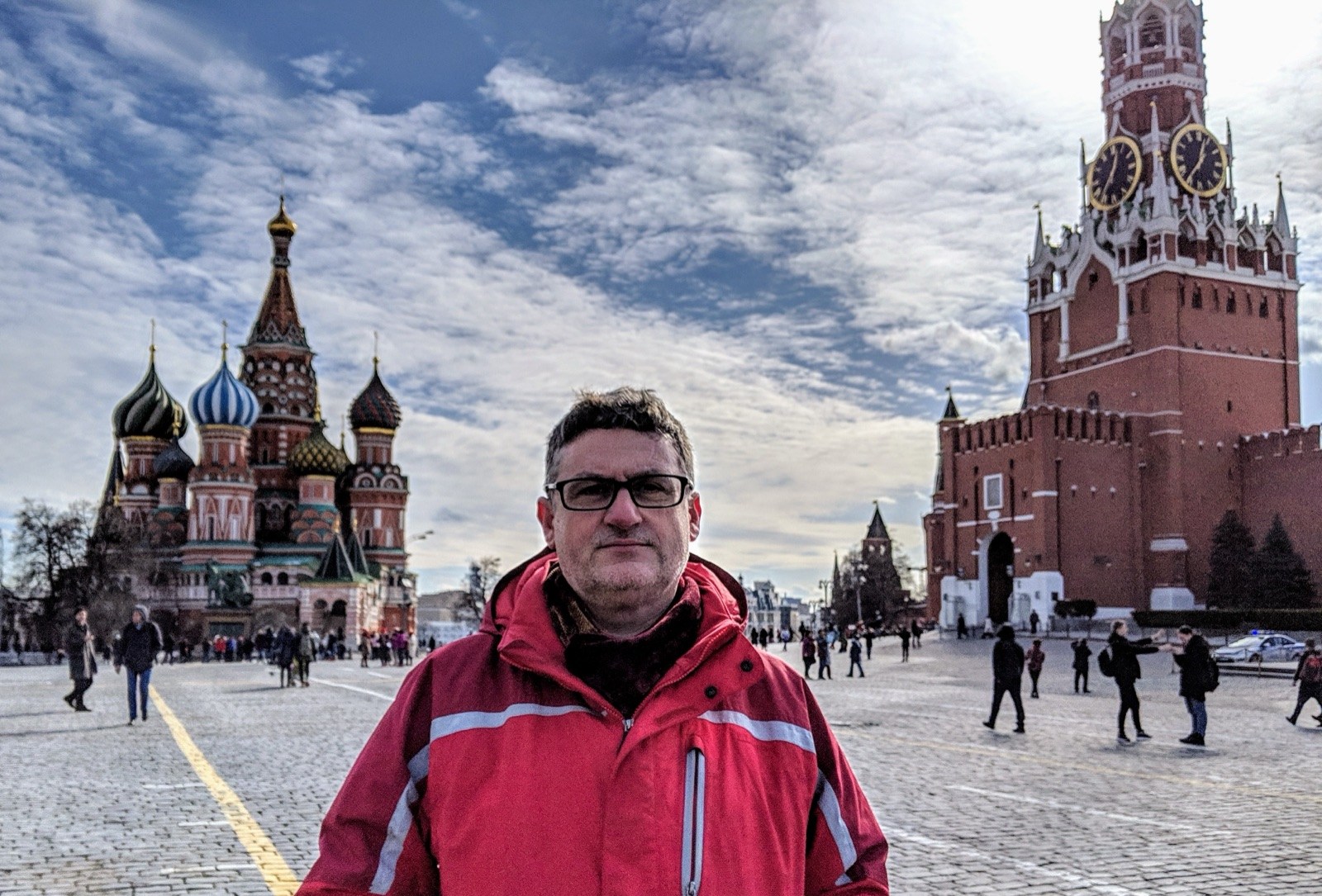
Mark Galeotti
Mark Galeotti is a Russian military scholar.
Episode Summary
This week on One Decision, hosts Kate McCann and former MI6 Chief Sir Richard Dearlove sit down with Russian military scholar Mark Galeotti to examine a war that’s reshaping not only Russia—but the West itself. Galeotti describes how Vladimir Putin, convinced he’s winning, is “burning through Russia’s future” to sustain a failing war. He warns that Europe, which has long sheltered under the American security umbrella, must now take its own defense seriously “if it wants to be taken seriously” and prepare for the unpredictable reality of a post-Putin Russia.
Episode produced by Situation Room Studios. Original music composed and produced by Leo Sidran.
Listen & Subscribe
- Watch on YouTube
- Listen on Apple Podcasts
- Listen on Spotify
Transcript
COLD OPEN
Galeotti: Putin's attempts to appeal to patriotism and national glory are pretty threadbare, and most Russians don't really buy it. So I think in the long term, this will prove to have been quite a catastrophic experience.
INTRODUCTION
Mccann: Hello and welcome to One Decision. I'm Kate McCann and I'm joined by my co-host Sir Richard Dearlove. Hi Sir Richard.
Dearlove: Hi Kate, how are you?
Mccann: Well, thank you. Great to have you with us. In today's episode, we're speaking to Mark Galeotti. He's an acclaimed author, an expert on the Russian military, and he's the executive director of the Mayak Intelligence Consultancy and an honorary professor at the University College London. We spoke about everything from what happens after Putin to how and when and whether one side or the other can really win this war. We'll get into all of that and plenty more on the episode today. Well, Mark Galeotti, welcome to One Decision. Great to have you with us.
INTERVIEW
Galeotti: Oh, good to be here.
Mccann: I'm going to start with the biggest question, the difficult one. What is going on inside Putin's head? What do you think he sees as the end game here?
Galeotti: Yeah, I mean that's always the difficult one because obviously he doesn't really tell us and the people around him on the whole don't tell us candid things. I think based on his actions, I think what does seem clear is that this is a man who genuinely believes that Russia is winning in Ukraine. We may well challenge that perspective, but nonetheless, I think that that's his view and clearly it is being supported by all kinds of sort of yes men and cronies around him.
Mccann: I'm interested that you say that he thinks or he believes that he is winning the war. What is the truth at the moment as you see it on the ground?
Galeotti: I mean, it's a glib response, but I would say both sides are losing, but I think the Ukrainians are losing more quickly. You know, I think we can often focus on the damage being done to one side or another. Clearly the Russians have taken much greater casualties, but they're at the moment at least willing and able to absorb those casualties and still find more men to throw into the battle. This isn't really a war that can be defined simply in terms of how many square miles have been taken this week or this month. That's not how wars tend to be fought. Wars are won by breaking the capacity and the will of the enemy to resist. And although the Ukrainians have shown extraordinary determination and courage in their struggle. As we look at the way the Russians are pounding their energy supplies, as we look at the troubles Ukrainians are having recruiting enough troops to man the front line. You know, as I say, it's not that actually I would say that the Russians are winning, but I think the Ukrainians in the medium term seem to be suffering them all.
Dearlove: Mark, we know what the war is doing to Ukraine more or less, but what actually is the war doing to Russia? And I don't necessarily mean in the short term, but in the medium to longer term, particularly to Russia's, let's say, overall economic position.
Galeotti: Yeah, this is the thing. I mean, I think that really when the historians get to write their accounts in fifty or a hundred years time, I mean, the degree to which Putin has committed himself to basically burning through Russia's future in the name of this imperial war is going to be very striking. We can see that, for example, Russia is industrializing in some ways, de-industrializing in others. As more and more resources go into the defense industrial complex, we're seeing the civilian sector suffering. We're seeing a grinding away at the reserves. And when I say reserves, I don't just simply mean those of the government, they are sort of suffering, but also just the reserves of companies and ordinary Russian families whose savings are dwindling as they have to pay higher and higher food and other prices. And of course, it is increasingly becoming, I wouldn't say a vassal state of China. That is the fear of many within the system. But on the other hand, increasingly dependent upon the Chinese economy and therefore subject to Chinese influence in the longer term. And finally, I mean, if one looks at the Russian people, it's not just that there's a demographic crisis affected by over a million dead and wounded. And God knows what chaos will come when soldiers eventually return from the front lines. But it's also a fact that the social contract has been broken. Putin essentially had based his regime on a deal that more or less said, you stay out of politics, you let us run the country and of course, embezzle hand over fist, but you too will have a steadily improving quality of life. And after all the chaos and misery of late Soviet times in the 1990s, a lot of Russians were willing to accept that deal. Well, no one really believes that that is going to return. And Putin's attempts to appeal to patriotism and national glory are pretty threadbare and most Russians don't really buy it. So I think in the long term, it will prove to have been quite a catastrophic experience. The trouble is that in the short term, essentially authoritarian regimes can ride over that. They can allocate resources a lot more freely to the things that matter to them. They can control public dissatisfaction with repression and so forth. So in some ways it's bearable in the short term, but really debilitating in the longer term.
Mccann: I want to ask you about stability, sort of political stability and how people actually feel in Russia in just a moment, but to pick up on the economic point, some people seem to differ on this. Is Russia reliant on the war economically? Or is the war doing economic damage? I mean, some people say it's in such a cycle now that actually Russia needs the war to continue to keep the economy stable. What's your view?
Galeotti: I mean, my view is that it is possible to demilitarize the economy. What is not possible is to do it quickly. I mean, if the war ended next Wednesday and wouldn't it be lovely if it did? And then the Russians decided, right, that's it. We're not going to be spending any fraction of the resources on the military. That would be catastrophic because precisely so much of the economy and so much of employment is now based within the defense sector and companies that depend on that. But the point is that's not going to happen because if nothing else, Putin is going to want to rebuild his shattered military after the war. So, you know, there will be, if the Russians manage it well, and to be perfectly honest, Russia has demonstrated that it has catastrophically bad political leadership, but depressingly competent technocrats actually trying to do their best in that political context. You know, if they're given their head, then they can actually wean Russia to a degree off that defense industrial complex over time. So, yeah, it's one of these complex ones and it all depends on the decision, you know, as with all, almost all of these issues, depends on the political decisions that are made. But I don't think it's a reason why Putin is going to continue to fight the war just because he's afraid of what happens to the economy, not least because Putin, he's by no means a communist, quite the opposite. He sort of presides over this sort of rapacious free market kleptocracy. But nonetheless, he has an almost Bolshevik approach to the economy. He thinks that ultimately political leadership can shape the economy to its will when in fact we know that it's more often the other way around.
Dearlove: Mark, if you look at the sort of state of the Russian military, I mean, what I find surprising, you know, apart from the sort of gerontocracy of this world who supposedly are loyal to Putin. There must be an awful lot of generals sitting there very, very discontented and unhappy, and yet we see no expression of this at all. I mean, compare the situation recently in China where Xi Jinping has just chucked out, I don't know, fifteen, twenty senior people out of the People's Liberation Army. You don't see any of these strains and political stresses apparently from the outside inside the Russian military, but they must be in a pretty desperate state.
Galeotti: They are, but I think that, you know, one mustn't underestimate the gut level patriotism that Russians, like most people, have when it comes down to it. They can regard this as a stupid war. They can feel that their political leader and indeed senior military leadership is fighting a stupid war in a stupid way. But when it comes down to it, who would you rather win, your country or the enemy? And I think this is really the same dilemma that faces so many ordinary Russians that this wasn't a war that they wanted, but once they're in it, they would rather win it than lose it. And really the best illustration I think of these tensions is what happened when a couple of years back, we had the mercenary commander Prigozhin launch his short lived, much like Prigozhin, mutiny. And what we saw was, you know, it was really, it was just a couple of thousand troops who were marching towards Moscow. And yet they were able to do that. Now Prigozhin had anticipated that soldiers would flock to his banner and they didn't, I think in total about 90 did, but more to the point, no one really was in any hurry to actually try and stop him. If this was a vote of confidence, essentially everyone abstained. And I know for a fact, for example, that on the crucial Saturday of the mutiny, the commander of the national guard, which is this internal paramilitary formation, was basically on the phone all day, trying to get through to local commanders along the route of march to get them to do something, to try and stop the mutineers. And local commanders were doing everything they could not to be contactable so that they couldn't be given orders that they would then have to either obey or defy. So I think this is the interesting situation here is that I don't see at the moment any kind of groundswell of people saying, well, we must topple the regime. We must bring down Putin or whatever. But on the other hand, if someone else does it, I can't help but feel that a lot of people would be thinking, oh, well, I'm glad that happened. And it's a very difficult thing to want to preserve your country, even while you're unhappy with the particular regime in charge.
Mccann: Do you think there's a chance that when the war is over and I say when, I know a lot of people say if, but if and when the war is over, that there is the potential that that could happen, that Putin could be removed, that there could be a significant shift in the way that regime works in Russia. Is that likely?
Galeotti: Well, it's always the thing that actually regimes tend to be at their most vulnerable when they either try to reform or precisely when pressures are lifted off them. In part because people feel they have more freedom of maneuver, in part because often the people in charge kind of take their eye off the ball because they feel that they've sort of won, that they've got through that moment. And it is a when, I mean, war will eventually end if nothing else, exhaustion will do what peacemaking doesn't. But you know, when it ends, at some point they will have to, for example, let the soldiers come home. And the overwhelming majority of the soldiers currently fighting are volunteers on contracts that basically say they're serving to the end of the special military operation. Now, when the war ends, there might be some attempt to try and redefine what that means or get more of them to enlist in the regular military, whatever. But basically I imagine most of them kind of want to go home. And frankly, in due course, the state will have to let them go home. You don't have hundreds of thousands of very angry, very armed men suddenly on your border. Well, you know, at this point, then in a way you get a lot of truth about the war coming home. You get a lot of disruption. You get the whole issue about what happens to the economy. I mean, at the moment wages are pretty high because it's a tight labor market because there's so many people who are needed and yet who are currently fighting or whatever else. You have people coming back who got used to being paid something like three and a half times the average salary, who are now going to be expected to go back to being farm workers or tractor drivers or factory workers or whatever else. Now I think there's going to be a period of massive disruption. And that does create the potential. And let me stress no more than potential for the kind of black swan incident, which could actually challenge the regime. You know, for example, if one gets an economic collapse in one region that might well sort of act domino style across others, or if you get a particular major protest and if the security forces refuse to actually put it down, that's the kind of thing that can expel. Now, you know, I really don't want to say that this is me predicting that that's what's going to happen. I mean, I do think this is within the realms of the amply possible. And it's certainly something that is being discussed within the Russian security community in that they are concerned about the level of protest potential that at present is diffuse and controlled, but could easily emerge once that pressure comes off.
Dearlove: It sounds a bit like 1917 historically.
Galeotti: Well, I mean, I do think there are some interesting parallels, you know, again, the usual sort of challenges with using history as a predictive tool. It's not. But nonetheless, even the issue of mutinies, I mean, if one looks at what happened in 1917, the Russian army at the beginning of that year was actually in a rather better state than it had been for a while. You know, in purely military terms, it could have once again, I think taken the offensive rather more effectively, but mutinies hit and because they weren't controlled quickly enough, they spread. And suddenly before you know it, your entire army is basically melting away. Well, again, I don't anticipate that happening in the midst of this wartime situation. But again, if we think about what could happen when the fighting ends, I can imagine a lot of people just simply thinking, no, I'm just going home. You know, no one can stop me when there's a thousand of us doing it at the same time. And that is incredibly corrosive to the authority of the state, which really is now based on its capacity to deploy violence.
Dearlove: If not Putin, who? That's always the big question.
Galeotti: The honest answer is I have no idea, because it depends not least on when it happens and how it happens. You know, if Putin doesn't wake up tomorrow, we have a pretty good sense of who the runners and riders are. None of whom will be in the position just to step into his shoes. I think we're going to see a situation in many ways, like what happened when Stalin died, when you actually have a whole variety of different interest groups and individuals jockeying for power, but having to basically build coalitions precisely in order to be able to take over. And that's, in my opinion, a good thing because coalitions tend to drag politics away from the extremes. But that's assuming it's unexpected and it's now, you know, it could be conceivably that it's a managed transition. So far at least Putin clearly doesn't want even the idea of succession to be seriously discussed, because he still clings to this idea of, as one of his sycophants put it, no Putin, no Russia. And he knows that as soon as, given that he's 73 now, as soon as he has an anointed heir, he becomes to a degree, not so much a lame duck as a lame dictator. So it's a question of when it happens. And I think that all we can really say, as I said, it's going to be a jump down in terms of the political generation. It's not going to be another 70 year old. It's going to be the 50 and the 60 something year olds who are already thinking as Russia becomes, instead of a gerontocracy, when is it going to be our turn? Who are frankly not so ideological. They're not so scarred by the end of the Soviet Union and that sense of, you know, who took grandeur from us, who are basically opportunist kleptocrats. Not nice people, but a rather different kind of leader. But as I say, I think at the moment we can throw out names, but this is the kind of thing which everyone wants to make it very, very clear that they are not in the running for, because it will be very, very dangerous in the current environment to be talked about as a potential heir.
Dearlove: That's probably a very good point. Transfers of power in Russia, they have always been chaotic. I mean, given that there is no mechanism, no structure. And, you know, if you're looking at Putin's regime, you can't construct a scenario without having some understanding of what's going to happen, and it probably would be violent or it would be at least haphazard, let's say. Apart from what we've discussed, are there other circumstances that might trigger this? Because, I mean, the whole thing is so brittle. It doesn't have any flex. I mean, either Putin's there or he's not.
Galeotti: Yeah, absolutely. And I think in this respect and this respect only, we might kind of find ourselves missing the Communist Party of the Soviet Union. Because at least back in the CPSU days, you know, there were structures, there were understandings, there were bodies of real power, the politburo, central committee, there were all the rules. Now, yes, of course, there's a constitution that says if the president dies in office, then the prime minister becomes acting president, blah, blah, blah. But in practice, these are so weak as institutions that they don't constrain anyone. I mean, I think the issue of armed forces, I'm not necessarily assuming that it's going to have to be a kind of a violent contestation, but it's going to be one of those issues in which whoever is trying to assemble a winning coalition has to be able to demonstrate that they have the siloviki, the men of force, or at least a significant portion of them on side. You know, frankly, all the other bodies can be subordinated. If you have the army properly sort of unified and also a credible political position, then you're probably in a good position. But if the army is, as it quite likely divided amongst different arms of service, different charismatic leaders and so forth, given that there are also other militarized forces in Russia, the whole arithmetic of power can get very, very messy. I mean, I'm hoping that it's not violent. But then again, my hopes don't really tend to have much sway in Russia these days, considering I was banned from there in 2022. But on the other hand, I think that the issue of avoiding a real conflagration, I think would be great. One thing that all the figures within the elite share is a desire not to find themselves all hanging from lampposts around Red Square, which is why I think we may well find again, drawing the parallel with Stalin. If for example, Putin doesn't wake up one morning, it may well not be announced. We might well have an attempt to establish a fait accompli politically before they even announce that the old boss is dead. Welcome to the new boss.
Mccann: Before we move on, what got you banned?
Galeotti: Oh, I mean, well, the official line is that my deep and abiding Russophobia and my sort of peddling of lies about the special military operation. I mean, look, given that I was in the first batch of Brits who were banned, I would love to, and I'm sure if I was more marketing savvy, I would claim that, you know, I'm the man Putin fears. In practice, it was probably some junior desk officer at the foreign ministry, who was told, put together a list of 26 or whatever it is, sort of snotty and annoying Brits, because we need to have some kind of tit for tat banning. And that's how I happened to get on it. But no, I mean, this is the trouble. And once you're on these lists, it's a lot easier on them than off them. So I'm reckoning that I'm going to have to outlive Putin before I return. I do feel I have numbers on my side.
Mccann: Does it worry you? I mean, presumably the ban is that you can't go there, but does it worry you in a broader sense being on this list?
Galeotti: No. I'm not important enough to need to be worried. And the thing about Putin is he has this odd distinction between enemies and traitors. Enemies you struggle with and yet you hope someday that you can reach some kind of modus vivendi with them. Traitors you can do nothing with but kill, because otherwise one day they will try and stab you in the back. Which is why, for example, you know, one can look at Litvinenko, one can look at Skripal, and we can look frankly at the extraordinary brutality being levied on the Ukrainians, which we didn't see in the admittedly much smaller wars in Georgia, for example. Because there is, as far as Putin's concerned, remember Putin's a man who doesn't really believe Ukraine exists. So the Ukrainians are not a real people. You know? Half of them are Russians who don't know it, and half of them are Poles who don't know it in his kind of cosmology. So as far as he's concerned, the Ukrainians betrayed Russia by trying to break away and sort of move closer to the West. So it's traitors that he has his particular animus for, not an enemy like myself.
TACTICS ON THE GROUND
Mccann: Should we talk a little bit about what is going on in terms of, because you mentioned the way that Putin feels about Ukrainians. Should we talk a little bit about the tactics on the ground and what kind of weapons and targets we're seeing at the moment? I mean, a lot of the press that we see coming out of Ukraine is civilian targeting at the moment. There seems to be a sort of fresh round of that going on. On the Ukrainian side, there's been some attempt to hit Russian facilities, Russian oil facilities, I think, Russian sort of energy sites with some success. What is your assessment of Russia's current strategy when it comes to this war in Ukraine on the ground?
Galeotti: Yeah, I think it's really sort of two layer, literally in many ways, because in the air, precisely, you have this very heavy campaign targeting Ukrainian energy systems. That's really what they're going for before the winter when obviously things get cold and everyone needs electricity or gas. They're hitting power plants, they're hitting transformer stations, they're hitting power lines, etcetera. So this is an attempt to really bring the war to the people again, you know, to go back to it when it comes down to it, wars are won on the level of morale and will as much as anything else. And at the moment, by sheer numbers, I mean, they have dramatically ramped up their capacity to produce sort of the long range strike drones, Geran, as well as a whole variety of other weapons that they're deploying. This has actually proven quite effective and they're also getting better at targeting. I mean, obviously the Russians have no problem hitting civilian targets on the whole, except in certain cases, that doesn't seem to be the objective. That is just simply because systems get jammed, targeting is inaccurate, etcetera. Now we're actually seeing the Russians get rather better at targeting. Unfortunately, they learn lessons. I think one of the things that we've really come to terms with, although the Ukrainians have been dramatically more inventive, the Russians do in their own sometimes clumsy way, nonetheless learn lessons. So that's the air campaign. On the ground, you have this bizarre fragmentary war, you know, it's no longer being fought at the level of brigades or companies, let alone armored units. It's, you know, three guys here and five guys there trying to get through the drone infested sort of no man's land. Get behind the Ukrainian lines, then cohere with another sort of handful of guys. So maybe then you've got 10 guys and perhaps then you can launch an attack on a similarly small scale Ukrainian position. I mean, this is given the impact of particularly, but not clearly the drone, you know, a very different kind of war. It's a kind of war in which the Russians are taking terrible casualties, but they are slowly pushing forward, but it does mean that they're unable to make rapid advances. If there was a sudden breakthrough, if let's say a unit suddenly withdrew or whatever, the days when the Russians could then throw a fresh mechanized battalion tactical group to exploit that breakthrough and push deep into Ukrainian lines, those are essentially gone. It's a slow, bloody, accretional war that is being fought tree line by tree line, trench by trench.
Dearlove: Mark, it does seem to me extraordinary that the Russians are incapable, I mean, given their resources, of making any sort of logistical buildup of any significance to, let's say, pressure one part of the front. They just seem no longer either to have resources or the ability to aggregate their forces in that sort of way. And so, as you say, they've fallen back on fighting this almost sort of disintegrated small units just pushing, and therefore you're seeing little bits of land being bitten off, but you're not seeing any real strategic change. I mean, looking ahead, do you see that now as a sort of permanent state? Or do you see a likely change back to, let's say, bigger military units moving strategically?
Galeotti: I think it's unlikely in this war. I mean, we may well see movement at the front line. It can suddenly shift. I mean, there's a lot of pressure currently on the city of Pokrovsk, for example. And at some point, eventually it's possible that, you know, you close enough Ukrainian supply lines, you blow enough bridges and so forth and they have to withdraw. And then all of a sudden, all those open source intelligence guys who can produce all their maps color in another area in red. But again, that takes a long time to build up to that tipping point. But I think this whole idea, it springs from, I mentioned about Russians learning. We've got such a sharp distinction in my mind between what's happening actually in the tactical space, where actually the Russians have learned a lot of lessons ranging from how to operate within this new environment to how they use drones and electronic warfare and so on and so forth. And then the operational and strategic levels, the generals rather than the colonels, majors and captains. And there, for whatever reason, there seems so much less willingness or capacity to learn the lessons of the war and actually come up with new approaches. I mean, if we look there was recently the regular Zapad West military exercises that took place in Belarus and Northern Russia. And it was extraordinary because if you just looked at what was going on in these exercises, yes, there was the odd little drone thrown in here and there, but basically this could have been five, ten, 15 years ago. This could have been a late Soviet military exercise. Again, this sort of very much tank heavy armor mechanized thrusts and so forth. Exactly the kind of war, which at present neither side can fight, certainly not in Ukraine. May return at some point, the pendulum swings back and forth, but nonetheless, for the moment is not there. And that said to me something about the Russian high command's inability or unwillingness to change. And it might well be because they precisely don't want to. If one goes back to the Soviet war in Afghanistan, they learned lots and lots of lessons from that brutal and bloody conflict. Many of which they deliberately forgot because they thought, well, look, you know, our political leaders are not going to be stupid enough to send us into a war against Muslim extremists in mountainous terrain again. So we don't want to lose focus on what we think the real next war is likely to be, which would be a struggle with NATO. Of course, then they ended up being sent into Chechnya in the 1990s and had to painfully and bloodily reinvent the wheel. But at that point, they'd made a deliberate decision to, in many ways, ignore lessons. I get this feeling that at present, the Russian high command is likewise stuck. They haven't got the kind of political pressure upon them to change their thinking. They don't know if Ukraine is the shape of the future of war or just something that happened this way because of the nature of this particular conflict. And therefore basically their military art seems pretty much stuck, despite the fact there's a lot of good stuff being written and discussed. And so, at the moment they don't really have any kind of grand strategy, which would say, you know, let's build up a reserve here. Let's target this particular point. They attack on this front. If they make a bit of ground, great. If not, then maybe they attack on that front. Again, when it comes down to it, they're just slowly trying to grind the Ukrainians down to the point at which they're willing to make some kind of an ugly deal that Putin will be happy with.
Mccann: So is it fair to say then that, you know, if President Zelensky had managed to secure, and it doesn't look like he has, it looks like the meeting with Donald Trump has not gone very well at all, Tomahawk missiles, that that would make a decisive difference in this campaign? I mean, it feels like what you're saying is that, you know, Ukraine has been more nimble, it's now at the sort of cutting edge of drone warfare. It seems to have completely changed the game. Combine that with something like a Tomahawk, would that change things in Ukraine's favor tangibly?
Galeotti: Not really, is the honest answer. I mean, there's always these new wonder weapons, which, you know, if only you could give us these F-16s, the M1 Abrams tanks or whatever, HIMARS, these are going to completely change. Of course it would have had an impact. It would have allowed the Ukrainians to be able to strike farther and harder than they can at the moment. And the Tomahawk is also an exceedingly accurate weapon. And we know that the Americans have been providing the kind of detailed targeting data that is needed. But when, for example, under the first Trump presidency, Tomahawk missiles were used against Syrian chemical weapons facilities. I mean, often to be absolutely sure of destroying what after all were kind of hardened and protected facilities, they'd have to use dozens on a single objective. And there was never any prospect that the Ukrainians were going to get hundreds or even thousands of Tomahawk missiles, which then a true game changing campaign would demand. I think there's only about 70 of them are actually produced every year. And the Americans also want to sort of rebuild their own stocks. So, you know, is it irrelevant? No, of course not. And indeed, if anything, it would have been, I would say at least as important politically as militarily, because again, it would have been a fairly dramatic symbol of Trump's willingness to support and indeed up the ante in his support for Ukraine. So it would have had an impact, but we should never assume that any one particular weapon is going to suddenly change the whole algorithm of the war.
RUSSIA AS A THREAT
Mccann: How do you think America and the UK, and I suppose Europe more broadly, should view Russia? Should Russia be viewed as a threat? Are we at war with Russia right now, would you say? How would you say we should view Russia?
Galeotti: I mean, although I've used the W word, war, myself, you know, again, I'm allowed to because I'm an academic and therefore it doesn't matter. And also I will tend to hedge it around with all kinds of caveats and conditions. I mean, I'm a bit worried about some of the more belligerent rhetoric. But no, there's no question, but that Russia is a threat, not least because as far as Putin is concerned, we are at war with him. I mean, it's striking that if you're a Russian and you call what's happening in Ukraine a war, you could be sent to prison. But Putin, his press spokesman and other figures within his government will use that same word war when they're talking about Russia's relationship with the West, because as far as they're concerned, we're the ones who essentially have declared war on Russia, that we are basically fighting a proxy war against Russia in Ukraine. Obviously it's somewhere between a dramatic oversimplification and an outright falsehood. But nonetheless, I think it's one that Putin genuinely believes. So, I mean, in that context, yes, they are trying to do their best to disrupt us, to subvert us. They realize that the West, its strength is precisely that it's a constellation of democracies. Its weakness is that it's a constellation of democracies. And that therefore there is scope to try and break us apart, change our perspectives and the like. But the point is, look, Russia's not going anywhere. You know, I would say that we are in effect at war with Putin's Russia, but that there will be a post-Putin Russia. And I'm not saying that it's going to immediately become our bosom buddy, but nonetheless, we are going to have to find a way of working and living with that Russia. I think that we need to consider the current Russian regime and all the forces at its disposal to be a threat. Absolutely. And for the moment, of course, you know, Russia is beyond the pale of the kind of values that we'd like to think that we espouse. But we also need to be thinking in longer term perspectives as well.
Dearlove: It does sort of put a question mark to an extent over, let's say, Europe's rearmament. Because perhaps if you're saying, well, we're going to be dealing with a post-Putin Russia, the situation might be rather different from the one that we're reading now.
Galeotti: It might well be. But on the other hand, if we wait up to that point and we discover that what we've got, which is, and this is a possibility, is actually a younger, smarter, more energetic Putin. Then it's a little bit late to then say, actually come to think of it. I mean, although I question a lot of the orthodoxies that, for example, come from say NATO leaders or Mark Rutte about the imminence and the likelihood of the war and such like, but nonetheless, I'm fully supportive of Europe arming itself. Firstly, in order to avoid temptations, we don't want some future Russian leader or even the present one actually thinking that there is any kind of scope for some kind of military pressure against Europe. And secondly, this is also about in some ways coming out of a period of willful infantilism. Europe was happy to shelter under the American security umbrella and gain all the benefits of not spending enough money on defense for so long. And now it finds itself in a position in which it has terribly little leverage with the United States and is worryingly dependent upon what Donald Trump happens to put out on his social media posts from day to day. Now that's precisely because of choices that were made in the past. And I think it's time for Europe, conceptualized broadly. I'm not just talking about the European Union, but Europe as a continent, to take its security seriously if it wants to be taken seriously. That's a much bigger issue.
Mccann: Mark, we started today by talking about what was going on inside Putin's mind. Can I finish by asking you a question about the Russian psyche more broadly? Do you think, and you know this country well, you know its people well, do you think Russia always needs an enemy to exist? Is that something sort of in the Russian psyche? Are they always going to need to be fighting a war on some level with somebody?
Galeotti: I mean, Russia often did. I mean, one of my more recent books, Forged in War, was sort of intended to be a military history of Russia that covered all of Russia's wars. Then I soon realized, unless it was going to be a 12 volume set, I was going to have to be a little bit more selective in which ones I really sort of dug into. But in part, the reason why Russia so often has been at war has been the nature of its borders. It doesn't have natural borders. It's on the kind of crossroads of Eurasia. And whichever is the rising military power of the age, whether it's the Mongols of the medieval era or Napoleon at the beginning of the nineteenth century, at some point is going to probably want to go into and through Russia. I think it's a fascinating kind of duality I feel within the Russians, because on the one hand, there is a strong martial dimension and it's one that successive regimes have tried to encourage, and you still go to school, let's say, and in the playground, there may well be a World War Two anti-tank gun, duly deactivated, I should mention, for people to play around in, in a way that nowadays it would be regarded as an atrocious thing to see in a British school. But at the same time, Russians also have a strong, almost overly sentimentalized attachment to peace because many of them have experienced quite what it means, or if not them, their families, you know, terrible, terrible costs of the Second World War in particular. So, I mean, I don't think Russians need an enemy. On the other hand, look, Russia's rulers have tended to be surprisingly weak. The reason they often use such brutal tactics is precisely because they feel their power is so precarious. And in that respect, having an enemy is useful. It gives you a propaganda angle. It gives you a reason why dissent is unpatriotic and indeed treacherous. And it gives you the excuse for locking up all those dissenters because the motherland's security is at risk. So I think it's more about Russia's rulers rather than Russia's Russians themselves.
Mccann: Mark, it's been fascinating talking to you. Thank you so much for giving us your time today.
Galeotti: My pleasure.
Mccann: Well, that's it for this week's episode of One Decision. And thank you once again to our guest, Professor Mark Galeotti. For more conversations with leading decision makers and thinkers, you can check out onedecision.com and our YouTube page where you'll find additional videos, commentaries and explainers. I'm Kate McCann. Thanks for listening.