Episode Info
- Season10
- Episode2
Hosted by Christina Ruffini and Sir Richard Dearlove
Guest
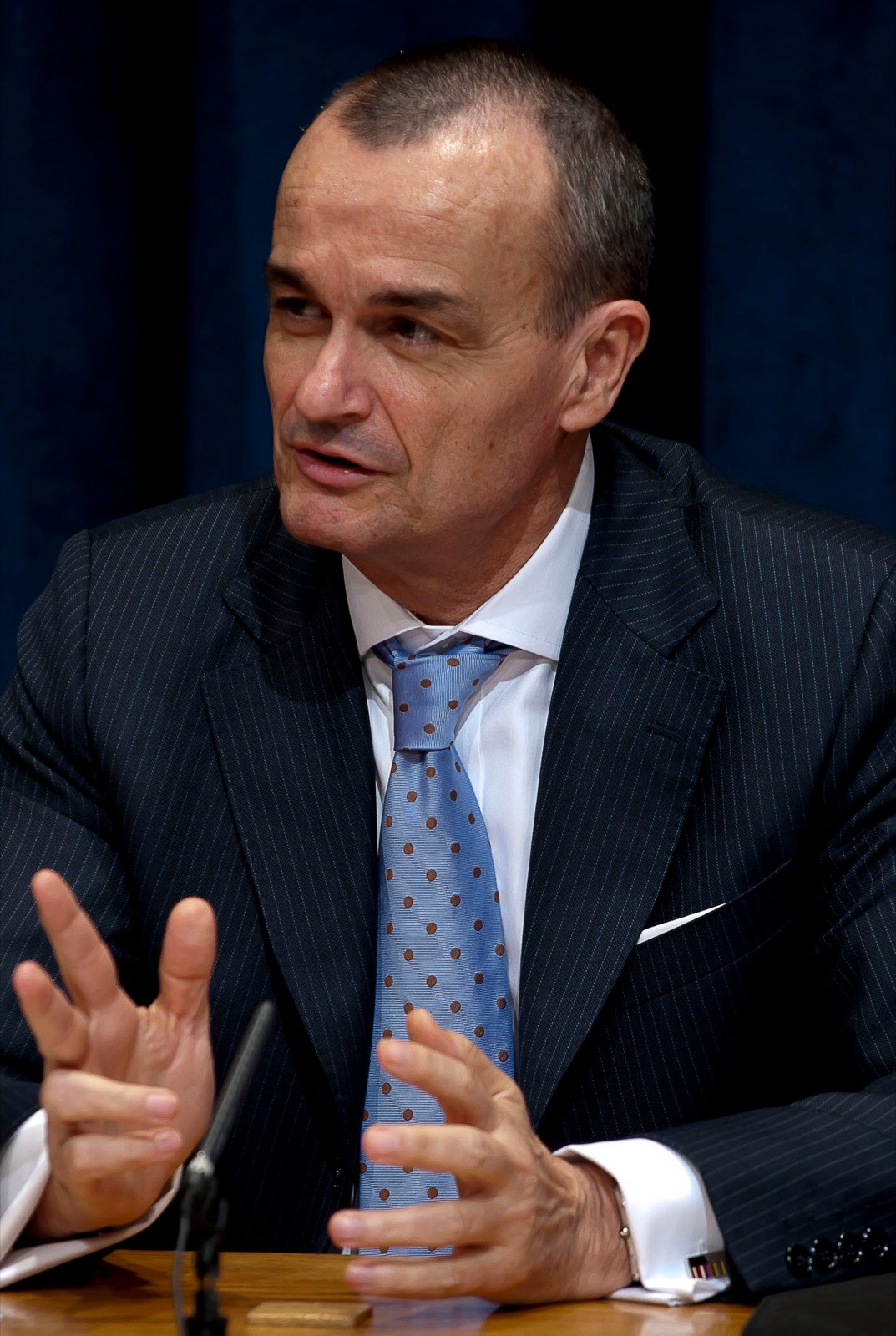
Gerard Araud
Gerard Araud is a former French Ambassador providing an insider perspective on threats facing France and China's efforts to undermine French influence in Africa.
Episode Summary
French President Emanuelle Macron is in a pretty tough spot. Recent legislative elections seriously undermined his standing at a dangerous point, as he starts his second term in office. In a country where strikes and protests are common, the next one might have far reaching political consequences. Meanwhile, Europe finds itself grappling with a war on its eastern border and an increasingly aggressive Russia. Former French Ambassador Gerard Araud shares an inside perspective on the latest threats facing one of Europe's critical countries. Sir Richard Dearlove, the former head of MI6, also dives into China’s efforts to undermine France’s influence in Africa, exploring what it might mean for security and stability around the globe.
Listen & Subscribe
- Watch on YouTube
- Listen on Apple Podcasts
- Listen on Spotify
Transcript
INTRODUCTION
Mcfarlane: You're listening to One Decision. I'm your host, Julia McFarlane. Some choices have global impact. We look at the people who make them, the people who are affected by them, and what decisions need to be made today if they are to make impact tomorrow. In the summer of 2017, the citizens of France made a bold choice. They elected a young former investment banker, a political outsider, who swept aside the French political establishment to become the youngest president in the history of the French fifth Republic. Fast forward five years and Emmanuel Macron's stunning victory has been exchanged for a limp over the finish line, beating once again his rivals from the political fringes, but with a barely tenable majority. Ambassador Gerard Araud is a retired senior diplomat, having previously served as France's ambassador to the United States, the UN, and Israel. He's now a distinguished fellow at the Atlantic Council. He sat down with us to talk about what the recent elections mean for Macron's leadership and France's standing overseas. How has the dust settled for the president? And how do you think France's foreign policy might be affected by the current domestic fractious politics?
INTERVIEW WITH AMBASSADOR GERARD ARAUD
Arraud: Now that Macron has many coalition partners, he will need to keep satisfied. First, it's a pleasure to be with you today. Actually, France is more or less facing the same political crisis that most Western democracies are facing, including the US or the UK, which means the rebellion of a substantial number of voters against the system, against the establishment. But the difference is that contrary to the US with Trump and the UK with Johnson, we had actually a centrist new politician who was trying to respond to this rebellion, which was Emmanuel Macron, who was coming from nowhere and was elected president in 2017 to the surprise of everybody. Because in France, to be elected president, usually, you have been around for thirty years, and you have never been elected to any office before. But in 2022, I should say, the surprise was a bit over. And what a lot of people didn't understand was that he was re-elected a bit by default because he was facing a candidate from the far right. Actually, Macron got a majority in the parliament, but a relative majority, 245 out of 577. And actually, according to polls, more than 70% of the French are satisfied by this parliament without a majority. And in the coming weeks and months, the president will try to govern with a relative majority, which means trying to have the support of the traditional left, the traditional right, which had been quite weakened by the election and without compromising with the far right and the far left, which are sort of powerful in the parliament. My personal bet, but, you know, in domestic politics, usually my compass is showing the South. My personal bet will be that at some moment in the coming year, it will send back the voters to the polls. It will dissolve the parliament and say, you know, I have tried, but it's not possible to govern without a majority. So please give me a majority. But for the moment, of course, it's much too early. We are facing an increase in right wing politics and left wing politics because you have seen that, well, actually the far left fared pretty well also behind Jean-Luc Mélenchon. And Jean-Luc Mélenchon, you know, has immediately presented what we call, you know, a motion to topple down the government, and he was defeated. And he has been very active, very vocal in this very beginning of the new parliament, while Marine Le Pen has been very keen on looking reasonable, really basically saying she's not going to oppose the government for the sake of opposing the government. She will decide actually on each bill on its own merit. So the problem of the far right is that it has always appeared for a lot of people as a total scarecrow, you know, really simply far right is not acceptable.
Mcfarlane: But I mean, Le Pen, she has clearly been listening to some of her critics and she has come under fire for her links to Vladimir Putin in the past. I mean, her party has borrowed millions from Russian banks. She was supportive of the annexation in Crimea. She even visited Moscow on the campaign trail ahead of the presidential elections back in 2017, somehow none of her team told her that would probably be a really bad display of optics back then. But so she has tried to dampen that down in recent months. The war in Ukraine has prompted her to admit that Putin's invasion has crossed a red line, but it's still her policy for a rapprochement with Moscow after the war stops. So I wanted to ask, how is the war in Ukraine affecting the political climate in France?
Arraud: Actually, Marine Le Pen was lucky because there was another candidate of the far right. And this candidate, you know, really was so pro Russia, so pro Putin, that actually he sheltered her. And she was not anymore the pro Russian candidate, he was. And actually, it cost him a lot, a lot. And, you know, so she succeeded in a way to get out of the Ukraine morass without too much really being tainted by her pro Putin credentials. But you have also, again, it's not only the far right, the far left also has a sort of pro Putin leaning. So on the two extremes, you have people who are really closer to the idea that we have to work with Russia. Why? First, because Russia is a bit special in France, because of the two world wars, you know, basically, Russia was our ally during the two world wars. And there is a sort of Russian romanticism in France. Really, when you speak of Russia immediately, you have Dostoyevsky, Shostakovich and Tolstoy who are coming back. Second point, you have also in France, far right and far left, a very strong anti Americanism, really far right and far left. And when you are anti American, you have to be pro something. So they are more or less pro Russia. It's also so what these people say basically that this war was imposed on Russia by the United States. So that's the still two really powerful forces, pro Russian powerful forces. Now, my concern, and it's going beyond France, is that in the fall, if Russia, and I think the French Minister of the Economics just said that he's convinced that Russia will do it, which means more or less shut the gas tap, you know, really in Europe, considering that we are already facing a strong inflation, a bit weaker in France than elsewhere. But nevertheless, inflation is there. You have also the fact that the recession is more or less looming. A recession is looming. If on the top of that you have the gas tap is closed, of course, it will give argument to all these people on the far right and the far left, who for the moment are a bit silenced by the Russian aggression, by the courage and the popularity of the Ukrainians in the public opinion. I think they will come back and they will say, well, let's think about it. What is our interest?
Mcfarlane: I have to change tack because I want to ask you Gerard, given we've had a very tumultuous few months here in the UK, there's been no love lost between Emmanuel Macron and Boris Johnson. Previously, we've had spokespersons for the French government go so far as to say that the French were sick of Johnson's doublespeak. That is his tendency to say one thing to Macron and then another thing to the public shortly after. Recently, reacting to the news that he was stepping down as the UK prime minister, the French finance minister said, personally, I will not miss him. What are your thoughts on the downfall of Boris Johnson? And do you think this could potentially, hopefully, mean a reset for what really is one of the most important strategic security and, frankly, cultural partnerships in the world today?
Arraud: Well, first, I think Brexit was a disaster for the French. Basically, we need the UK, we need the capabilities of the UK for our European endeavor. But also, you know, in the European Union, there is a balance of power between the different members. And so we needed the UK in this balance of power. Now we are alone facing Germany. So it's really all the balance of the European Union has been really undermined by Brexit. Secondly, we have always worked very closely in security terms with the UK. We have a treaty, you know, we had the Treaty of Lancaster House, setting the terms of a close cooperation, including nuclear affairs. And really, that's a fact. Germany doesn't want to step in as world power, doesn't want to use its military capabilities, which are limited anyway, for defending a European interest. So we have said from the beginning, even after the Brexit was voted, we have said we want to work with Britain. The problem is that with this Prime Minister, it's nearly impossible. You know, it's not double speak, you know, it's totally unreliable. And really, he was using the relationship with the European Union as a domestic tool, domestic instrument. So really, the French are pragmatic, contrary to what a lot of people believe. I can tell you that in the French Foreign Ministry, there was a commitment to working with the British. When I was the perm rep to the UN in New York, I can tell you that the British ambassador was by far the closest colleague that I had. On most issues, we were working hand in hand, and our two teams were very close. We want really to maintain this close relationship. The fact was with this prime minister, it was not possible. And so we do hope that the next UK prime minister will allow us, you know, to have a more serene relationship. But I doubt it at the same time, I doubt it, because in a sense, all the Tory government is really based on Brexit, and Brexit has to be a success. If it's not a success, which we believe it can't be, it's because of the European Union. You know, it's not because of Brexit, it's because of the European Union. So it means that we are doomed down the road to go from an incident to another incident, to a problem, to another problem, especially because the UK has chosen a hard Brexit. As you know, the UK has refused any harmonization of regulations of rules and so on. So it's a hard Brexit, which means incidents, problems at the borders, control at the borders and so on. So, again, I really do hope and that's the French national interest that we build a new strong relationship with the UK. But the logic of Brexit makes me quite skeptical about it.
Mcfarlane: Are there any conversations going on between members of the French political elite, members of the government, your former colleagues, anyone you speak to currently in government about the possibility of an independent Scotland? And back in 2014, the last time we had this big constitutional question put to the people, the SNP were very much campaigning on the basis that if the UK, because we knew this vote was likely to come, if the UK were to vote to leave the EU, an independent Scotland would likely retain its membership. Now that's not, of course, how it works. An independent Scotland would have to reapply as a new country. But has the mood changed since then? Because there wasn't any chance for an independent Scotland back then to get membership of the EU whilst there were places like Catalonia in Spain. A lot of countries not wanting to give any ideas to any potentially rebellious parts of their own nations by rewarding independent Scots with membership. I mean, has that changed? Is that still the case? Or do you think the fact that the UK has now been taking European security and defense very, very seriously with regards to Ukraine, that a lot of European countries maybe are now even more set against letting independent Scots join the EU because they don't want to anger the UK? I mean, what's your feelings on this? And do you think the mood has changed at all?
Arraud: Now, first, there is a sentimental aspect of Scotland, France, the old alliance, you know, really, but let's forget sentiments because they don't really matter in this case. No, I think what is the most important is basically, let's not encourage in any way the partition of member states. There is Catalonia and for the Spaniards, you know, Spain has not recognized Kosovo. And really, so Spain will never accept Scotland if Scotland actually secedes against the will of London. But you have the same thing with Belgium. You have even the French with Corsica, really. So I'm convinced that without the green light of London, I do think that the European Union will not take on board Scotland as a member state, however full of sympathy we may be towards Scotland.
Mcfarlane: Now I wanna ask about an important area for French influence that doesn't get much headway in the news, but really needs to be because of the interesting intersection with China, and that is Africa. Now Macron earlier this year pulled French troops out of Mali. They'd been stationed there to support the government against insurgents. There's also a French military presence in Chad, Niger, Mauritania. China has also been stepping up its presence in Africa through its Belt and Road Initiative, building up a lot of infrastructure in African nations and working on expanding its soft power on the continent. And I wanted to ask you as a diplomat, given what we know about China's wolf warrior coercive diplomacy, do you think it's wise for Paris to buddy up with Beijing? Or is it because France is starting to lose its influence in the African Continent? And is China its best option for building that back?
Arraud: I think first, I think our concerns in Africa are not so much China, but Russia. You may know that actually, Russia has used its mercenaries, its Wagner company, first in Central African Republic, willing to get the minerals basically of this very poor country. And in Mali, also now they are in Mali. And the fact is that they are taking advantage of a big wave of anti French feelings among the civilian population in all the Sahel region. Why? Because I think the French made the mistakes that the Americans committed in Afghanistan and in Iraq. Basically, they came in 2013, and they were greeted by the population because they were coming to expel, to push back the Jihadists. But after that, they remained and any foreign force becomes an occupation force with time. So there is a big anti French wave, and the Russians are playing on that in the Sahel region. As for China now, you know, when I was the Undersecretary for Political Affairs, so ten years ago, already I went to China on a mission, basically to tell the Chinese, listen, we have ourselves committed a lot of mistakes in Africa, especially by corrupting the people, by investing in white elephant projects, you know, really, I don't know if you say it in English, but in French, white elephant projects means really big projects without any concrete or realistic significance. And so we are ready to work with you, because we think we have an experience in Africa. And there is no reason why you shouldn't invest in Africa. Obviously, our approach didn't lead to anything substantial on the Chinese side. The Chinese were triumphant at the time. But now, we have the impression that the Chinese are discovering that actually they have committed mistakes, the same mistakes we were committing fifty years ago with the same result. You know, for instance, in Uganda, suddenly they realize that they are not going to get back the loan they consented to the Ugandan governments and there is a lot of incidents against the Chinese in Africa.
Mcfarlane: Interesting. And it's also interesting the way you paint it as being with the Chinese at least something that's mutually beneficial. And I did read that you said in a recent interview, I believe in the Global Times, China is not threatening Europe. China is not a military threat against Europe. There is no reason to have this inflammatory rhetoric that the Americans are using against China. And I want to put to you then, because we recently saw the heads of MI5, the British security service and the FBI warn that China poses the most dangerous long term threat to the security of the West, they say. They alleged that Beijing conducts a massive economic, political and intelligence offensive. The damage from that totals around billions of dollars of worth of stolen technology. There's political influence and academic infiltration too. Now are they right? And do you still have the same views that you expressed to the Global Times a few months ago?
Arraud: You know, the problem is that China was still in 1750 by far the richest and the most powerful country in the world. And now they are back. And so you can interpret this, the Chinese are back, as an offensive against the West. Or you can interpret it as well, it's the nature, as we say in French, the nature of the things. China is again a big power, and it will be and it is actually the other big power compared to the United States. But should we interpret any move by this new power in asserting itself as a threat against us, you know, really? And, you know, again, in what you said, I would object first in terms of the West, you know, as if we were sort of a bloc, a bloc frightened by the rest of the world. You know, the Ukraine war, the war in Ukraine is good evidence that actually the West, unfortunately, we are an island. We are isolated from the rest. You know, it's the West against the rest. But the rest is not only China. It's not only India. It's a large part of Africa. It's a large part of Latin America. When I was the French perm rep at the United Nations, I discovered the resentment of the rest of the world against us, the way we have been really basically bullying them, the way we have been using double standard. Really, I remember one day I was making a speech about human rights in Cuba, and the ambassador of Cuba was a good friend of mine, actually came to me and said, you know, invite me when you make the same speech about human rights in Saudi Arabia. And, you know, an Indian friend told me, he said, you know, Gerard, I don't remember the sanctions you took against the US when the US invaded Iraq. So there is this resentment. So I do think that creating a sort of stronghold, the West as a stronghold, really will feed the beast.
ANALYSIS WITH SIR RICHARD DEARLOVE
Mcfarlane: Ambassador Gerard Araud, ending our conversation there. Now to pass the mic over to my cohost, Sir Richard Dearlove, for his thoughts on France's crossroads. A career intelligence officer, he was previously stationed in the Paris Bureau of MI6 before he rose through the ranks to eventually become the intelligence services chief in the late nineties. Nice to have you back on, Richard. How are you doing?
Dearlove: I'm very well, Julia.
Mcfarlane: All the better for being in my little house in Cornwall, which I love. I would give nothing more than to be by the sea during this hot, hot summer. So I'm very on that Anglo French relationship, so I just want to take us back to even before Boris Johnson became PM, because Macron and Boris, these two men have really been sparring at each other since before Johnson even took office. Because, of course, he was the Brexiteer in chief, and Macron has never really hidden his dislike of Boris. But Johnson is on his way out, and Macron is in a sticky position domestically. And we have two front runners for the new prime minister of the UK. And both of them have had quite public spats with France. In recent weeks, we had Liz Truss, who by many accounts is the front runner. She waded into a bit of a blame game between the UK and France over these recent disastrous jams at the Port of Dover late last month, where there were these chronic queues as people tried to get away for their summer holidays. And she accused the French of not doing enough, saying the tailbacks were entirely avoidable. Rishi Sunak, the other candidate, he also told the French to stop blaming Brexit for the situation between those bottleneck ports of entry between the two countries. Which candidate do you think Paris might favor? Or do you feel that really neither candidate is likely to take the French British relationship to better levels than we've seen in previous years?
Dearlove: Well I think I would say that you know I would expect Macron and Rishi Sunak to get on pretty well because they're both technocrats with a common banking sort of Goldman Sachs type background. And I think they have similar views on, interestingly, what I would describe as state intervention in the economy, which of course is one of the reasons why I think Rishi Sunak is not a natural conservative candidate to be Prime Minister. That doesn't mean he won't be. I am not endorsing Liz Truss. And I think that she will have a more fractious relationship initially with Macron. But you know if Macron wanted to set off on a more positive note he could make some concessions over the Northern Irish Protocol for example, where I think the EU has been totally unreasonable and have used it as a sort of stick to make sure that the sort of Brexit issues are not put to bed. And I think the other point you bring up about Ukraine, well, France and the UK I think have to an extent acted in unison. But it doesn't remove the other aggravations which are pretty significant at the moment in the relationship. I mean I would like to see someone designated by the British government with a clear experience of Anglo French relations who both, as it were, represents what the current government's policies are and is sufficiently understanding of France and French culture to work for a better relationship. I mean I'm very very keen to see the two countries, as it were, come back together.
Mcfarlane: Going back to the interview that we did with ambassador Araud, we wanted to talk to him to see what direction France might go in, now that it's just embarked on a second presidential term with Mr Macron, who now has, as you alluded to earlier, a bunch of different domestic issues to balance, given that he has lost his majority. It was largely expected that he wasn't going to do well, but I mean, what a change since his first election when he stormed into the center of the French political stage, almost out of nowhere, with this almost impossible sense of self belief. A brand new party named after his own initials, with a stable of lawmakers who were also brand new entrants into the world of politics. How did he go from that? Almost a French Obama, we can, to this sort of deflated balloon limbering on because everyone else was too controversial and outrageous to vote for?
Dearlove: Well, I think the explanation of that is relatively straightforward. And I mean, for example, Obama rode to power on the back of the Democratic Party with the party organization firmly behind him. Macron, which is in a way characteristic of French politics, French politics has always been vulnerable to the sudden arrival of personalities. You can go right back in French history to Napoleon. And Macron creates this party En Marche but there's no party infrastructure there to speak of. There's no, as it were, durable party organization there in the long term. It's a political flash in the pan. It's a spontaneous creation. A lot of people rushed to his banner. Without a party structure, in La France your political reputation or your political future is going to lack durability unless you put in place a really hefty party structure. I mean the only parties in France that have managed to do that in the medium to long term were, and they pretty much disappeared, the communists, the PCF, the French Communist Party, the Parti Socialiste but that really has now been massively eroded, and of course the Gaullists and those parties that relate to Gaullism like the RPR. They generally speaking have party organizations or rural representatives who are quite powerful and influential. Macron is not that type of politician and I think that explains why. It's easy to explain why he was president because the threat of a Le Pen presidency, Marine Le Pen, is too much for most French voters. So they vote for the only alternative, which in this case is Macron. But the moment they get into the National Assembly you see his political weakness and I'm not surprised by this at all. And I'm not surprised by the way his position has evolved.
Mcfarlane: Ambassador Araud, he also had some pretty interesting things to say about French politics and Russia that I really wanted your views on. We obviously talked about Marine Le Pen and her sort of long standing, I hesitate to use the word ties, but let's say connections with Russia and the Kremlin. And he said that actually she did quite well because there were other candidates in the recent elections who were a lot more pro Russia than she is. And she's actually tried to row back this association that she's had with the Kremlin over the last few years. But he also said something really, really interesting, which was that France has a little bit of a soft spot for Russia because of the history of the world wars and how Russia was France's ally. And then he mentioned this sort of Russian romanticism in France. And he talked about Tolstoy and Dostoyevsky, and that you also have in France, he says, among the far right and the far left, very strong anti Americanism. And if you are anti American, you have to be pro something. So they become more or less pro Russia. I mean, what did you make of that assessment? Do you agree with it or?
Dearlove: Yeah I agree with it entirely. I mean I'm very familiar with this. France has always had, I would say, a romantic view of aspects of Russia and has had a close relationship politically and culturally which has had all sorts of twists and turns historically and you know there's probably not time to go into that. But I mean you just have to go back to the fact that before France acceded fully to NATO membership you know it had its own defense policy which was based on what's called tous azimuts, which means you know all targets. You know France has always defined itself by having a slightly different view and close relations with Russia at different times. Yep that's been very common and bear in mind that the French Communist Party was closely associated with Moscow and that was a very significant chunk of French politics in the post war period. And yep anti Americanism is alive and well in Paris, in France generally, and has always been a feature of French politics. But I mean these attitudes are both variables which you can identify and describe and you know they blow hot and cold at different times depending on what's going on. But I mean the ambassador describing that was spot on accurate and I agree every word that he says. I mean bear in mind that after the revolution a lot of the Russian aristocracy came to live in Paris. There was a huge Russian community in Paris which is much smaller now but you can still find remnants of it in terms of Russian restaurants and that type of thing which survive. And then you know if you go back, just read War and Peace. I mean half of War and Peace, there's long acts. If you haven't read it recently go back and large chunks of the book are in French if a proper translation. Because of the Russian aristocracy who were largely fluent French speakers at that period of time. I mean it's got a long and honorable history and a very interesting one. I mean one of the restaurants I used to go to regularly in Paris with Roslitt just down the road from where we lived was a wonderful Russian restaurant just off the 5th, no it was in the 13th Arrondissement, which was delightful and very much typical of that French attachment to good things Russian. And I mean we must bear in mind that Russian culture is in its own right a marvel. I'm not talking about the political culture of Putin, I'm talking about you know Chekhov and War and Peace and Russian music and Russian opera and all those other wonderful things about Russian culture.
Mcfarlane: Whereas the Russia of today is now sort of the boogeyman of Europe. So the last question I have for you is going from one boogeyman of Europe to another. The last thing I thought very interesting about that conversation with French ambassador, Gerard Araud, was his thoughts about China. And I wanted to ask you about it, because he is of the view that China is not threatening Europe. He says that China is not a military threat against Europe. There is no reason to have this, what he described as inflammatory rhetoric that the Americans use against China. And it was interesting that we spoke to him when we did, because it was right after we saw the heads of MI5, the British Security Service and the FBI warning that China poses actually the most dangerous long term threat to the security of the West. He didn't really agree with that assessment. So what did you make of that part of the interview?
Dearlove: Well I would say again it's a typical French diplomatic view of China and you can replicate many of the things that he said about Russia, about the French view of China as well. And the French traditionally have always, as it were, been very clear in defining their own relations with China and his comments are a reflection of that. I mean I basically think he's got that wrong and that if China you know were not ruled by Xi Jinping, if China were not regionally becoming a predatory power, if China had not had a massive program to steal the West's intellectual property, so on and so forth. I mean I could go on but I think that that warning issued by the heads of the FBI and the Security Service, MI5, was very timely, very sensible, and was spot on. And I think if you talk to the French Security Service, who I used to know extremely well, they would be much closer to the joint assessment of the bureau, the FBI, and MI5 on the sort of Chinese threat to Western interests. And there's no question that France is in the firing line as much as the United States and the United Kingdom and other European powers. But it's again it's typical of a French attitude which is particularly strong in my view in the Quai d'Orsay and you're hearing that from the ambassador. I mean most of what the ambassador said I strongly agree with. I did not agree with him on that specific point.
Mcfarlane: France in general?
Dearlove: They're sort of a lifetime study,
Mcfarlane: but a fascinating lifetime study. Thank you so much Richard. That's it for this week's episode of One Decision. If you enjoyed this conversation, why not subscribe to us so you never miss an episode? We drop new shows every Thursday. From me and the team, thank you for listening, and see you next time.