Hosted by Christina Ruffini and Sir Richard Dearlove
Guest
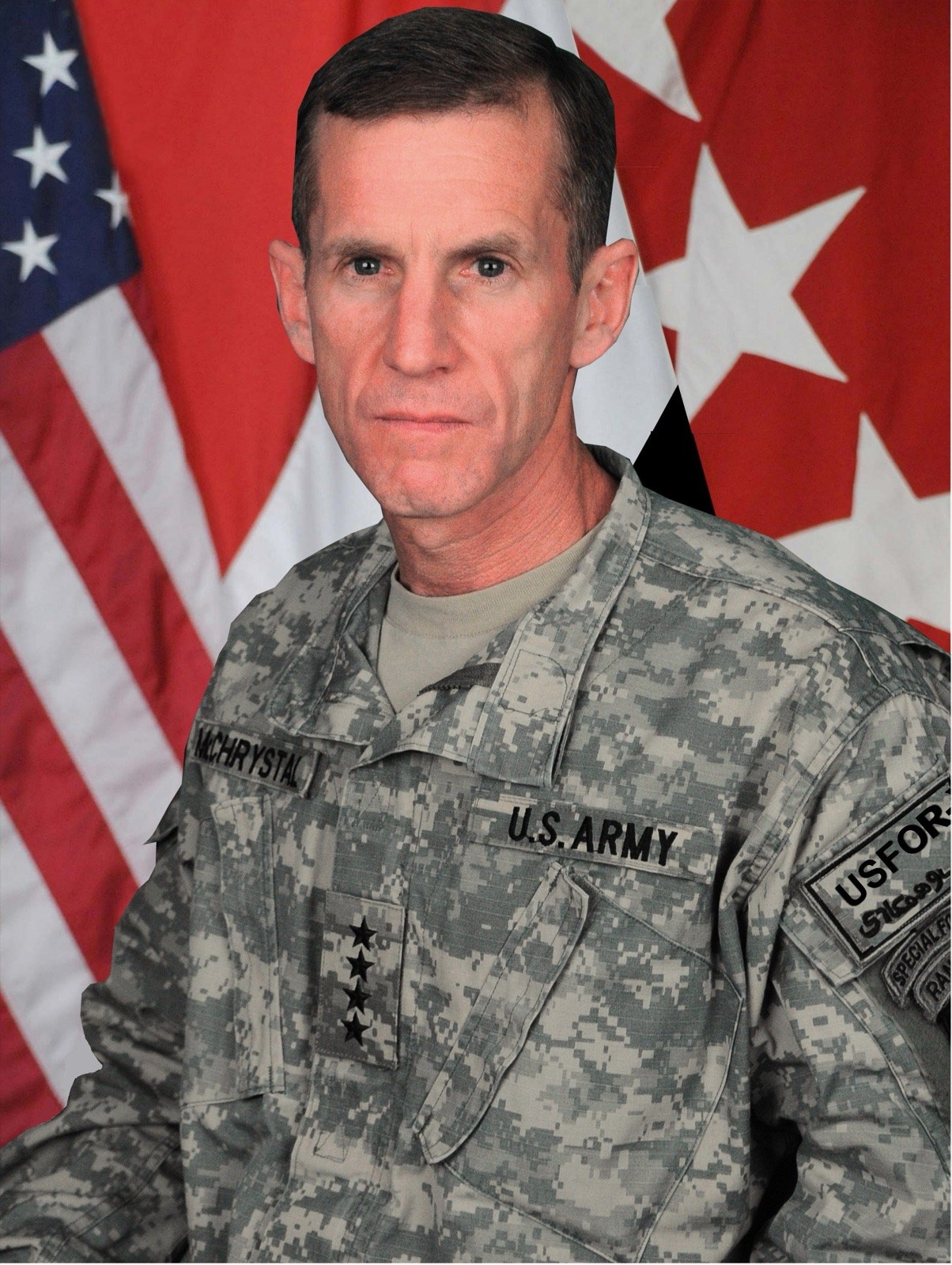
General Stanley McChrystal
General Stanley McChrystal is a retired United States Army General who was the leader of the Joint Special Operations Command during the war in Iraq and reflects on that conflict and Israeli foreign policy amid the war in Gaza.
Episode Summary
In this episode of One Decision, hosts Christina Ruffini and Sir Richard Dearlove, former head of Britain's MI6, sit down with General Stanley McChrystal, a retired United States Army General who was the leader of the Joint Special Operations Command during the war in Iraq. McChrystal and Dearlove reflect on the war in Iraq and share stories of meeting and working with former Afghan President, Hamid Karzai. They also discuss Israeli foreign policy amid the war in Gaza and explore the significance of character in a world leader.
Episode produced by Situation Room Studios. Original music composed and produced by Leo Sidran.
Listen & Subscribe
- Watch on YouTube
- Listen on Apple Podcasts
- Listen on Spotify
Transcript
COLD OPEN
Mcchrystal: If you're in the room with the great decision makers are deciding and you're in there and you're kinda surprised you're, for that moment, one of the great decision makers, do I push back and speak up? Or do I just sorta hold my comments to myself and go along with the flow to retain my influence later?
INTRODUCTION
Raffini: Welcome to this week's episode of One Decision. Today, Sir Richard Dearlove and I have logged on from opposite sides of the Atlantic to talk to retired General Stanley McChrystal, West Point grad, former top commander in Afghanistan and of course subject of that infamous Rolling Stone article Runaway General that prompted the end of what had been to that point a stellar military career. McChrystal is out with a new book on Character, Choices That Define a Life where he talks about owning his mistakes and why he thinks leadership is a dwindling American attribute. General McChrystal, thank you so much for being with us. As I was prepping for this interview this morning, I kept singing that song from White Christmas. You know, what do you do with a general when he stops being a general? But it seems like what generals do, what you've been doing is is writing a book, and you've been writing a book on character called well, it's called On Character. Why did you wanna step back in the spotlight, and why is this something that you felt you wanted to address at this time?
INTERVIEW
Mcchrystal: I didn't intend to write this book. I'd written four books before this, my memoirs and business books and whatnot. And then I was sitting in my living room as I do. My wife and I sit in my living room and read. We both really like to do that. We're very quiet. Then every twenty or thirty minutes I will interrupt her because I'll have some brilliant idea and my opinion on issue X or Y. And she nods and smiles and every once in while she agrees. And then finally she said, shut up and write them down. And so I started writing each of these into, we call them reflections or like essays on a variety of subjects. And the original title, you know, after I put a bunch of these together, she goes, this is a book. And I said, I don't know. But my publisher decided it was, if I could get this book to start a national conversation on character in America, not one with me leading it, but one starting at the bottom at in schools and families on teams and things and just saying, okay, we've had enough of the politics we see. We've seen we've had enough of the divisiveness. We've seen enough of the dishonesty. Let's just go back to character at an individual level and then at a societal level and reassess.
Dearlove: I have a feeling that the general and I might be on a similar wavelength. I think aspects of character are important, but the spin I would put on it myself is I'm intrigued by what I call personal chemistry, which is an aspect of character, i.e. how the people around you, maybe the people you're leading, how their characters interrelate, how they mix, how they get on. And I've always been much more interested in having the right mix of people. You can muck around with structures. You can muck around with organization. You can do all sorts of things. But what ultimately counts is trusting the people who are closest to you in terms of, let's say, responsibility and developing a methodology where you as a group, and that is an expression of character, work together successfully. And I think what the general is saying for me has a huge amount of resonance. And the other issue that he's always emphasized, and I always emphasize this when I'm giving talks on leadership, which I do from time to time, is integrity. And I think, you know, integrity lies at the center of my conceptual world.
Raffini: I'm not in the same business, but I am in a business that, you know, I've gone to war zones, and you've got to trust the people that you're with. And you have to know who you can trust source wise because you do put yourself out there. And one of the things I've noticed in my business, and I'm wondering if if you've seen this trend either in the intelligence world or in the military world, is people are less and less able or likely or willing to tell you something you don't want to hear. Because when I first started in this business, pushback was something you wanted. You wanted to have that fight about what should be in the story. You wanted to have that fight about ethics. And more and more, I'm wondering if you think the culture is moving towards compliance rather than character and what the possible repercussions could be for that.
Mcchrystal: I think on an individual level, it's probably always been there in terms of speaking truth to the general or the director or the president, very powerful people. And it's incumbent about those people to surround themselves and create an atmosphere that gets the truth up, which means you literally have to pull the truth up. You have to bring people around you who have that because it's really easy not to. Organizationally, or even at a broader level, like in my country right now, what I'm seeing is we are almost institutionalizing that. Some of the activities to limit access by certain media outlets to the White House or to other things means that you are gonna have to tow to a certain line to get access for the news itself. And of course, that reinforces itself. If you go do a powder puff interview with someone, they're more likely to give you another interview in the future.
Dearlove: It's a very hackneyed phrase, but truth unto power, I think, is a very accurate way of describing what we're talking about. But it is difficult when you're, let's say, sitting in the middle of a crisis to be absolutely, independently truthful and not influenced, let's say, by the power of your surroundings. And if you're operating at the top levels of government, and I think that's a joint experience that both the General and I have had, maintaining that trusting relationship but an independence of mind, it's quite a tough call, I think. That's when you really find yourself under pressure. It's also quite a lonely position to be in. And this is not something that is reserved to the current administration.
Raffini: I mean, General, you've talked about both in your book and interviews, it's not just a Trump problem. It was a Biden problem too. I mean, look at what we're learning now about his age and how he was protected and and all these, you know, issues he was having actually doing his job. And it was because it seems people in his inner circle weren't willing to say the thing out loud.
Mcchrystal: Yeah. I mean, absolutely. And of course, you can go back to Dr. Irving Janis who studied the Bay of Pigs fiasco and he came up with the concept of groupthink, so I mean, it's a very old problem, but to personalize it and I think all of us would probably recognize this, if you're in the room with the great decision makers are deciding and you're in there and you're kind of surprised you're, for that moment, one of the great decision makers, you have an opinion, but you're not a 100% sure. It's not binary, it's not all right or wrong. You think something's a bad idea. And maybe you're like 70% sure. And in the room everybody is saying, no, it's a good idea, it's a good idea, it's a good idea. So now you're in the position, do I push back and speak up? They're smart people and I might one, seem stupid because I don't think it's a good idea and I'm not sure it's not a good idea. Or do I just sort of hold my comments to myself and go along with the flow to retain my influence later? And so when I tell people it's not black and white, if it was a very straightforward question of a fact or something, then it's probably easier. But when it is a judgment call, particularly as you are growing your way up, it is something you have to learn your way through.
Dearlove: There probably is a slight, I was going say, bifurcation in our experience here, because if you're an intelligence chief, you're very much not a policymaker. And, I mean, I remember sitting in the White House with George Tenet, with the president then. I was on a visit. And we were both of us, I think, scrupulously careful to try to retain our position as intelligence chiefs and explain what we knew and what we thought, but without preempting the decision process. Because it I think both of us instinctively felt, hang on. We're in a you know, we we've really gotta preserve this border between the elected representative of the people and the fact that, you know, we're officials with a certain job who are here to maybe give advice, but we're not ultimately there to decide. Maybe the general's been in a rather different position because he's had to decide.
Mcchrystal: That's a that's a great differentiation because military are a little bit in both. On the one hand, they will ask you militarily, can you do something from a technocratic standpoint? And you are obligated to give your best advice there. Yes, it can be done. This would be the potential cost and whatnot. They often don't ask you if it should be done because sometimes they view you as a policymaker and decision maker and sometimes they don't. And so I go to the invasion of Iraq. That was one of those cases where the US military really fell back on our technocratic side of it, the execution of it. And I was only a two star at the time, but I was in some of the more senior meetings because I was the vice director of operations. And I never remember a discussion, is this a good idea? Now, most of us had been in the first Gulf War, we'd been messing around in the region for a long time. So we had a view, a fairly informed view. And yet it never seemed appropriate for us to slam the table and say, wait a minute, afterward, I regretted that we were silent as we were. Afterward, I regretted that we didn't say, you know, after this invasion, what next? What happens? What do you think is gonna play out? We missed the opportunity and maybe abrogated a responsibility not to be more forthcoming. I mean, Sir Richard, you were on the other side of that. Any regrets there?
Dearlove: Well, I think you do regret. But what I would say was, in terms of the aftermath, that that was a point at which this is historically recorded. There was a pretty profound disagreement between us on the British side and the American side. And I remember having some very tough words with the military commander in Iraq. And we had some very tough meetings and quite difficult meetings because we disagreed with disarming the Iraqi military. I mean, historically, this was, we felt, was a fundamental mistake because we felt that they were the people who were gonna control the country. And, I mean, sorry, this is technical, but it's historically interesting because the Iraqi military were not strictly Ba'athists. They weren't hijacked totally by the Ba'athist regime. The inner guard corps that were Saddam's praetorian guard were Ba'athists. So we wanted to keep the military in place, and we wanted them to help us run the country, and that's where we had a disagreement over decision making. It was tough. And some of the I had made two visits into Iraq during that period. It wasn't it was difficult. It was very difficult. And the trouble was, I think CIA agreed with us. The DIS did not agree with us.
Mcchrystal: I think you're exactly right, and of course, we disarmed and disbanded them. Even if we disarmed them, we shouldn't have disbanded them. We should have kept paying them because you suddenly put all these people. To me it was a huge misstep, but even goes back further to the question of the value of the intervention in Iraq at all. They became the soldiers for ISIS. A lot of those ex military disbanded people became the shock troops for ISIS. Of course. You know? And why wouldn't you? There's no economy. There's no opportunity. That's that's what we saw. But also if we went back even further, what I've concluded over time is Saddam Hussein was not a good guy, but there was no requirement to overthrow his regime at that point. He was sort of like rotten fruit that I think was gonna fall at some point anyway, And we'd have been better to let things evolve in the region. And Al Qaeda was not there. I mean, 9/11 had been about Al Qaeda and Al Qaeda was not in Iraq. To me, it was sort of a misstep.
Raffini: I mean, Sir Richard, you were involved in the lead up to those. Obviously there was the WMD issue, but what were those meetings like? What was the furor like? Why was there such a rush to do the thing the General was just talking about? Why go in in the first place? Where was that really coming from?
Dearlove: It was coming really, in my opinion, from the DOD, which had the bit between its teeth. But there was a definite drive within the DOD to remake the country, or that that was the idea. And some pretty crazy ideas were being discussed. But during that period of time, I did have an historic one to one meeting with Donald Rumsfeld, which was organized for me well, I I guess I can say it now. Henry Kissinger organized it, because he's deceased. He couldn't comment on this. And I spent a long time with Donald Rumsfeld trying to put across to him, let's say, the historical lessons that the British had learnt in Iraq because of the complexity of the country. And I thought it was a fantastic meeting. It was a very long meeting. He had those American yellow note blocks, and he was taking copious notes, and we were getting on fine, and we were talking, and we were talking, and we were talking. I don't think that meeting had any impact whatsoever on, as it were, their thinking and their policy, and the sort of other people who were advising Rumsfeld at the time, given that I was an aberration coming in from the sidelines, as it were, we didn't win that argument at all, which was tragic in a way, because things did, you know, turn out badly. The irony with Iraq now is that the long term picture, actually, if you're cool in your analysis, it actually has turned out much, much better than people expected, but it's taken a very long time to get there and at significant human cost.
Raffini: General, I want to talk to you about Afghanistan, obviously. But since we're talking about character, my understanding is you have an interesting story about your first meeting with Afghan President Hamid Karzai. What was that like, and and what was your read of that man as someone who covered the fall of Afghanistan?
Mcchrystal: A little bit of background. I had been in Afghanistan for part of every year from 2002 until 2009 when I became the commander. I'd been in a different role. I'd been in my counter terrorist role, but I'd spent a lot of time there, but I'd never met President Karzai. So, I was named the commander on sort of short notice. And I go over there and I am gonna be the ISAF commander of all International Security Assistance Forces. And we had, the international community had essentially been there eight years and I was the tenth ISAF commander coming in. So, if you think about that, it's a revolving door in his mind. And, when it had started, there were great hopes and expectations on the part of the Afghan people that the overthrow of the Taliban and the international community coming in was gonna produce economic and security and political stability that it had not delivered on. Now that was partly the Afghans' fault for sure, but the reality is their experience over eight years was disappointing. And for President Karzai, who had really embraced the Americans particularly, but the international community, he now had eight years of unmet hopes and he was in a extraordinarily difficult internal political environment. You know, he had forces pushing on him from every direction, the factions inside Afghanistan. So the first thing is to understand is he's not in a simple position of, you know, a client leader and you had to respect, he is trying to walk this tight rope and do that. If he leans too far to the Americans, he looks like he's a sellout and they internally they cut him out. If he doesn't, obviously he's not supportive. So, I go over there and I, before I had my first meeting with him, one of my aides had suggested I bring my dress uniform to Afghanistan, which I'd never done before. You know, because we were in battle dress uniform because we're there to fight a battle. But when I got there, I put on my uniform for our first meeting and I went in and he was stunned. And he he remarks, he says, you're you're in your dress uniform, why are you here? And I said, because you're the president of a sovereign country and I'm here to work in support of you. And we started to build a relationship. Now it was not, you know, we didn't hang out and have beers and watch football, but it was a relationship where I tried to, as much as possible, respect his authority and increase it. For example, we decided to do a big operation into Helmand after I'd been there a few months and we briefed him on it and then as we got close to the operation, I called over to the palace and I said, I need to see the president because I need to get him to approve execution at the beginning of this operation. And they said, well, he's sick. And I said, well, I don't care. I gotta see him, we are ready to go, I'm coming over. So I came over and he was out of bed and he looked like hell. So he was really sick and he had some of his ministers there who generally I got along quite well with. And I said, okay, mister president, here's what we briefed you on. We're set up to go. I need you to give approval to execute. And he looked and he goes, in all these years, I've never once been asked to approve a single military operation. I said, well, times have changed. This is your country. I'm not doing operations without your approval. And he then proceeded to ask a bunch of really thoughtful questions and approve the operation. The point was that here's a guy who had we were beating him up about corruption. And all of those things were true. But at the same time, I think he was doing about as good a job as anybody I can imagine of navigating these things and trying to balance the realities of Afghanistan with me. And the two foreign leaders that he liked, there were only really two, and it was Angela Merkel and Prince Charles. The reason he liked them is they treated him like a head of state. Most of the others patronized him. And the United States patronized him pretty badly in a lot of different ways. We'd have congressional delegations come over and, they'd have a meeting with him and they'd all just browbeat him for an hour and a half and he'd take it. So I'm not saying it's not wrong, but it gets back to the idea of what do we want the relationship with that leader to be? How do we want that leader to be viewed internally? You know, if if we don't respect him, it's gonna be pretty hard to expect his people to respect him. You know, he's a human being. He's gonna respond like a human being. You criticize him, he's probably not gonna appreciate it. And I think we're all the same way.
Dearlove: I certainly met Karzai several times. I never met him in Afghanistan. I only met him in Europe. But he was a gracious character, I felt. But he was doing an impossibly difficult job. And, you know, my conversations with him, I guess, were much more political than military. One had the feeling that, you know, he was he was beleaguered by the events around him.
Raffini: I also wanted to ask you, you know, when you were commander, you instituted this policy to try to reduce civilian casualties at a time when you were pressing a very reticent President Obama who you did end up convincing to send more forces over there to, you know, not lessen the American presence, but give you the forces you needed to get this done. Casualties from airstrikes dropped about 60% because of these new policies and protocols that you put into place. And I wanted to ask you why you thought that was important, not just from a humanitarian and ethical standpoint, but I think sometimes when we think about these policies, especially in the current climate, people forget that there is a self serving purpose to a policy like that or to aid or to treating people with respect. What did that get America?
Mcchrystal: And I'll be honest, the purpose of my policy was almost completely that. It was a practical standpoint. I did morally not want to kill Afghans, but the reality was it was not for that reason. The reality of any effort like this is you are trying to convince the population that they are better off under the government than they are under the insurgents or outside force that they're opposing. So you're really fighting a popularity contest to make it sound simple. And there is this desire to take the gloves off and go after the enemy and kill them as fast as you can. But the reality is, if the enemy is any good at all as an insurgent or a terrorist, what they do is they do operations in such a way that your response affects the population in a negative way. And they are counting on your response to alienate the population. When you do that, in the short term it makes you feel good. And this is the same true in counter terrorism and insurgent, make them feel good. And so we had this whole movement inside the US of people who say, let's take the gloves off, you gotta bang them. I was getting people writing me cards and letters and saying things that you're not being strong enough. But the reality is you weren't gonna kill enough Afghans to solve the problem because I used to talk to my troops, there's insurgency math. And I used to say, okay, if there are 10 insurgents and we kill four, how many are left? And they'd look at me and they go, is this a trick question? Six. And I'd say, no, you have no idea. Because those four have brothers, sisters, fathers, mothers and whatnot. And so, the reality is many cases that the answer is 40. So, I got with the organization and I said the only way we're gonna win this is gonna be very frustrating, but we've got to stop killing Afghans. You remember from 2001 when we first went in and toppled the Taliban government, we had shown this extraordinary omnipotence. We could have drones and bombers above and doing these pinpoint strikes. So they thought we were omniscient. We had perfect intel and we were omnipotent. We could hit whatever we wanted to. Or at the best, they thought we were just casual about it. Either conclusion on their part is negative for us. So we had to try to turn that around. And, of course, all the while, the enemy is trying to make a counter narrative.
Dearlove: That is such a crucial point the general is making, and I think everybody should study the French war in Algeria, because there's a brilliant book about it which has a remarkable title. It's called The Savage War of Peace. You know, the French won or defeated the insurgency and completely lost the political battle despite remaining militarily in complete control of the country. And that's the key lesson that comes out of that war, you know, which dates back to the early fifties. I mean, so many people who have, let's say, to face the problems that the general had to face have never really learned that lesson, and with a leading Israeli, I feel like saying to them, why do you walk into every political trap?
Mcchrystal: What Sir Richard said is exactly right. They've already made most of the mistakes that are going to be difficult to unwind because they've killed so many people in Gaza, done so much damage that you're likely to have generations of Palestinians who are going to produce this the next three intifadas or different similar actions. But when you're in a hole, stop digging. You know, they're not gonna kill everybody. There are 300,000 military age males roughly in Gaza. They calculated at the beginning of this that there were about 50,000 members of Hamas and I went over there not long after October 7, got with the Israeli intelligence and military leaders, because I'd known a lot of them from before. And they were sort of doing this math, 50,000, we gotta destroy 26 battalions and these 50,000 people and a certain number of leaders. But if there are 300,000 military age males in Gaza itself, potentially there are 300,000 members of Hamas in that demographic. And so suddenly it doesn't seem doable unless you're gonna do a genocide. To me, that's not an acceptable course. You've gotta get a better approach to this.
THE ROLLING STONE ARTICLE AND RESIGNATION
Raffini: Obviously, I want to talk about the Rolling Stone shaped elephant in the room, which I know you write about. So I feel like it's okay to ask you about. But obviously, you know, in 2010, when you were the top commander in Afghanistan under the Obama administration, now you and the president hadn't really gotten along from the get go. And then you have Michael Hastings, this Rolling Stone reporter come along in bed with your team and get it seems kind of unprecedented access. And this article came out, and there were derogatory things said mostly by your staff, you know, about the president, about other leaders, about the vice president, and it ended in your resignation after this very stellar thirty five year career. I want you to talk us through kind of the aftermath, how that unfolded, and how you've kind of come to terms with it, if you have come to terms with it.
Mcchrystal: I was in the Pentagon from the summer of 2008. I came out of Iraq from the counterterrorist, and I went on the joint staff. And so I got to watch the last few months of the George W. Bush administration and then the arrival of President Obama and his new team coming in. You know, I voted for President Obama, strong supporter, and the idea that we didn't get along is still not true. We still get along even in the meeting where I resigned. What happened was there had been a request for forces in the spring or early summer of 2008 and the DOD had decided to just hold it until after the election so who was ever elected would have the opportunity to make the decision whether you're gonna reinforce Afghanistan. So that decision was taken. And then when President Obama and his new team got in, one of the first things we did from DOD was present this requirement for more troops. And literally, they just got in. Now, they had campaigned on Iraq's a bad war, but Afghanistan's a necessary war. So, they're a little boxed in there. And now, the military says we need more troops. And it sounds like William Westmoreland for Vietnam and this new administration to include the president are skeptical, naturally, and they go, hold it. You're not getting them right away. We gotta do a study. We gotta do an analysis. Fair question. But because the request had been delayed, the forces were to cover the election in the spring of 2009.
Raffini: The Afghan election we're talking about. So, DOD goes, you can't wait. You got to make a decision because we need these troops by this date. And so people in the White House who almost nobody had military experience, you know, naturally. And they weren't I mean, I covered them, and they were, especially at the start, a very young, inexperienced administration. I mean, they were the insurgency campaign. They were not supposed to win. All the experienced folks were on the Clinton campaign. So they really did take quite a while to get their feet underneath them, which they did eventually do. You know, they couldn't even figure out the press credentialing. I can imagine coming to them and telling them they need troops immediately was was a tough dynamic.
Mcchrystal: Yeah. And it was threatening to them. And they weren't a team either because you remember they were put together with part of the Clinton people, part of the Obama people, it was not this cohesive group. We start to have this tension build up between DOD and the White House who was very skeptical. So, they removed the commander, General McKiernan, a good friend of mine, in Afghanistan in early June and sent me over there. I didn't really have a meeting with President Obama before I went. I went over there for a photo op for about two minutes and he says, you're going, and I got. And, what I wish I had done, and I've told this to people before, I wish I'd put a piece of paper in front of him and a pencil and said, mister president, write on this paper what you want me to do and I will do my very best to accomplish that. If you can't write that, maybe you should take some time before you send me over there till you can and don't make me write it, don't approve my plan, you write in very simple terms what you want. But we didn't do that, I didn't have the presence of mind or courage to do it. So I go over there and I'm told to do an initial assessment before I make any changes. So we start this strategic assessment, which we did. I went over there not thinking we would need additional forces. I went over thinking we need to change the strategy and start to protect the people and what not. But as I went through this, I retained that belief we needed to change the strategy, but I also, as we did the math, we needed additional forces to cover enough ground until we could grow the Afghan forces. So that's the backdrop to this sort of growing mistrust. And then in the fall, as we went and requested the additional forces, there was a series of teleconferences. Some of them got kinda contentious, you know, about what's the strategy in Afghanistan and but ultimately, the president approved it. But when he approved it, he also approved it with the eighteen months we're gonna start the withdrawal of forces. And so there was a lack of confidence on his part that we were really doing the right thing. So that's all the backdrop of this thing. There was nothing personal between me and him or me and anyone that I knew of, but there was this tension over the mission. And then of course, my own fault, we let this freelance reporter, as one of, you know, countless reporters.
Raffini: Who made that decision? Who approved that? Did you approve that yourself?
Mcchrystal: No, I mean, I had a team that was doing that stuff and I didn't micromanage it, but I was responsible for it because everything they do is I own. This guy didn't hang around as much, was only in Afghanistan a few days. I mean, it wasn't like he was embedded with me a lot. And then we went to Europe to do a series of meetings so that we could basically buttress support for the war. And he showed up there, but again, didn't spend a lot of time with us. But he wasn't vetted, and it was funny, my wife flew over from the United States when we were in Europe. She immediately comes to me and she says, who vetted this guy? And I said, well, I assume my team did. And she goes, have you read the book he wrote about Iraq? And he did a hit job on a commander in Iraq from before. And I said, well, I certainly didn't. I wasn't aware of it. But still, we didn't know that he was spring loaded to be wanting to write that kind of report. So I thought it was gonna be a very innocuous, almost a puff piece article about, you know, most of my staff had been together at war for years, so it was a tight team. And so he writes the article with the title, The Runaway General. And of course, once you see a title like that, you know, you got an issue.
Raffini: And it blew up. Where were you when you saw the article?
Mcchrystal: I got awoken to two in the morning, and apparently the White House saw it early. I got awoken to two in the morning by my military assistant who said, sir, the Rolling Stone article came out, and I go, okay. So so what? And he goes, it's negative. And I said, really? I didn't expect that at all. But I read the article. As soon as I read the article, I said, alright, this is an atomic bomb in a relationship between DOD and whatnot. So I made some phone calls. I called the chairman, talked to sec def, things like that, and knew that this thing was gonna really be a big issue. Went over and saw President Karzai that day, and then was asked to fly back that afternoon to meet with the president. I prepared my resignation, carried it on the plane with me as we flew back.
Raffini: So you knew. You knew what this meant.
Mcchrystal: I did. Now there were people the chairman says and the sec def went over apparently and told the president, if you take McChrystal out, we're gonna lose. Now that's what I was told. I wasn't in the room when he did that. And President Karzai called the president and said, hey, don't do this.
Raffini: What was Karzai's reaction when you went to go meet with him? What did he have to say?
Mcchrystal: He goes, a magazine article? And I said, yeah. It's a big problem. And he goes, it's a magazine article, what could be the problem? But I told, I assured him it was a big problem and I, as I flew back, he apparently called the president. So I got back into the United States that morning, immediately put on my dress uniform and then went over to the White House to meet with the president. In my heart, I knew what he was gonna do. There were people who thought maybe he wouldn't. Went into the room and he was remarkably professional and gracious. He says, what happened? I said, really, I don't know. I haven't been had the chance to really delve into what was said and whatnot. But I am responsible, mister president, and my job is not to put things like this on your desk. And so, I own it and here's my resignation and if you wanna accept it, I'm fine with that. If you want to tell me to go back to Afghanistan and command, I'll do that too. And he accepted my resignation, again was remarkably gracious and I walked out. Now, the second I walked out, I mean you go through those motions and then you walk out and go into this other waiting room where my assistant was waiting and suddenly the realization hits about what just happened. So I drive from the White House over to Fort McNair, which is right across Washington DC where my wife was living. I go into the house, she's waiting for me in the entryway of the house, and Annie was a son of an army officer, spent her whole life with me, we'd been married thirty three years at that point. So everything about her was connected to my life as a soldier and I just told her. But I said, it's over. He accepted my resignation. And so, she looked at me and she goes, good. And I kind of was surprised and then she goes, we've always been happy and we'll always be happy. And from that moment on, that lady set the azimuth for us because it was really interesting. You know, I had about thirty days where I had to get out of the army, I wrote personal handwritten notes. You know, I went from living alone in a little place in Afghanistan to not only living with my wife, but my son and his girlfriend and their cat came in and moved with us. So there was a life change, I started a new business, I agreed to start teaching at Yale in a month, which I'd never even been to the place, I'd never ever taught in my life. I did all these things in the midst of a period when my identity was suddenly in question. You know, I wasn't a soldier, I wasn't a commander, and you know, for a period of time, I'm on the ticker of the news every two minutes, disgraced general. Now, blessedly in America, that's like forty eight hours. And then everybody just sort of moves on, but it didn't move on for me. For me, I am this damaged goods, had a lot of dark thoughts. My father was a retired general living in Florida and I knew he's seeing the news and I knew how hard that had to be. Everybody who was my friend, who had trusted me, who had believed in me, suddenly had a reason not to. And in my mind, they all had a legitimate reason just to walk away. Now, clearly, I connected the dots in a way that were as bad as they could be. I'd walk through an airport or somewhere and people would kind of point at you and look and talk to each other, there's that guy and you assume they're saying something negative about you. Later I found out, in many cases that wasn't the case, but in my mind they were. And I would go through TSA where you give them your identity, the person would look at it and they go, are you that? And I go, I am. And 99% of the time the person put out their hand and goes, thanks. You suddenly realize that people are more gracious than your mind will sometimes realize. I didn't want to do a retirement ceremony because my feelings were hurt and I was, you know, embarrassed, but I was convinced I had to do that. So, we did a retirement ceremony right across the street from my quarters at Fort McNair before we left. And we did it in field uniforms, combat uniforms, it was a really hot night and I asked the sec def if we could do that, kinda because I didn't wanna dress up in the other stuff. And I had this outpouring of friends that came from all over the world. I mean, people I would have never expected or asked to come. And you realize in that moment that you have got this net of people who care about you. And I think that became a very reinforcing moment for me and I started that process of saying, okay, I am not going to live my life as an angry retired general or disgraced general, because there's no point in it. I was gonna be something different, I was gonna be whatever I could be. And that's when we started the business, I started teaching, we started all this stuff and it was really hard for the first couple years and it's never completely gone, because I'm still talking about it today. It's the best moment of my life in terms of learning what matters.
Raffini: What is your best advice as to, you know, how to retool and re-identify yourself after a lifetime of doing something?
Mcchrystal: The advice I have is look forward, decide what you wanna do. Don't try to just be what you've been. You can be proud of what you've been, they can be experiences that build your qualifications, but decide what you wanna go do and be that completely.
Dearlove: I never dreamed I would be podcasting, particularly having led a life of clandestinity. So there's a certain anachronism in that change. But actually, what the general is saying is crucially important. Don't depend on your past life or your reputation in your past life, because you've got to focus whatever new challenge you take on. I mean, I went to a Cambridge College, much to my surprise. I got elected to be the master of it, living with 80 very challenging academics and 500 very, very intelligent, brilliant students. And you can't sit there talking about your past. You've got to focus on what's happening and what's going to happen and look forward. And I think my whole life since I left SIS or MI6 has been learning well, process of learning, taking on new responsibility. And I've found that really engaging.
Raffini: I'd love to know, when you look at the landscape of American leadership, world leadership, who stands out to you in terms of someone you think has good character? Is there anyone?
Mcchrystal: Christina, I'm really worried about it. No name jumps out at me. I know that there are people with great character in America. In fact, probably most people. But we are celebrating, we are empowering, we are enriching, we are doing all the things we shouldn't do for people who are demonstrating a lack of character. And that unwillingness to demand from ourselves or the people that we give those gifts of support to is dangerous for our country. But we can control that. The beauty is we have agency.
Dearlove: That's such a tough question. I'm gonna duck it, but I'm gonna say one thing, and this is an anecdote which the general appreciate. When I was made chief of MI6, my mother, who was, you know, totally compos but not in great health, wrote me a card. And she was a smart lady, but not a highly educated one. And she wrote me a card, written inside it was a quotation from King James the First of England, and it said, Richard, beware the highest benches. They are the slippiest. I think that what happened to the general really bears out that saying. I mean, I had one or two very, very slippery incidents in my later career, because once you get up to that level, it is political. I mean, I came back from Washington, DC during the build up to the Iraq war and said in a very closed meeting after a conversation with Scooter Libby, okay, I'm worried there's a name I'd forgotten about. Sorry. I'm worried that the policy, the facts are being fitted around the policy. The policy has been decided, but they're fitting the facts around it. Now that's quite a dangerous thing to say, but I said it in a very small group, including the prime minister. That comment got leaked by another politician, and it was headlines in British newspapers three or four days later. Okay. It didn't kill me off, but it was a pretty tough incident to deal with. Unfortunately, you know, the prime minister was on my side as it were. But, look, these things can be incredibly volatile. And I think that quotation, beware the highest benches, they are the slippiest, is a good one.
Raffini: Well, thank you gentlemen both so much. I have enjoyed getting to know more about your characters and, hopefully our listeners can pick up your new book and examine a little bit of their own. Thank you again for taking time with us, General. Thank you, Christina. Thank you, Sir Richard. That does it for this week's One Decision. A special thanks once again to General Stanley McChrystal. If you enjoyed this conversation, be sure to subscribe to our feed on Apple Podcasts, Spotify, and wherever you get your podcasts for more in-depth conversations with politicians, military officials, world leaders and more. Of course you can also click on our socials and YouTube page because they've got interviews with people from all around the world, additional commentaries, and our new headline explainers. I'm Christina Raffini. For me and the whole team, thanks for listening.