Hosted by Christina Ruffini and Sir Richard Dearlove
Guest
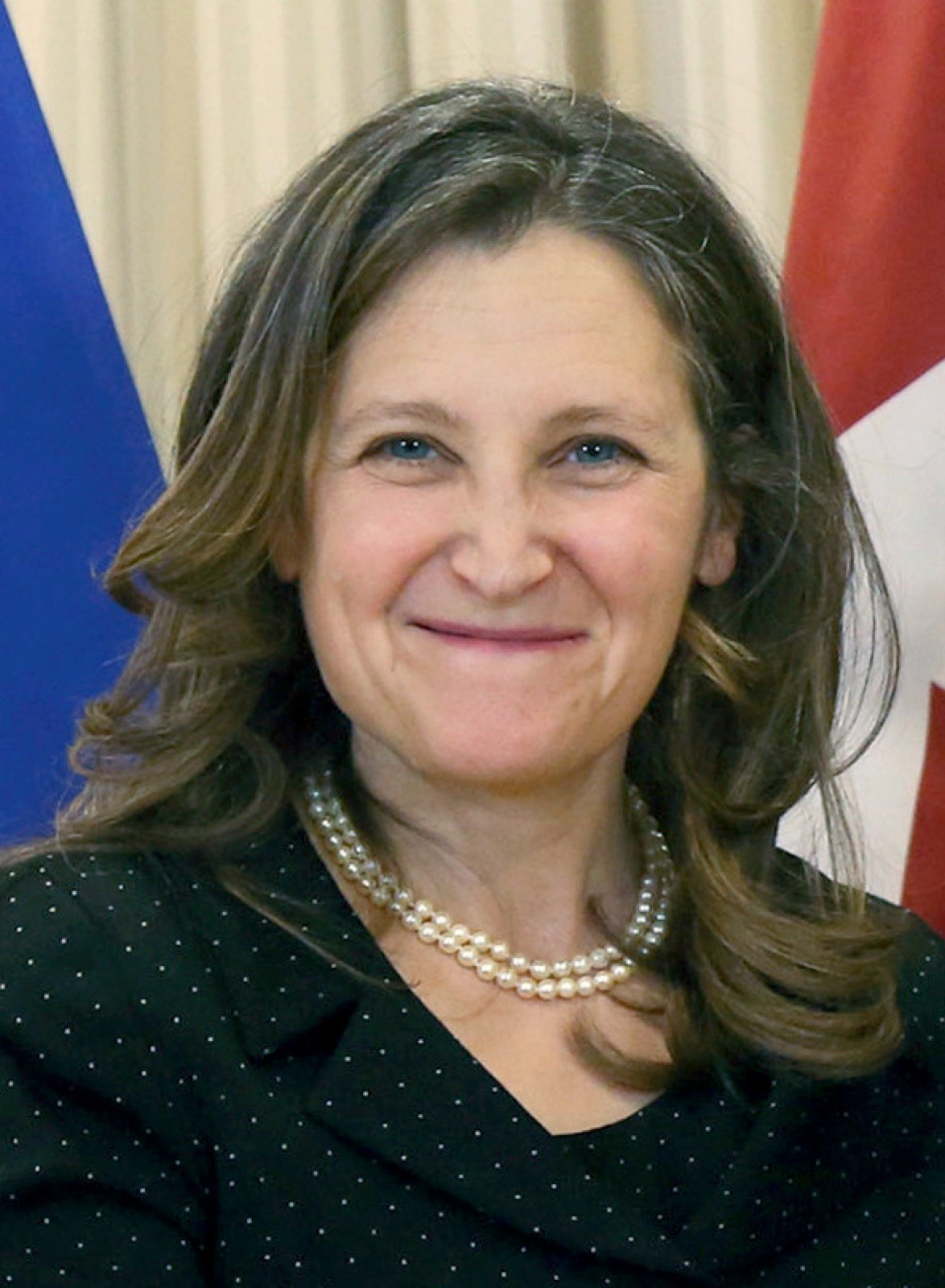
Chrystia Freeland
Chrystia Freeland is Economic Advisor to the President of Ukraine, making the case for why Ukraine is winning both on the battlefield and economically.
Episode Summary
In recent months of the war, Ukraine has managed to hold its front lines and bring war to regular Russians via attacks on infrastructure. That’s why Economic Advisor to the President of Ukraine Chrystia Freeland believes Ukraine has flipped the narrative from being the virtuous victim of Russia’s aggression to the necessary ally and shield of Europe. This week, she joins Sir Ben Wallace and co-host Kate McCann to make the case for why Ukraine is winning, and why winning on the economic battlefield is equally important to the country’s future.
Freeland talks about how Ukraine’s President Volodymyr Zelenskyy is laying the political groundwork for Ukraine’s economic success, the importance of Ukraine’s alliances, and why Poland’s success story should serve as a model for Ukraine’s post-war future. They also discuss Ukraine’s strong defense industrial base, the importance of rooting out corruption and the remnants of Soviet ideology for bringing in investment to the country, the challenges of attracting people back to Ukraine, and why victory for Ukraine is a victory for liberal democracy.
Plus, In Brief: what Andy Burnham is up against on the UK’s defense front as he ascends to the role of Prime Minister, another battle in the Strait of Hormuz reignites conflict between Iran and the United States, and a leadership shakeup in China’s People’s Liberation Army.
In this episode:
(00:00) Cold Open and Introduction
(02:21) Incoming UK PM Andy Burnham
(04:16) IRGC Proscription Explained
(05:20) Renewed Tensions with Iran
(09:14) China Military Leadership Shakeup
(10:32) Chrystia Freeland On Ukraine
(11:35) Is Ukraine Winning?
(15:38) Ukrainian Sentiment on the State of War
(24:43) Zelenskyy’s Political Strategy
(29:44) Ukrainian Defense Innovation
(33:36) Why Crimea Was A Strategic Blunder for Putin
(37:17) Ukraine’s Future Economic Vision
(42:39) Corruption and Investment in Ukraine
(53:32) Rebuilding Ukraine and Returning Home
(56:28) Why Allyship is Key for Ukrainian Success
(59:48) Reflecting On Politics, Alliances, and the Future of Ukraine
Hosted by Sir Ben Wallace (former UK Defense Secretary) and co-host Kate McCann (Political Editor at Times Radio).
Listen & Subscribe
- Watch on YouTube
- Listen on Apple Podcasts
- Listen on Spotify
Transcript
COLD OPEN
Freeland: Ukraine has been successful militarily because they realized this was existential. They had to decide: do we want to be a country or not?
Wallace: War is the mother of invention, and sadly — but the reality of it — Ukraine has learned well.
Mccann: Do the people in Ukraine feel they're winning?
Freeland: Regular Ukrainians are more fiercely determined to building a free, prosperous country, even than their leadership is.
Mccann: Does President Zelensky worry about people not wanting to come back?
INTRODUCTION
Mccann: Hello and welcome to One Decision. I am your host, Kate McCann, and today I'm joined by my guest co-host, the former UK Defense Secretary, Sir Ben Wallace. Hi, Sir Ben.
Wallace: Hello, hi.
Mccann: So, how have you been? What have you been up to?
Wallace: I've been trying to get to terms with the fact that it's actually sunny in the north of England, where I live, so that's always been a bit of a problem. I've been traveling — I've just come back from the United States, went to California on work, and I went to see some of the mighty tech-bro companies. And I'm off to Scandinavia later this week, so just getting things sorted, looking at the papers, waiting for the new government in Britain. Andy Burnham is going to walk across the Thames. The new messiah, I think, is being sent from the north. And we'll see how that plays out.
Mccann: Well, let's pick up on a bit of that, shall we? Because it is a big development and it will have a huge impact on everybody in the defense industry, because he's going to be in control of what the UK does next. We'll come to that in just a moment. And we've got a really interesting guest joining us this week. Chrystia Freeland makes the case about why Ukraine needs long-term economic investment. And she's not just making the case for it — she is actually a big part of the plan that President Zelensky is putting together for how Ukraine moves from a war footing to becoming one of the most liberal economies in Europe. Is it possible? And what are the steps the country needs to take? It's a really great discussion. You don't want to miss it. Subscribe to One Decision on YouTube or wherever you listen, and you won't miss any of our interviews. We'll come to that conversation in just a moment. But first, it is time to go over a few smaller stories that have been hitting the headlines around the world. Sir Ben, you mentioned Andy Burnham. People might not know the name Andy Burnham, but he's going to become very important for all of our listeners and our allies around the world. He will be the Prime Minister by the end of the week. Out goes Keir Starmer, in comes Andy Burnham. He is a regional mayor — he runs a regional city, the Manchester City area. But he's going to be in charge of the UK's defense policy. What can we expect?
IN BRIEF: ANDY BURNHAM AND UK DEFENSE
Wallace: Well, I think a fast learning curve for him. He's never had that background. I worked with him in Parliament — we would often be on the train together in the early days, 200 to 2010. He was a Home Office Minister and a Health Minister and has very much been rooted in metropolitan city politics as a mayor of Manchester. So he's going to have to have a fast learning curve. I don't say anything to doubt that he won't be patriotic, pro-British in the world, but he's going to have to tackle the biggest challenge in British politics at the moment, which is properly funding our NATO commitment and defense. It's been very sad in the last couple of years that when it's been put to the government — you need to spend more on defense — their first instinct has been to get other people's budgets and artificially put it into a GDP percentage increase. In fact, the latest figures show a real-term cut in the day-to-day running of the MoD in the next 3 years, and that's going to have to be changed. So he's going to have to lead, and to lead is to choose. So he's going to have to start cutting something else if he is going to fund defense properly. We'll see. But it's going to have to become core to his existence as our prime minister, because defending the nation is the number one. Russia is going to get more dangerous. Iran is a pretty dangerous place at the moment. And we need to get that stability to help our economies to grow. And if that's what he's about — which he is — that's what stability leads to: growth.
Mccann: One of the final acts of Keir Starmer's government this week is to proscribe the IRGC. It's something that people have been calling for the government to do for quite some time. And proscription means in this country that if you show support for the IRGC in any way, shape, or form, you could go to jail for — I think — up to 14 years. It's a significant prison sentence. How important is it that that is one of the final acts of this particular government?
IN BRIEF: UK PROSCRIBES THE IRGC
Wallace: Well, I think it's a symbol of it. The IRGC was always viewed as part of the mainstream military of Iran, and therefore proscription is usually about terrorist organizations. But their activity and behavior has been more and more terrorist. We've had hit squads in the United Kingdom. So it is important. I proscribed a number of organizations when I was the UK Security Minister, and it may be it should have been done a long time ago. But I think he's probably just trying to clear it out of the block so that Andy Burnham doesn't have to deal with that himself and he can have a free run.
IN BRIEF: IRAN AND THE STRAIT OF HORMUZ
Mccann: Which brings us to the question of what's going on in Iran. We have this memorandum of understanding, which is supposed to be the basis for much broader peace talks. And yet at the moment, there is another row over the Strait of Hormuz. There are American attacks.There were further attacks over the weekend from the Americans, and retaliatory attacks from Iran against the Gulf states — the bases in Kuwait, Qatar, for example, and Bahrain. Where are we? You speak to people around the world all the time. You've just come back from America. Where are we in terms of moving towards some kind of stability and a peace agreement that can keep that strait open?
Wallace: I don't think we really are at the moment, because what Ukraine has showed the world is that might does not necessarily mean you get your way. And if you use unconventional weapons like drones — or even sub-sea surface drones or simple weapons — you can actually put at risk very expensive equipment. And so in the Iranians' minds, first of all, they think they've won. They haven't lost their regime. They're still running Iran. The IRGC are even more powerful than they've ever been. Traditional opponents, some of them have actually decided to support Iran because they don't like being bombed by Israel or America. So they feel a bit more confident than they probably were before. They're also showing that a man with an RPG and a RIB motorboat can damage an oil tanker, and the mightiest navy in the world will find it hard to completely stop that. So I think the problem is the US don't have a proper plan. And until they do have a proper plan about how to comprehensively and militarily stop this and find a comprehensive peace plan, I think you're going to see these spats continue. And that just feeds into insecurity in the insurance market, and nations will start making different arrangements. So I don't see much light at the end of this tunnel. What more can Donald Trump do? Well, he could put people on the ground, and he's not going to do that. He called them scum last week, and in the Iranian mind they'll be like: well, you've done your worst and we're still here.
Mccann: You obviously have a vast experience of the UK's diplomatic and defensive role. When you look at what the UK is doing in terms of this conflict, is there anything more you would like to see us involved with? Is there anything more we can do?
Wallace: Yeah, they can. I used to chair the Parliamentary Iran Committee for eight years, so these sort of people are there. I know Iranians pretty well. They’re a pretty determined nation. I think what Britain can do is help support our Gulf regional allies — the Gulf states are the ones who are currently facing the blowback. They constantly get bombed in Bahrain, UAE, Qatar, and even Oman, I think, recently got hit by Iran, who lashes out partly because they want those countries to put pressure on the United States, but also maybe because they just want to widen the conflict. So I think Britain can be there to stand by our friends — the Saudis, the Qataris, the Omanis, the Bahrainis — and stand by them. They are some of our oldest, friendliest, closest allies in the region and in the world. And so we should do what we can to help them — in the same way maybe we helped Ukraine in technology transfer, supporting them, being present, just showing solidarity. I think Iran will listen to a strong GCC, Gulf Cooperation Community — all those countries of the Gulf. A strong GCC will send a message that Iran is not just taking on America, it's taking on its neighbors. And that's not in Iran's economic interest.
IN BRIEF: CHINA'S MILITARY LEADERSHIP CHANGES
Mccann: That's really interesting. I wonder if Andy Burnham will take you up on that advice — we will see. Just finally, there's been some change at the top of the Chinese military. People may have missed this, but what does it mean? How significant is it? Should we care about it?
Wallace: Well, there's been some constant churn. I think we're now on to the 3rd or 4th Minister of Defense in the last 4 years in China. I think it shows two things. One is that President Xi is determined to root out corruption, and therefore there must be quite a lot of corruption in the Chinese military for these people to be removed. But I also think it's President Xi trying to get his ducks in a row vis-à-vis Taiwan. He has a timetable — and it’s been pretty public about unifying China with Taiwan by whatever methods in the next decade or so. So I think he's trying to make sure that it is ready. It will soon be the biggest armed forces in the world. Their capability is extraordinary. They have leapfrogged many of us in the West in some of their capabilities — not all of them. And I think he's trying to modernize it, but he's also trying to make sure that — as ever in a revolutionary society in a sense — no one's allowed to be powerful for long.
GUEST INTRODUCTION: CHRYSTIA FREELAND ON UKRAINE
Mccann: It's really interesting. We'll keep a close eye on that, Sir Ben. Now it is time for our interview. The tide is turning in the Russia-Ukraine war, and recent strikes on Moscow's energy infrastructure have forced fuel rationing in Russia, while targeted attacks by Kyiv in occupied Crimea continue to squeeze the Kremlin's military machine. But to cement this momentum, our guest this week argues that serious investment must evolve beyond short-term aid and towards Ukraine's economic reconstruction. Joining us is Chrystia Freeland — Ukrainian-Canadian politician, journalist, author, economic development advisor to President Zelensky, and Canada's former Deputy Prime Minister, Foreign Minister, and Special Representative for the Reconstruction of Ukraine. So quite the expert. Chrystia, welcome to the podcast.
Freeland: Great to be with you.
Mccann: I'm not sure we've had anybody with as many job titles as you have.
Freeland: You're making me feel very old, Kate.
Mccann: Well, that wasn't the intention — it's to make you feel very expert, because you are. And so I suppose the question our listeners will really want to hear from you on is whether we can genuinely say at this point that Ukraine is winning here.
IS UKRAINE WINNING?
Freeland: I think we can. I actually have been confident. I would say within the first 48 hours, I became confident that one way or another Ukraine was going to win. Obviously, it wasn't obvious to me at that moment what that victory would look like, nor is it obvious to me today the exact shape of it. But yeah, I think Ukraine is winning. I think Ukraine has managed to do three things that are really important. The first is Ukraine has figured out how to bring the war to regular Russians. One of the things that was a real problem in the first few years was if you were a citizen of Moscow or St. Petersburg, you could really feel like you were not living in a country at war. And that made the war much more sustainable for the Kremlin. Today, because of Ukraine's deep strikes inside Russia — particularly on Russian refineries — if you are a regular Russian, you know that it is not normal times. So that's the first thing Ukraine has managed to do. I think the second thing Ukraine has managed to do is really hold the line on the front lines. And this is quite different from what a lot of experts were expecting. Think back to a year ago — that absolutely terrible meeting between President Trump and President Zelensky. I think really appalling, shameful treatment of a leader who is defending democracy in the world. And one of the key lines there was President Trump saying to President Zelensky: you don't have any cards. And what that reflected was a view that Russia's success on the front line was inevitable — it was just a question of how far, how fast Russia would move. What Ukraine has managed to do is really stabilize the front line. And that is principally because of how effectively they're using drones, and also because of how they've managed to turn Crimea from a Russian strength to a Russian vulnerability. The final thing that I think Ukraine has done — and I think this is long overdue. When the war first began, there was this view of Ukraine as the virtuous victim, and there was sort of an attitude of supporting Ukraine in a kind of philanthropic, charitable way. You know, they didn't deserve this, we felt sorry for them, we should help them out. All that's true — Ukraine is a righteous victim, Ukraine does deserve our support. But I think over the past 6 to 9 months, Ukraine has flipped the narrative. Ukraine has succeeded in getting the rest of us to recognize that Ukraine is not a righteous victim — or not only a righteous victim. Ukraine is a necessary ally, especially for Europe. Ukraine today is Europe's shield. And Ukraine is increasingly becoming Europe's arsenal. THE VIEW FROM THE GROUND — MILITARY EXHAUSTION AND DETERMINATION
Mccann: I want to come on to talk about that. But Sir Ben, do you sense among Ukrainians that you speak to — because I know that you will still have close contact with people who are really in this war — do you sense that they feel that they are winning? And do the people in Ukraine feel that they’re winning? I ask that because we are increasingly seeing these attacks now on civilian infrastructure: cafes, restaurants, bars, apartment blocks. Russia is being indiscriminate in a way that perhaps it hasn't been before – desperation, I suppose. Do people in Ukraine feel that they're winning?
Wallace: I think it depends on who you are and where you are in Ukraine. I think if you're on the front line, you're actually quite exhausted, because President Zelensky has not really mobilized his population. I've talked about it before — being a curious decision from the beginning that he didn't mass-mobilize in the same way the United Kingdom did in 1939. And so the military units, the front-line units, are tired. That's inevitable. They are the same units, with the casualties. So at one level, these guys realize they're in a long war, they're tired, they want it to end — understandably. But they also are proud of their successes and their victory. I think there's a feeling within most of the military command that in a sense Ukraine has done this despite the behavior of Donald Trump. That actually, at the beginning — as Chrystia said — it was a strong partnership and Ukraine very quickly relied on outside support. The lethal weapons that we put in — the United States and others, Canada and everyone else — started to grow. But over time, in dealing with President Trump's both unpredictability and bullying towards them, they have forged stronger, more independent routes. They have developed their own capabilities, their own intelligence gathering. They're much less dependent on the United States than they were at the beginning of this war. So at one level, they know they've still got a hill to climb, but they're doing the right things to bring Russia to a ceasefire or a table. And they are absolutely damaging Russia and starting to make Putin run out of cards to play. And he's really only got two or three cards left. The first is mass mobilization, which he hasn't done. And in the Soviet-Russian psyche, mass mobilization is a very significant thing. It's probably one of the reasons Zelensky didn't want to do it — it's almost a failure of the state. So he's been doing it in secret, but he hasn't done it yet. All those middle-class children of Russians in St. Petersburg and Moscow — or in the UAE, where they're all hiding — they are still slightly protected. But when he has to mobilize those people, I think it's the beginning of the end for Putin and his political support base. And slowly but surely his reserves — that the Russians kept, but most European countries don't have — are starting to run out. So he's definitely got himself in a place where he can't replace people on the battlefield as quickly as he loses them. That's a very important factor in military planning. The political leadership of Ukraine thinks it's winning. Ordinary Ukrainians on the front line believe they've got the strength and the initiative, but they are also exhausted and they will be putting an internal pressure on Ukraine to say: come on, we've got to find a way for this to resolve itself. But they now know who their friends and foes are. Ukraine knows that Canada, Europe, is unquestionably really with them. Look at Hungary — the last obstacle has gone at last with Orbán. And I think they're not going to bet their mortgage on Donald Trump anyhow, so they're going to prove to the world they can do it.
RUSSIA RUNNING OUT OF CARDS
Freeland: First of all, I do want to say thank you very much, Ben, for everything that you've done. You've played a really important role in this fight. I know the Ukrainians really recognize that. And I personally think that this war is the most important conflict in the world today — maybe of our generation — in terms of democracy versus dictatorship. And you've made a huge contribution. So it's really nice to be with you. And then just specifically on a couple of points. I think, Ben, your point that you sort of made en passant about Russia now losing troops more quickly than it is able to replace them is absolutely critical. I remember a conversation I had with President Zelensky in his office at the end of last year, and this is when he was under maximum pressure from the US to accept a bad deal — in fact, under pressure to surrender territory Ukraine already held. And he took my notebook and he drew some lines in my notebook. And one of the things he wrote was 35,000+. And he said: if we can get to 35,000+ Russian casualties a month — and he said, we are getting there — Russia can't replace that quickly. And that's going to be a turning point. And I think it's really important to note that, because I think there was this view going back to the Second World War that quantity has a quality of its own — there’s this sort of vision of Russia just being huge and being able to throw such waves of troops at Ukraine that Ukraine couldn't resist. But Ukraine figured out what that tipping point was and they pushed past it. I think that's so important. And the second thing I would say in response to your comments is I'm really glad that you highlighted how tired people are. And I think that's true of people on the front lines. I think it's also true of just regular people, because this war has now lasted more than 4 years. It's longer than the First World War. It's a really long time. And not only are conditions of daily life hard, but regular civilians are being attacked. And I think that's really worth recognizing. The three of us are in nice, comfortable environments right now. I feel confident I'll be able to sleep through the night without having to go to a bomb shelter. It's worth really recognizing that that's not the case for anyone inside Ukraine. But the third thing I would say — and I'm interested if this is consistent with your own experience — I find when I speak to Ukrainians in Ukraine, whether it is the president and the Ukrainian leadership, whether it is regular Ukrainians, whether it is soldiers serving on the front lines, yeah, they would love the war to stop tomorrow, but they are not prepared to surrender. And they are absolutely determined. How I would put it is: Ukraine should be strategically and economically viable, and they will only stop fighting when they have reached a place of strategic and economic viability.
Wallace: I think it goes right to that point at the beginning of the war that President Zelensky said: for this to stop, Russia just needs to stop. Ukraine has to survive. Russia actually needs to stop. And there was this sort of sense that somehow some of the older diplomatic gang thought that actually it could just become a sort of mutual ceasefire. But the reality is Russia is the one who's fighting the war, in a sense. Ukraine is defending a war. Ukraine has to survive. That's it. That's what it's fighting for. It's not some convenient mark on the map for Donald Trump or some convenient giveaway of territory to try and appease Putin. It's got to be a nation state before this war and after it. It cannot be anything else. And I think people sometimes forget that when they start trying to hand strategic assets to Russia. If you remember, the Trump deal was looking to give them the most important part of the Donbas in some bizarre way, which would have only prolonged the war in the long term.
THE ZELENSKY CABINET RESHUFFLE
Mccann: Chrystia, can I ask you — is the tiredness that you're talking about, and the sort of recognition from people inside Ukraine that this is difficult although they don't want to give up, is that the reason that we see President Zelensky making political changes? He's talking this week about a new political strategy. He's removed the Prime Minister after a year, and there's talk about a new political direction. What do you think that's about?
Freeland: I don't think it's about the tiredness, Kate. And I would like to start by paying tribute to and saying thank you to Yuliia Svyrydenko. She's worked really hard as Prime Minister in really difficult circumstances. What I see the president doing is focusing on three things right now. The first is very much aligned with this new — well, this increasing — military success. He wants to build a cabinet that is focused on that, that is focused on building on that, including when it comes to using that as a foundation for economic growth. I think the second focus that we're going to see from him is a real focus on what will be the relationships — including the post-war relationships — of Ukraine: EU, US, and then also new partners, Gulf states, China. And then the 3rd thing, and I think this is something that we're going to see more and more of in the coming days, is that the Ukrainians are increasingly thinking about — starting with President Zelensky — what happens the day after the war ends? Who are we going to be after that? And I think he is increasingly recognizing he has to be thinking about two battlefields. There's the military battlefield, and he's doing really well there. Has to conclude that — not be taken for granted. That's the most important one. But there is also an economic battlefield. And Ukraine's medium and long-term viability is going to depend on Ukraine being as successful on the economic battlefield as it has been on the military battlefield. For a kind of shorthand, Ukraine is going to have to be the new Poland. Just as Poland has been the economic tiger of Europe over the past couple of decades, Ukraine has to figure out how to do that.
Wallace: I think this is going to be the hardest part of the conversation with Ukraine. I work with Ukrainian companies who are trying to grow outside of Ukraine and do well, work with allies in the military space, and they have amazing capabilities. But it's a different type of alliance in the post-war economic context, because you're also in a competition. And as much as Poland and Britain and France and everyone have been greatly supportive of Ukraine — economic support is more of a cooperation partnership than it is an altruistic response. And while of course I suspect you'll see lots of aid money or grant money to help Ukraine rebuild its economy, ultimately you get into Ukrainian farmers versus Polish farmers, you get into all the normal parts of life. And you can see that when I work with Ukrainian companies and when they are trying to export to a European country, it becomes quite hard, because defense exports are – there's a tension within the Ukrainian system because Ukrainians want to use them to fight. So the government on the one hand is like: we don't want you to export any of this, we want you to use it on the battlefield. But another part of the Ukrainian government is saying: we need to grow the economy and get revenues, so we do want to export. And at the same time, host countries are saying: we've put $100 million into this drone, we would like a bit of work share for our taxpayer workers. And that's just the simple reality of economics. I think that's why, as much as I would like to see Ukraine join the EU very quickly — personally I'm a supporter of the EU, I wanted to remain in the EU as the UK — I suspect it won't be as smooth as we would like, just because there are all sorts of nation states with different interests. And that's going to be more uncomfortable than military support. HOW UKRAINE FLIPPED THE NARRATIVE — FROM VICTIM TO ARSENAL
Mccann: Chrystia, while we say that, at the same time Ukraine — as you say — it's really clear that President Zelensky is thinking about what happens next. And Ukraine has done something quite remarkable in turning itself from this kind of – I don’t want to say charity case. But this idea that we should support Ukraine because it's the right thing to do — into actually a place where countries like the UK are now looking to Ukraine for expertise and for defense exports. We've just developed our own strategic defense review and a defense investment plan that's very focused on drone technology — something that Ukraine has developed and taken far beyond where anyone could have imagined because of this war. How has that happened? How has Ukraine done that? How have they flipped the narrative, do you think?
Freeland: Look Kate, I think that is a great question. And it's not only that Ukraine has flipped the narrative — it's not some great rhetorical success. I think what's happened is Ukraine has flipped the reality on the ground. And it is really remarkable that Ukraine has turned out to be so good at fighting. I would attribute it to three things. First of all — and I'll be interested in Ben's view of this — I think it really matters if you know what you are fighting for and you have unity of purpose. Ukraine has been — the leadership, the military, regular people — just utterly united. I think that surprised a lot of people, maybe even the Ukrainians themselves. But they recognized from that very first moment — remember when President Zelensky was in the square outside his office and he said, I'm here. And the whole country was like: okay, we're going to do this. Because I think they saw this quite rightly as: is Ukraine going to be a country or not? I think the second thing is Ukrainians just turn out to be good at modern war. They are a very technologically advanced society, very highly skilled. They actually have a strong military-industrial base — the SS-18 missiles were manufactured in Ukraine. So they know how to make things, they know how to invent things. And that has been really important. But I think the third thing that people don't talk about so much — and I think we should, because it could give us the courage of our own convictions — is that I think Ukraine has been winning because democracy is stronger than dictatorship. And one of the things that has been really striking about how Ukraine has mobilized itself is that it's been a profoundly democratic, decentralized approach to war, including in military production. They have procurement at a brigade level. Brigades often design their own weapons and are in close collaboration with the weapons designers and manufacturers. Regular people contribute — they make donations to their top brigade. There's a leaderboard that shows who is the most effective. And that kind of very decentralized, very grassroots approach to fighting, to weapons development, to procurement — I haven't seen it anywhere. And I think it has made Ukraine much more innovative, much more effective, and has made this truly a people's war. Ben, is that consistent with what you've seen?
Wallace: Yeah. I think there's an irony here, as ever with Putin's strategic blunders, which is that he actually helped Ukraine be ready for this big invasion by the fact that he invaded in 2014. Because a nation where large parts of it were really sort of agnostic — whether they were European-facing or Russian-facing — were made to choose in those days in 2014. And I remember sitting down — I think 2017 I went — sitting down with former generals of the Soviet army who had spent 30 years in the Soviet army, now despising Putin and what he stood for, because he made them choose. He invaded their country, he brutalized people. So by the time this invasion happened, there was already, for about 2 or 3 years previously, a desire in the Ukrainian military to junk the Soviet doctrine, the Soviet way of doing things, the centralized control, and start reforming. And that wasn't easy. There was lots of frustration amongst my counterparts — I would often meet them. But that had already started. And there were some framework nations — and this is where we should congratulate Canada — there were framework nations who weren't put off by Putin's intimidation after 2014 and went into that country to help rebuild and reform its military. Those nations were Canada, Britain, Sweden, and the United States. Some of them for historic reasons, some of them for what we just thought was the right thing to do. So on one level, Putin did everyone a favor. Horrible, I wish it hadn't happened, but it meant that Ukraine was ready. And then what happened — I remember in the weeks before and literally in the weeks after — all the things that the political leadership in defense in Ukraine had been wanting to do were done, because there had been quite a lot of resistance. And I would regularly visit, we'd have some pretty frank conversations. But fast forward to today: Ukraine is now the teacher. Canadians, Australians, New Zealanders, Scandinavians — they all came to teach in our bases here in Britain, thousands and thousands of Ukrainians. They've basically dispensed with that now because there's nothing for us to teach. In fact, we're learning from them. So war is the mother of invention, and sadly — but the reality of it — Ukraine has learned well. And I think one of the lessons is that devolving of military planning and military capability. You have these sort of brigades they describe as rockstar brigades. Now, I'm not sure even if someone invaded Britain or America today that we could copy it, because it does involve a little bit of entrepreneurial spirit — insofar as some of these brigade leaders are themselves business people. They've blended their business knowledge, they would fundraise themselves and then establish. But there's no doubt about it: the difference between the Russian army and the Ukrainian army is that in the Russian army, no one tells the truth upwards. It's all centralized control. And because it's not a democracy, everyone lives in fear. In the Ukrainian armed forces, it's devolved. Young, middle-ranking officers make decisions, drive reform. And it means that ultimately they're very potent military units that can make decisions on their own. And people tell the truth much more than they do in the Russian system.
THE CHALLENGE OF THE ECONOMIC BATTLEFIELD
Mccann: Can we turn to talk about the future? Because I think what you've just said there, Ben, is so interesting, but it presents a problem really for the way that Ukraine thinks about what happens next. Because that entrepreneurial spirit, that mixing of business and military and sort of thinking about what you need and just going out and getting it — as you've said yourself, when you seek to export and work within a bigger structure like the European Union, you suddenly come up against rigidity and rules and licenses and: well, how did you get here and where did the money come from, and hang on, what about corruption? All of those questions which actually are quite difficult to answer. So Chrystia, part of this is professionalizing, I guess, and accountability, and thinking about how Ukraine can meet that challenge as it moves forward in the next stage. How is Ukraine going to do that? How can it partner with European countries? How can it continue to capitalize on what it's learned within these existing structures?
Freeland: I think you're absolutely right, Kate, to point to the fact that winning on the economic battlefield is going to be even more challenging than winning on the military battlefield. I think to do it, actually, the really big challenge for Ukraine is going to be to come up with a plan and a vision. Ukraine has been successful militarily because they realized this was existential. They realized they had to decide: do we want to be a country or not? They decided they wanted to be a country. And really, to a remarkable degree, they united around that. They're going to have to….And I think this cabinet reshuffle is part of the process of doing this. They're going to have to unite around an economic vision — a long-term vision, a vision that is shared by the different parties, and that Ukrainians are prepared to work towards for the next 10 to 15 years. And when I look at the countries of the former Warsaw Pact and I look at which countries have been more successful — the ones that have really succeeded have had that clear vision, and it has been sustained even when there have been changes in government. Poland has done it. Poland started the 1990s, and the Poles said: we're going to join the European Union and we are going to build a market economy. And it's going to be hard, we're going to have to change a lot of things, but we are going to do it. I think the Baltic nations have had the same attitude and have done the same thing. And we're now seeing, astonishingly, these countries approaching a per capita GDP of that of many Western European countries. Ukraine now needs to articulate that vision for itself and then build national unity around that vision. I think they have the capacity to do it. If they bring the same ingenuity and commitment to transforming their economy that they have brought to the battlefield, they're going to be unbeatable. But they need to build that vision and that national unity around it. And that's going to be hard.
Wallace: I think the point about a market economy is absolutely right. If you look at the ex-Soviet countries — not all of them or the Warsaw Pact countries have had the same success. I remember talking to the leadership of Estonia, and they said to me: remember, in the 1990s, our first prime minister was an avid supporter and student of Margaret Thatcher. And he took a very risky but brave decision, which was he fired all the Soviet administrators and started to build Estonia from scratch in a market economy. And the prime minister at the time said to me: that's why we have entrepreneurs, we don't have oligarchs. And it's absolutely the case. If you look at Poland and you look at Estonia, the choices they made have developed them into really successful countries. If you go to our friends in Hungary, under the Orbán system, where they seem to have not really let go entirely of a sort of Eastern European view of the old world, they haven't been as rich and successful as they could be. And I think that's very important. And I think Zelensky and many of his supporters understand that. There will of course be the creeping oligarch — there's always a few lurking around. And I think it's a question for the Ukrainian people whether they are prepared to say: that's not our way. And that's entirely up to them and their democracy. But ultimately the prize is great. It's an incredibly productive country. The people are wonderful, but also their quality of education, their capability — they're building weapons that if we pay hundreds of millions of pounds for in our system, and then the Russians do, they're building weapons that can defeat all of those things. And they have a huge potential to be another Poland in Europe.
CORRUPTION: UKRAINE VS. THE US
Mccann: Chrystia, how safe a place is Ukraine to invest? We need to talk about corruption — I think we need to tackle that, because it's kind of what we're skirting around here. How safe a place is it to invest right now?
Freeland: You know, Kate, I would say if we're talking about corruption, Ukraine's government today is less corrupt than the government of the United States.
Mccann: You really believe that?
Freeland: A hundred percent. A hundred percent. I'm not saying that Ukraine — I mean, that is less a positive judgment about Ukraine than it is a negative judgment about the direction that the US is moving right now. But I think we need to really realize this is not 2021 when it comes to how governments around the world are operating. And I would say Ukraine's government is less corrupt than the government of Viktor Orbán was. And Orbán — Ben, just going back to what you said — I think Hungary went backwards in terms of oligarchization. I think Hungary actually did really well coming out of the gates when the Berlin Wall fell, and I think Orbán took it backwards. But look, Kate — I think corruption is a very important issue. And Kyrylo Budanov, who is the head of President Zelensky's office — President Zelensky's chief of staff — has convened a group he calls the Union of Ukrainian Entrepreneurs. And it is the counterpart to a group that I've convened, an International Business Advisory Council for Ukraine. And he recently held a meeting of this Union of Ukrainian Entrepreneurs with some outside advisors — me, some people from McKinsey. And the end result was to charge us with helping him develop an economic plan for Ukraine. And he said: here are the three things that this plan has to do. The first is end corruption — really important, and important for Ukrainian leaders to tackle that head-on and announce that as a goal. Second thing is build an economy which is able to support the defense of Ukraine and take advantage of the defense sector as a source of economic strength. And then his third point was: our objective has to be to build the most liberal economy in the European Union.
Mccann: It's ambitious.
Freeland: Well, it is ambitious. I think the EU itself is seeking to liberalize. And I think it's very consistent, actually, with the vision that countries like Estonia and Poland had going into the EU. Now, it's easier to outline objectives like that than it is to actually do it. But you have to start with outlining the objectives and then you have to rally the country around them. I think that if Ukraine could build an economic plan that accomplished those three things and unite around it, then I'd bet on Ukraine.
Wallace: When Ukraine strongly and proudly basically declared that it wanted to face Europe, wanted to reject Russia and become European — and it already is geographically — do you think that Ukrainians understood that what that means is not just lifestyle and not just democracy? It also means a rejection of corruption. It also means that the Russian way is oligarchs, corruption, intimidation, protection rackets, brutality, disempowerment, and crooked judiciary. And that the European way — none of us are perfect — but the European way is that rejecting corruption goes hand in hand. And therefore, do you think Ukrainians connect what they're fighting for on the front line — is it not just to reject Russian military forces, but to reject Russian values that seem to embrace this awful culture of corruption and everything else? Do you think they connect the two? And if they don't, do you think President Zelensky will do so?
REJECTING KREMLIN VALUES — UKRAINE'S TRANSFORMATION
Freeland: So I am a dreamer, Ben, including when it comes to Russia itself ultimately becoming a democracy. So instead of calling them Russian values, I'm going to call them Kremlin values, because I hope that one day Russia will go back to that hopeful place that it was in the early 1990s. I know it's hard to imagine that today, but knock on wood. So let's say: rejecting Kremlin values. And there I would say a million percent. I think actually regular Ukrainians are more fiercely determined to building a free, non-corrupt, non-oligarchic, prosperous country, even than their leadership is. And one of the things that I think is positive for Ukraine is the power of the veterans and their families. In Canada, we talk about the post-World War II greatest generation and the way our veterans came home. One of them was my paternal grandfather — he married a Glaswegian war bride and brought her back to Canada. And that generation of Canadians who came home, they came to Canada, they came home to the United States. I think it is in large part because of them that we had those postwar decades of remarkable prosperity, because they came home totally socially committed. They were not prepared to put up with a government that wasn't working for people. They themselves were so committed to making their countries better. You're going to see Ukrainian veterans doing that too and imposing it on their government. I'm actually less worried about corruption — very important to root it out — than I am worried about getting rid of the remnants of Soviet thinking, getting rid of the remnants of a Soviet notion that you have central command and control of the economy. And I think that what Ukraine needs to do is figure out how to decentralize the working of the economy to the degree that it has decentralized how it has fought the war. If it can do that, I think they will be a long way towards being economically successful.
Wallace: Can I just take one issue — not on Ukraine, but on your point about Kremlin values? At the beginning of this war we all spent a lot of time saying: it's just the Kremlin, it's not Russia, it's just the Kremlin. But corruption only stops through peer group pressure. In the end, it's when every village, every mayor, every citizen says: I'm not prepared to take part in this bribery or corruption. It doesn't just come from the high end, it’s just center of power. Because if we believe that, then it's always somebody else's responsibility to deal with the corruption, and people can console themselves that it's not really them. And it isn't. At the moment, it is part of the Russian value system that corruption is acceptable, that war crimes are acceptable, that what is going on is an acceptable part of Russian non-Anglo Saxon culture. And ultimately, I'm afraid that until Russia faces up to its own value problem, there's no point labeling it a Kremlin problem because it won't change. You might change the Kremlin people, but it's not going to change on the ground. Whereas — that's my point about all these millions of veterans of Ukraine, all these people who've suffered or lost their lives — they did it for a value change. And I'm wondering whether in fact that is going to be strong enoughly felt in all the families and the widows and the girlfriends who said: their husband, their boyfriend, died not just for economic success and freedom from Russian invasion, but they did it for those values.
Freeland: Look, Ben — quickly on Russia. I do agree that Russia needs to undergo a huge national and personal and values-level transformation. I just want to hold out the possibility that that happens.
Wallace: It's absolutely possible. Post-Second World War, Germany did it.
Freeland: Exactly. Germany did it. Japan did it. I lived and worked in Russia in the 1990s. And it started out — I was Moscow bureau chief for the FT, and it started out a very hopeful time. And by the time I left it was pretty bleak. So I just want to hold out the hope and the opportunity that Russia could transform itself too. When it comes to Ukraine, I really believe that what you said about 2014 was very true and powerful. A lot of Ukrainians in that moment — including actually President Zelensky, who up until 2014 was a Russian-language TV star. He made most of his money in the Russian-language market outside Ukraine. Everything he did was in Russian. He didn't speak Ukrainian very well then. So I think Ukraine absolutely made a choice then, and we're seeing that choice reflected on the battlefield. As you know very well, it's one thing to make a choice as a person or even as a leader — it's another thing to actually implement it. And transforming the Ukrainian economy will be incredibly hard.
THE $1 TRILLION REBUILD — RENEW, NOT REBUILD
Mccann: Chrystia, we are running out of time, quickly. So can I just hit 3 quick points before we let you go? The first is how much rebuilding needs to be done. Can you give us an insight into energy, transport, infrastructure — how much rebuilding needs to go on in Ukraine when the war is over, when we start talking about growing the economy? What's the situation like?
Freeland: The estimate is as much as $1 trillion worth. I would say though, Ukrainians are starting not to use the word rebuild, and starting to use words like renew or build back better. Because they are very much focused on the idea that this needs to be an opportunity. And instead of building back that old Soviet apartment that was wrecked — let's build something new and better.
Mccann: Which is interesting in the context of the discussion we've just had about leaving behind some of those things from the past. I suppose the other question is: how much do you think Ukrainians who are not living in Ukraine anymore will want to go home? And is that vital to this next stage?
Freeland: It would certainly help. And I think the Ukrainian government is very focused on attracting people to come back. It's hard. Many Ukrainians have been really successful at building lives outside Ukraine. And it's hard to go back to a devastated country. I think we should look to the example of Poland and the Polish diaspora — you're starting to see a lot of Poles go back to Poland because the opportunity is so great there. And I think it's going to be incumbent on the Ukrainian government to make the opportunity so remarkable that Ukrainians want to go home.
Mccann: Does President Zelensky worry about that — about people not wanting to come back?
Freeland: A hundred percent.
Mccann: Because why? What's his concern?
Freeland: It's hard to live in Ukraine right now. It's very hard to live when you are facing Russian attacks every night. And it's hard to live in a place that has faced so much ruin and devastation. And Ukrainians — as Ben was saying earlier — the level of education is very high, people work hard and are accustomed to working hard. And a lot of Ukrainians have already been really successful at building lives outside Ukraine. So it will be hard to lure them back. And I very much hope that the government devotes a lot of energy to making it appealing to come back. I think that's something the government is very focused on.
ONE DECISION TO WATCH
Mccann: The final thing — and we ask this of all of our guests on the podcast — is what is the one decision that you are watching out for over the coming weeks and months? And what that decision is and why people should be aware of it. I'm aware that you said you're worried that there might be a bit of complacency creeping into the conversation, especially from Western allies. Is that what you're watching out for? Is that what you're worried about?
Freeland: You're a great journalist, Kate. That was exactly what I was going to say. Here's the thing — we are now seeing that Ukraine can win. Ukraine really does have the capacity to succeed on the battlefield. And we're also seeing that Ukraine can help defend us, can help to defend Western democracies — particularly of course European ones — against Russia and other aggressors. And in fact, Ukraine is now helping the Gulf states defend themselves against Iran. So Ukraine can win in Ukraine. A strong, successful Ukraine can help make us all safer. I would say this summer is the time for us to give Ukraine the support it needs to get Putin to stop fighting. And I think that is absolutely achievable, were we to decide to do it. It would spare Ukraine a terrible winter. And I think it would actually — weirdly, I find when I'm in Ukraine — people there have a more passionate belief in freedom and democracy than some people do in our own countries. I think a clear Ukrainian victory would kind of cheer us up too. It would be a victory for liberal democracy in the world and would have a positive impact on us too. So I say: let's make the summer of 2026 the summer when we say, let's give Ukraine the tools that it needs to end this war.
Mccann: Ben, is there anything you wanted to add?
Wallace: I think the decision I'm looking to see is whether Putin mass-mobilizes. Because if he does, I think that's the beginning of the end for him. I think it will mean more suffering in the short term for Ukrainians because they will have to carry on fighting. But I think that is the final end of Putin. If he has to mass-mobilize, he will suffer even more loss of manpower in huge extremes, run out of his reserves, and ultimately lead to a place where he has no other exit — other than probably out of the window that most of his opponents have fallen out of in the last few decades. Because that's him done, that's his back to the wall. And if he's clever, he'll realize that Crimea is about to become untenable and that his best move is to try and come to the table and create a ceasefire and bring this thing to an end.
Mccann: Chrystia, thank you so much for joining us on the podcast. It's been really fascinating chatting to you. Thanks so much for your time.
POST-INTERVIEW DISCUSSION
Mccann: Sir Ben, I thought that was really interesting. There's a lot in that and there's obviously a lot going on. Chrystia is clearly quite heavily involved in the economic planning for Ukraine post-war. And the fact that we're seeing Zelensky take these political decisions — changing the Prime Minister, thinking again about the team in charge, thinking about how those people will be able to build relationships around the world — it's a big part of what Ukraine's doing right now, isn't it? I found that fascinating.
Wallace: Yeah. I mean, he does change his government quite regularly. Given the country's been at war, they've had a new defense minister every year. So he does do that quite a lot. And I think that's part of the internal politics of Ukraine, which is quite full of power bases and rivalries, and there's a little bit of legacy of the past. You know, what was the wonderful ambassador General Zaluzhny sent to London because he was a rival, or was he just the right man to do the job? There's always that type of political argy-bargy. But I think he's right. Zelensky has never stopped keeping one eye on the economy. One of the reasons he's resisted mass mobilization is to give the economy the best chance of thriving. So I think that is really interesting. But I do think one thing — I'm not quite sure they're ready for the world of what comes after. Suddenly friendship is one thing, but rivalry and economic competitiveness takes its place. There won't be the same levels of generosity. There's been an ongoing dispute between Polish farmers and Ukrainian farmers for quite a long time, sometimes ending up with borders being closed on grain exports. And that's their biggest industry at the moment — agriculture, one of them. So I think at one level, I'm not quite sure they're ready yet to realize that if it all happened perfectly tomorrow and they start to grow their economy, they will end up having to compete or partner with outside nations.
Mccann: And I wonder if that's why we hear a lot of talk about Ukraine and the defense industry there, because there is absolutely no doubt that they have capability far beyond European nations. And we see European nations — Germany, for example, and the UK — redirecting, thinking again, investing huge amounts of money in drone warfare, which Ukraine has developed. There's a real opportunity there for the Ukrainians to become, as you were saying in that conversation, the teacher. They don't need us anymore, and they have technology that we need now. They could capitalize on that. But as you say, the other relationships and the structures they'll have to work within might be much more difficult.
Wallace: Yeah. And the defense sector is always collaborative — it's just the nature of how it's always developed. Britain makes the Typhoon fighter aircraft, for example, but it makes it with Germany, Italy, Spain. It's a huge collaborative project. In nearly every Western or NATO weapon system you will find that the supply chain stretches across a number of nations. And part of that is because the nations insist that they get a job share — they don't want to just go and buy things off the shelf, they want jobs in that development. So ultimately I think Ukraine can be and is collaborative. The question for the defense sector to really succeed is they'll have to give a bit as well in that sort of sense. And you already see Denmark, Holland, Britain, Poland insisting on manufacturing bases there in their countries.
LISTENER COMMENTS — NATO PREVIEW EPISODE
Mccann: Well, Sir Ben, you've had your thoughts, I've shared mine. And now it's time for you, our listeners, to let us know what you think. And a lot of you got in touch with emails and comments — actually from all around the world — about our NATO preview episode. We were talking with Wes Mitchell and Ambassador Julianne Smith about what to expect about NATO and the relationship and the balance. We talked a lot about America, as is always dominant in those conversations. And I have to say, many of you tended to agree more with Ambassador Smith and Sir Richard Dearlove in that conversation. Mark got in touch to say that Wes is not hitting the mark for him. The trust in the USA is totally gone, and Europe only goes through the motions to ensure the current support on contracts is awarded. All new commitments will be in Europe and for Europe. Ukraine is winning, and Putin will be gone before the end of 2026. The Republicans will be devastated in the midterms in November, says Mark, if there are still free elections in the USA. And interestingly, picking up on something that we heard there in our conversation about the corruption in America versus the corruption in Ukraine — which again, really interesting conversation we should pick up on another time. And if you want to get in touch with us, you can. We read all your comments and we welcome them. Our email address is hello@onedecision.com. You can drop us a note there. And if you want to suggest an episode or something you'd like to hear more about, you can do that too. And you never know, we may pick up on it. Well, that's all for this episode. You can join us every Thursday for more exciting conversation about world events that goes beyond the headlines. Subscribe to One Decision on YouTube so you won't miss any of our conversations or behind-the-scenes content. And you can send us your questions, your comments, your insights, and your secret pet theories if you like. Our new email address is hello@onedecision.com. And for more conversations with leading decision makers and thinkers, you can check out onedecision.com where you will find plenty more. I'm Kate McCann and I was joined today by Sir Ben Wallace. Thank you so much for listening.