Hosted by Christina Ruffini and Sir Richard Dearlove
Guest
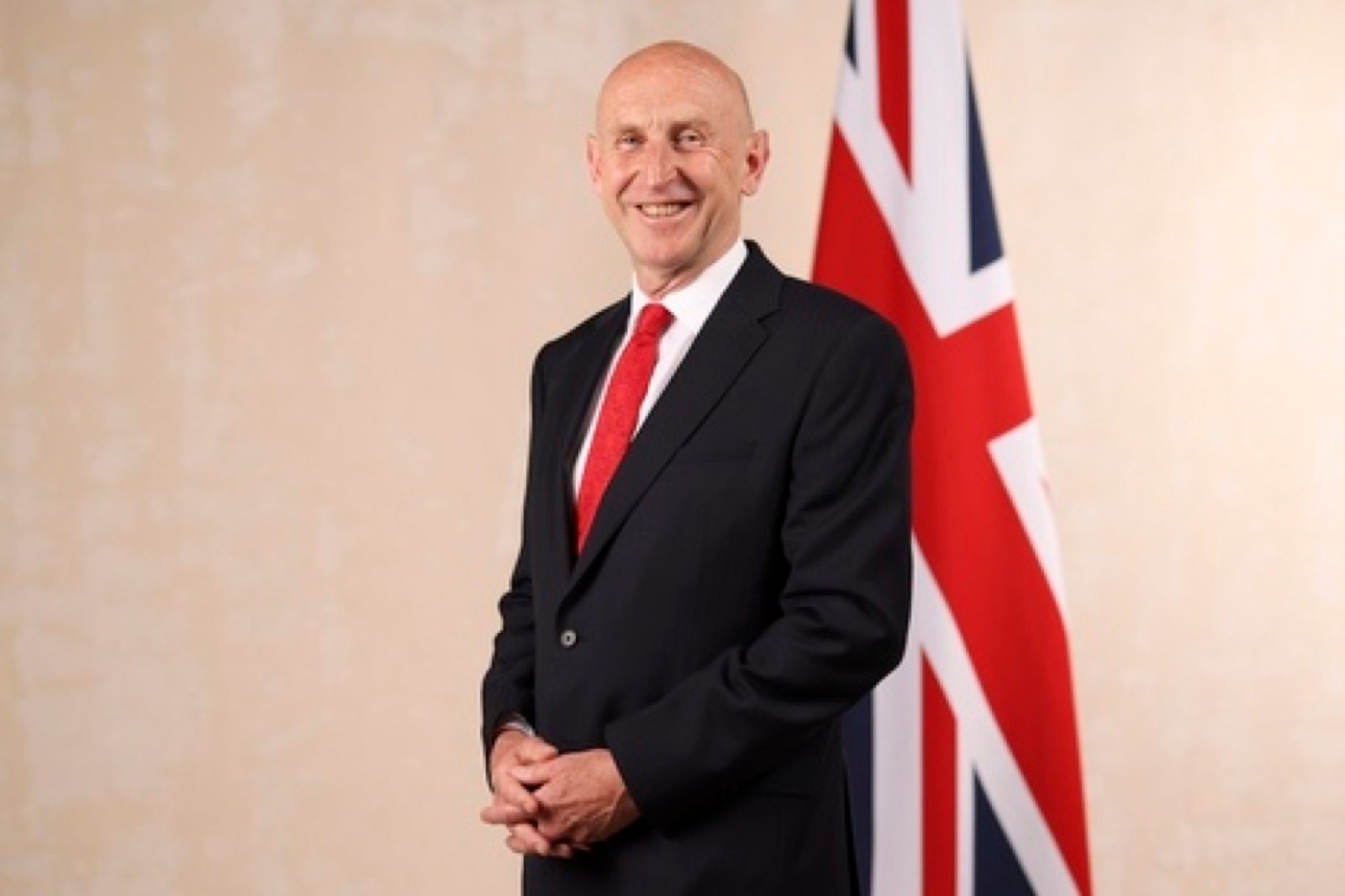
John Healey
John Healey is the UK Defence Secretary and shares his perspective on the NATO summit and President Trump's significant role in the agenda.
Episode Summary
In this week's episode, hosts Kate McCann and Sir Richard Dearlove, former head of Britain's MI6, wrap up their on-the-ground reporting at the NATO summit in The Hague, Netherlands. Kate and Richard discuss President Donald Trump's closing press conference, his statements about an Israeli assessment that the U.S. strikes on Iranian nuclear sites were successful, and the intelligence methods that could support this. Later in the episode, Kate interviews UK Defence Secretary John Healey about his perspective on the summit and President Trump's significant role in the agenda. Plus, Sir Richard and Kate share their favorite moments over the last two days, including NATO Secretary General Mark Rutte's viral moment referring to Donald Trump as "Daddy,” and how a renewed sentiment among European nations for greater defense spending shifted the American president’s attitude towards the alliance.
Episode produced by Situation Room Studios. Original music composed and produced by Leo Sidran.
Listen & Subscribe
- Watch on YouTube
- Listen on Apple Podcasts
- Listen on Spotify
Transcript
COLD OPEN
Healey: This NATO summit, this declaration, this set of commitments would not have happened without president Trump.
INTRODUCTION
Mccann: Well, hello, and welcome to this recording of the One Decision Podcast. We are at the NATO Summit in The Hague. I'm Kate McCann, and I'm joined as always by sir Richard Dearlove.
Dearlove: Hello, Kate.
Mccann: Hello. Yes. We're here together. Well, the summit is wrapping up. It's pretty much in the final moments. We've seen the big meeting of all the leaders. We've seen those press conferences, both the prime minister of The UK, Keir Starmer, and, crucially, Donald Trump's press conference. And so, Richard, I think still one of the biggest questions that people have is about Donald Trump's wrestling the agenda essentially towards his own motives. And one of the things he did at the press conference when he was leaving NATO earlier was to mention this new piece of information he had, this new piece of intelligence about America's attack on Iran. Should we just have a quick listen to what he said?
Trump: A statement came in from the Atomic Energy Commission of Israel. The devastating US strike on Fordow destroyed the site's critical infrastructure and rendered the enrichment facility totally inoperable. It was devastated. We assess that the American strikes on Iran's nuclear facilities has set back Iran's ability to develop nuclear weapons for many years to come.
Mccann: So that was Donald Trump there explaining that the Israelis — it's an Israeli government agency. They've provided him with this new information about how successful the American attack was. Why do you think he chose to do that now?
Dearlove: Well, obviously, it's to counter this assessment that supposedly been leaked in Washington DC. I think it's now been attributed to the DIA, the Defense Intelligence Agency. But to have an authoritative letter which he reads out in public from the Israeli Atomic Energy Authority is pretty authoritative, I think, in its own way and says, look, the Israelis themselves, who are the people most concerned, are supporting more or less what I've said. And I must say when I heard about the assessment published in The States, I was skeptical as to what it actually consists of, you know, whether to take it at face value. I mean, I do have some knowledge about how things work in Washington. And the, you know, the these are highly classified issues. They don't normally leak in quite that way. Maybe you had one sort of maverick analyst speaking out of turn, but saying something like, well, not proven, it could easily be misinterpreted by The New York Times even with their double sourcing.
Mccann: On the one hand, you look at that and you can clearly see this is a man, Donald Trump, who's come into the summit, recognized he's got a bit of a problem, this leaked report by two news organizations in America, suggesting that his attack was not as successful as he had previously said. He's obviously sought additional evidence. He's got it. The difficult question for me listening to the president is he started off by saying, well, nobody can possibly know. Because he said, we've dropped so much ordinance on it so accurately. The whole area is obliterated. And he actually said earlier in the day, well, no one can go into the room where the facility was, the deep, deep facility at Fordow, because we've dropped 10,000,000 rocks on it, and nobody can get in. So how does he balance that? He's now saying definitively it was definitely, you know, obliterated, but in the same breath saying, well, nobody can possibly know.
Dearlove: Well, it seems to me that what they probably do know or what that letter suggests from the Israelis is that it's buried under a pile of rubble. Now if it is buried under a pile of rubble, that means that these very sensitive delicate cascades are almost definitively action. Yeah. I mean, they are disrupted by vibration, let alone having ordinance smashed down on top of them. I'm inclined to accept most of what Trump is saying about the destruction of the program and that to restart it. I mean, he sort of said, well, it could in years be restarted, but it will be very, very difficult. He then talked about some deal, possibly a meeting with the Iranians next week. He was actually saying we're gonna meet them, and I think probably what one's looking in the direction of is some document which is signed, which they forego a nuclear program altogether.
Mccann: But interestingly, I found that whole exchange really fascinating because Trump set up the Iranians essentially for a win there. He said, I don't really care about a new nuclear deal. I've bombed their nuclear sites. I don't need a piece of paper because I've already got rid of the program. And he said if they were to start up this program again, it wouldn't be me that they would have to deal with. It would be another American president who would likely step in and do something about it. I mean, the big unknown is, as you were highlighting there, is the enriched uranium. The Iranians say they have removed it from the site. The Americans say it was still underground and therefore is inaccessible. The Iranians have also come out today and said the sites have been severely damaged. They have an interest in saying that, don't they?
Dearlove: Well, of course, they do. And I mean, there is — okay. There's a note of uncertainty, quite a significant note of uncertainty. I think that, you know, the weight of evidence suggests that the Iranians are in such a position that for the moment, they haven't got a program, and they're unlikely to restart it. I think that's where I would rest at the moment. You know, getting the whole thing restarted is a huge project, assuming that all the ancillary facilities. And look, the other thing is to restart at Fordow, you've got to reenter the tunnels. Now they're gonna have overheads sitting over the tunnels. Anything reentering the tunnel is gonna be a sitting duck to the Israelis. So I mean there is a sort of certain amount of common sense about this. You know, they would have attacked it through the ventilation shafts where there's less concrete and less, you know — if you begin to think about it logically, I think the Americans could be reasonably confident, notice they're reasonably confident, that for the foreseeable future, the project is at an end.
Mccann: How much information would you have as a boss of an agency about something like this? Would we be talking about aerial surveillance from satellite pictures? Because the reality is America cannot put people on the ground. So how would you go about compiling an assessment?
Dearlove: Well, you would have historic human probably. You would have overhead. You would have work done by analysts on the site. You would have sort of progressive photos taken during construction. I mean, that, you know, there would be a very significant file with all the latest stuff added on the top. But given that it's only just happened, I mean, the primary immediate material is gonna be overhead. And there will be additional stuff which is intercepted, of course, from NSA and other. So anything the Iranians have sort of talked about, which is interceptable, will be in the intelligence as well.
Mccann: The other thing that struck me from that Trump press conference, aside from the question about Ukraine and how center Ukraine has been, the discussion about that has been quite a prominent discussion here on the sidelines of NATO. Trump said he met with Zelenskyy, really nice guy. He was very deferential to me, but really very clearly didn't want to be drawn on whether there was any agreement or anything like that. But what Trump did seem to indicate was a shift in his personal feelings towards NATO as an organization. At the very sort of end stages of that press conference, he said, I came to NATO because I had to be here, but I left feeling differently about it. Let's just have a quick listen to what he said.
Trump: I came here because it was something I'm supposed to be doing, but I left here a little bit differently. I said, I watched the heads of these countries get up, and the love and the passion that they showed for their country was unbelievable. I've never seen quite anything like it. They wanna protect their country.
Mccann: So that was Donald Trump talking about a shift, and I think that's probably quite significant, isn't it?
Dearlove: I think it's very significant. And I think one of the conclusions from this summit is that he's probably managed to achieve what was the original US intention was — to get the Europeans to step up to the plate and spend more money. By his account, they're spending a massive amount more. So if we accept there's a general move in the direction now of 5% of GDP, which is huge. I mean, it's the biggest figures in years for NATO expenditure. He's sitting there having solved what he saw as a problem, and he's saying supportive things. He's saying good things about NATO. He's furiously blowing his own trumpet as he does in a quite inimitable fashion.
INTERVIEW WITH JOHN HEALEY, UK DEFENSE SECRETARY
Mccann: It seems like a good moment to bring in our chat with The UK defense secretary because John Healey is here representing the UK government, and I think there was a real nervousness from inside the government in London about this summit, about the Americans, about the unpredictability of Donald Trump. But I started by asking John Healey whether he had also picked up on that change of tone from the Americans towards the NATO summit. Have you sensed a change in American attitudes towards NATO being here? Some people are calling this historic.
Healey: In the political and public debate, historic's often overused, but I think this could be described as that. We've got the 32 nations of NATO stepping up to respond to the increasing threats we all face with a commitment to a new benchmark, a new target of 5% spending by 2035, and that's about core defense. But for the first time, it's also about the other national security elements that are important and increasingly important to us all. But also commitments to developing the capabilities that strengthen the deterrence and keep us all safe. So this is a good day for NATO. It's a good day for British industry and jobs. It's a bad day for Putin. And in terms of the American attitude, so I was with defense secretary Hegseth in February soon after president Trump issued his challenge to the European nations in NATO in particular, and Pete Hegseth came to NATO headquarters to the meeting I'd convened of the organization supporting Ukraine. And he was very clear about the challenge to us all to step up. It was a tough challenge, and he made clear at the time Europe stepping up doesn't mean The US stepping away. And what I've seen, I think, and felt, and it's been there in the main meeting, but also in the side meetings, is a sense from the Americans that they're greatly encouraged by the extent that the rest of NATO have stepped up and are willing to do much more in the years ahead. And that's as it should be. For some time, Keir Starmer and I have been arguing that European nations need to do more of the heavy lifting and that NATO needs to become more European, and it will.
Mccann: So in a way, I mean, not to be reductive, but would you count this as a win for president Trump? Because that's certainly how Mark Rutte is pitching this. You know, this is something that only Donald Trump, the type of president he is, could have achieved.
Healey: I think it's certainly true this NATO summit, this declaration, this set of commitments would not have happened without president Trump. But none of us have done this for president Trump. We've done this because it's necessary, and it's necessary to respond to the increasing threats that we face, to the rising nuclear risks, and that's one of the reasons that we've made this big announcement with the biggest strengthening of The UK's nuclear posture in a generation.
Mccann: You talk about the threat that NATO faces. Many people, including when you speak to some of the Ukrainians who are here, they have been a bit concerned that maybe the issue of Ukraine Russia has been sidelined, maybe partly because there is a concern about American attitudes towards Ukraine in that particular fight. Have you sensed any warming of relations, any more positivity from the American administration towards Ukraine? Because let's be frank, it has been a bit fraught in the past.
Healey: Well, and I speak with the defense minister in Ukraine very regularly. I see president Zelenskyy on a regular basis, and Keir Starmer and I received and spent the afternoon with president Zelenskyy in Downing Street at the beginning of this week. And we did that in part because we recognize that most eyes have been on The Middle East in recent weeks with good reason and understandably. But for Ukraine, it's really important that we don't drop our sight of Ukraine because that's exactly what Putin wants. And so our talks with president Zelenskyy at the beginning of the week before this NATO summit, the big commitment that this NATO summit is making to support Ukraine are all important markers, not just to keep the confidence of the Ukrainians to maintain the courage to fight the Russian invasion, but big signals to Putin as well that we're a large number of nations standing by Ukraine in the fight, willing to stand with Ukraine as well if a negotiated ceasefire can be achieved. But there's much more that we need to do, and we really look to president Trump to help bring Putin to the negotiating table, to negotiate, not to go through the motions and talk talk because in the end, a ceasefire is in everyone's best interest.
Mccann: Are those talks still alive somewhere? We don't really talk much about them anymore. And is it your sense that the more that Donald Trump has seen of that conflict, the more Donald Trump has seen of the reality of president Putin, the more that he recognizes actually being four square behind Ukraine is the best place to be.
Healey: Well, certainly what president Trump, the defense secretary, and the American delegation will have had over these two days of the summit, they would have been part and have been part of discussions in which the argument that Ukraine is the frontline of our European security, the argument that Ukraine needs our support in the fight and the negotiating table, and that the critical leadership role that president Trump can play remains at the center of the prospects for a negotiated ceasefire. He, after all, has opened up this opportunity and the discussions and the urging of many people at this summit, including from prime minister Starmer, from me with our counterparts and David Lammy, has been that The US can pick up that leadership role, can help bring Putin to the negotiating table. If we can get a ceasefire in Ukraine, then The UK alongside the French are also ready to lead the coalition of the willing to help make that a lasting ceasefire, a lasting peace where Ukraine can become its own deterrent against any future Russian invasion.
Mccann: Do you think sometimes America plays this game of making it look like there's one foot out of the door, but actually the reality is America is never going to walk away from NATO. I mean, I'm thinking about Donald Trump's comments on the plane overnight about article five. I mean, I presume that you would say you trust America would be there if called upon. Do you think there is sometimes a bit of game playing to make European nations sit up and listen?
Healey: I don't think America plays a game with NATO. It's too serious for that. And when Keir Starmer first went to the White House in the Oval Office, president Trump said to him in public, I'm committed to article five.
Mccann: And — sometimes he says the opposite then.
Healey: Well, look, fundamentally, the commitment to the alliance, the commitment to the principle of the alliance that attack against one is an attack against all is our collective defense and deterrence. And article five has only been triggered once, and that was in the after 9/11. The terrorist attacks on New York, and every one of the NATO allies responded to America's call and to America's aid at that time.
Mccann: And so the message to America is we helped you. We would expect you to be there for us, I presume?
Healey: No. The message to America is it doesn't need to be said. They're a member of this alliance. They do a great deal of the heavy lifting. They're fundamental to the strength of the alliance and what they're saying to us, the rest of us, is the challenge to you is to step up and do more. We've recognized the case for doing that, Keir Starmer and I, for four or five years. This NATO summit confirms that the rest of NATO is stepping up, and the Americans have always been clear. That doesn't mean them stepping away, but it does mean it will allow them to provide more of the priority focus that they have on the Indo-Pacific. But in the end, the two are linked. And we see this in Ukraine with Chinese technology helping the Russians, Iranian drones and missiles helping the Russians, and North Korean troops actually fighting on the front line because Putin is struggling to get enough of his own people to the front line and has passed this month that really grim milestone of a million Russian casualties killed or injured in this fight.
Mccann: John Healey, UK defense secretary, thank you so much for your time.
ANALYSIS WITH SIR RICHARD DEARLOVE
Mccann: So that was John Healey talking to us at the end of the summit here in NATO. Clearly also feeling optimistic, feeling optimistic about the American involvement, also optimistic about the role of NATO in Ukraine and defense spending, as you've said. But I found it really interesting. He picked up on a point that I've heard you talk about before at the very end there, which is that you cannot see global conflict as isolated, siloed things. You have to see it as one big map, one knotty picture. And that maybe seems to be where Donald Trump is moving.
Dearlove: Well, I think that's the challenge with the Trump administration now. We seem to have been confronted by a series of issues. You know, we've been worrying about each one. We seem to be making progress. We see clear progress now on the solution to NATO, NATO leadership, NATO expenditure. But the point you're making and the point that Healey was making, I think, is absolutely right. For example, you know, you can't sort of sit there and look at Ukraine in isolation. And, of course, as far as European security goes, we're much more concerned about Putin and Ukraine than even we are about the Iranian nuclear program, although that has been a massive destabilizer and threat to world security. I think the crucial issue is that the challenge is to tie Ukraine and Putin into a globalized holistic view of American foreign policy and not to sort of put it in a separate package and say, I've got a great relationship with Putin, and we're gonna solve this problem. Because it doesn't really fit if you make that sort of description of it.
Mccann: Talking of great relationships, and we should close out this podcast from the NATO summit by talking about our highlights, I think. And I will go first, give you time to think about yours, because I know there've been quite a few. Mine is an odd moment. I think you probably know what I'm going to say next. I think Mark Rutte has had a really good NATO. He's a secretary general. He's clearly prepared for this conference. He narrowed the terms. He narrowed the talks right down to the crucial issue of money, and he managed to come out of it despite having his messages leaked on the Internet by Donald Trump looking like a man who knew what he wanted. And if it takes deference to get there, then fine. That's okay. But for me, he overstepped the mark just ever so slightly by calling Donald Trump daddy at a press conference. And I have to tell you, all the way through the rest of the day, every press officer, every official, every journalist I've encountered have been saying to themselves, who would you call daddy? Who do you think's mommy? Who do you think's cousin? In a quite disturbing way, so much so that it almost came up at the Keir Starmer press conference. I had my hand up, but the prime minister looked at me and sadly walked away. Otherwise, he might have got a question on it. That's my highlight.
Dearlove: Well, it was in the context of two children fighting, wasn't it? Iran and Israel being two. I rather wish you had said big daddy, and I wish I could remember which movie that comes from.
Mccann: Well, I'm sure we can look it up. We can look it up where there's a woman there's a sort of patron figure and she's referring to him as big daddy. I'll look it up for you. Anyway, and I've got it clearly in the back of my mind. And we just talked there about my favorite moment. It was the daddy moment, and Donald Trump was asked about it. Have a quick listen to what he said. NEWS CLIP [21:34] Do you regard your NATO allies as kind of children?
Trump: No. He likes me. I think he likes me. If he doesn't, I'll let you know. I'll come back and I'll hit him hard. Okay? He did it very affectionate. He daddy, you're my daddy. NEWS CLIP [21:50] Do you regard your NATO allies, though, as kind of like children? And they're obviously listening to you, and they're spending more, and you're obviously appreciative of that. But do you hope that actually they're going to be able to defend themselves, defend Europe on their own without —
Trump: I think they need help a little bit at the beginning, and I think they'll be able to. And I think they're gonna remember this day. And this was a big day for NATO. You know, this was a very big day.
Mccann: It's typical Trump, isn't it? And I applaud the journalists who asked that question of him. It's good to tax him on it because he should be pressed at these about these extraordinary moments.
Dearlove: Yeah. What a moment it was. I honestly think that the person who comes out of this really well is Rutte, and I think that Rutte has done amazing chairmanship. And what he's done is prepared the agenda by making sure that the big disagreements were not public, that they've taken place outside the arena of the summit. I mean, for example, dealing with Spain. And he's managed to present NATO in a solid alliance at a time when, let's face it, it's been through massive crises. The other bit I liked, we've just seen it in the press conference where the Finnish correspondent had asked Donald Trump about playing golf with the Finnish prime minister, and Trump ends up speaking about buying icebreakers. It's extraordinary to watch Trump in these press conferences. You know, no other leader in any of our experience has been able to do anything like that. It's hilariously funny, but it also has a deeply serious aspect to it.
Mccann: Yeah. And I think you're definitely right. We agree. And I can hear the helicopters taking off behind us, which means Donald Trump's probably on his way.
Dearlove: Which means that's our cue to leave as well. It's been great being at the NATO Summit with you. Here's to the next one. It's been really educational observing the sort of morass around world.
Mccann: Lot of running around between places, lot of chasing after politicians. Extraordinary. Very, very interesting. That's it for this special edition of our One Decision Podcast from the NATO Summit. Make sure you check out all of our other podcasts. We've done a couple while we've been here, we've done plenty more before that on the website or on YouTube, wherever you get your podcasts from. And we will be back next week with a new episode for you.