Hosted by Christina Ruffini and Sir Richard Dearlove
Guest
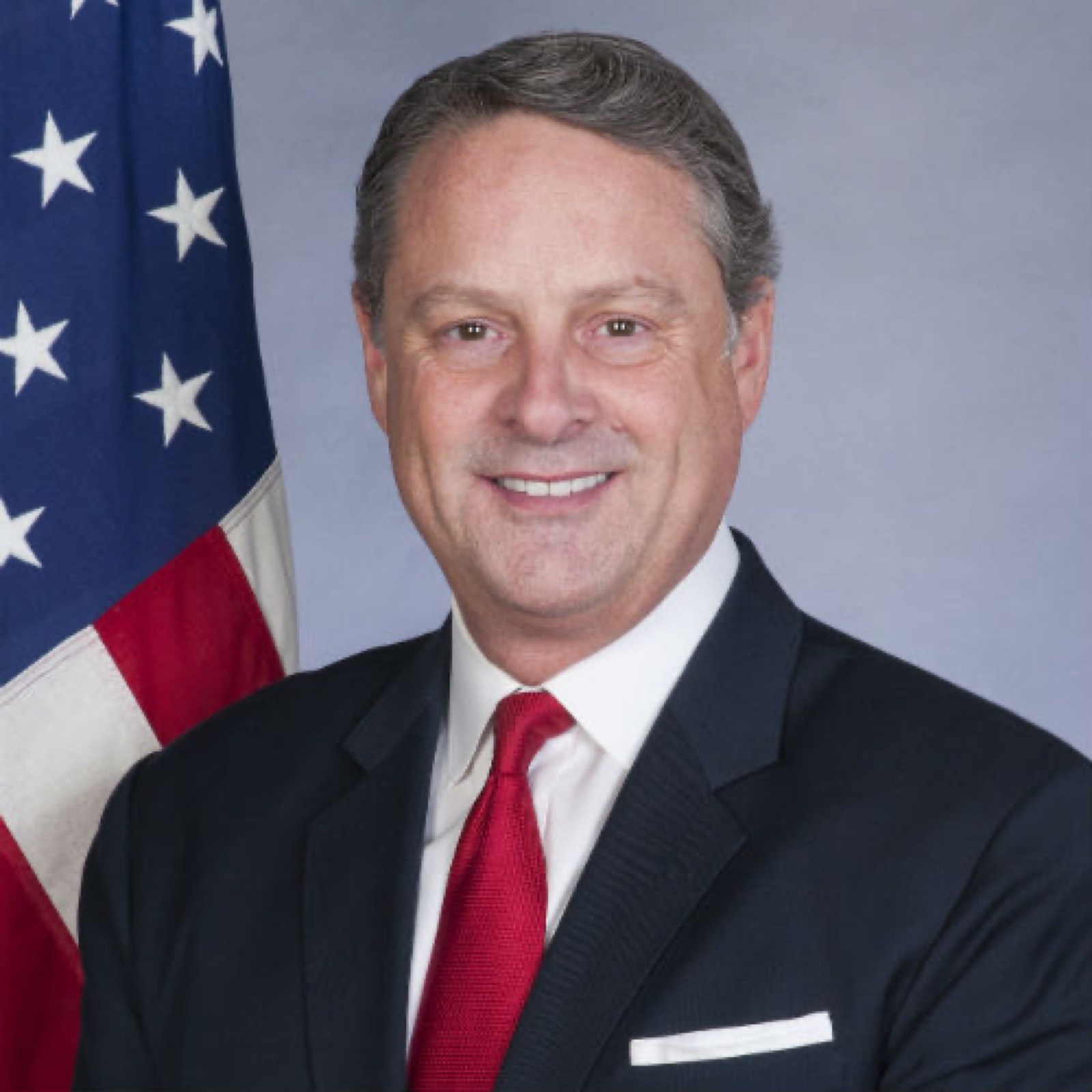
John Feeley
John Feeley is a former U.S. Ambassador to Panama (2015-2018) who resigned under the first Trump administration. John Feeley offers an insider's perspective on Venezuela's transition and China's influence on the Panama Canal.
Episode Summary
Former US Ambassador to Panama John Feeley joins guest co-host Sabrina Singh and Sir Richard Dearlove to discuss the Trump administration's turn toward Latin America.
Ambassador Feeley served as US Ambassador to Panama from 2015-2018 and resigned under the first Trump administration. He offers an insider's perspective on Venezuela’s transition of power to Delcy Rodríguez, China’s influence on the Panama Canal, and the collapse of traditional American diplomacy in the Western Hemisphere.
Listen & Subscribe
- Watch on YouTube
- Listen on Apple Podcasts
- Listen on Spotify
Transcript
COLD OPEN
Feeley: They make the call that they're gonna go ahead and leave the regime in place. So as you say, it's not regime change. It's simply change of the top dog. I'm not sure if this sort of is linked more to a neocolonial, geostrategic strategy or just simply being a good mob boss from New York City where I grew up along with Donald Trump in the 1970s and eighties. But that's what we have today.
INTRODUCTION
Singh: Hi, and welcome to One Decision. I'm your guest cohost, Sabrina Singh, former deputy Pentagon press secretary. I'm joined by One Decision host, sir Richard Dearlove. And today, we're sitting down with someone who has operated at the highest levels of American diplomacy in Latin America, John Feeley. He served as The US ambassador to Panama from 2015 to 2018, and he made headlines when he resigned under the Trump administration. Welcome to the show.
INTERVIEW
Feeley: Well, thanks so much for having me.
Singh: We would love to just jump right in and talk about Venezuela through the Panama lens. I'm curious your thoughts. You know, so many people make comparisons to what happened in 1989 and the parallel to Manuel Noriega. And as you know, well, in 1989, you know, you had US troops go in. Noriega was removed from office. It was a successful intervention, but, you know, there was a key difference there in that The United States did install the opposition leader, I think, on 12/20/1989. And I'm just I'm sort of curious on your thoughts at this moment given your most recent position in Panama.
Feeley: Sure. I think when you look at similarities and differences and you sort of do the, you know, the rack and stack of them, there are two big similarities that jump out at everybody, and it's understandable. Both countries had come under the sway of a really malevolent, horrible human rights abusing dictator, and both dictators were removed by US military force. I have to be honest, that's about where the similarities end. Let's take a look at some of the differences. In Panama, which is a country of about 3,000,000 people at the time, 12/20/1989, as you mentioned, which was the night of the invasion, and United States already had military presence there in the form of US military bases, army, air force, and navy bases, all in the Canal Zone. Remember, this is still about a decade before the handover of the canal back to Panamanian or to Panamanian sovereignty for the first time. And even with the presence of those military members there, The United States sent an invasion force of close to 30,000. So the numbers were overwhelming and the point of the operation, which was where Colin Powell, who was the chairman of the Joint Chiefs at the time, invented his famous sort of, you know, idea of the Powell Doctrine. You go in with overwhelming force for very well defined military objectives, and then you get the hell out. And that's what The United States did. There was a genuine counter narcotics charge that was leveled against Manuel Noriega. He was removed, and then he was brought back and tried. And as you mentioned, Sabrina, there was a transitional president, who was sworn in. And keep this in mind, Panama under Manuel Noriega had declared war on The United States and begun to kill uniformed American service members in Panama. So very different pretext. Now let's move over to Venezuela. You have a very malignant dictator who is involved in narcotics trafficking. That's the similarity. Then what's the reason for removing him under Article two of The United States Constitution that narco boats a thousand miles from US shores present an immediate danger to America or American citizens? It's a little bit different in terms of the immediacy and the clarity of the reason than American soldiers being shot and killed in Panama. Second huge, huge difference that you have to understand is that the motivation for the operation is questioned by most legal analysts of international law and constitutional law, And that pretext sort of went away when we saw that the superseding indictment in New York for Nicolas Maduro dropped the charge that he is the head of the Tren de los Soles. You have a kind of a false pretext. Remember, nobody in the Trump administration said regime change from September 2 until January 3. They always said very carefully, and even Marco Rubio insisted after the operation had happened, this was the United States military in support of a law enforcement operation. Well, where we stand today at January 16, nobody believes that. So very, very different scenarios.
Singh: Well, I think you just pulled an important thread there of that the administration's justification for Venezuela did start with this idea of narco trafficking and narco terrorism and the blowing up of those, you know, those strikes on different speedboats. And then all of a sudden, it evolved into oil. And then, you know, when the president came out, with his members of his National Security Council and talked about this being a law enforcement operation, I think we can all agree that this would probably be the most expensive law enforcement operation in history. But also, you you know, you didn't even have the representatives of law enforcement such as, you know, the attorney general or, you know, the head of DHS in in the room for that. So so the justifications, of course, that this administration gives have evolved over time, so I'm glad you pointed that out.
Dearlove: I don't think any of us are surprised by the difficulty of justification. I mean, this is power politics. But one thing I find fascinating about the removal of Maduro is he's removed without regime change because, you know, Venezuela is a very complex country, very large. So basically, take Maduro out of the equation, and then you leave the regime in place who has a degree of authority and control, but you pressurize them. I mean, I think what's interesting in terms of sort of geopolitical lessons, if you go back to things like Iraq let me give you the parallel example. I argued, and I was heavily involved in the Iraq issue, that we should have left the Iraqi military council and the Ba'athist administration to run the country as it were under direction rather than creating a void which was then filled by Fedayeen. And in a way, there's an aspect of Venezuela which I find quite subtle and quite clever. They're leaving the government there. That means there will not be, as it were, a vacuum and loss of control, and yet, you know, pressurizing the government to take decisions which are gonna be, as it were, driven partially out of the White House. I don't I mean, I'd be very interested, John, in your observations on that because I haven't seen many commentators make this point.
Feeley: No. I think you put your finger on something very interesting, Richard, and obviously your experience back then is instructive. At that time, just for sort of context, I was a staff officer to Colin Powell back in the early two thousands. I remember very well. And I think boy, very well did meet as a matter of fact. It was one of those relationships where I remembered you, you didn't remember me, and that's perfectly fine. That's the way bureaucracies work. But, no, you put your finger on something. I do wanna sort of pull on the thread a little bit. So you have Donald Trump run for office for the second time in 2024, and he is sort of a dyed in the wool isolationist. Foreign wars. Joe Biden blew Afghanistan, and there's all sorts of criticism. And he gets very, very high marks within his MAGA base for no future foreign adventurism. So you have this MAGA corps in America that doesn't want to go to war. That's represented by J. D. Vance and others. You have Trump run on it, and then within a year, he's clearly got us involved in another, what I would consider to be a neocolonial episode, or at least he attempted a neocolonial episode in Venezuela. But some of the folks in his environment remember very well what you just mentioned. Jerry Bremer famously wore boots with his suit, so it was boots on the ground in a very visual way. But Jerry Bremer made the decision that we were going to do de-Ba'athification, and that frankly was the one Jenga piece of the puzzle that when you pulled it out, the whole apparatus of the Iraqi state fell down. And as you said, you fell into chaos and clans fighting and Fedayeen, and this is the roots of ISIS. Right? So they don't want to make that mistake. And so while Marco Rubio babbles on about democracy in Venezuela, which Donald Trump could really not care very much about, they make the call that they're going to go ahead and leave the regime in place. So as you say, it's not regime change, it's simply change of the top dog. I'm not sure if this sort of is linked more to a neocolonial, geostrategic strategy or just simply being a good mob boss from New York City where I grew up along with Donald Trump in the 1970s and eighties. But that's what we have today.
Singh: You know, I think sir Richard brought up a great point and that you also made it just about the changes that we're seeing with this administration and how we kind of view not just democratic values, but, you know, transitions and changes that happen in different countries. So we have the acting president of Venezuela, Delcy Rodriguez, and then we have Maria Corina Machado who just met with president Trump. I'm curious of your take on both of these two leaders and how you see them playing in Venezuela, in the current state that the country is in right now.
Feeley: This is obviously a malignant regime that is really not so much a government as it is a criminal syndicate masquerading as a government that operates by fear. Again, I think the mob analogy, the mafia gangland analogy is quite apt. In that environment, Delcy is an exceptionally skilled survivor. Keep in mind, she's educated. That makes her different from most of them. Her father was an inveterate ideological communist who was killed in prison on the orders of the CIA according to her. I don't believe the CIA ever said kill him, but as the way things worked in the fifties, sixties, and seventies, the CIA would wink, Latin American strongmen would act, and she blames The United States for that. This is a woman who has a very personal animus against The United States, against imperialism. She speaks French. She speaks English. She's been around the world. And she fell afoul of Hugo Chavez, and Chavez kind of exiled her. She never had any serious positions there. When Maduro gets in after Chavez dies, he spots her and says, you know what? I need her on my team. And she does a yeoman's job for him. She's credited with stabilizing the economy amidst the American sanctions. She is described by all of the international businessmen who meet her as alternatively charming, ruthless, diligent, etc. It's not very surprising that she would get along well with Donald Trump if she is willing to forego that ideological socialism, anti imperialism. On the other hand, you have Maria Corina Machado. This is truly the iron lady of Venezuelan democracy. She's hung in there. She's never left the country. Her family's in exile. She herself has been physically beaten up when she was an assemblywoman in legislature, and she is the absolute extreme of no quarter for Chavismo, for the Maduro regime. She has undermined opposition attempts over the years at negotiations, and she is just, you know, sort of the untarnished beacon of democracy, neoliberalism, and capitalism. The fact that the president would give her the bum's rush yesterday, literally tell her in not so many words he wants the Nobel Prize and that she would go ahead and then give it to him. It's a horrible debasement of Maria Corina Machado. I can tell you, I speak to many people in the opposition, they are destroyed by this. Many are now scrambling to put the best face on it and say, well, this is realpolitik, you know, you play with the cards you got, not the ones you wish you had. But the fact that she has done this and the fact that it's pretty clear the Trump administration is not going to facilitate her return to Venezuela, and even if she gets back in by paying some, you know, mercenary group to smuggle her back in, it's pretty clear the regime would imprison her without much complaint from the Trump administration. I hate to say it, but I think she has begun her sort of dying on the vine act. I hope I'm wrong, and I'm wrong many times, but that's how I see the future.
Dearlove: I'm surprised you make that judgment because I would have thought, let's say Rubio, who is the national security adviser, is subtle enough. The argument would be wait eighteen months, two years, pressure the regime, then hold the democratic election when Machado would have to run. So I would rather hope that by not hurrying in the direction of regime change but letting democracy do its work, because it was quite clear, of course, that Maduro lost the last election catastrophically, and then fixed the result, of course. And it would be very difficult to have an election and, as it were, allow the regime to do that again. But, anyway, look, one of the things I'm really fascinated by now is what the geopolitical follow ons might be from what's happened in Venezuela. And, I mean, the two countries that sort of immediately spring to mind for me is, you know, the impact on Cuba in terms of Cuban oil and what impact that's gonna have on the Cuban economy, and of course, the position of China in the region, and you know, what China feels its options are now in Donald Trump's back yard as it were. So I'd be very interested using your experience, John, to hear what you feel those, you know, in those two. I mean, before we get on to the Panama Canal and CK Hutchison and some of those issues.
Feeley: Yeah. Certainly, sir Richard. Let me just come back to one thing before we take up Cuba and China on the election scenario. I hope that your vision or the possibility you outline of Marco Rubio being that subtle and that persuasive comes to pass. I genuinely do. But think of your own experience in Iraq. What does it take to hold an election? Above all, it takes security on the ground. And right now, the arms on the ground are in the hands of Delcy. Why would Delcy order security on the ground absent a US force? Why would she order the election that's gonna remove her from power and probably put her, if Maria Corina gets in, in the accused box, in an international court. I mean, she doesn't have an ICC charge, but a number of the others do, including Diosdado Cabello, who is the strong man security guy who actually does control the arms on the street. So I think security is a big issue. Delcy's willing to provide security on the ground for a few oil wildcatters to go in there and for Chevron, which is one of the only real majors that's there now and working, and maybe Repsol as well. But I don't think Delcy is going to be the artifice of her own destruction by providing and ensuring security for an electoral process and a full transition. Moving to Cuba, I think the term I used earlier was dying on the vine. I think Trump himself said that, and I think that's the plan. You know, these guys in the Trump administration, they're by no means classicists, but they certainly have studied the lessons of Thucydides and Julius Caesar's siege warfare. When you put a blockade on the ghost fleet coming out of Venezuela with its crude, you effectively starve Cuba. Cuba's been in horrible shape for a long time, fully independent of the American embargo. It contributes, but it's certainly not the prime mover. And you've seen Diaz-Canel in Cuba and the Cuban regime making all kinds of noises about how they're going to survive on revolutionary spirit, but, you know, you can't eat revolutionary spirit. And so I think they probably have the right, and just yesterday we saw the Trump administration up its rhetoric against Cuba, which is sort of surprising to believe. Spinal Tap had a line of, you know, why don't you just go to eleven on your rhetoric against Cuba? Well, they went to eleven yesterday, and I think they'll keep doing that, but they don't have to invade. So he took a huge domestic political risk and it paid off. You know, he bet it all on black and his number hit on the roulette wheel, and he's reaping the rewards right now. But he doesn't have to make that bet in Cuba. I think you'll just see the consistent siege of Cuba by the tightening of the oil. I don't think there's gonna be any kind of revolution in the Cuban streets. Despite Marco Rubio's desires, I think that will be a long and relatively slow atrophy of the Cuban state's control. Beyond that, I'm not sure what the Trump administration would be willing to do because Cuba doesn't have all that much that The United States wants. It certainly doesn't have the kinds of resource riches that Venezuela does. On China, we all know their exposure to the region is commercial. Now it is dual use commercial. There's no question about it. They use it for their intelligence purposes, both national security intelligence and business intelligence, you know, for intellectual property theft, things like that. I think that the Chinese who are owed billions of dollars by Venezuela probably long ago realized that they weren't going to be repaid. They're certainly not going to be repaid with Donald Trump controlling all of the oil wealth that comes out of Panama. But I think there may be an aspect that they take comfort from if you ascribe to the spheres of influence belief about how Donald Trump certainly sees the world. I'm not sure he's held the Yalta conference to be able to sit down with Vladimir Putin and Xi Jinping and say, all right, you get Asia, you get Europe, I get The Americas, but that's certainly how Donald Trump acts. And we know that China's big obsession is its own near abroad, which is Taiwan. I think they probably feel that if, as stated in Xi Jinping's congress speech, his annual speech, to, you know, to their committee, he sees, as they always have, the reunification as being inevitable is the word that he uses. I think this may have made it a little bit easier. One argument against that could be that they saw the prowess of the US military in that operation and they thought, even if there's only a 10% chance that Donald Trump might react poorly to a Chinese invasion or takeover of Taiwan, if they do react, they at least, the Chinese, have a very real understanding of the capability of the American war machine.
CHINA AND THE PANAMA CANAL
Singh: I think you make an interesting point about China and knowing sort of US military capability. And I think certainly the operation on January 3 showed the incredible sophistication that our military can conduct an operation like that. And then, of course, you know, when we joined Israel in the strikes against Iran, again, that was a showcase of US military might. So it does, it is a signaling to China, and it's also showing, I think, China that we are, what are we not focused on in the Indo Pacific, which I think opens up certainly more avenues for China as it looks to reunify with Taiwan at some point. Because we're talking about China, and I know sir Richard brought up CK Hutchison. And I'm curious, you know, there is this supreme court case moving through in Panama. Can you give us a little background about that case and also the Chinese influence in Panama over its critical infrastructure and why this administration and Donald Trump is so focused on the Panama Canal when it comes to the lens of China, of course.
Feeley: CK Hutchison, Hutchison Holdings, worldwide port operators, worldwide conglomerate, richest man in China, Hong Kong based, gets two of the five port concessions in the Panama Canal way back before the turnover in 1999. The United States actually signed off on it. We were still operating the canal when they got the original. The two ports Hutchison has are outside of the canal. They don't control the gates to the locks. They don't control the transshipment of the ships. That contract was renewed by then president Nito Cortizo. Quite frankly, Nito Cortizo was a sick old man who was hiding behind a mask. It was his vice president who was running for office in the next election, Gaby Carrizo, who oversaw the renegotiation of that contract. There were any number of alleged irregularities to include the fact that it didn't go to an open solicitation. It was a closed door Hutchison, Carrizo, and, you know, the associated, what's called the Panamanian Maritime Authority, which is in charge of negotiating those use contracts. They don't control, they don't own anything, but they have the right to operate it and make money operating it as long as they pay money back to Panama. Well, the new Molino government, which came into office in 2024, among the first things it did was say that was a corrupt, improper public concession that was renewed for Hutchison. And in addition, since 1999, for the last two decades plus, they've been ripping us off. There was alleged that there were billions of dollars that weren't paid under the original concession that had been granted. All of that goes to a long, long investigation. The investigation is then presented to the Supreme Court, and the goal of the investigation is that this contract should be abrogated. And they put it to the Supreme Court to find out if indeed the contract is legal. And the betting in Panama is that the decision of the Supreme Court will go against Hutchison and that the government of Panama will thereby be legally empowered to abrogate the contract. When that happens, I have no doubt according to my sources in Panama that there will be a seamless handover to continue the operation of the two ports, Balboa and Cristobal, and there will be, they'll probably split them because they'll make more money if they offer two new concessions. The loser in this, frankly, is not CK Hutchison because Hutchison wanted to sell it in the first place and had a deal with MSC, huge Italian shipping conglomerate, and BlackRock, the American hedge fund, to transfer the sell or transfer the concession. That was stopped by Xi Jinping several months ago, who said, wait a minute, wait a minute, you can't do that. I want COSCO, the large Chinese shipping conglomerate. I want them to have a stake. And indeed, Xi Jinping in his own sort of power politics place said, I want them to have a majority stake. Well, that didn't go anywhere. That's sort of sitting on a back burner while everybody waits for this court case to be decided, and hopefully we'll have an answer to that pretty soon. When that happens, I believe that that will be sufficient justification for Donald Trump to go, see, on January 20 in my inaugural speech, I said we're going to take back the canal. We took back the canal. The Chinese are out. And point of fact, it's really sort of smoke and mirrors and political rhetoric, but for world consumers, certainly for consumers on the East Coast Of The United States where most of the North Asian manufactured goods flow through at the lowest possible cost, it'll be good news. And it'll be good news for Panama because it'll be business as usual.
Dearlove: There is a general point that lies behind this, which I think is quite important. Maybe in terms of your interpretation of what's happening, it's no longer relevant in Panama. One of the criticisms or dangers of dealing with CK Hutchison and COSCO and these big Chinese port companies is that over time they are constructing maritime port facilities in a manner which makes them only compatible with Chinese built ships, so that you have this huge maritime blue water building program. And China, as we know, are brilliant at creating dependencies. So what you find isn't just a sort of domination of their presence, but you find that if you want to transport something quickly, you have to put it in a Chinese ship because the port facilities won't fit an Italian ship or a Panamanian ship or whatever it is. I mean, do you think this issue applies in Panama at all?
Feeley: It's a marvelous point, sir Richard, and you're absolutely right. We've seen this in places like Djibouti. We've seen it in Africa. We've seen it in Southeast Asia. One of the great things about little old Panama is they, you know, they kind of learn how to do business with pirates and angels. And the canal operators, the Panama Canal Authority, is truly perhaps the only institution of Panama's democracy, which isn't so bad compared to regional standards, but that is the one institution that has really never been corrupted. They run the place efficiently. They run it for the Panamanian people and state. And the difficulty or the thing that I think will be very hard for and probably what keeps Jose Raul Molino, president of Panama, up at night, is once Trump claims victory in Panama, right, which he will present to his MAGA supporters as The United States running the canal. Most folks won't dig much further than his truth social post, and everyone will be happy. The Panamanians are smart enough to go, yeah, yeah, yeah, let him just let him say that. Just let him say that. Molino, I suspect his next worry will be, well, what else does the rapacious, seemingly, you know, insatiable Donald Trump want here in my little country? And I just don't have an answer for that right now. But kicking the Chinese in the shins even further might be part of what he does see in Panama if he chooses to look at it.
THE STATE OF AMERICAN DIPLOMACY
Singh: It does seem that this administration, you know, depending on how the court case goes at the Supreme Court level in Panama and how it unravels for CK Hutchison, will take it as a win and spin it to the American public that this is exactly what I promised. But as you rightfully point out, there's a lot more there to sort of unpack. Just given your expertise in the region, I would love your kind of 30,000 foot view of just diplomacy and where it stands. We had a purging or mass recall of ambassadors at the end of December in 2025, from all around the world. We're seeing the president threaten military action in Colombia going after cartels in Mexico. Of course, we're seeing an expansion of military prowess with our joint strikes with Israel and Iran and then this potential idea that we're gonna just take over Greenland. But there's a clear focus back on the Western Hemisphere and the so called Monroe doctrine. And I would just love your thoughts on kind of where we go from here and the impacts that you see this having on diplomatic relations with The US and, you know, countries in that region and with our allies.
Feeley: You know, as Richard knows, diplomats are famously cynical and I always try to, you know, pose a cynical front. But I have to be very honest here, Sabrina. The state of diplomacy, American diplomacy in the hemisphere is almost moribund and it's personally very painful to see. If you look at US national strategic doctrine, not the recent strategy issued, but our doctrine since the end of the second world war, we have always used the acronym DIME as the sort of shorthand for the instruments of American national power and power projection outside The United States. And that acronym stands for Diplomacy, Information, Military, and Economic Power. I think it's fair to say that in the first year of the Trump administration, it is now ME, military and economic. And I would also say ME, Donald Trump. There really is no professional diplomacy that's going on. What there is are a host of his crony friends. These guys are three talking points deep on everything. Now there is an advantage to that when you back it up with task force one hundred sixty and ten, twenty percent of US military prowess sitting off the coast of a country because you don't really need to be PhD level or Oxford first level if you've got guns, right? And that's what Stephen Miller said the other day. He said, you know, power. These are laws of history. Well, yeah, but it brought us to a very bad place. So diplomacy, I think, has been completely neutered. All of the ambassadors that run the 20 plus missions in Latin America are political appointees. Most of them are woefully unqualified for their positions. Take a look at the diplomatic aspect of humanitarian work and soft power. Completely rejected and the entire apparatus by which we used to conduct that work, USAID, completely taken down over a weekend by a bunch of DOGE kids with computer codes. Trump administration, the Monroe doctrine, I always like to say it's Thucydides. Just go back to the Melian dialogues. The strong do what they will, the weak do what they must. We've heard that a number of times. I don't think there's a doctrine there. I think there's an instinctual understanding of that. I think Stephen Miller may have actually been right when he said that these are laws of history. From the time of organized society, we do see the powerful try to impose their will over the weak. But the best of mankind, the best of western liberal democracy, the best of American exceptionalism, if you will, indicates to us that self restraint, checks and balances, all of the things Trump administration has destroyed, is what provides for better outcomes for a broader majority of people. Right now in the Western Hemisphere, I don't see them trying to do that at all. I see a neocolonialist rent extraction plan that's starting in Venezuela.
Dearlove: I think I would give it a bit more historical context and say there has always been, you know, this strongly isolationist aspect to American foreign policy, which of course has been in abeyance for a good chunk of the latter part of the twentieth century, and actually before that there are quite a number of examples of sort of US power as opposed to US diplomacy. But of course the world that John and I have got used to professionally is the one that he describes, and it's abrupt, and it is abrupt, its disappearance for many of us is a severe shock, and it does have significant downsides. What I find fascinating is I think there's a sort of split in Trump's administration because I detect in Rubio and some of the people around Rubio that there's almost a nostalgia for what John's talking about. Okay. Maybe they are not able to express it because this is a solid administration, but it seems to me that the isolationists, strangely are what you now call in the Department of War, the less isolationists, let's be charitable, are in state departments. So you've got this rather peculiar juxtaposition where you would expect it maybe to be the other way around, but I'm not really disagreeing. I think the thing that someone like me who spent an awful lot of time talking to people in Washington, despite the always hard nosed of American power, and that's there even within the special relationship. There's a sort of civility about, in my book, about the way The United States has conducted itself, particularly in relation to its allies. And I think what I find a little surprising, and I guess that's pretty good British understatement, is the way that that civility has been abandoned by the White House. And I do find that really takes me back. Because, I mean, let's say I had a lot of dealings with George W. and Condi and all the other people in that period, was in and out of the White House, saw them frequently, talked to them a lot, and that there was a sort of civility about the exchange even when we had severe disagreements, which we did, and that seems to have disappeared, and I'm worried about that.
Feeley: I would agree a 100% with you, sir Richard. One of the reasons why Donald Trump came to office was that he ran against the deep state. He has really weaponized language about elitists in the federal government, across all agencies, but in particular in the State Department, in the CIA, and in the senior ranks, not the junior ranks, but the senior ranks of the Pentagon. And by lashing out at them, by making some of his first moves when he got into office, which as president, has the prerogative to do, firing a number of service chiefs, whacking just through senior intelligence officers, going through the state department. He sent a very clear message that these elitists were no longer in charge. And some of the nativists that you described, the Bannons of the world, the Millers of the world, who are very educated men themselves, make no mistake, but who represent a very uneducated constituency. Those folks provide the intellectual top cover for demonizing, if you will, an educated elite that ran the foreign affairs of The United States for about eighty years. And that change in tone is one that leads somebody like me and you who are so easily caricatured as pearl clutchers, as, you know, sort of effete academic elite removed people who, you know, oh dear, how could he say that? I find that the Trump administration has been enormously successful in not only changing the tone, but as we can see here, changing the actions in such an abrupt fashion that most of the world is still sort of catching its breath in, oh my God, what just happened? And because it happened so fast and because it happened so surgically, I think the danger that we run is that a lot of people will forget the sort of fact that, you know, our thing, to use mafia terms, our thing for eighty years kept this world pretty free and safe, and they will normalize this new scenario of a sort of rapacious crony capitalism in the service of a small group of Americans and not the American people.
Singh: Well, John, that was, you've given us a lot to think about, and that might be the perfect place for us to wrap. Thank you so much for your time and talking us through what is an incredible moment in history for The United States. So thank you. Thank you, John. Very interesting. Fascinating.
Feeley: A real pleasure, Sabrina. Sir Richard, thank you so much for the conversation.
Singh: For more conversations with leading decision makers and thinkers, check out onedecision.com and our YouTube page where you'll find additional commentaries, conversations, and explainers. I'm Sabrina Singh, and thank you for listening.