Hosted by Christina Ruffini and Sir Richard Dearlove
Guest
Episode Summary
Everyone is calling it another Iraq. Sir Richard Dearlove disagrees. In this episode of One Decision In Brief, the former MI6 chief makes the case that what's unfolding in Iran may be something different: the final chapter of a decades-long conflict, with a window for the United States to actually close it.
Sir Richard and guest co-host Baroness Ayesha Hazarika break down the military logic — why Kharg Island is the likely first target, what securing the Strait of Hormuz would actually take, and whether a ground operation could stay limited. They also assess Iran's internal fractures, Russia's quiet role, China's conspicuous absence, and what the Gulf States really want from Washington right now.
Is this the moment the West finally resolves the Iran question, or the beginning of something far worse?
In this episode:
07:09 Uranium Extraction Scenario
09:14 Avoiding a Land Quagmire
10:58 Trump’s Legacy Calculus
11:52 Russia Helps; China Absent
13:39 Will Gulf States Choose America?
Hosted by Sir Richard Dearlove (former MI6 Chief) and guest co-host Baroness Ayesha Hazarika (House of Lords)
Listen & Subscribe
- Watch on YouTube
- Listen on Apple Podcasts
- Listen on Spotify
Transcript
COLD OPEN
Dearlove: I think Trump personally has decided to go for broke and that he wants to go down in history as the American president that solved the Iranian problem.
INTRODUCTION
Hazarika: Hello, and welcome to One Decision in Brief. I'm your guest cohost, Baroness Ayesha Hazarika, and today, I'm delighted to be joined by Sir Richard Dearlove.
Dearlove: Hi, Ayesha. Well, we've had a pretty buzzy few days on the international scene, haven't we? I mean, it's been quite extraordinary.
Hazarika: It is. How's your war going so far?
Dearlove: Well, it's so difficult to track and to follow because you get these extraordinary statements coming out of the White House. And I don't think anybody really knows whether Trump is speaking for effect, speaking the truth, or just riffing in the way that he does sometimes.
Hazarika: It is genuinely quite exhausting trying to keep up with everything because things are moving so quickly, and there's always so many different developments. There's part of me that thinks he knows the reaction that he commands, and he knows that we all hang on his every word. And I think some of it is done to kind of scramble with all of us as well. I think some of that is deliberate, to sort of send us off in lots of wild goose chases.
Dearlove: Yeah. One's just not sure, you know, whether it's a very clever act or whether it's just him riffing off the cuff all the time. So some days, I feel he's an idiot savant who just instinctively gets certain things right. And other days, I think, oh my god. This is impossible to have someone in such a powerful position who is so irascible and unpredictable.
Hazarika: Anyway, we have to live with the reality and not wish for something different because that's what we've got.
INTERVIEW
Dearlove: Yeah. Exactly. We have to deal with the world as it is, as we find it.
Hazarika: Look. Let's turn our attention to, of course, the war in Iran and a lot of discussion around this sending of troops to the area, about three and a half thousand American troops moving to the area along with others stationed there. And it feels like a lot of military commentators, Richard, are saying that it feels like this is pitch rolling for some kind of ground operation in Iran. What do you think?
Dearlove: Well, on the evidence that we have, when Trump deploys a military force, he has a tendency to use it. Okay. I'm not saying that this is gonna happen on every occasion, but it must be a serious intention. And at the same time, I guess it's a negotiating tactic. But all the evidence would suggest that the Iranian leadership such as it now exists is not ready or anywhere near folding its cards. And if that's the case, Trump then has to carry through with a military threat, and the obvious one is to take Kharg Island, which I'm pretty sure the Americans could do rapidly with low casualties. And once they're on the island, the effectiveness of their air defenses and the paucity of resources that Iran have got to respond means that they can hold it as a bargaining and negotiating tool. I think that would be the first objective. And the second objective, which is more complicated, would be to take control of the littoral, the coast in the Straits Of Hormuz. And there are a couple of islands too there which are strategically placed, which, of course, could be easily occupied. And that would be the first step towards reopening. So if you took Kharg Island, secured the straits to the extent that made them reasonably safe, I'm not saying a 100%, you then have pretty much control over the outflow of oil. And then in terms of negotiating with the Iranian regime, you'd be in a very different position. So I think that's the logic of where we are at the moment, and I don't see the Iranians making the concessions early on which are gonna prevent that unless there's some sort of crisis or implosion in the Iranian leadership. And I'm certainly of the view, although the media are not reflecting that, that there must be serious division and discussion amongst Iranian leaders at the moment because it's all very well to say, well, they hold the escalatory cards. I'm not sure I quite subscribe to that argument. They must be in a very perilous situation themselves.
Hazarika: That's interesting because that is a view, as you say, that you don't hear very often. And just going back to those two scenarios that you've outlined, Kharg Island and the Strait Of Hormuz, how achievable is that for the Americans? And I presume the Israelis would help as well. How achievable is that for them to do?
Dearlove: I think Kharg Island, the first, I wouldn't say it's straightforward, but I think it's definitely achievable with a low casualty rate. The Straits Of Hormuz is more complicated because we're not sure exactly. Well, the Americans and the Israelis probably know from intelligence, but what actually the Iranians have got left along the shore in terms of fortified emplacements, missile, anti-missile launch points, various things. And actually, if you've been along that coast or flown over it, which I have, it's incredibly mountainous. So it's very hard to travel along it, and you really have to access it from the sea. And I think that the Iranians already have pretty significant fortifications built into the area. So that, I think, is much more complicated but probably doable. And I think there's another question which arises, which is the Iranian military. How hard are they actually gonna fight the Americans? I think if it's IRGC, they probably are formidable. If they're the Iranian military, which is different, I just wonder what sort of motivation they have to put up serious resistance.
Hazarika: There's another possibility as well, which Trump has hinted at, which is American troops going right into Iran to try and extract uranium. I mean, that feels like that's a much more complicated exercise.
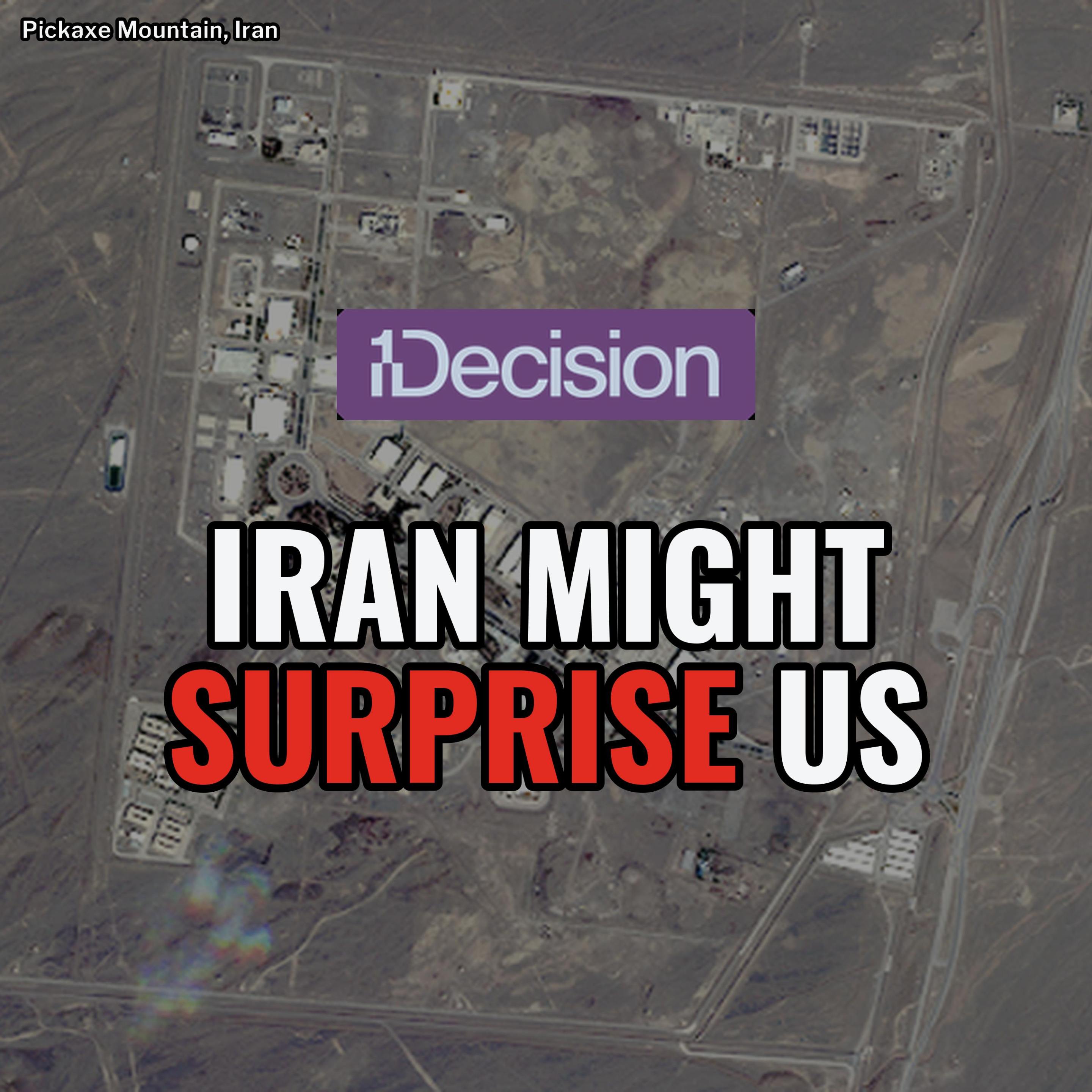
Dearlove: Yeah. That's a very difficult special operations exercise, which I think the Israelis would be more likely to attempt than the Americans. But on the other hand, they do have these special forces groups, which certainly have the capability to do that. But I would have personally thought the complexity of such an operation puts that very much last on the list of the options that we've discussed. And a much easier solution would be to have, as it were, throttled the Iranian economy and for the Iranians to agree to hand that over to the International Atomic Energy Agency rather than trying to capture it militarily. But I think it's something that we have to consider still as a possibility because if the Iranians won't negotiate at all and they see that as their — this is not an intended pun — Trump card, then a military option is going to be necessary, or you could have the remnants of a hostile regime with a thousand pounds of highly enriched uranium and the ability — I wouldn't say to weaponize, suggests a program of construction of nuclear devices, but certainly they could make a sort of artisanal — that's not a nice word to use in that context, but a sort of artisanal nuclear device, which could be very, very dangerous.
Hazarika: And in terms of actual, you know, boots on the ground and escalating this, how wise do you think that is for Donald Trump? Because, you know, history suggests we don't have a great track record in terms of boots on the ground. That very much escalates things at a time when, you know, the world is hoping that things will de-escalate. Iran has also said that, you know, it will absolutely fight back with all its might if there are troops on the ground. I mean, do you think if that happens, this whole thing could just sort of completely get out of control?
Dearlove: Well, it could. But I think what we're talking about are pretty surgical operations, which are not designed to be logistically long term. And I think one has to remember that the US military commander, Brad Cooper, is a very subtle, clever, accomplished general. And I think they would do everything to avoid becoming embroiled in a land war. And, you know, Kharg Island is an island, and certainly if it's taken by the Marines, I don't think the Iranians have the amphibious capability to retake it. So that would be a limited operation. And similarly along the coast, it would be about going in and blowing up the offensive facilities that the Iranians have built there and probably withdrawing pretty quickly. I don't think there'd be any question of them holding territory. I think Trump personally has decided to go for broke and that he wants to go down in history as the American president that solved the Iranian problem. This has been the running sore in The Middle East since the 1970s. And everybody has, let's say, attempted to pacify and negotiate with the Iranians. I mean, my view now is this is probably the final chapter in a very, very long running conflict. I think a lot of the commentary is taking the sort of short term, oh gosh, this is Iraq, another embroilment which the Americans can't get out of, will have disastrous results. Well, it could. I'm not denying that, but I think there is another perspective, and that's the one I've just outlined.
Hazarika: And let's move on to people who could benefit from this and potentially help Iran possibly. How is Russia playing into all of this at the moment, Richard?
Dearlove: Well, I think there are two aspects to this. The first is Russia, and it's pretty clear now from some of the material that's been publicized that the Russians have helped the Iranians with targeting material, from using their satellite overhead. I don't know what further logistic support the Russians have given, but that's clear. And I just wonder how Trump now will regard that in relation to his so-called relationship with Putin and his attitude towards Ukraine because the Russians have made it pretty clear where they stand. I think the other thing which is fascinating is the absence of China. I mean, China has been trying to ingratiate itself, particularly with the Saudis and with other Middle Eastern regimes in the Gulf States. But the situation that we have is that there's been obviously a very clear Chinese decision to keep out of this conflict. And, you know, they haven't appeared. They haven't given support to the Gulf States. They haven't given open support in any way to Saudi Arabia. So the idea that somehow, you know, China is a choice ally for a future balance of power in the Middle East, I don't think holds any water because they have absolutely been absent on pretty much the whole conflict.
Hazarika: And if this does move forward to boots on the ground, how do you think some of those Gulf partners will feel about that, Richard?
Dearlove: Well, they hate the war. They're worried about the war, but I think I agree with the view that the Gulf states now have no choice but to have an even more strengthened relationship with The United States in terms of their long term security. I think that what one's looking at are not the politics of emotion, but the politics of strategy of where your real interests lie. And although, you know, the Qataris are desperate for the war to end, having been attacked by people who they thought were reasonable partners, I think they're probably reconsidering their options. And what this means is a strengthened relationship across The Gulf States and Saudi Arabia with America as a strategic partner. I know that's counterintuitive to what a lot of people are saying, but I think if you think about where these countries' real security interests lie and their ability to redevelop tourism, redevelop their fossil fuel businesses, America is for them the essential partner, and nothing's gonna really change that. So I think that Trump has a window within which to continue to be aggressive. I'm not sure of the length of the window because it will shorten and at some point it will close. But at the moment, I don't agree with the view that the Gulf States are desperate for it to end. I think they've got this far. They're desperate for America to solve the problem and not leave something which is gonna cause them more problems in five to ten years' time.
Hazarika: Yeah. I was at an interesting embassy event this week where there were quite a few senior staff members from different embassies of Gulf States. And they were making that point, but they were also making the point to me that, you know, after this is over, they are going to have to — you know, they have to live with Iran. They have to — you know, Iran is a hugely important player in the region as well, and they're very angry with Iran in terms of attacking them. But they'll also have to find a way to live beside Iran after all of this as well, which is interesting.
Dearlove: Yeah. I agree with that. Absolutely. And they will have to have a dialogue with Iran, but I think they hope it will be a different sort of regime and more amenable. I think the problem with Iran has been that after they signed the JCPOA, they focused all of their aggressive resources in the axis of resistance and felt that they had, you know, pretty much a laissez-passer to destabilize the Middle East generally, which they continue to do through arm's length proxies who are more or less attached to Iran. Well, the closer ones, Hamas and Hezbollah, closely attached to Houthi, less so, but still armed by them. And this has been catastrophic for all of the Middle Eastern countries. So I think they're looking at a close relationship — a different sort of relationship. And perhaps the model for that is the sort of dialogue the Omanis have always had with Iran, where they were never in an aggressive stance with Iran and always talking to them and were an important channel of communication. Anyway, we'll see how that develops.
Hazarika: Well, look. That's all for this episode. Join us on Thursday for another exciting, illuminating conversation about world events that goes beyond the usual headlines. For more conversations with leading decision makers and thinkers, check out onedecision.com and our YouTube page, where you'll find additional commentaries, conversations, and explainers. I'm Baroness Hazarika. Thank you for listening.