Hosted by Christina Ruffini and Sir Richard Dearlove
Guest
Episode Summary
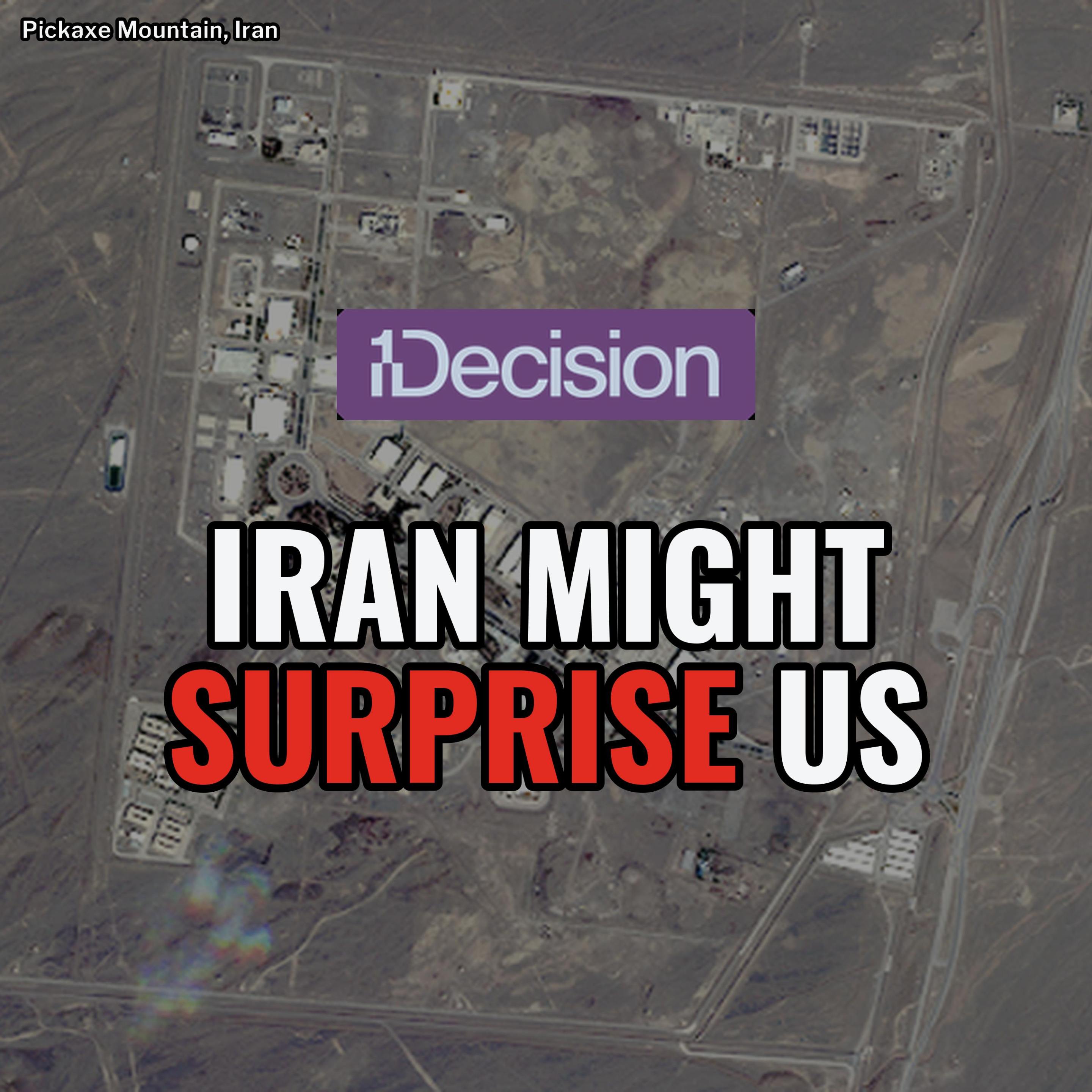
From an ultimatum to a “pause” in attacks, did President Donald Trump just blink, or is he playing a much larger game with Iran? Former MI6 Chief Sir Richard Dearlove and journalist Kate McCann analyze whether President Trump’s sudden shift on Iran is a genuine diplomatic opening, a calculated move to cool soaring global oil prices, or an attempt to buy time for US Marine reinforcements to arrive. They also explore the potential strategic friction between the US and Israel, Trump’s broader foreign policy objectives, including Venezuela and Cuba, and the UK and Europe’s reluctant role in the escalating Iranian conflict.
In this episode:
01:56 – From 48 Hour Ultimatum to Five-Day Pause
03:40 – The Fragility of Global Markets
05:26 – Are There Backchannel Talks Inside Iran?
07:48 – Escalating to De-Escalate
09:41– Israel-US Divergent Aims
11:36 – Does the Conflict Help or Hurt Trump?
15:14 – UK and Europe on the Sidelines
Hosted by Sir Richard Dearlove (former MI6 Chief) and Kate McCann (Political Editor at Times Radio).
Listen & Subscribe
- Watch on YouTube
- Listen on Apple Podcasts
- Listen on Spotify
Transcript
COLD OPEN
Mccann: From a forty eight hour ultimatum to a five day pause, President Trump claims a breakthrough with Iran. But with the global economy on edge and Israel still on the offensive, the question we're all asking, who's really calling the shots?
INTRODUCTION
Mccann: Hello, and welcome to One Decision in Brief. I'm your host, Kate McCann, and I'm joined by my co-host, Sir Richard Dearlove. Morning, Richard.
Dearlove: Good morning, Kate. Are you well?
Mccann: I am. How are you?
Dearlove: Well, I'm fine. Because I'm at my house in Cornwall, and I always enjoy being here, but gripped by following world events. One seems geopolitically detached in a place like this, but on the other hand, you can't avoid the news. It's so dominant.
Mccann: That's true. Shall I let our listeners into a secret about what we were discussing before we pressed the record button? And it relates to your house in Cornwall and potentially your ability to go off grid.
Dearlove: Well, I could if I spend a bit more money. I've certainly got springs which would provide me with fresh water. I've got a falling stream which drops many, many feet which would provide hydroelectric power. And those two things would make us pretty much off grid and independent. And I'm thinking of doing the hydroelectric anyway.
Mccann: Does all this chatter about Iran, you know, having The UK in range of a ballistic missile, does it ever make you think twice about it? Does it ever make you think about becoming a hoarder?
Dearlove: Not really. I'm not quite like that. The trouble is if you're in London, maybe you feel these things more graphically. If you're in a country area like this, you do feel really detached, maybe artificially so. One could be a bit more careful. But there's lots of natural food around here. There are rabbits. There are pigeons. There's a vegetable garden.
Mccann: Look out, rabbits. I know where I'm coming if we ever get into trouble in the city. Should we get into it then? Because I'm joking about it, but partly because it's been a bit of a whiplash twenty four hours or so. I mean, Donald Trump issued an ultimatum to Iran saying, I'll blow up your power plants. In fact, not just blow up. I'll obliterate your power plants if you don't open up the Strait of Hormuz. There was a forty eight hour timeline. And at the point we're recording this, that timeline still hasn't elapsed. And yet Donald Trump, well, he's climbed himself down, hasn't he? He's blinked, and now the Iranians are making the most of that.
THE FIVE DAY PAUSE
Dearlove: Yeah. It seems that he's given them another five days. He's saying there's an encouraging negotiation. The Iranians are saying there's none whatsoever. I think how do we interpret that? My guess is that the Omanis who've played this intermediate role of passing messages between the two administrations, and maybe there's some content to them which indicates possibility of starting negotiations once again. But it's pretty serious. I mean, if you were to knock out Iranian power, I think we would then see other bits of infrastructure. Of course, the most crucial one in this part of the world is desalination. Those are incredibly vulnerable plants. If you look at their complexity, and if you hit them with a drone, you then knock out the water supplies which are fundamental to life in that part of the world because they don't have any natural water other than, well, they have a little bit, but very, very, very little. So I think that whole escalation is something we should have in the back of our minds as the very vulnerable area.
Mccann: Yeah. And it does seem that, you know, the American president has been spooked by what he was seeing and hearing. I mean, it's very clear that Iran had the ability and had made the most of the ability to choke off the Strait of Hormuz, all traffic passing through, bar really any vessels that it had given permission to, Chinese vessels, maybe Indian vessels perhaps. And that in turn had done incredible damage to the oil price around the world and also the global stock market. And Donald Trump has always been worried about the economic damage that could be done to his civilian population. I mean, how much do you think he's been swayed by the economics of this?
Dearlove: I'm not sure he's been swayed yet by the economics, but I think what they have done in Washington is to talk down the price of oil. And he's done it already once. And maybe he hasn't blinked. He's just talking down the price of oil because I've been following Brent Crude and the stock market valuation of the big oil majors, and they've been rising exponentially. But for example, today, the last time I looked, they would, you know, drop 10%. It has gone down to below a $100 a barrel for Brent crude, and a lot of the share values have dropped instantly. And I think that talking down the market is very characteristic of Trump's political approach to these issues. And I think it's interesting that the Iranians are saying no negotiations. So maybe he's just doing this on the back of messages from the Omanis, and it's more aimed at the market than anything else. The other factor which I think is important is the arrival of this Marine Corps expeditionary force coming from the Pacific. And I don't know quite how soon it's gonna be there, but if you wait five days, they're gonna be pretty much on the doorstep or on the threshold of this war.
Mccann: Yeah. And there's a huge rejection of the idea of boots on the ground of a forever war from the MAGA movement, but also a divide within Donald Trump's most senior team. And the American public do not want to stomach that either. Should we talk a little bit about the Iranian response? Because you mentioned something really interesting there, the idea that Donald Trump may well be basing this on back and forth between an intermediary. He has commented to say that the Americans are speaking with the top guy, but he says that that is not the new Ayatollah. He says, we haven't heard from the son. And when the reporter asked about the new Ayatollah, he said nobody wants that job. And Trump has also made clear that America and Israel, and he's quoted here saying, we've wiped them all out. It's quite difficult. Do you think there is any way that the Americans could be in direct talks with somebody inside the IRGC at a senior level in Iran at the moment?
Dearlove: I think personally, it's possible. You know, this is when maybe you use clandestine means to carry out conversations which everybody can say are not happening. And I can think of precedents and parallels. And I did speculate at the beginning of this war that it was possible that there would be a group, let's say, IRGC military, who would want to do a deal with the Americans. And in effect, you'd get a new regime, which would still perhaps be quite hardline in a nationalistic sense inside Iran, but on the other hand, would be much more amenable to deal with the West in some respects and with Arab neighbors. I think you have to consider all of these possibilities. It's rather naive to suppose that they don't exist. In my experience, in situations like this, there are always links, however tenuous. And I think that's probably what we're talking about at the moment.
Mccann: I mean, the Iranians have also suggested that they believe that this could be a tactic by Donald Trump. And in fact, there were a number of comments that came out of the American administration over the weekend, a suggestion that Donald Trump was escalating to deescalate and basically being able to do two things at once. The Iranians seem to believe that this is a power move, that it's a way for Donald Trump to regroup to make sure the oil price comes down a little, but then to hit Iran even harder. They don't trust that this could be the end of the conflict as we see it at the moment.
Dearlove: Yeah, I think that probably would be my view too. But on the other hand, those sorts of suggestions coming from Trump could be designed to factionalize the regime in Iran and start to split groups, you know, between hardliners and those perhaps who are a bit more moderate and would be thinking that a deal is the best way out of this. So I think all of these options are there in front of us. And I'm sure that maybe all of them contain an element of explanation and truth. And they're just a reflection of the complexity of a conflict like this. And I mean, tomorrow morning, we could wake up, find it escalated, find the oil price has gone up, or, you know, we could find out that suddenly there are two IRGC generals who've split ranks and are talking to the Americans. We just don't know yet.
Mccann: Yeah. It's very hard to know whether this makes what happens next more or less predictable. And clearly, The UK prime minister, Keir Starmer, is also cautioning, saying this doesn't mean that the war is over. It doesn't mean that this is the end of the conflict. We need to recognize that this may well be a long drawn out battle. I suppose the other element of this we haven't mentioned so far is the Israelis. There's been a sense over the last couple of weeks that actually it's advantageous for Israel for this to continue long term. And they have, you know, they've got a lot going on in Lebanon too, for example. The Israelis have pushed back on the idea that America is looking for a deal, suggesting that that is not the way forward. What would a fracture between Donald Trump and Benjamin Netanyahu mean?
Dearlove: Well, I'm not sure I would speak about a fracture. I would sort of say a divergence of interests, strategic interests. But I think ultimately the glue that holds Israel and The United States together would accommodate to an extent a divergence of interest whereby the Israelis carried on hitting certain targets, particularly Hezbollah targets, but also to reduce the military capability of Iran. That would not be incompatible with, let's say, ongoing discussions with the Americans over a period of time. You could have the two simultaneously happening. I mean, I do take the view that they have different war aims because I don't think Netanyahu is particularly concerned with anything other than the destruction of Iran's strategic reach, its power militarily, its ballistic missile program, and its proxies. And, you know, they'll damage and wipe out as much of that as they can whilst the fighting continues, and they won't be in a hurry to finish it. But they will have to bend eventually if The United States has a different destination strategically. The Israelis would, I think, almost certainly be obliged to literally pull in their horns and follow the American line. But you can equivocate for quite a long time.
ANALYSIS WITH SIR RICHARD DEARLOVE
Mccann: Do you think this conflict has strengthened or weakened Donald Trump?
Dearlove: We don't know the answer to that yet. And I've been sort of reflecting on this in the last few days. And if Trump, let's say within the next two months, has solved Venezuela as an American problem, begun to solve Cuba as a strategic problem, and has got close to regime change in Iran. However distasteful his behavior, however outrageous the route he's taken judged by international lawyers, I think this will be seen as a significant strategic achievement which could change the reputation of his presidency, second presidency. If you look at this in the whole, three of the West's significant enemies or problems, maybe enemy is too strong a word for Venezuela and Cuba, but certainly not for Iran, their political position could have been significantly shifted. And I think a lot of Americans, if they had been asked the question pre-Trump whether that was a good idea, they would have said yes. They wouldn't have expressed views on the means, but the endgame, they would have liked.
Mccann: I agree with you to an extent about Venezuela and Cuba. And I personally think that that's how Donald Trump ended up in this situation in Iran. I think he was buoyed by his perceived success in Venezuela and Benjamin Netanyahu. You know, this is something that he has been wanting to do for some time. And we know that we've spoken to John Bolton on this podcast before about the fact that Bolton was very keen for Trump to do this first time around. It was Trump that was concerned about it. I just wonder whether, you know, if Donald Trump manages to extricate himself at this point, can this really be called a success? Because from all the reports we get from journalists who've been able to get inside Iran, the mood of the public is not necessarily anti-regime at this point, especially the mood of the public inside Tehran who've been subject to significant bombing campaigns over the last couple of weeks, big, big heavy bombs doing lots of damage, who are not necessarily feeling that warm towards the idea of regime change at the hands of the Americans at this point. Is that really a success?
Dearlove: I agree with your analysis, and I agree with what you're saying about what's happening inside Iran. But I think you've got to look at it in a broader context. And the defanging of the Iranian regime will be celebrated by the Sunni majority in the Middle East. It will be a complete alteration and shift in the power balance. And particularly, if in time a regime emerges in Iran, which I think would happen against that background, which has a different disposition towards the West, then that's what Trump will be judged on, not the short term. And I think what you're talking about is the understandable emotion and tragedy which has been released by this conflict. But on the other hand, the strategic outcomes would, in my view, be judged differently. That's a tough thing to say, but I think that's a realistic view.
Mccann: I think that's a much more long term and probably a hugely wiser view than mine with the ability of a lot of context. I suppose where does that leave the Europeans? I mean, irrelevant, maybe not relevant in this conversation at all, but there's been a huge debate about why The UK has been hesitant, and at times, you know, defensive about joining in this action in Iran. Where does it leave us, do you think?
Dearlove: Well, I think it leaves us in an equivocal position with a government which is uncertain about its strategic role, I'm quite sure over time that that could be repaired. And what I mean by that is a rebuilding of, I mean, if I say our influence in The Middle East, I don't mean that, you know, influence of a big power, but our cultural influence and links with The Middle East are complex, historical, far reaching, and still actually really important. And bear in mind the number of, you know, Middle Eastern personalities that have their residences in London that look to London as an aspect of their lives, which is really important. You know, I think we've been unfortunate. We've had a government which has caught off balance. We have a government which should be rearming, which hasn't. You can't entirely blame it for not doing so. What happened in the last ten, fifteen years in The UK relates to that issue. I think it raises all sorts of questions about how The UK disports itself as a middle ranking power, particularly in areas where it's played such an important historical role. And I don't think that's all completely shot to tatters. Far from it. But it will need attention and careful thought and a different sort of government with a different attitude.
Mccann: Interesting point. A different sort of government. Well, we will conclude this edition of One Decision In Brief because I think at the moment everything is changing so quickly. We could record a different in brief every day of the week. But we will be back, of course, on Thursday for a conversation about the crisis in Cuba. And as always on this podcast, we try and look to what happens next, where the story goes next. And that's what we think the story next will be. Is it the final straw for the regime there? I'm Kate McCann. I've been joined today by Sir Richard Dearlove. Thanks, Richard.
Dearlove: Thanks, Kate. That was an interesting discussion and a very important one, I think.
Mccann: For more conversations with leading decision makers and thinkers, you can check out onedecision.com and our YouTube page. You'll find lots of extra commentaries and in brief explainers on there for you. Thank you for listening.