Episode Info
- Season5
- Episode1
Hosted by Christina Ruffini and Sir Richard Dearlove
Guest
Enes Kanter (Enes Freedom)
Enes Kanter became a US citizen, changed the name to Enes Freedom, and is an NBA player who spoke out against the Beijing government despite pressure to stay silent.
Episode Summary
NBA player Enes Kanter learned a lot about US values when he became a US citizen and changed his name to Enes Freedom. One of those is freedom of speech. But he says speaking out against the Beijing government, whom the US government accuses of cultural genocide, is considered out of bounds. Lifting the lid on the murky relationship between sports and sponsorship, Freedom tells all - including who has been pressuring him to stay silent.
Listen & Subscribe
- Watch on YouTube
- Listen on Apple Podcasts
- Listen on Spotify
Transcript
INTRODUCTION
Mcfarlane: Welcome back to another season of One Decision podcast. I'm Julia McFarlane, and I am really excited to be cohosting today's episode with the former chief of MI6, Britain's secret intelligence service, Sir Richard Dearlove. Hello, Sir Richard. How are you?
Dearlove: Hello, Julia. Very nice to be with you on the podcast.
Mcfarlane: Likewise. Likewise. I have to say it isn't actually the first time that we've spoken. Quite a few years ago when I was a fledgling producer at the BBC World Service, I actually interviewed you for a radio program. I don't know if you remember this. But to find myself many years later as a cohost alongside you is quite an amazing turn of events.
Dearlove: Well, I won't immediately say I remember the event. I've done so many events like that, but I'm sure if I dig back in my memory, it'll come to me.
Mcfarlane: Here at One Decision, we speak to people around the world at the center of foreign policy. People who make it, people affected by it, people who seek to influence it. In our ever changing world, we often find we're increasingly impacted by choices that are made, sometimes even on the opposite side of the globe. And so on this program, we seek to understand the complicated and interconnected world around us by talking to those who seek to shape it. And sometimes, those people may not necessarily be who you'd expect. You might not think that, for example, a professional sports star is worth hearing on international politics, but you would be wrong on that score.
INTERVIEW WITH ENES KANTER FREEDOM
Kanter: Just because of you want another contract or you want more endorsement deals or you want not just from, you know, the bank, you have to stay silent when it comes to China. This is bigger than basketball. This is bigger than the NBA. When people tell me that, listen, my focus on basketball, stop doing politics. I never do politics. There's a difference between politics and human rights.
Mcfarlane: Enes Kanter is not your average 29 year old. An emigre originally from Turkey, he was drafted as a teenager by the NBA. He played for the Knicks and is now a Boston Celtics player. He became a naturalized US citizen last December and changed his name as part of the process to Freedom. Enes Freedom's journey to becoming an American has had one defining aspect that has marked him out from every other professional basketball player in the NBA and from pretty much every professional sportsman on the global scene. His ferocious criticism of China's human rights record. Xinjiang is China's biggest province. It borders Mongolia to the East, Kazakhstan to the North, and Kyrgyzstan, Tajikistan, and Pakistan to the West. Its inhabitants are predominantly Turkic Muslims, also known as Uighurs. The Chinese government has been widely accused by Western nations of carrying out systematic ethnic cleansing of the minorities in Xinjiang. And last year, the Trump administration accused it of cultural genocide. Beijing denies this and says reports of concentration camps where activists and former detainees have told chilling stories of rape, torture, forced labor, and sterilization actually refer to reeducation camps carrying out a program of deradicalization. Many Uighurs who are Muslim are perceived by Beijing to pose a national security threat to the nation. There's a growing number of US and international companies who are finding themselves at the center of this growing row between Western and Chinese consumers and the issue of slave labor in China, and none more so than Nike, the biggest sportswear company in the world. Enes, I want to talk to you about Nike because you've been incredibly vocal about this company. You've accused them of hypocrisy and of staying silent about human rights violations in China. And a year ago, the US government released a report into the situation in Xinjiang and accused Beijing of crimes against humanity. They accused them of crimes that constituted genocide against its Uighur population. And Nike was getting quite a lot of heat last year and they released a statement saying that they were committed to ethical and responsible manufacturing and we uphold international labor standards. We are concerned about reports of forced labor in and connected to Xinjiang. Nike does not source products from the Xinjiang region and we have confirmed with our suppliers that they are not using textiles or spun yarn from that region. And do you accept or believe that statement?
Kanter: No, definitely not. I mean, everybody knows that it's all a lie. And, you know, you talk about Nike, you know, obviously it's the NBA's biggest sponsor. And when you look at Nike, you know, in America, you know, they stand up for Black Lives Matter, Latino community, you know, Asian hate, LGBTQ community. But when it comes to China, it remains silent because they are the one paying the bills. There's so much business involved. There's so much money involved and stuff. I don't believe that. Whatever they're saying, I do not believe that. And, yes, modern day slavery is existent, is done by Nike. And they're the biggest hypocrite. And I even like say this in many of my interviews, every time you buy the shoes, you buy that t-shirt, you know, there's so much blood and sweat and oppression on those items, so think twice.
Mcfarlane: What would Nike have to do in order to convince you that they have guaranteed that they are not involved in the oppression in Xinjiang, that they are not involved in slave labor?
Kanter: I think the right thing to do, first of all, I mean, it's a step by step. I know they're not gonna shut down all their store or everything in China. It's a huge business, and I understand that there's so much money involved. But I think they should definitely shut down all the sweatshops because the conditions in there. I mean, it's a very easy access, obviously. If you go on the YouTube or if you go on these reports out there, there's so much reports or articles out there to show what kind of conditions the kids are having over there, their parents. So I feel like, yes, the first step should be the shutdown of those sweatshops.
Mcfarlane: Okay. In an Instagram post last November, you challenged the founder of Nike, Phil Knight. You said, how about I book plane tickets for the both of us to go to China, let's fly to China together, let's visit these slave labor camps, and you can see it with your own eyes. And you also tagged LeBron James and Michael Jordan in that post, and you said, hey guys, you should come along too. Was there any response to that post? Have you heard from Nike, from their management, or from LeBron or Michael Jordan?
Kanter: No. No. And, obviously, I was not really expecting any kind of answer from them because it's just obviously, when these people, these players, these athletes, these companies, they just call themselves as social justice warriors or organizations or companies. But when it comes to China, they remain silent. And I just want us to put all the hypocrisy out there to show people what they are all about. And I wish we could go. I wish we could go and show the whole world and show them the company you signed with. You know, you're making millions of dollars, what kind of act that they're in, you know? So I wish that there is such thing, but I didn't think they were gonna answer it anyway.
Mcfarlane: Would you go to China if the Chinese government extended an invitation to you?
Kanter: I mean, if they promised me to, like, I'll be safe, for sure. Yes. I would love to go out there and show the whole world that what kind of, you know, what people are going through, concentration camps, sweatshops, what Tibetans are going through, what Hong Kongers are going through. Of course. Yes. I would love to.
Mcfarlane: Okay. What about teammates of LeBron or Michael Jordan? I mean, you've had quite public beef with LeBron James, given his association with Nike. You've said, I think you said on Fox News, that apparently a teammate of LeBron told you to keep speaking up. He said, keep doing what you're doing. Don't stop.
Kanter: I remember when the Lakers came to Boston to play, played against us. I was in a free throw line with one of their players. I don't think I should give his name because, obviously he still plays for them and he is my friend. And the thing that he told me just blew my mind. He said, listen, he has so much things to say, but just because of these teams got us, just because of you want another contract or you want more endorsement deals, or you want not just from the Nike or for any other companies, you have to stay silent when it comes to China, because obviously China uses money to buy silence. And I think if you're staying silent, you're part of the problem. But this player told me that, just keep speaking the truth. I am with you. I cannot say it out loud, but we are with you. Trust me. And that gave me so much hope, actually.
Mcfarlane: Did he say that anyone had told him to be quiet, or did he give you any indication that there were lots of other players who felt the same way?
Kanter: We actually had a conversation while we are on the court, so we didn't have, like, a long conversation. But the thing he told me is that these teams got us. Means, obviously, if you say anything that the NBA or these teams, then your next contract will be very questionable. So that's what he tried to say. But I was just like, I just couldn't, I just didn't wanna say that, like, listen, man, this is bigger than your next contract. This is bigger than all the endorsement deals you're gonna get because there are so many lives that are involved. So I was like, but I just couldn't say it.
Mcfarlane: Has anyone told you or hinted to you that you should maybe dial it down a bit, or maybe you should be careful what you say, or has anyone said, look, this is gonna negatively impact your career?
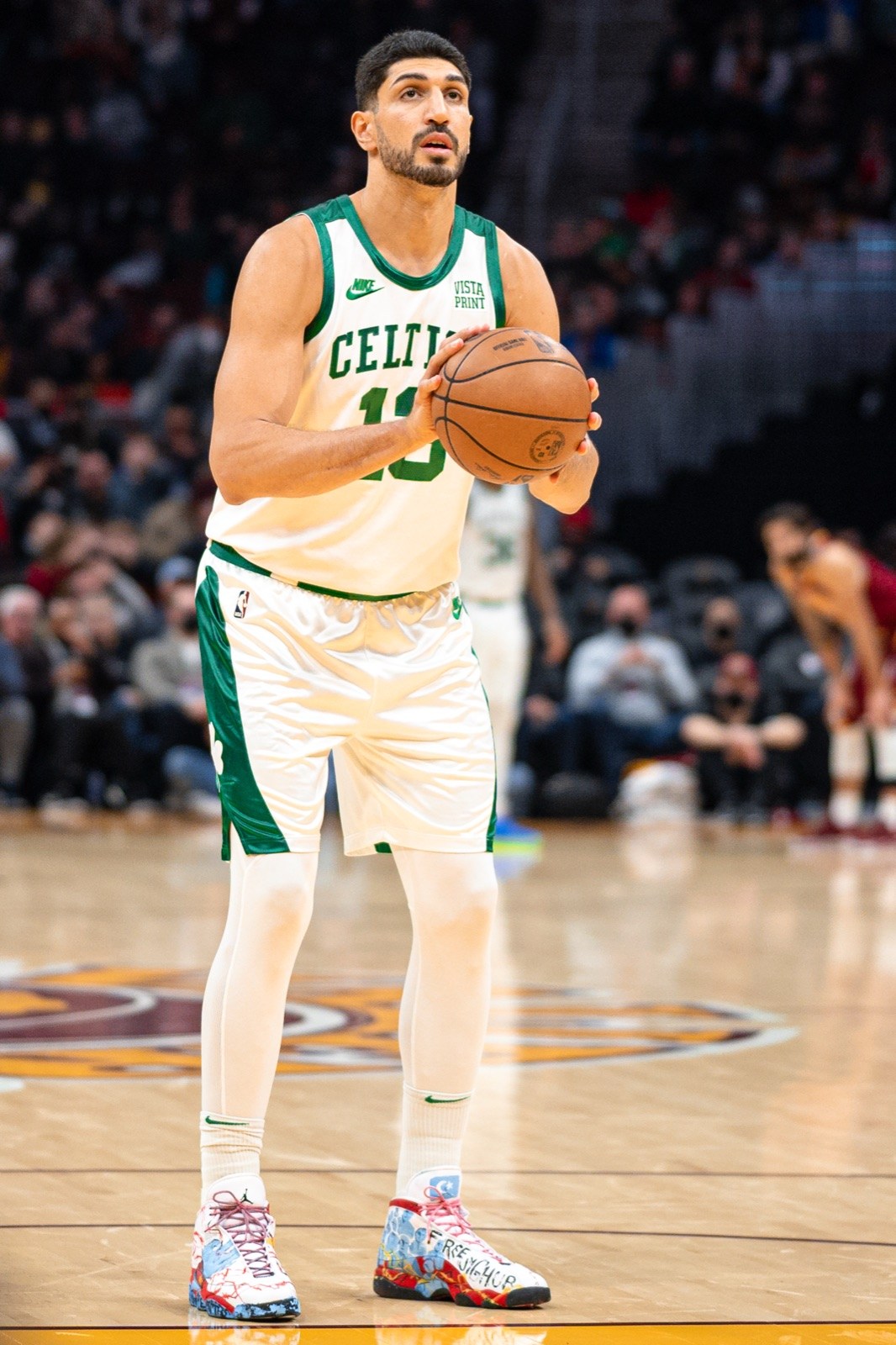
Kanter: I remember first time, first game, it was back in end of November. Our first regular season game was against New York Knicks and Madison Square Garden. I remember I went out there with my Free Tibet shoes. Right? And right before the game, there was two gentlemen from the NBA, which NBA said, it is not true, but I just don't wanna give their name because they're my friends. The second I give their name, they'll get fired. Anyway, and many of my teammates knows that actually. Two gentlemen from the NBA came to me and said, we are begging you, please take those shoes off. And I asked them straight, I was like, listen, is there any kind of rule that I cannot wear those shoes? He said, no. But then I told him, I don't care if I get fined, I'm not taking my shoes off. And they said, listen, we are not talking about a fine. We're talking about getting banned. So I was like, it was a really good moment for me because I was just getting ready for my citizenship test and I was working on the amendments, right? 27 amendments on my first amendment freedom of speech. I told them like, listen, you cannot take my first amendment from me. Go tell your boss I'm not taking my shoes off. You know, I don't care if I get banned or if I get fined. And they left. They actually came to me and said, sorry, and apologized in a halftime. And I looked at my phone in a halftime, actually, my manager texted me and said, all Celtics games are banned in China. I was like, wow. It literally took that twenty four minutes, first quarter or second quarter, twenty four minutes to ban every Celtics game in China. And I was like, that shows one more time there's dictatorship in China.
Mcfarlane: How have your teammates reacted to your activism? I mean, you must have a ton of friends in basketball and in the NBA, has anyone treated you a little differently? Have people changed in the way they speak to you? Has anyone sort of given you the cold shoulder or is avoiding you a bit more?
Kanter: I think my teammates are my biggest motivation, and they just wanna understand like what's going on, you know? Obviously, when I talk about the problems that are happening in Xinjiang, so Uighur people or Hong Kong or Taiwan or just Tibetan people, they wanna know what's going on. And once I tell them there's a genocide happening in Xinjiang, there's a cultural genocide happening towards the Tibetan people, what Taiwan is going through, what Hong Kong is going through. And they're like, you know, just we will pray for you. And I think one thing they want me to understand is, you know, there are problems that are happening in China and Turkey and not just but all over the world. And you just became an American citizen. There are problems that are happening in America too. So teach yourself about the things that are happening in America. That's the only thing they want me to understand, learn.
Mcfarlane: Is that their way of saying that you should spend more time worrying about problems that America has domestically rather than issues that are outside the US borders?
Kanter: No, they just want me to know that there are problems that are happening, not just in overseas, but there are problems that happen in America too.
Mcfarlane: Right. You say they offered you their prayers, is that enough? I mean, is it a bit disheartening that after you told them about what's happening in Xinjiang, that you explained the situation that it's genocide. I mean, there's lots of problems. There's racial injustices, inequality. There's a lot of things that are happening in our own countries in the West, but this is the United States government saying that there is genocide in China. How does it make you feel that more of your teammates aren't joining you in solidarity, that they aren't speaking out?
Kanter: I mean, once I started this road, I knew it was gonna be a very long road. And I knew that not many people, not just my teammates, but the league, the front office, or whoever, they are gonna say that we support you, but obviously, they cannot say it out loud. And I think that's the one thing that really kind of broke my heart. When NBA two years ago, when Black Lives Matter were happening, when we were in NBA bubble, I was very happy that I was like, NBA is finally standing up for something bigger than basketball. Right? And Adam Silver, the commissioner, was the one going around and saying that we are encouraging our players to go out there and say whatever they wanna say, however they feel like. And I was like, okay. You are the one that give me this confidence. You encouraged me to talk about it. Now I'm talking about a problem that happened over there in China. You are not saying that you're against me, but, like, do you support me really?
Mcfarlane: Have you ever spoken to Adam Silver directly?
Kanter: I did. Yes. I had a conversation with him almost thirty minutes. Because I remember first time this were happening. So there is NBA and there is NBPA. NBPA is a players association. Right? So first time that I wore those shoes, NBPA, the player association, were calling me and calling my manager every day. And they were begging us and saying, please take those shoes off. NBA is putting a lot of pressure on us. And I was like, listen, you're supposed to work for the players. You're supposed to work for me, but you are not doing your job. From now, do not call me, do not bother me. I'm gonna talk to your boss. And I was just so sick of them pressuring me and putting a lot of stress on me because I even told them, am I breaking any rules? Am I going against any kind of rules in NBA? They said no. Then I'm like, then why are you putting all this pressure to take my shoes off? And they said, obviously, there's so much money involved, business. I'm like, I don't care. This is my right, and I'm gonna do it. And I was like, from now, do not call me or text me. I'm gonna talk to your boss. And when I had a conversation with Adam Silver, I asked Adam, am I breaking any rules? He said, no. He's like, okay, then I will continue to wear my shoes.
Mcfarlane: So how did you leave that conversation with him? Did he sympathize with your cause? Or did he at all just warn you to be careful with what you were doing?
Kanter: You know, he didn't warn me or anything like that. Obviously, to my face, he said he supports me. Obviously, that's, he has to say that because he's been going around saying, since he took the commissioner job, that's the one thing that he was saying. We are supporting every player. Whatever they wanna talk about, we are supporting every player. So they cannot say that they don't support me, but I don't feel like they do. Then when all this were happening and there was so much news out there, why haven't I, I did not see one, any kind of statement from the NBA, from the commissioner, from anyone from the NBA office. So I'm asking myself, do they really support you?
Mcfarlane: What would you like him to do? Did you ask him to do anything?
Kanter: I feel like NBA should stop working with companies like Nike number one. And when there is a problem happening, I'm like, they put a statement out there and have your players back because I gave everything to this league. I've been playing this league for almost, you know, this is my eleventh year. So I think that's the one thing that they could have done. We are literally wearing a jersey every night where there is, where they made in sweatshops. That should be definitely unacceptable.
Mcfarlane: But what do you think the NBA should do? Do you think they should boycott China or do you think they should put certain demands on China? Or do you think the NBA should sever ties with companies like Nike, who in your opinion, have not yet proven that they have nothing to do with slave labor?
Kanter: I think for sure. Just because NBA is a huge market, they should definitely boycott companies has anything to do with sweatshops. And the other thing is, I feel like if there's a country where there is a genocide happening and where American government said that there is a genocide, it is a fact, then I feel like NBA definitely should think twice to work with a country like China.
Mcfarlane: What do you mean by think twice, though? Do you think they should cease operations? Or would you go as far as saying that?
Kanter: I don't wanna say separation because obviously there are billions of dollars at home. But when, if you look at what NBA is doing with other countries, you know, obviously, there are other markets around the world, that I understand not as big as China, but they could be focusing on some other things than just working with China.
Mcfarlane: Do you feel like you will always be a lonely voice speaking out against this particular issue given that China is such a big player in the basketball scene financially, there's such a big incentive for people not to say anything. Do you think any players will join you and more will start speaking out?
Kanter: No. That's that easy and that simple. I don't think so. I think they saw the pressure that I got from the league, from the player association, from media, everything. And when China just banned every Celtics game over there, I don't see any player in our time right now will just go out there and say anything about the comments to that party. Because the consequence will be huge for them. I feel like they just need to do the right thing because this is bigger than basketball. This is bigger than NBA. People keep asking me like, dude, you're crazy. There are so much money involved. You're gonna lose all your deals and this and that. But I'm like, listen, man. If your mom, if your sister, if your daughter was in that concentration camp, getting torture and rape every day, would you still think about your next contract? Would you still think about your endorsement deals? So I don't really see any player right now speaking.
Mcfarlane: And how about your situation, your contracts, your endorsement deals? I mean, what's the situation with your sponsors? Has all your campaigning impacted you at all on that side of things?
Kanter: I mean, I've never signed with any kind of deals with Nike since I've played in NBA or any other companies. But there are many people around the league now telling me that, listen, dude, if you don't stop speaking out against China, you might not be in the league next year. They're just telling me that, but I'm like, listen. This is bigger than basketball. This is bigger than NBA. I have to do the speaking for the people over there, because someone had to do it. You see, not just we keep talking about athletes, but not just athletes. You see actors, singers, rappers, John Cena, whoever. I don't wanna give a lot of names, but they're just speechless. They can't say anything.
Mcfarlane: I know you don't wanna name names, but you say people have said, you know, that you're not gonna be in the league next year? Is that a voice coming from your team or coming from your management?
Kanter: The players that I play with before.
Mcfarlane: Right. And what about your team? What have the Celtics management—
Kanter: I mean, to my face, Celtics has told me that they are supportive. They support me. And whenever I talk about an issue, whenever I was talking about the Tibet, right, they were telling me, yes, Tibet should be free. Whenever I talk about Uighurs, and they came and told me that, yes, there's a genocide happening. Right? So to my face, they are supportive, but obviously, I don't really expect them to put any kind of statement out there.
Mcfarlane: You don't get sort of emails every time you pop up on the media talking about China and Beijing? You don't get—
Kanter: Not anymore. Not anymore.
Mcfarlane: But you did?
Kanter: Oh, listen. I talked about Turkey for ten years. I did not get one phone call. I talk about China one day. My phone was ringing almost every two hours. People from NBPA, people from my agents, management team, they were just calling.
Mcfarlane: And saying what? Telling you to stop?
Kanter: NBPA, yes. The Player Association. I think that was, like, the one that really made me sad because they're supposed to work for the players. And whenever I answered them, they're like, listen, the decision coming from NBA, NBA telling us and pressuring us to tell you to stop.
Mcfarlane: And are they still telling you to stop, or have they stopped that?
Kanter: Not anymore. Because when I talked to Adam, right? When I talked to Adam, I was like, Adam, I don't wanna talk to anybody but you from now. And I told my manager to tell the player association, do not call me, text me, do not contact me every game because, I mean, you guys are not doing your job.
Mcfarlane: The US has a really proud history of athletes standing up for human rights. There was Muhammad Ali very famously refusing to serve in the Vietnam War. There was Tommie Smith and John Carlos raising the fist and protesting against African American poverty in the 1968 Olympics. And then of course, Colin Kaepernick taking a knee in 2016 against police brutality. And so, do you think athletes have a responsibility to take a stand on issues? What do you say to the people who say that athletes, you guys should all just stick to sports?
Kanter: First of all, of course, athletes should speak out more about any kind of issues out there because, like I said again, there are so many kids out there right now because of the social media, they're idolizing it. They're following everything you're doing daily basis. So I feel like, yes, we need to talk about all the stuff happening around the world, not just in America, but around the world. And the other thing is, when people tell me that, listen, my focus on basketball, stop doing politics. I never do politics. There's a difference between politics and human rights. I never go out there and say, hey, everyone. We should vote for Republicans. We should vote for Democrats. We should pick this president, that. No. I never talk about any of this stuff. Whenever I go out there, you can read all my op-eds, interviews, everything. I always talk about human rights. I always talk about the voice of innocent people, not just in Turkey or China, but all around. So, I think it is important for athletes to use their platform.
Mcfarlane: When it comes to China, are athletes pawns in all of this? Is America playing a kind of game where they have athletes and people such as yourselves can play the freedom loving American and get all the attention in the media, but the bottom line is that American business and governments continue to engage with authoritarian regimes like in Beijing.
Kanter: Mhmm. That's very unfortunate. I feel like it all starts with, I don't wanna go too deep, but it all starts with Wall Street. It all starts with the local congress and Hollywood, and I can go on and on. But I feel like, when you see America, when I was growing up, I always see America that represents democracy and freedom and rights. But, unfortunately, I feel like when it comes to authoritarian regimes sometimes, they're remaining silent like Turkey. Right? I remember this, actually not many people knows about this, but I was actually having a lunch in a senate with one of the really, really big senator, and he was a democrat too. And I asked him, listen, do you think president Biden knows my story? And the senator said, absolutely. And I asked him, no, I had been trying to have a conversation with him since the day he took office. Why is he not accepting our invitation? And he's like, listen. I understand, he knows all the human rights violations and political prisoners in Turkey, but Turkey is still a NATO ally. And obviously, the America doesn't wanna go war with Turkey. And the president meeting with you is pretty much a screw you to president Erdogan. So that's why he is pretty much scared to have a conversation with you. So I was shocked. I was like, so you're telling me the most powerful person in the world and most powerful house in the world are scared to meet with a 29 year old NBA player, and he's like, unfortunately.
Mcfarlane: So you have directly reached out to the White House, and they have not responded to you?
Kanter: Of course. Do you really think that, you know, my family back in Turkey, I haven't seen my mom and my dad and my sister since 2015. Do you think I wasn't gonna try the White House and have a conversation with the officials and the White House and whoever? I haven't heard anything. And I know that they got an invitation because I have so many politician friends. And, unfortunately, I guess it's politics. But I feel like they should definitely more focus on the human rights part.
Mcfarlane: What about president Obama? Have you ever reached out to him?
Kanter: I reached out to his people. I reached out to his people. I reached out to Joe Biden's people, nothing.
Mcfarlane: You have to let us know if you hear back from them.
Kanter: For sure, no, I'll, yeah, for sure.
Mcfarlane: Can I ask you about Peng Shuai, the female Chinese tennis star? She posted on social media a few months ago that she had been assaulted by a senior Chinese official. And then there was this very disturbing situation where she wasn't seen for a few weeks after that post, and then a series of seemingly very orchestrated public appearances she made didn't persuade a lot of people that she was safe and free of movement. The WTA, the Women's Tennis Association, their chief executive Steve Simon, he has been repeatedly calling for international investigations into her whereabouts and her wellbeing. And he even went as far as canceling all WTA tennis tournaments in the country. Do you approve of how he handled this particular battle with the Chinese government?
Kanter: First thing about her, while we know that she is alive, we don't know if she is free. You know, free to speak, free to travel, and everything I believe is staged by the Chinese government to keep her under control and control the narrative about her. I think this is very common tactic that used by the Chinese government because it is alarming that the International Olympic Committee is part of it too. When WTA came out and made a statement like that, I was like, how come the other associations out there can take notes and see what they're doing? They could have lose hundreds of millions of dollars, and they might. But they still said, we don't care about any of that stuff. We care about our player. So whenever I had a conversation with an Olympic athlete that are about to go to China, right, I am telling them, listen, look what they did to their own player. Are we really, all the governments out there, are we really gonna trust them with our own players? And especially there's an article came out, I think it was on USA Today and said, we are telling everyone, I think the American government was telling everyone to not bring their personal cell phone because China can tap into that.
Mcfarlane: Right. That's exactly, Team USA, they shared guidance for their athletes. Do not take your personal cell phones or laptops to the Beijing Olympics because of the concerns they have about cyber surveillance. I mean, what do you think about the fact that the US is still sending its athletes to Beijing for the Olympics?
Kanter: It's a shame. I understand diplomatic boycott. It is good, but it is not enough. Because the communist party does not represent the Olympic core values of excellence, of, I even said this before, of respect, of friendship, and they are a brutal dictatorship, and they engage in censorship, and they threaten human rights. They don't respect human rights. They threaten freedoms.
Mcfarlane: The preservation of human dignity is on the Olympic charter.
Kanter: While we are talking right now, there's a genocide happening. I understand. I seen that Biden administration put a statement out there and said, all the athletes work so hard in their life to get to this point, so we are not gonna tell them not to go. But, like, all to all the athletes out there, all the gold medals you can win in the world is not more important than your morals, your values, and your principles. And I think I said this before, the International Olympic Committee is sleeping on the same bed with China. It's a shame that they're organizing an Olympic Games in a country where there's a genocide happening. But I hope that they can do, you know, the diplomatic boycott after US, UK, Canada, Australia, some other countries did that, but I feel like it is not enough. I feel like athletes needs to go out there and say, you know what? Enough is enough, and someone needs to stand up to this country.
Mcfarlane: Does money trump everything in the world of sport?
Kanter: I think yeah. I think all they care about is money, and they will stand up for the things. But as soon as if the things that they're standing up is affecting their pocket, the business, and their money, they are going to stay silent. And that is the one thing that I cannot stand.
Mcfarlane: And would you say that sport is more of a business now? I mean, we started this interview. You said that you grew up as a boy, you had dreams of being a basketball player. If you were to go back in time and talk to that little boy, what would you say to him? Would you say sport is not as beautiful as you might think, that it's really all about the big business?
Kanter: You know, to that little boy, I will still say, keep chasing your dreams and never give up because this platform is given you by God and use it to do the God's work. But understand, at the end, it's a business. You cannot go against the system. Once you go against the system, they're gonna do everything they can to shut you off and shut you down. And there's not many people out there in any kind of association that has, when trying to go against the system, one of them is Kaepernick did it, and they pretty much blackballed him, and he is not in the league anymore. But I think it is important for athletes to stand up for what they believe in.
Mcfarlane: I just wanna ask you, lastly, some personal questions about how your activism has impacted you. I mean, you've had multiple arrest warrants from the Erdogan regime in Turkey. I think you posted the latest one on social media. They've searched your house, they've intimidated your family. You know, have you ever worried about your own safety? I mean, what are you doing to stay safe? And is the NBA helping you with that? Is anyone helping you and giving you advice and providing you with any assistance?
Kanter: You know, it did affect me a lot. Last time I saw my family was in 2015, and they revoked my passport, put my name on, actually. And I have 10 arrest warrant for me in less than four years. I think not NBA, but America, yes, it does help me a lot. I remember I was getting so much death threats. And we sit down with FBI and had a conversation with them.
Mcfarlane: When was this?
Kanter: This was around two years ago when I was playing for Portland Trail Blazers. I remember I was having a conversation with FBI, and they were very concerned. First, they told me to take a screenshot of all the death threats and send it. But it got to a point there was so many of them, I stopped doing it. The second thing is when I was in a road game playing against one of the teams, I was staying in a hotel room because they said the house or apartment is not safe. So you have to stay in a hotel room. So it's more secure. So when I was in a road game, actually, FBI came to my hotel room and they set up this thing called panic button. They said, whenever you feel uncomfortable, push that button. We'll be there in two, three minutes. I remember the button was right next to my bed and in my living room in a hotel. But other than that, I do feel safe in America, but anywhere else, it could get very ugly because obviously everyone has arms everywhere in the world.
Mcfarlane: Yeah. I mean, are the death threats continuing? Are you still talking to the FBI?
Kanter: I mean, after a point, it's like, I understand it's gonna sound very crazy, but it just becomes like a normal DM, you know, because you don't even take them serious because you get used to the people sending you death threats. It sounds very crazy, but after a point, I don't wanna take them serious anymore because you cannot live your life like that.
Mcfarlane: But do you have any security? Like, are your team monitoring these?
Kanter: Yeah. I mean, everywhere we go, we have a security because, and especially with the cell phones, we have, like, a three-team security is pretty much traveling with us everywhere where we go. And whenever I'm in Boston, I don't really leave my house a lot. And everywhere I go, I have to let my either manager or agent know where I'm going. But other than that, I mean, that's the thing that if you are standing up against the dictatorships around the world, that's the risk that you're taking.
Mcfarlane: Have you had any scary, I mean, I think that's a pretty scary moment, the FBI coming and sorting out a panic button. That's pretty terrifying, I think. But have you had any sort of, you know, has anyone actually tried to do anything? Have you had any scary moments at all?
Kanter: Back in 2017, when I was in Indonesia, they actually did try to kidnap me, but we got the word early and actually escaped the country. And then we landed in Romania, and that's where they revoked my passport. And I took a video of it, so it's on Internet that everybody can see it. And pretty much, one of the police were basketball fan, and he said, you have two hours to leave this country or they might report you back to Turkey and stuff. So yes, we do have some really scary moments, but not in America. I remember in Jakarta, we landed, and we had a basketball camp. And that night, I remember we had a phone call around like 2:30 a.m., and my manager was staying right next to me. And he told me that there's some people came to a school that you just had basketball clinic. Right? And I asked him, who's those people? He said he has no idea. And I remember he said, because we heard about the Erdogan's operation in other countries like Malaysia, Bosnia, Albania, and he said this could be dangerous, and we just need to leave the country. And I remember we left the country around 5:30 a.m. to Singapore. When we landed in Singapore, we called the our local guy and asked him, who's those people? And he said, you guys are very lucky to left because there's no police. And I think he said, like, intelligence service or something. I'm not sure who he said to take you guys away. And because this happened actually a hundred times around the world where Erdogan worked with the countries, like I said, and kidnap people and send them back to Turkey, and they become a political prisoner. So we got the word early. We get out of the country. And I mean, that just shows one more time what kind of person he is.
Mcfarlane: God, terrifying. So I take it you'll never go back to Indonesia in that—
Kanter: No, it was a beautiful country. It was a beautiful country. Don't get me wrong. I love the people over there. They were so warm and nice people. The food was amazing, actually. But we only stayed there for, like, one day. There's actually some Turkish schools over there, so I went there to just visit them and do a basketball clinic with them. But I actually have all the videos when we were about to leave and we were escaping when we're at the airports.
Mcfarlane: Crazy. And do you, I mean, back then, you weren't a US citizen, but you are now. Do you feel any more protected?
Kanter: In a way, yeah. I mean, now I have an American passport. I'm a US citizen. And now, obviously, just because of the platform I have, that is the reason that the Turkish government is scared to touch my dad or my mom and put him in jail because my dad was in jail for a while, but we put so much pressure. And every time my dad goes to a court or they put him in jail, it becomes an international news. So they are scared to touch him. I do feel a little comfortable, but my name is still on Interpol, so we have to solve that problem.
Mcfarlane: How, I mean, can your family leave Turkey? Do you think you can see them again? Can they come to the US?
Kanter: I mean, I hope so. That's the goal. And I hope maybe one day I can go back there because that's the goal. Whenever I talk about Turkey, sometimes people gets me wrong. I love my country. I love my flag. I love my people. And Turkey could've been the bridge of Islam and West, but just because of all this stuff happening, it's impossible. But I hope they can get out of Turkey one day and come to America.
Mcfarlane: I really hope that for you, Enes. It's been an absolute privilege to talk to you. I'm really moved. I'm really moved by your activism. And I just wish you weren't such a lonely voice. I think your courage is an example to all of us. And I'm really, really grateful for your time to speak with us today. And I wish you all the best of luck.
Kanter: For sure. Thank you so much for inviting me.
Mcfarlane: That's it for this episode of One Decision. I'm Julia McFarlane. Don't forget to subscribe so you never miss an episode and get in touch. What decisions have impacted your lives and your part of the world? We would love to hear from you. Find us on Twitter. Our handle is at One Decision Pod, and we're on Facebook at One Decision Podcast. See you next time.