Episode Info
- Season6
- Episode5
Hosted by Christina Ruffini and Sir Richard Dearlove
Guest
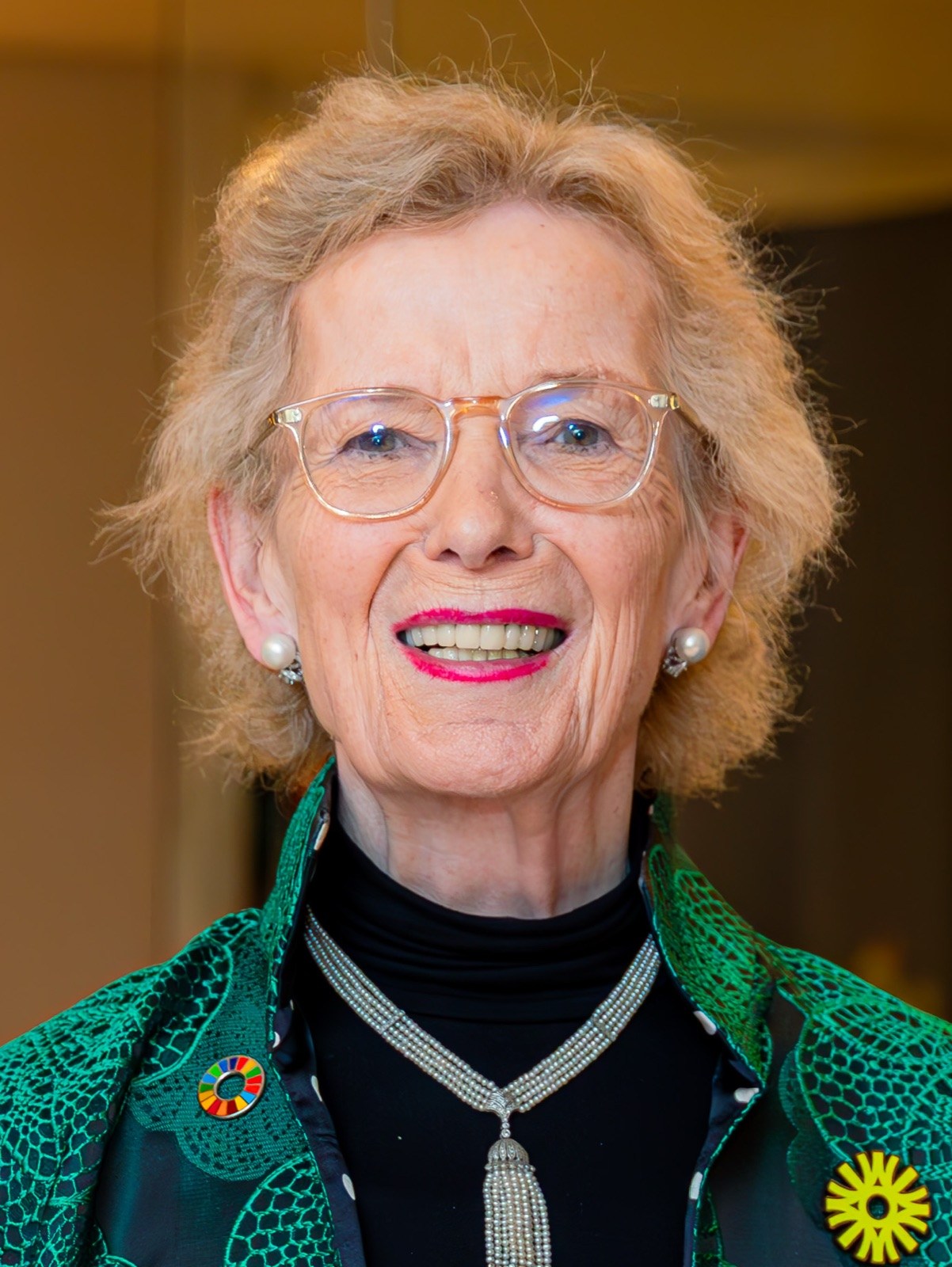
Mary Robinson
Mary Robinson was the first female President of Ireland and has spent decades fighting climate change as a member of the Elders.
Episode Summary
The Elders' Mary Robinson was the first female President of Ireland. She has spent decades fighting climate change. One Decision's Julia Macfarlane gets her take on China, Biden, & whether a world weary from COVID can rally the strength to make the sacrifices necessary to reduce carbon emissions. Plus the former head of the British spy agency Sir Richard Dearlove on the serious security and stability implications we are likely to see emerge from environmental issues in the coming years.
Listen & Subscribe
- Watch on YouTube
- Listen on Apple Podcasts
- Listen on Spotify
Transcript
INTRODUCTION
Lockwood: Welcome to One Decision, the show where we speak to people behind some of the key decisions that have shaped our world. Mary Robinson was Ireland's first female president. Leading the country from 1990 to 1997, her commitment to human rights and equality transformed Ireland. She was central in the decriminalization of homosexuality and the legalization of contraception and divorce in the deeply Catholic country. She didn't stop her campaigning after leaving public office. She worked for the United Nations as High Commissioner for Human Rights, and along with Nelson Mandela, she founded The Elders, a group of former world leaders working together for peace and equality. She was also attending COP26 this year in Glasgow and sat down to talk to us about her assessment of the state of climate change and the damning revelations in the latest report from the Intergovernmental Panel on Climate Change released in February and March. You were speaking at the sidelines of COP26, and you described your disappointment at what you saw was a total lack of urgency among world leaders to address the climate crisis. And that was pretty notable since it's usually quite rare for global leaders, even the ones who've left office, to criticize their counterparts so directly. Do you think you are a lone voice being quite as outspoken and critical of governments and of world leaders as you are? And should your colleagues be more outspoken?
INTERVIEW WITH MARY ROBINSON
Robinson: I don't think I'm a lone voice, and indeed, the Elders were brought together by Nelson Mandela in 2007 to be independent, to speak about, you know, human rights, justice, peace, and also the climate crisis, and to speak truth to power. And, you know, I think it's good that young voices are coming out now, brilliant young climate activists, are speaking so well.
Lockwood: One thing I wanted to ask you was a lot of these reports, I mean, we look at the IPCC reports and a lot of these climate change reports, a lot of these stats and this data, the modeling looks for the catastrophic endpoints of climate change and it hypothesizes situations that could happen. 2100 is a date that is often used to paint a pretty shocking and bleak picture. Do you think there is an issue with a lot of the science and a lot of the models focusing on decades ahead of us when current world leaders will all be dead, their children are likely to be dead, their grandchildren will be alive. But do you think that the fact that we are talking about 2100 onwards and painting a bleak picture in that timeframe is helpful, given that people right now who have to do something about it will never live to see those events take place?
Robinson: Well, I don't think that it's too far ahead at all. It's frighteningly close. When I heard that Climate Action Tracker report that, you know, we were heading for a world of 2.4 degrees by 2100. My take on that was anybody 70 in our world today is going to suffer some kind of catastrophe as we go above 1.5 up to two degrees. That would be catastrophic. And anybody 30 will live through, if they are able to survive through, a catastrophic world. That was my take. So nothing distant about this. Awfully, awfully close.
Lockwood: Well, paint for us a picture of at least one or two possible catastrophes for the currently under seventies, let's say, majority of the world population right now. What disasters are we most likely to see that would reach the level of catastrophic?
Robinson: What the IPCC said about, and I'm simplifying a little bit just to answer your question, about the difference between 1.5 and two degrees is that probably in that band of time, very serious things will happen. The Arctic ice may disappear. The coral reefs of the world may disappear. They're disappearing very fast as it is. And the permafrost, and there's a lot of permafrost up around the Arctic, may melt even more than it's begun to melt and throw up not just carbon, but also methane, which is even more serious in its short term impacts. So, you know, getting up to two degrees is very, very serious. It's the outer limit of where we should be. And every inch of, if that's the right way to describe it, every sort of tiny bit of increase in warming is going to be felt in terms of more severe droughts, rain bombs, like the rain bomb that's happening in Australia at the moment and causing very severe flooding, terrible wildfires, much, you know, wildfires like the ones recently in California and Oregon, aggravated by, I mean, there have been wildfires before, but now they're taking a life of their own. And the firefighters know it. They've never had this before, this kind of intensive. And everything will be intensively so, intensively worse in people's lifetime if we don't change course. I think it was disappointing that President Xi didn't turn up, yes, but even more that China didn't bring in any new, more ambitious pledge. That was a disappointment. And, let's put it this way, the United States should be pledging far more, particularly on climate finance. I mean, it went up to $11,400,000,000. It should be up at around 40,000,000,000 a year meeting its commitment to the $100,000,000,000 a year of developing countries. And so it's hard to single out a country. I was very tough on Australia at the COP because it's an industrialized country that's still sort of wedded to fossil fuel. It's got a fossil fuel mindset, which is such a tragedy for the Australian people. And I know many, many people in Australia, many organizations who are desperately trying to make the point that Australia should be making the same commitments as the European Union, as New Zealand, as other countries in relation to climate. But, you know, the truth is we need more ambition right across the board.
Lockwood: You say you don't want to single any country out, and I'm not asking you to single anyone out. But I do want to ask you about the second biggest emitter in global emissions in the world and its president. That is, of course, the US and President Joe Biden. Now Biden may have reinstated the US to the Paris Climate Agreement in 2021 after President Trump took the US out. Biden, he may have killed the Keystone XL project, but he's also encouraged OPEC to produce more oil in order to lower fuel prices. He's declined to block several other oil pipeline projects, and he's also greenlit drilling in federal land at a faster rate than the Trump administration. So I wanted to ask you, is the US and is Joe Biden himself failing on climate change right now?
Robinson: Well, I don't disagree with any of the points you've made because I've noted those points myself. I think it is very welcome that, you know, the United States has a president who actually does believe, and his special czar on climate also, John Kerry, absolutely believes that we have to be on course for an alignment with 1.5. There are many political problems with delivering, including with the Build Back Better legislation, which was to be the major climate legislation.
Lockwood: But on his climate policy and his energy policy, you say it's great to have a US president who believes in the seriousness of tackling climate change, but those words belie his, you know, his actions belie that pledge.
Robinson: Yeah. No. I agree. And it's part of the problem that we have of getting countries to really commit as seriously as they must. I hope, as I say, that this particular report of the IPCC, which is the grimmest one yet, I would say, to be read by anybody, and then the next two reports on mitigation and the synthesis report in October will, you know, move the needle on political will. The Biden administration did step up on adaptation finance, but as I said, not nearly enough. None of the countries that we're talking about are taking sufficiently seriously what is in this report and the other reports. And the connectedness between the climate crisis, the loss of biodiversity, the extinction of species, what's happening to our oceans, it's all connected.
Lockwood: You mentioned something earlier, and that was the challenges particularly faced by the US and a lot of Western countries are having right now with energy security. And there's a lot of public anger about the rising price of gasoline and how that is affecting countries around the world. Here in the UK, petrol has topped one pound fifty, which is totally insane. How much has the global gas shortage, and now the war in Ukraine, which is likely going to exacerbate the issue, certainly in Europe, given the cancellation of Nord Stream 2. How has this impacted the move towards clean energy and trying to clamp down on the use of fossil fuels like gas?
Robinson: I think it has made the absolute sense for European countries, because that's what we're talking about here, to move as rapidly as possible to clean energy. And I'm really pleased that the new chancellor of Germany has made exactly that commitment and that point and sees it in that way. I do think that in order to be able to move to clean energy more quickly, it's necessary to have gas in the short term and possibly to import the LPG from the United States in the short term to, you know, prevent a dependency on Russia. That would be a transition, a just transition measure to enable countries. But both the EU as a whole and Germany giving leadership as a single country and others, the faster they can go to clean energy, which is the cheapest form of energy now. Everybody is recognizing that. You need the investment to do it. We need to get into green hydrogen as quickly as possible, clean hydrogen. We need to get the innovative approaches that will ensure that we can, you know, continue to have a prosperous world, but based on clean energy, on circular economy, on all of the things we've been talking about over the years, but we need to accelerate implementation.
Lockwood: Well, we had a bad year, did we not, for green clean fuels. The winds didn't blow a lot last year. So a lot of wind farms produced very little electricity. In the UK, the UK has been building wind farms at pace and wind provided only 7% of the UK's energy compared to 25% it generated during 2020. 2021 was a bad, bad year for wind energy in particular. And the UK has now returned to coal energy, which is the worst of the fossil fuels after they had a very short lived celebration of going coal free for two months. So, you know, how damaging has the lack of wind power? How damaging has that been for building faith in green energy as a plausible replacement for fossil fuels?
Robinson: It, you know, it's important to retain a complete sense that it is renewable energy, which is the only way forward, the only way forward. As you say, coal is disastrous because it is destroying us, and that is the essence of the IPCC reports over the years and intensively this one. If the Cameron government had not changed the way in which the United Kingdom was committing to clean energy, the United Kingdom would be in a much better place, and there are a lot of studies to show that. We need to get, you know, the innovations of hydrogen as a very good source of clean energy if it's done properly, as I say. We need to have better battery retention so that, you know, we can rely on energy when the wind isn't blowing adequately. But, I mean, Denmark is a country that has absolutely committed to clean energy and has done very well from it. So I don't think the, you know, some problems are proof that a form of energy is not one that the world should invest in. I'm very supportive of all forms of clean energy as being the only way forward. We shouldn't be tax exempting fossil fuel. What we have to be careful about, and I think you were touching on this earlier about energy prices, we have to be sure that consumers don't suffer from energy poverty because of high fuel prices. And actually, governments have to take steps as governments to ensure that this doesn't happen while we move more rapidly out of fossil fuel and into clean energy. And I sometimes encourage governments to be prepared to do unusual things now like we did during COVID, unusual things to make sure we're paving the way with incentives towards clean energy, even if that costs. Because whose money are we spending? Our children's money. And if we spend our children's money well, they will have a safe future. If we don't do anything, we don't move rapidly into clean energy, they won't have a future. I mean, that's pretty stark.
Lockwood: What is in your crosshairs for the single most pressing thing in terms of one kind of solution? Is it for people to take fewer long haul flights? Is it for as many people as possible to change their cars to electric? What is for you the top sort of realistic everyday thing that people should and could be aiming for that you advocate for?
Robinson: I do encourage people when I speak to an audience. I encourage three steps. The first one is to take the climate crisis seriously in your life, to own it if you like, because it's as serious as that. You should take it seriously. And actually, you probably feel better if you, and how you take it seriously is you commit to doing something today and tomorrow you weren't doing yesterday, like recycling more carefully or changing your diet or changing how you move around or whatever. And secondly, get angry with those who should be taking much more significant steps like governments, like business, like investment, like cities, etcetera. Get angry with them and use your voice, join organizations, do whatever you can to make your voice heard. And then the third thing, we have to imagine this world we need to be hurrying towards. We don't do enough of that. And this world we have to be hurrying towards must be significantly benefiting in 2030 from the steps we've taken. We need to be 45% less, you know, polluting with fossil fuel. So remember during COVID, how the air cleaned up and we heard the birds and we felt closer to nature. We need to be a lot closer to nature by 2030 with living cities, with transport changed, with revitalizing and regeneration of agriculture, all of these things. We need to talk about them much more in order to get excited about doing them. But all of those things are less important than the commitments that governments have to take, that the heavy emitters have to be stopped. Maybe they'll be stopped by litigation over the coming years, but they have to be stopped. And we have to stop these subsidies on what's destroying us. It's the big things that matter.
Lockwood: Well, I, if I may put a red herring or push back slightly on that, you say it's the biggest moves need to be made by the government. The government can set policy and restrictions on industry and business, but that is driven by demand from the consumer. Should it not really? Should the onus be on governments or should the onus be on citizens, on the billions of people around the world to change their habits first? Because their demand for fossil fuels is what drives businesses, what drives lobbies, is what drives policy and the decision of politicians. Should it be, you know, from that end of from the grassroots up, do you think maybe the movement should come that way?
Robinson: I think it's important that we have more and more of a movement, and I'm glad that the movement calls itself a movement for climate justice because justice is at the heart of what we're talking about, the injustice of the way climate affects the poorest countries and poorest communities, the injustice of the gender dimensions, the intergenerational injustice, etcetera. I think, you know, governments have their responsibility to listen and to accept the commitments they have made. You know, we're not asking governments to do something they haven't committed themselves to. Just do what you've committed to because you know you should be doing it. But I do agree that, you know, we all need to think through how to live more sustainably with mother nature, and COVID can help there. I mean, I think there are probably four lessons from COVID that are relevant. The first one is that collective human behavior can actually make a difference. We changed our habits to socially distance, to washing our hands, to wearing masks, things we hadn't done before. And we did it because it was the only thing before the vaccines that would save us, and we knew that it was serious. The second lesson from COVID is that government matters. We can see how bad governments caused much more loss of life of their countries, and they won't be forgiven by history. You know, just how bad it was and how unnecessary the large loss of life. There will be a lot of analysis of that kind over the coming years. The third and very important thing from COVID is that science matters. Look at the way health experts were side by side with government determining how economies would open or not or have to close and maybe close again after they had opened because they were listened to. And we must listen to climate scientists in the same way. And the fourth point is a subtle and more gentle point, but I think it's an important one. During COVID, we saw a lot more empathy and compassion for those worse off because everybody was out of their comfort zone. And we saw, you know, food parcels, we saw people talking about those who were worse off in a way that showed a real empathy within countries. We didn't have as much empathy as we should have had globally with access to vaccines, which of course is also in our self interest because until the whole world is vaccinated, we're not going to be safe from the coronavirus and potentially future pandemics. So we need to, you know, to have a better framework on that. But I do think that, you know, COVID has some useful lessons for us.
ANALYSIS WITH SIR RICHARD DEARLOVE
Lockwood: We're joined now by our cohost, Sir Richard Dearlove, and his first impressions on this topic surprised me at first.
Dearlove: Well, it is a fascinating interview, but I think this is maybe where we're gonna encounter generational differences between you and me.
Lockwood: Bring it on, Richard. Bring it on. Bring it on.
Dearlove: I mean the one thing that struck me, and I'll come right to the point, is, and maybe I'll sort of put to you the rhetorical question, what is the biggest, as it were, cause of climate change? It's too many people on the planet. And the one thing that they never referred to was population growth and population decline. And I mean, you know, this is the sort of central question, and I cannot understand when these debates happen about climate change. No one talks about the size of the global population and the rate at which it's growing or the rate at which it may decline in the future, because that will have a bigger effect on the issue. And I find that really in a way quite surprising that you can talk about climate change, but no one seems to say, well, what is going to happen to the size of the world's population over the next fifty to one hundred years? Because that's going to be more influential than any other measures that we take. And it almost seems politically incorrect in a climate change debate to say this, which is why I think I should say it now.
Lockwood: But is it not because we can't really do much about the fact that—
Dearlove: Well, but, for example, the population of Russia last year declined by over a million. And in the developed world we're beginning to have less and less children. And if you look at the demographics of many, as it were, sophisticated economies, their populations are actually going, well, this is very hard to model, and, you know, Malthusian modelers over the last two hundred years have got these statistics wrong. But it is a very, very crucial and central part of the debate. And when something like Ukraine happens in Europe, this isn't a great encouragement to have a large family, is it?
Lockwood: But I think there's not a huge amount we can do about a growing population, and we look at how China tried to address its growing population by instituting the one child policy. And that has led to all kinds of big systemic problems in the Chinese population now. I read a really disturbing article in the New York Times a few years ago about how brides were being trafficked from Myanmar and Vietnam and Laos to China because there aren't any girls in China and there is a huge number of single men who cannot find a wife because they were born of the one child policy generation and so many Chinese families chose to have a boy instead of a girl. And so, the route that China went down has turned out to perhaps be a lot more trouble than it's worth. So I mean, there haven't really been any other ways we can address population.
Dearlove: No, but there isn't, but I mean, what I'm saying is that there should be some, as it were, much closer statistical analysis of how this issue may influence climate change in terms of modeling what is going to happen to various populations in different parts of the world. And that sort of debate is conveniently left out of any talk about climate change. I mean, that's the first point I guess.
Lockwood: But is that not because a lot of these developing countries, which are often the countries with the biggest populations, they are not per capita the most responsible for climate change, whereas big developed nations where the population is aging, where the number of people having lots of babies is on the decline, those are the countries that are causing the most pollution, burning the most fossil—
Dearlove: That's why it's really important to pursue, you know, zero low carbon policies, and I have absolutely no problem with that at all. I mean I do have a problem with how you implement those policies and what we actually do and how we do it. You know, we have an energy intensive economy which is unworkable without retaining some carbon fuels for a period of time. Now, you know, and it's clear that, you know, there are three routes maybe to a low carbon economy. You know, gas as a transfer fuel, nuclear, probably SNR, small nuclear reactors, as, you know, the ones that are used to power nuclear submarines, which are much less expensive and can power, you know, small towns. And the third, you know, is new technologies such as hydrogen, and the fourth, about which I'm highly skeptical, are renewables. The problem with hydrogen is that to make the technology work you have to generate energy. And I mean it's definitely an area that we should research, and if we can crack mass production of hydrogen based fuels, that's a massive breakthrough which would, you know, be really important. I mean there's no question that in the short term we need a certain amount of oil. I mean, but getting back to Mary Robinson, and I'm going to say something now which will be deeply controversial, she accepts the IPCC report as something like holy writ. You're not allowed to question the IPCC report. Now this is a model and a pretty well based model, and okay, I'm told by lots of people who know more than me that it's exactly what's happening. Look, I was told this by the modellers during the pandemic and half of them got it completely wrong. I mean, if you're a sceptic about aspects of so called science, I mean, when Boris gets up and says, follow the science about the pandemic, no. Yes, follow the science to an extent, but every decision is political, it's not scientific. It's how you interpret the science. And, you know, the fact that IPCC now is accepted as absolutely holy writ and not to be questioned, I'm afraid I'm still in a rather skeptical position on that.
Lockwood: I personally am growing increasingly anxious about climate change because you see evidence of it everywhere. We are having these extreme weather events all the time. I'm noticing myself, like, you know, the change in even just in the country that I live in and, you know, those epic wildfires in Australia, all of these crazy hurricanes in the US, the permafrost melting, all of this. The fact that you have, you know, there's so many angles. Fact you had Chennai, like a massive Indian city ran out of water for a period of time. There was no water in the city. And the fact that, you know, we are gonna run out of water in London by 2050. And, you know, there's so many aspects to climate change that we don't seem to be really taking as a serious threat when we see evidence, we see warnings from nature all around us.
Dearlove: Yes, I agree, that's worrying. But there are so many variables, there are so many scientific variables, how many of these are climatic events and how many are weather events?
Lockwood: I don't think it's just about climate versus weather, I also think, you know, it's about pollution, it's about urbanization. My own personal feelings about this is that humankind has, for so long now, we have changed nature and natural systems around us to suit our needs. And we are bending nature to our will and that it is an unsustainable way to live and it is something that is going to prove extremely problematic for us in the sense that, you know, I think in the next few decades, we are going to have tens of millions of climate refugees going up from the Equator, up to developed countries, and it's going to be so much more worse and destabilizing than, you know, the tiny migration crisis that threw Europe into disarray in 2015. I think we're gonna be fighting wars over water supply. I think, you know, more and more people are gonna die from pollution. I think there's all of these things that are going to be huge problems in the future. And by that time, we will have done so much damage, it will be impossible for us to dig ourselves out of that hole. And I think that is kind of, you know, where the scientists are coming from, where they're trying to instigate change and mitigate that risk now, but people are just too preoccupied with things that are happening today. It's hard to try to get excised over things that are going to be really, really problematic, you know, in the years ahead.
Dearlove: Well I think you can definitely take that, well I wouldn't call it an extreme view. On the evidence of some of the climatic events that we're experiencing you can take a view which supports what you're saying. But it's based on, I think, significant assumptions about what will or might happen in the future. And I mean, ironically, I think I'm a bit more optimistic than you. And the reason I'm optimistic, I think, maybe more in line with Mary Robinson in a strange way, although I disagree with her in a number of areas, is that I think the advance of science is one of the most extraordinary phenomenon of the twentieth century, and I think that it may be that the answers to our problems lie in scientific research and scientific development in solving some of the problems that we're faced with. And okay, maybe we won't get there in time, but for example, you know, if we were to crack the issue of fission rather than fusion, nuclear fission, if we were to crack the issue of hydrogen as a fuel. I mean there are all sorts of areas which could, if the solutions were found, quantum computing, I mean we're on the cusp of many of these, as it were, ground shaking discoveries, and all of them would be instantly and highly applicable to the climate change problem.
Lockwood: I agree with you, but the one thing that is not rising as much as scientific development is equality. And it's all very well for people like you and me to sit here and think, oh, we can replace our dirty fuels, we can change our lifestyles, we can drive electric cars. But, you know, the people, you know, down the road from the street I used to live in in Jakarta, how can you say to them, the people who live in kampungs and they drive, you know, dodgy bikes which have very dirty petrol, how can they change their lifestyle? They can't afford to buy vegetables that come in cardboard and paper instead of plastic. They can't afford to have electric cars. They can't afford to have a greener lifestyle because equality is going to be a problem still. And, you know, it's those countries, it's developing countries that are, to go back to what you said at the beginning of this conversation, the ones that have the rising populations. And so, science can develop all at once. We can, you know, advance to nuclear fission and fusion, but inevitably we're going to leave people behind in that.
Dearlove: Well I think you put your finger on a key issue which is the extent to which development can be spread evenly internationally. I mean it's even a massive problem within nations if you look at the UK, the difference between North and South and the government's policy of evening up. Yep, and you know if you go to a city like Jakarta, which I've been to several times, I mean you understand, you know, how chaotic a third world city like Jakarta can be, particularly when it's built on a floodplain.
Lockwood: I read a report recently about this town in Wales that was right on the coast. And it was encountering this curious phenomenon that house prices were shooting up despite the fact that it is on a list of towns that will have to be abandoned by the year 2050 or something because of rising sea water levels. And the reason that house prices were being driven up was because all these houses were being bought by pensioners who have their retirement savings to spend and they don't care that their house will be underwater by 2050 because they won't be around by then. And so I thought that story was interesting because to me, it seemed like, I think a lot of the global leadership are dealing with a problem that they will never live to see the ramifications of. And I wonder if that's maybe a reason why climate change is not prioritized in the way that a lot of younger people who know that they will live to see these consequences will?
Dearlove: Yeah, I think, you know, that's a very, very fair point. You know, someone like me will not really live to see the consequences of what you're talking about. I do worry for, well not so much for my children, I worry for my grandchildren, what sort of world. And they are, even at their young ages, you know, which is 11, 12, you know, they're little boys. But they're fiercely engaged and interested in this issue. And for them I think it's a legitimate concern, but I just wonder how accurate our predictions are. I mean I was born by the sea in a little Cornish fishing village at the end of World War Two, and I really, you know, do come from that little village. My mother was born and brought up there too. And my last connection with it, which I've refused to give up, is I still own a fishing cellar, a traditional fishing cellar, which is very very close to the beach. And there's no question that in my lifetime the height of the tides in that particular place have risen by about two or three feet. And you now see during spring tides they'll wash up against the door of the cellar and come underneath the door. And it doesn't matter, it's designed not to matter if seawater comes in, but I can't remember that ever happening in my childhood. So I think yes, there is clearly for me very local evidence of a slight rise, but a significant rise, and of course you get a storm with the right atmospheric conditions, those tide rises can become quite a frightening phenomenon.
Lockwood: Well, I mean, the city I was born in, Jakarta, that's going to be underwater soon, and they're actually thinking of abandoning it and moving the capital to Kalimantan. So for me that's also a very sad thought to behold.
Dearlove: Yeah, on one of my visits to Jakarta the whole place was underwater, I mean it was completely flooded, it was extraordinary. I've never seen anything like it. You know everybody paddling around and little boats being pushed down the streets, and I mean it was an extraordinary experience and that was years ago. I mean it must have been in the 1980s, I don't know. I spent a week there.
Lockwood: I love Jakarta, but it is—
Dearlove: It's an incredible sort of colorful, vibrant, mad city.
Lockwood: It's mad as a box of frogs.
Dearlove: Yeah. That's a good way to describe it, as mad as a box of frogs.
Lockwood: No. It totally is. I miss it so much. But it is one of the things I asked Mary was, you know, so many global cities are on the coast because they established themselves through shipping routes, grew on trade. And so what's going to happen to a lot of those cities which are on the coast? You have New York, you know, you have so many global cities that look like they are going to be on the front lines of a rising seawater in the future, and what's gonna happen to them?
Dearlove: Well, I think in a way they'll have to move back into the hinterland and, you know, bits will be abandoned. I mean, if the seawater rise is as predicted, I mean they're talking about what, a two meter rise by the end of this century if the current rate of the ice caps melting continues. And of course that's quite a lot, that's in my parlance six feet, and that is huge. And you know you will lose a lot of hinterland and that is a huge international challenge. And of course when something like Ukraine happens, we are massively distracted because all the security issues sort of override the long term policy issues, and I think that's the position we're in at the moment. We're on the cusp of having to rethink our energy policy, but we have to write climate change into it. But I honestly think that we have to put our national security at the moment first and we put climate change in the next thing. I mean Cicero I think said, you know, the security of the citizen is the primary responsibility of the state. And I think it was Benjamin Franklin who said he who puts security before freedom deserves neither. So which, in a view, do you take? Well in the present climate I think I put the security of the system as the primary responsibility of government, but it's interesting. There are those two challenging concepts of the state's primary authority.
Lockwood: Thanks for listening to this week's episode of One Decision. Don't forget to subscribe so you never miss an episode. See you next time.