Hosted by Christina Ruffini and Sir Richard Dearlove
Guest
Rahm Emanuel
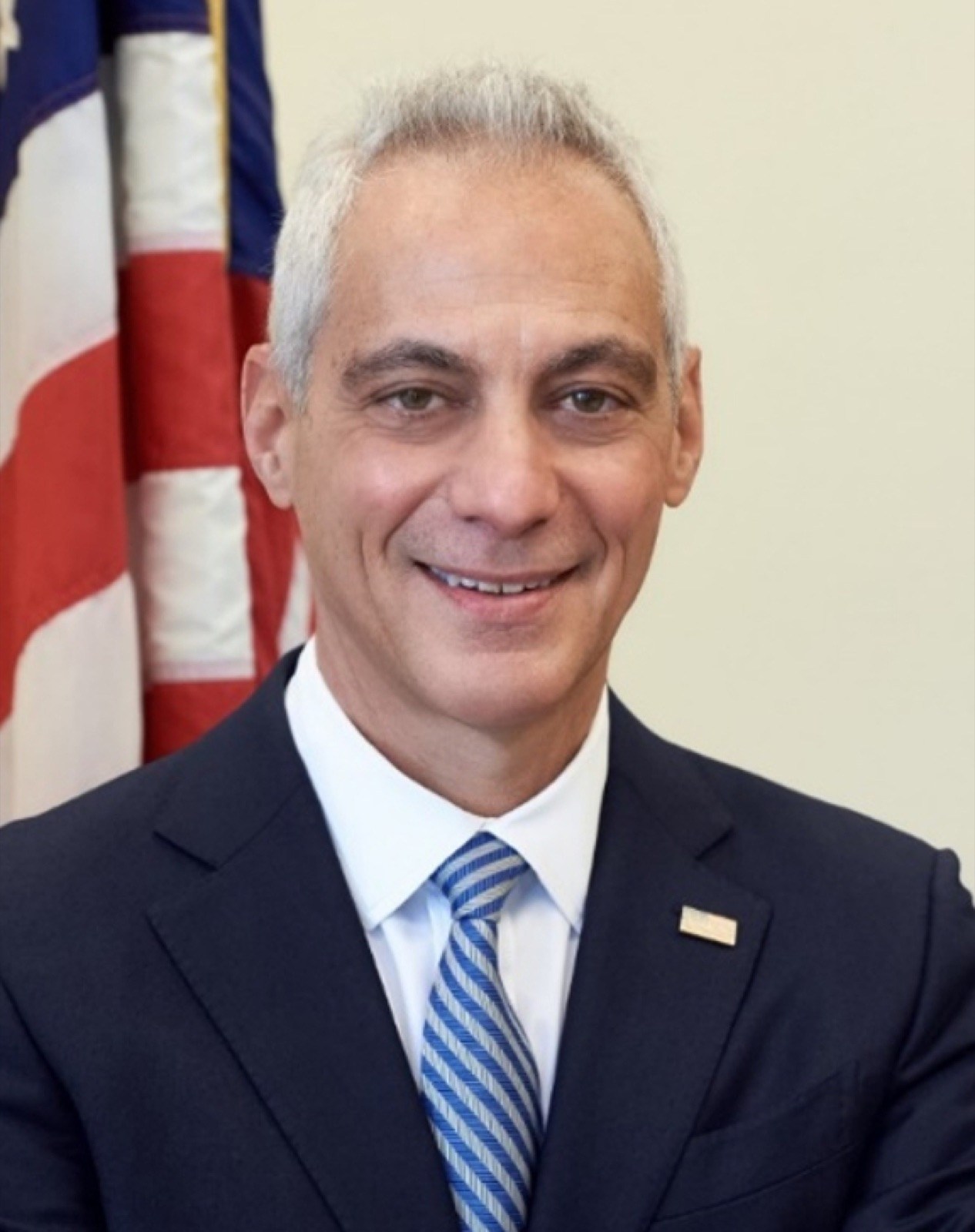
Rahm Emanuel is a former U.S. Ambassador to Japan with a long political career who previously served as mayor of Chicago, U.S. Congressman, and White House Chief of Staff for President Barack Obama. Emanuel discusses the ongoing conflict in Gaza and Biden's legacy.
Episode Summary
In this week's episode, hosts Christina Ruffini and Leon Panetta, former US Secretary of Defense and CIA Director, are joined by Rahm Emanuel, the former U.S. Ambassador to Japan. Emanuel has a long political career having previously served as the mayor of Chicago, a U.S. Congressman, and the former White House Chief of Staff for President Barack Obama. They discuss the ongoing conflict in Gaza, Israeli Prime Minister Benjamin Netanyahu's war strategy, and the shifting commercial interests of the Middle East. They also explore the legacy of President Joe Biden's presidency amid recent news about his health, and Emanuel discusses the state of the Democratic Party and whether he's considering a potential run for president in 2028. Plus, Panetta and Emanuel share stories of working with each other under President Bill Clinton's administration.
Episode produced by Situation Room Studios. Original music composed and produced by Leo Sidran.
Listen & Subscribe
- Watch on YouTube
- Listen on Apple Podcasts
- Listen on Spotify
Transcript
COLD OPEN
Emanuel: I don't think that either Galant, the former minister of defense for Israel, the prime minister have committed either war crimes or genocide. I do think the prime minister has been a horrible steward of Israel's security, of Israel's interests, and that's what he's guilty of.
INTRODUCTION
Raffini: Hello, and welcome to One Decision. I'm Christina Raffini here today with our cohost secretary Leon Panetta and our guest former ambassador Rahm Emanuel. Now, mister ambassador, you have, like, a bunch of different titles because you are also a former mayor, a member of congress, former chief of staff. Like, which which honorific should we go with? Mayor, ambassador, man, what are what are we calling you today?
Emanuel: Every morning when Leon was chief of staff, I used to run in it. I would seven in the morning, I would say stuff with hands flying, everything. Leon would look up and go, you sure you're not Italian? I said Italian enough to date your daughter goes, not that Italian. Not that Italian. So you go with whatever title, and I'll I'll respond to it. So one conclusion you could probably have from all the titles is I can't keep a job. Or you just are in demand for many different jobs, a renaissance man, if you will. How about this? I'm I'm very, very lucky. It's been a I no. I am. And I will say on my last assignment, it's not like my Wikipedia page is empty, and yet I found something at this point in my life where I'm still learning, still contributing.
Raffini: It was a whole new world that opened up to me. So I feel very fortunate and also to find a way to give back. I mean, obviously, you went to good schools, you had a good education, but, you know, we need to start off with something. This is a foreign affairs podcast, and I wanna make sure we start off with the most serious topics. We wouldn't be doing our job if we didn't ask you about things that, you know, you may or may not be willing to talk about in your past. Sir, did you study ballet at college?
Emanuel: Yeah. Well, first of all, you said went to good schools and everything, probably the building foundation is we had a good family. Yes. I did. So I wanna say this. So I was 13. I was on the soccer team. It was off season. I said to my mother, I wanted to improve my soccer game. Now that year, Rosey Grier from the Minnesota Vikings in the off season took up ballet, defensive lineman. And my mother said, well, you should take ballet and improve your footwork, your balance, etcetera. I'm in the ballet class, and I'm looking around, and I realized there are 30 women and me. And in soccer, there were 14 of us on the bench, and I realized and all guys. Those are better odds over there. So I went and I stayed I stayed with ballet. If my if my mother hears this, thank god she's deaf, she still thinks I made a mistake. I had a scholarship to the Joffrey Ballet School, and I did not take it. And I convinced her to let me go to Sarah Lawrence that had a great dance program so that I could I would study academics and still dance and not lose it. And if I really cared, I could go down to New York, and I'll just be a dancer. And the moment my parents pulled away dropping me off, I threw the ballet shoes against the wall and said, sucker. And look. Since being back, I've been to I'm on the Joffrey board now. I went to the Joffrey opening. I went to Twyla Tharp's recent show, Gus Giordano. I love dance. My youngest one dances, but I did study ballet. And modern dance. That is correct. It's the reason Rahm has been able to dance his way through politics.
INTERVIEW: ISRAEL AND GAZA
Raffini: All right. Well, I don't wanna tiptoe around why we're really here. So let's get into it. I wanna start off with some news that broke just a little while ago. This week, you've got former Israeli Prime Minister Ehud Olmert and former state department spokesperson Matt Miller, both in separate interviews, accusing Israel of committing war crimes in Gaza after this incident where IDF forces opened fire on civilians near an aid distribution point. According to local health officials, as many as 30 or so were killed, many of them children. The Israelis have said, you know, these were people who wandered off the designated paths. They didn't respond to stop commands, and they posed a threat to IDF soldiers. You were a civilian volunteer for the IDF, I think in 1991. You were also Chicago's first Jewish mayor. So what is your take? Is Israel committing war crimes?
Emanuel: I think it is crazy to have Israeli soldiers on their third tour of duty reservists doing food distribution. If you look in Lebanon and Syria, the security apparatus of Israel accomplished through a means of security, an opportunity that now the government is strategically making the most of. Israel's met with the Syrian government, talked about security. They're cool. In fact, the new head of Syrian government said, Israel and Syria have common enemies. He's getting the act in the Arab world for that. Lebanon is cooperating with Israel on rooting out Hezbollah South of the Litani River in Lebanon. Sovereign nations are good for Israel. Here, I'm sorry, the prime minister and he and I, when I was president Obama's chief of staff, he called me a self hating Jew publicly. We got into a big fight, and I didn't need a war to know he was wrong. This situation, because he has refused for his own domestic politics and his own coalition government to develop a day after plan has forced the IDF into untenable positions. Now they have degraded and decimated Hamas. There's a way to create a food distribution system that doesn't allow Hamas to regroup and to centralize their power. I get that. But what Israel is doing and where the security apparatus is not a means to an end, it's become an end in itself because Bibi Netanyahu will not end this process. There is a diminishing returns calling on the IDF. There's no reason for the IDF to be in food distribution business. There are plenty of NGOs to do that, and they've got reservists who should be back home with their families on their third, fourth, fifth tour of duty doing food distribution because he refuses to show any leadership on a day after plan. And everything I just said has been said by leaders present and former in the security apparatus of the IDF and the state of Israel. It's nuts. And I don't believe the IDF is involved in either genocide. The crime that's been committed is that the prime minister refuses to permit a recognizable day after plan for the management and stewardship of both the people in Gaza and the Gaza Strip. That's the problem.
Raffini: If you don't think the IDF itself is committing, you know, however you're to fight them, war crimes, do you think Netanyahu is guilty of of something along those lines?
Emanuel: No. But here's let me say this. I wanna be very clear about one distinction here. When there were some issues to IDF conduct, individual soldiers and their leadership were held accountable within the legal system. When Hamas was accused of rape, they said that's not true, and then they said they were glorified. There's different standards here, and we're not gonna do apples and oranges. That's number one. I don't think as somebody there's a great book out, I think it's called East West Street, on the history of the legal terms of crimes against humanity and genocide. I don't think what this is my personal view. I'm not a lawyer. That either Galant, the former minister of defense for Israel, or the prime minister had committed either war crimes or genocide. I do think the prime minister has been a horrible steward of Israel's security and a horrible steward of Israel's interests, and that's what he's guilty of.
Panetta: Basic problem here, you know, without getting into using terms like war crimes, etcetera, is that Netanyahu is conducting a lousy war, and he's conducting it because he wants to survive in office. It isn't about what happens in this war. I mean, I think that's always been the problem is that he has never clarified what the mission is, who are we after, when can he really claim that he's achieved those goals, and can end the war. He has not identified those goals. I mean, from the beginning, frankly, when he said, you know, we're gonna just wipe out Hamas as our goal, it was unrealistic. But you can wipe out the leadership of Hamas, and that is a goal. But you go after those that are responsible for what happened. That was the target, and they did that, but then they never developed, as Rahm said, you know, what's the day after plan? How are we ultimately gonna try to find some kind of more permanent peace in The Middle East? Two weeks ago, Israel went after Mohammed Sinwar and other elements of the leadership that were meeting. And then you have violence associated with the food distribution, who's responsible, etcetera, that will be determined. What has had a greater contribution to Israel's security?
Emanuel: Shooting at civilians at a food distribution or through technology understanding the leadership of what was left of Hamas was meeting and then firing a missile at that. There were other civilian deaths in that situation. That was a call that an elected government makes a decision of, etcetera. They made it. But you don't need reservists on their fourth tour of duty to actually degrade the Hamas security threat to Israel. That was done by the air and by technology. You wanna defeat Hamas? Go repopulate the kibbutzim on the South Of Israel next to Gaza. Go bring back those communities. It will show a symbol of the renaissance rejuvenation of the Israeli pioneer spirit of settling Israel. Nothing would be a greater detriment and a greater degradation to the war efforts of Hamas, not just to what the IDF did. As the son of a pioneer whose family left Odessa in 1907 and went to Palestine, my father's family. The whole esprit de corps of Israel was to settle all parts of Israel. Let it flourish. You wanna beat Hamas? Go start those kibbutzim again. Bring those families back. Rebuild them. Have them become the agricultural manufacturing centers that they were, places where families could grow, prosper, etcetera. That would be one of the most severe blows to Hezbollah, to Hamas, and the Iranian terrorist entities that Iran sponsors. That would have its own power.
Panetta: It's much easier to drop bombs. It's much easier to go in and shoot people. It's much easier to conduct a war than it is to try to settle down and decide how do we build a nation? How do we try to provide a more peaceful solution for the future? That's tough work. It's a hell of a lot easier. I mean, as secretary of defense, it's a hell of a lot easier for me to basically, you know, have ordered people to go into battle and drop the bombs. That's easy. And Netanyahu, to a large extent, is caught up in that. It's about conducting the war, dropping bombs. That's the politics that he's playing right now. And he knows damn well that ultimately what has to happen involves diplomacy. It involves trying to build something positive for the future. It involves working with the Abraham Accords and building a coalition of other countries that can help provide that more permanent solution. That's a lot of work, but it's possible. And that, frankly, is where the key is to building some kind of hope that we're not gonna have wars every two years. It's a lot of work. It means a lot of tough political calls,
Emanuel: and he doesn't wanna make those calls. He was the one that wanted to fund Hamas because he didn't wanna deal with the Palestinian authority. He was the one that had permitted the money from Qatar to come in. This is his responsibility. What happened? He was the one that divided the country on some stupid court and judicial process, and he doesn't wanna spend the capital. I mean, I go back to 1998 at the Wye Plantation advising president Clinton not to give up Pollard. So my disagreements with this prime minister go way back to the point that he publicly attacked me, and it's one of my prouder moments in public service. What he is and what he's doing here is part of a character. He's not gonna spend his political capital when he can spend yours or that kid's or that reservist. And that's what he's doing.
Panetta: Rahm and I were part of the Clinton administration in different capacities, but, you know, we were there. And Bill Clinton, to his credit, decided that he was gonna really try to exercise leadership in trying to promote peace in The Middle East. He basically rolled up his sleeves. He had everybody in administration roll up their sleeves. He was willing to approach these people. And one good thing about Clinton was that he was always able to put himself in somebody else's shoes so that he understood where they were coming from and what their problems were. But he was willing to do that and try to achieve peace in The Middle East. Does it cost you something? Of course. Is it politically difficult to do? Yes. It is. But in the end, if you can make it work, you really accomplish something that benefits the world and benefits the cause for real peace.
Emanuel: President Clinton showed both Wye Plantation, Oslo, and Aqaba with Jordan and Israel, but in the Camp David towards the end of his tenure. Leadership and any plan is gonna be in the end of the day what he proposed. But I'm sorry. Arafat, which would have had 98% of the real estate of a Palestinian state, was not willing to show that leadership. And since 2000, that has been a real consequence. In the same way, the prime minister of the state of Israel today is missing the opportunity to seize the future, and he's allowing Israel to be held back from that.
A HISTORIC MIDDLE EAST REALIGNMENT
Raffini: You've said you think the Middle East is on the precipice of an historic realignment. What do you mean by that, and who do you think is involved, and how do you see that potentially playing out?
Emanuel: In the end of the day, don't watch the negotiating table on Iran's nuclear. The real action is what Syria and Lebanon are doing in Israel. Unlike in 2015, you have the emergence of a sovereign nation with terrorists pushed back in Lebanon. Lebanon is starting to get their sea legs as a country. Assad's gone. He was a surrogate for Iran. As he says, the president said, Israel and us have similar enemies. He's paying a price in the region for that comment, but he said that. And they're meeting with the Israeli security apparatus. When there are sovereign nations, Iran cannot function. When there are broken states, you get Hezbollah, you get Assad, you get Hamas, you get the Houthis. Sovereign nations, total different factor. That means that Shiite crescent from Tehran to the Mediterranean is pushed back to the suburbs of Baghdad. That's one. Major, major difference from 2015. Two, in the last, call it, thirty years, somewhere in that zone, the petrostates have become key players in the global economy. Tourism, finance, real estate development, venture capital, investments in new technology, semiconductors, etcetera, data centers. The Gulf Nations are no longer petrostates. They know that their success requires quiet, stability, certainty. They're ready to take off. That is a huge opportunity for both The United States' interest and for the state of Israel. The Mideast today, in just a decade, is a lot different than 2015, a lot different than 2005, and a lot different than 1995. And I think there's a potential since Tehran is the greatest sponsor of terrorism in both the region and the world to push them back, get all eyes on their nuclear capabilities, set it back decades, and allow those who believe in order, sovereignty, and prosperity of domestic populations, that political philosophy to flourish. It's sitting there. If you wanted to be a kind of a pragmatist, you say, well, that never happens, and it won't happen. But all the building blocks are aligning in that way. Now leadership, to Leon's point, is about seeing that tomorrow and pushing the system into that tomorrow or allowing it to get drawn into the sands of Rafah and Gaza Strip. I look at the sovereignty of the Lebanese government. I look at the sovereignty of the Syrian government. I look at Tehran getting pushed back. I look at Hezbollah degraded. I look at Assad regime degraded and all the kind of petri dish of terrorism that could be there. This is a huge opportunity just waiting to be seized.
Panetta: It really is an opportunity because we're now in an era where, frankly, these countries want to enjoy economic wealth. They want to be able to move. They want to be able to be part of the world of the twenty first century. And The UAE has moved in that direction and Saudi Arabia wants to move in that direction. Qatar and others, the same thing is true. So there's a different motivation here rather than just hatred of Israel. There really is a motivation to try to improve their own country. And that gives you the opportunity to build that kind of alliance that would bring together these moderate Arab nations, bring together Israel and be able to then have them operating not only in terms of providing for the economic wealth of that region, but that would be a tremendous security force to be able to confront both Iran and terrorism, which still remain some of the primary threats in that region. A fundamental problem is the lack of leadership. You know, whether you look at The United States, whether you look at Israel, whether you look at other areas, I mean, and to have our president just go there, you know, visit Saudi Arabia and visit these other countries and try to get a lot of money out of the deal without really focusing on any kind of diplomacy about what can happen to build what Rahm was talking about,
Raffini: you know, is a tragedy. It's a shame. He did do one thing that plays into what you've both been talking about at the behest most likely it seems of the Saudis, and that's lift sanctions on the new Syrian government so that they can do exactly what you've been talking about. Try to stand up a government, try to be international players, try to get some legitimacy for that administration or whatever we're calling it, which was a bit unexpected and very interesting. And my sources were telling me that came from the influence of the people he met with. I'm not sure that impetus came from the White House itself, but that matters. Right?
Emanuel: Look. I mean, whatever the motivation is, he did something. And to me, if you compare this moment, 2025 with 2015, 2015 was about their nuclear capacity, Iran's, and getting eyes on it, setting it back, and moving it back. Because of the lost decade, mainly because of president Trump's decision in 2017, we lost that decade. They're farther along. But what you do have now, which you didn't have then, one of the criticisms of the agreement back in 2015, is you severely have diminished Iran's partnership with Hezbollah. Hezbollah is not the player it was five months ago. Same thing with Syria. That makes a nuclear agreement within that context dramatically different because Tehran has been degraded and diminished.
BIDEN'S LEGACY AND LEADERSHIP
Raffini: I do wanna talk to you two about the other thing that's on everybody's minds the last couple weeks, and that is this book, Original Sin, talking about president Biden and the people around him and the role they played or didn't play in keeping what the authors allege was his cognitive decline kind of behind the scenes. You both have talked a lot already about leadership, about speaking truth to power. Where do you think this all started going wrong with president Biden? Was it when he decided or someone decided to run again? Was it the debate? Was it before all of that? And do you think the people around him failed to hold him accountable or themselves accountable?
Emanuel: Yes. Yes. Yes. And yes. Here look. Here's the thing. The Oval Office is incredibly seductive, and White Houses are incredibly insular. Leon said to me when I became chief of staff, one thing you gotta do, keep your peripheral vision. The other thing, he says, keep your character. The White House became insular, and the Oval Office became seductive to a man who said, I'm gonna be a transition. And he made a decision. It's on him, and the White House didn't push back, and it's on them. This was not a secret. Do you think that was his decision, or do you think he was pushed into it by people who wanted to keep their cool jobs? Leon's the Italian one in here. I'm the Jewish one. But let me just say this. Raffini. My last name is Raffini. You got two of us. Okay. I better watch myself. But as the old saying goes, the fish rots from the head down. Leon and I both know this. You know what you get paid for as chief of staff? To get your head handed to you every day. You walk in. I used to be six three. I'm five eight now. Your job is to walk in there and say, okay. If you're gonna do this, I wanna just tell you upfront. Here are the consequences. Now your job is not to just say, hey. That's a dumb idea. Your job is to say, here's an alternative. Or if you're gonna do what you're gonna do, this is what you gotta do. Your job is to tell them the thing that they don't wanna hear. And a good president will hire a chief of staff and counselors and senior advisers to do exactly that. And there were plenty of times along the way I walked in and said, I'm just telling you, I think this is the dumbest thing, and let me tell you why. What was the nastiest thing either of you ever had to go tell a president in the Oval Office? That's an endless list.
Panetta: Let me just stress what Rahm said, because it really is a very important point. You walk into the Oval Office, and clearly, there's a lot of power that goes with that office. But presidents who don't want other smart people in the room who are able to provide experience on issues, who are able to look at the president in the eye and say you're gonna make a mistake. There are consequences here. Presidents who want to have those people in the room are successful. No president knows everything about everything. They just don't. I don't care. The smartest I mean, Clinton was a very smart guy. Obama was a very smart guy. But let me tell you something. There are things they did not know a lot about, but they were willing to listen to people that knew about them. That this president, the one we have now, has deliberately basically excluded anybody from the ability to stand up to him, look him in the eye, and say you're screwing up. Biden was the same way. Biden had a lot of people that worked for him for a long time. And while they were capable people and knew a lot, and worked with a lot of those people, they were good people. But the ability to look at Joe Biden in the eye and say, mister president, you are wrong.
Emanuel: But let me give you one example to flush out what Leon is saying from Obama rather. And I remember this because we had gotten the recovery act done, we got national service done, we got children's health insurance done, Lilly Ledbetter, all when I say done, signed into law. The budget passed. It was a Saturday in March, and we were having a meeting about health care, banking, financial reform, cap and trade. You fast forward, the president decided health care first. But the debate was which one? Now the president's sitting in the chair that he sits at the Roosevelt desk in the Roosevelt Room. It seats you about 25 all around. And I was on his left. The vice president was on his right. At the other end of the table where the domestic people said, every day you don't do health care is a day we're not going to get health care done. The clock starts. And if you don't use your time, you're diminishing your chances. Absolutely correct from a legislative perspective. The economic team didn't really wanna do health care. The health care, they were kinda agnostic to financial reform. They were worried that as long as there was a wet blanket over an uncertainty, there would be no lending. It would adversely affect the economy. Not wrong. Some of us, David Axelrod and myself, advocated doing financial reform first, Old Testament justice, because in this moment in time in another country, if you do financial reform, the bankers are on the other side of the table, and you have a good enemy. You're gonna fight them, and they deserve to get spanked more than that. If you do health care reform, the insurance company, the pharmaceutical company, the doctors are on this side of the table sitting next to you because that's the only way to pass it. That was a lesson out of Hillarycare. Now the president has 24 smart people except for the chief of staff, all in the room. Different advices. His judgment, as he said that day at the end of the three hour meeting on that Saturday morning and afternoon, health care is first among all equals. Financial reform, cap and trade went not to the back, but they weren't the primary. He knew the decision he was making. Nothing is a 100% this way and zero that way. It's equities, and you have to see if you can square it. He made his decision. We have universal health care today because of it. Kids have coverage. People with preexisting conditions. Now I happen to think our politics, this was my argument, paid a price for not having that fight with the bankers up front. Because one of the problems we have today is people think the system is rigged on behalf of people that screw everybody else. And guess what? They're not wrong on that. So you weigh equities. And to the core question, it's clear both the seduction of the Oval Office and the insularness of the White House. We paid a price because nobody went in and told the president, no. You can't run. It's wrong. I know you want to. Can't happen. Are you gonna run for president? Look. I'm spending my time thinking about, if I did, do I have the ideas for the future? I don't wanna spend my time just fighting Trump, and I think there's a lot to fight over because I think what he's doing is destructive. But by 2028, you gotta be able to if you want the keys to the car, to lay out an agenda for the American people about the American dream. The core issue in this country, the moment the American dream started to become unaffordable is exactly when our politics became unstable. And if you wanna restore democracy, restore the American dream. You want a more stable country that's brought together, have people that's more than just the three of our children have access to that American dream. And you can't have an American dream that only 10% of the country has access to. It's not stable. It's not affordable, and it's not why your parents, Leon's parents, and my parents sacrificed to get here, and we have to restore that dream. And if I have an idea that I don't think other people are articulating, I'll do it. If I don't, I won't. It's that simple.
DECISIONS AND REGRETS
Raffini: Throughout your career, is there a decision that you made or didn't make that really stands out to you as something you wish you could have a do over?
Emanuel: Oh, there's that's a long list. There's two moments. One is early on, in my tenure, I'm living off the fumes of the last contract from mayor Daley with the teachers, and I'm pushing a big robust education agenda. The mayor in the contract has the right to yank a pay raise unilaterally in the contract. No mayor had exercised it, but every contract had. And without calling the head of the teachers union, he never did a budget his last year because it was too hard to do a school budget. He left me with that. I yanked it. I should have called the head of the teachers union in and said, look. We got a problem here. Help me out. Even if she said, hey. It's your problem. I'm not doing that. I gave her a shot at the table. And that was a mistake, and it set off a problem that didn't stay just on the pay and the contract. It reverberated. She and I became very good friends towards the end of my second term, in the middle of my second term, etcetera, but that's on me. Second is and I said this when I was confirmed for ambassador. I addressed the issue of Laquan McDonald. I made a series of reforms and changes that I thought brought accountability, and the problem within the police department was much more severe, much more not only built into the culture, and the solutions I thought I addressed were not adequate to the problem. And both of those, there's not a day that goes by or a week that goes by that on either one of those, I don't think about the what ifs. Nobody in public life of any time or tenure who's in a decision making role doesn't make mistakes. The real question is you don't get a do over. You get lessons learned. But if you ask me the one decision, there's, like, multiple decisions. But those are two things out of my career that I own. I own them. They're on me.
Panetta: They're on me to fix. They're on me to address. As I said, Rahm and I go back a long way. But when I came in as director of the CIA, and Rahm was chief of staff, the president made clear that we had to go after Bin Laden, but we also had to go after Al Qaeda. And so we had operations at the CIA that basically targeted those that were involved in nine eleven. Took a lot of work, took a lot of review. When we had a target, we hit it. And I would call this guy in the Oval Office, tell Rahm, you know, that we'd gotten something. There was nobody happier about the fact that we had gotten the target than Rahm. He was very supportive of what we were doing. And although Rahm wasn't there when we did the Bin Laden raid, I can tell you, I know Rahm feels that kind of, you know, you put a lot of effort into it. It's a mission that's very difficult to do, but you're able to get it done.
Emanuel: That is the reward of public service. So Leon knows this. The chief of staff, the president, the vice president, vice president, chief of staff, national security, and deputy of security all have this giant secure phone usually behind the desk. Nothing ever happens. I'm three days before I'm leaving. And for the first time, both senior adviser to president Clinton, chief of staff to president, that phone rings. I never heard it ring. I got Jewish motor skills. I have no idea about technology. I pick it up. It's Leon. And Leon says, Rahmer, I need a meeting. And I thought, because it was towards the end, Leon was pulling my I said, Leon. I went, the Leon? Is this real? He goes, Yeah, it's real. I said, Leon, you're pulling my leg and there's some surprise here. He goes, No. So three thirty that afternoon, we had a meeting we scheduled. And that last kind of really official meeting was the first meeting where the CIA, for the first time ever, came in with data because we made them come in every month, once a month to report. Even if they said nothing. Nothing. Nothing. Nineteen months later, we got something. I said this to Leon Panetta after the presentation. I said, that's not enough data to get a search warrant in a court. You got to be kidding me. That was my last official meeting in the Oval Office. It was the first meeting on that.
Raffini: So the data was where Bin Laden was?
Panetta: Yeah. Following the courier to a place that kind of gave us a sense that that might be the location of Bin Laden.
Emanuel: Higher walls,
Panetta: no internet, burned garbage. That was it. And interestingly enough, the president's first reaction was, we got to continue to do surveillance for almost another year.
Emanuel: That's why leadership is judgment. It's not here's my policy position, here's which count a lot. Don't get me wrong. And having smart people around. But it's having the judgment both because you did something right in the past, you did something wrong in the past, you made a mistake, you learned from it. And my example of this is, thank god the Bay of Pigs happened before the Cuban Missile Crisis so Kennedy could learn. I'm serious. In this situation, the most important quality for a leader, especially a president, is their character and their judgment because they're gonna make mistakes, and do they have the capacity to learn from them? And also being willing to admit mistakes. But, yes, thank you so much for your time. It's great to be with two Italians who allow a Jewish kid to say something. You're welcome back anytime.
Raffini: It's a rarity. You're welcome back anytime. Thank you so much. Good to be with you, pal. That's it for this week's episode of One Decision. Of course, a special thank you once again to ambassador Rahm Emanuel. And if you like this conversation, be sure to check out a previous episode where we talked to former US ambassador to China, Nick Burns, on what it's like working with Chinese officials.
Burns: But I think that the threat from China today is even greater than the threat from the old Soviet Union for one reason. China is more powerful. Xi Jinping's China is a much more powerful
Raffini: economic, technology, and military adversary than even the Soviet Union was. Of course, for more exclusive content and interviews with world leaders, be sure to check out our website, 1decision.com. And for more stuff, including topical explainers and in-depth commentaries, subscribe to our YouTube page. I'm Christina Raffini from the WHOLE team. Thanks for listening.