Episode Info
- Season11
- Episode3
Hosted by Christina Ruffini and Sir Richard Dearlove
Guest
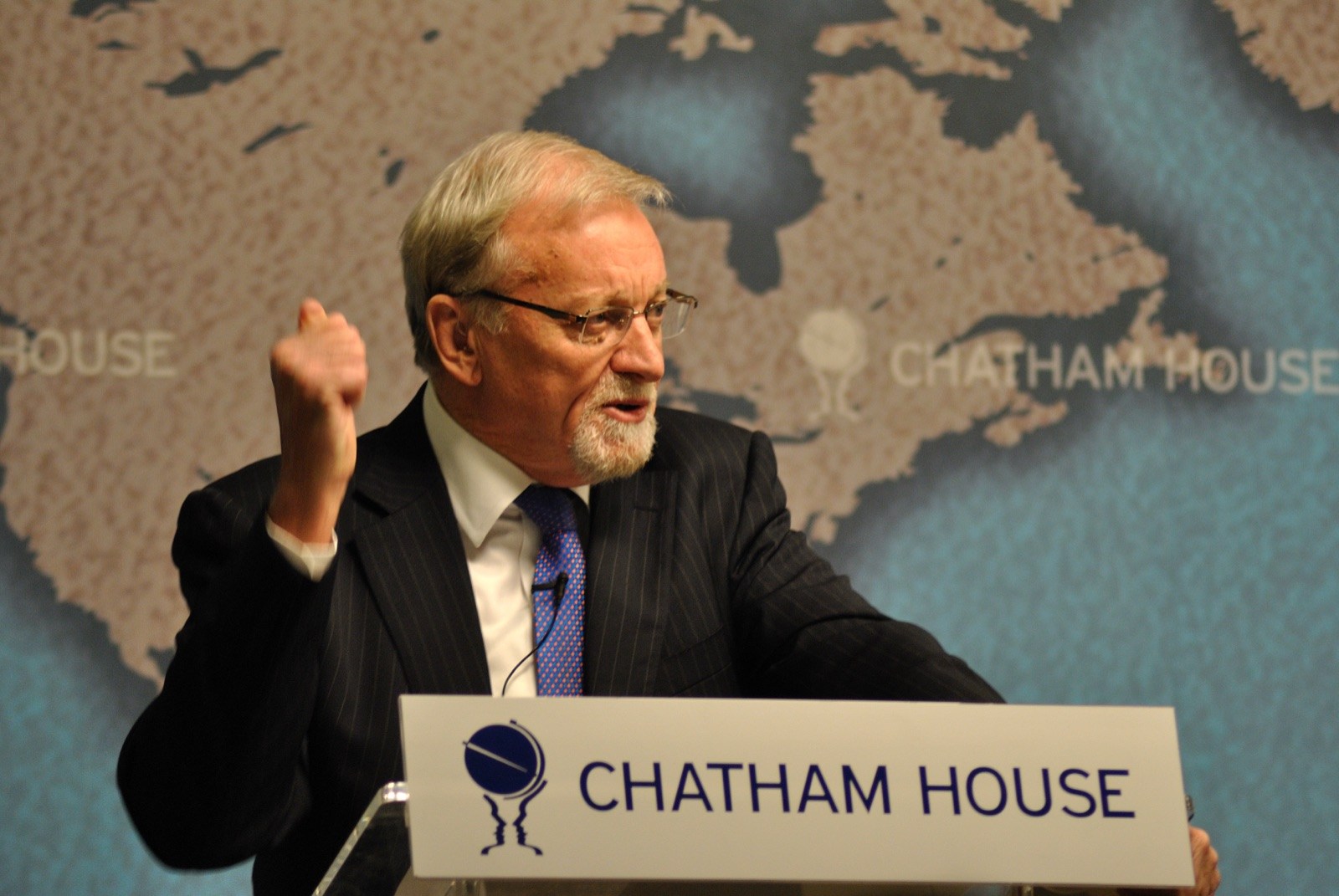
Gareth Evans
Gareth Evans is an Australian former Foreign Minister who played a central role in brokering peace in Cambodia and helping to bring about the end of the Khmer Rouge regime.
Episode Summary
As the world faces so much turmoil, we reflect on a moment just more than 30 years ago when Australia took a leading role brokering peace in Cambodia, helping to bring about the end of the infamous Khmer Rouge regime, behind the genocide now known as the Killing Fields. The man at the centre of that historic agreement is Australian former Foreign Minister Gareth Evans. What lessons for today can we draw from the past, and a conflict that saw China, Russia and the US on different and competing sides? We explore those issues and how these chess moves continue to play out today.
Listen & Subscribe
- Watch on YouTube
- Listen on Apple Podcasts
- Listen on Spotify
Transcript
INTRODUCTION
Mcfarlane: I'm Julia McFarlane, cohost of the One Decision Podcast. We're coming up on a significant milestone. It's our one year anniversary of bringing you in-depth analysis of the critical decisions shaping our world. To celebrate the occasion, cohost and former head of MI6, Sir Richard Dearlove, and myself, will answer questions submitted by you, the listeners. Spies are usually pretty tight lipped, so don't miss the chance to write in. Your question might even make it onto the podcast. For more information, head over to 1decisionpodcast.com.
Mcfarlane: You're listening to One Decision, the show that looks at the choices made that have shaped our world. I'm your host, Julia McFarlane. As you may be able to hear from my voice, I've come down with COVID, but thankfully not before we managed to speak to a fascinating guest for this week's episode. For the working diplomat, the highest aims one could hope to achieve besides representing your country and its values overseas is to effect positive change. Negotiation, dialogue, helping to solve some of the world's difficult sticking points, and maybe even helping to save lives. There's not many around who could lay claim to having done just that, but we spoke to one former foreign minister who managed one of the most significant feats in diplomatic endeavor, helping to end what was one of the worst civil conflicts of the twentieth century. Gareth Evans, Australia's top diplomat, was instrumental in bringing about the Cambodian peace agreements, ending a brutal war that saw some of the most hideous acts of brutality by the genocidal Khmer Rouge regime. The plan was initiated by Evans, and with Australia taking a leading role in the negotiations, that agreement was finally signed in Paris in 1991. But while Cambodia might technically be no longer in a state of war, the former rebel Hun Sen, who was back then the nation's big hope for peace, has become Cambodia's longest serving leader and an autocrat in the process. We sat down with Gareth to hear how he managed to broker peace in a nation ravaged by civil conflict and what lessons from the past are still relevant to today.
INTERVIEW
Evans: When I became foreign minister in 1988, Cambodia was still in terrible, terrible shape. It had been ravaged successively, first of all by the US bombing campaign in the last stages of the Vietnam War, then by internal civil war, then by the horrific Khmer Rouge genocide, which, as you said, resulted in two million people losing their lives through outright execution or malnutrition or disease. Then there was the Vietnamese invasion, which helped to quell the immediate impact of the Khmer Rouge, but created another long lasting civil war, which was completely unresolved by the late '80s. There had been a number of international attempts to try to broker some sort of peace between the warring factions and their external supporters, but they'd all come to naught through the '80s. It was probably one of the most complex international diplomatic problems you could ever think about, because you had not only the internal divisions between the Vietnamese backed Hun Sen government and the Royalists and third parties as well, and the Khmer Rouge, of course, as the communist element within the Cambodian system. You had Russia supporting Vietnam, supporting Hun Sen, and you had China supporting the Khmer Rouge. So how in the hell did one try to unravel this sort of nightmare of competing interest in which nobody was prepared to give up any influence. The particular solution that Australia came up with was really pretty simple, but it proved to be the key which did unlock the diplomatic dilemma. The idea was, essentially, to give an absolutely central role during a transition period to the United Nations, an unprecedentedly central role not just involving election monitoring or peacekeeping and so on, but rather actually heavily participating in the administration of the country during the transitional process. And the idea was that to give the UN that role would give a face saving way for China to step back from its support for the Khmer Rouge, which was the thing that was really ultimately inhibiting any kind of capacity for compromise from anyone else. China was getting increasingly embarrassed internationally by the genocidal character of the regime, which by then was universally known. But China did not want to cede ground to Vietnam and Russia. It didn't want to be seen to be stepping away from the kind of influence that it had. But giving the UN that role was the key which got us there. And it took a long and very, very complex process of negotiation. But that was essentially the way we got there. And we got to the election in 1993, which seemed to, at last, have resolved the problem, to create a new government democratically elected and a new capacity for peace. But, of course, we'll come to this now, I guess. Getting peace in Cambodia, with all that entailed, was one thing, but getting democracy and human rights was something else.
Mcfarlane: I think it's very interesting how instrumental the UN was in brokering that peace and taking responsibility for that transition, and particularly the transitional administration. And so the obvious question I have for you on that is, was it only possible because the UN itself was in many ways a very different body than the UN it is today, and it was held in different regard. What do you make of the United Nations of 2022? Do you think it has the influence? Do you think it has the international respect, and the ability, and the legitimacy in many countries' eyes to carry out a similar role, if such a situation like Cambodia and the opportunity for some kind of brokered peace deal were to happen today?
Evans: Well, a couple of factors were very significant, I think, in the UN playing the role that it did. One was the personal role that Kofi Annan, the Secretary General, played, who very much although he'd been pretty much just a middle order bureaucrat in his previous career, rose so brilliantly to the occasion as the Secretary General, and using the moral pulpit that the position gave him to articulate an approach to the big issues of the day and the big problems of the day, which had a sort of compelling flavor about them. He brought people with him and that was important, personally. It always is leadership at that individual level. But what was also critical, of course, was the period we're talking about. This is all coinciding with the end of the Cold War. It's coinciding with the breakup of the Soviet Union, the shifting of all the tectonic plates, the huge new sense of possibility there was about reaching cooperative solutions to big, intractable problems, which now has evaporated in 2022 almost completely. But when I think back to what was doable in that period, it wasn't just for me the Cambodian peace settlement, which we played such a central role in. Was the initiation of the end game of the Chemical Weapons Convention. It was the creation of new regional security and economic architecture in the Asia Pacific. A whole bunch of things were possible because the Cold War was over and people saw the virtue in a cooperative approach and cooperative solution. So, you can't ever put the onus on the United Nations to do stuff which its key member states are not themselves willing to do. As I think it was Richard Holbrooke, the US ambassador diplomat, once famously said that blaming the UN for things is a bit like blaming Madison Square Garden when the Knicks lose a basketball game. It's the players that matter. It's the members that ultimately determine it.
Mcfarlane: I really like that Madison Square Garden phrase. I'm absolutely going to keep that. That's interesting. So, it sounds like it was largely the circumstances facing all the big players. I mean, we had a United States that was humiliated after the Vietnam War, trying to handle the dismantling of the Soviet Union. You had the Soviet Union itself crumbling, and this former Great World Empire sort of dissolving and losing all of its satellite states. And then you have China, which was not the wealthy, powerful China that we know today, but China absolutely riven with a lot of socio economic issues. The government of Mao Zedong had sent billions of dollars worth of military and financial support to the Khmer Rouge. And that was before some of the worst years of the genocide. And obviously, not only wanting to disassociate itself from this bloodthirsty regime, but also clearly looking at their coffers and the many people who had starved to death in their own country, thinking that Chinese money needed to be spent on China and not elsewhere. I ask you this in the context of Cambodia, but obviously we have a number of intractable conflicts at the moment going on. A lot of opportunities where peace talks could go on, whether it's in Ethiopia, Ukraine and Russia, Israel and Palestine. I mean, what would you say are the most important things needed to bring opposing sides together, especially when there are ideological differences? Is it the need for all sides to feel that they have lost? Is it for economic gain? I mean, what would you say are the key things for any peace settlements to be brought?
Evans: Well, it's a combination of things. It's a combination of generating a fear that something worse could happen if efforts are not made to find some kind of solution. It's a combination of economic pressure, very often, making it unpalatable to sustain a very extensive conflict. It's a function simply of the imagination, or lack of it, of the leaders of the time and their willingness to take risks in order to tease out the possibility of solutions, which may be embarrassing if they're prematurely disclosed, but nonetheless do offer a way forward. I'm at the end of the day still very much an optimist. I mean, a diminished optimist because of the events of the last decade or so. But I'm an optimist about the unwillingness of the really major players to get into another full scale kinetic war. It's not just because of the fear of nuclear weapons and so on. I think it is a genuine fear on all sides now that with the technology we now have, the conventional wars of the twentieth century would be even more horrific in terms of their implications for human suffering and for the lack of any rational cost benefit conclusion to come from this. Russia didn't go to war with Ukraine because it was willing to pay the price of a long, drawn out, major, major conflict. It went into Ukraine because he thought it would win in twenty four, forty eight hours. It thought Ukraine would collapse. It believed its own crazy propaganda about the nature of Ukraine as not a serious country.
Mcfarlane: I want to bring us back to Cambodia because I want to talk to you about Hun Sen. Now, he is the 70 year old prime minister of Cambodia, and he was a Khmer Rouge soldier during the civil war in the late '60s to '70s. But he then joined the rebel force backed by Vietnam that eventually toppled the Khmer Rouge. He became Cambodia's foreign minister when he was in his 20s, and then he rose to power in 1985. And he has been there ever since. I believe he's currently on his sixth consecutive term, and he's now one of the longest running leaders in the world. Did you ever meet him personally? And if so, what did you make of him? And talk to us about how peace that was achieved in Cambodia was the best I think you could have hoped for, I'm sure is fair to say, but it has not resulted in a democratic peace for Cambodia.
Evans: Well, I knew Hun Sen very well indeed. I dealt with him a lot during the course of the negotiations from '89 through to '93. He used to describe me as his brother, which was a bit embarrassing when he turned out to be as dictatorial as he subsequently did. By the time we got to 2014, his behavior was so bad that I wrote an op-ed which was given global circulation through Project Syndicate saying that the Cambodian government has been guilty of murderous violence, which was a perfectly accurate description of what they'd been doing since first acquiring half the power in '93 and then acquiring the lot through a coup in '97, and then consolidating their position thereafter through periodically resorting to outright killing of opponents as well as intimidation and fraud and manipulation. I went to Cambodia rather adventurously about a year after putting out that op-ed, and Hun Sen heard that I was coming to speak at a conference and he was due to open the conference and he invited me up on the stage to join him at the opening of this big international conference. And I thought, well, this is an interesting gesture of reconciliation after I've been so tough on him. Maybe there is a way forward. Well, he took the opportunity to embark upon the brown glass eye staring, fist waving fulmination that lasted about twenty minutes, in which he just absolutely took me apart as his former diplomatic partner that had brought peace to this country, who he'd had the greatest trust and confidence in and affection for, and now I deserted and betrayed him. The international audience was shocked to its core, and, you know, we were stunned by all this. His own cabinet ministers sitting in the front row were sort of deeply bored by it all because they'd heard the stuff before. I'd heard enough of it before, not to be sort of overwhelmed by it, but to sort of stare him back down. It was an interesting example of the kind of relationship that I had with him and the kind of relationship it's been since. It's been non existent since, because I've periodically said in my own analyses and writing that this is a country that had a chance, not only for peace, but for democracy, for human rights, but it's a country which blew it. It blew it overwhelmingly because of Hun Sen's own personal ambition, his greed, his corruption, his determination to stay in power and his willingness to employ any methods at all to do that. And so, it's a very unhappy situation that continues to this day. Basically, since 1997, Hun Sen's been running a one party state. In the National Assembly there's 125 seats, not one of them occupied by the opposition party, which has been banned. Major opponents have been either exiled or imprisoned or, in one or two cases, murdered. And it's just a very, very unhappy situation. And the human rights environment, as well as the democracy environment, sort of mirrors that. No free speech worth the name, no free association worth the name, and extraordinary levels of corruption as well. So, it's a very sad story. What could have been an absolutely brilliant twenty first century story has become a very sad one. And my relationship with Hun Sen has not recovered and I don't think it ever will as a result of that. But he was there when it mattered. He was there and he was prepared to make the compromises that counted in bringing that solution about. Had he stood against it, had he refused to go down the path that the Vietnamese by then were pushing him, then we wouldn't have been able to manage that solution. So, I give him credit for that. But I don't give him credit for anything that's happened thereafter. It's tragedy.
Mcfarlane: So why did that happen? As someone who knew him well, tell me, is this an age old example of ultimate power and money corrupting? Or do you think he maybe always had an inner dictator inside of him, and back when he was the freedom fighting rebel, wanting peace, that was not the real Hun Sen?
Evans: Well, I don't know that that capacity for analysis is really possible. I do know that even right back when he was Prime Minister of the country before the peace settlement had come about that his wife, on formal occasions, was absolutely dripping with diamonds in a way that was inexplicable, except through quite a significant element of producing that wealth. I mean, Hun Sen is now estimated to be worth somewhere between $500,000,000 and $1,000,000,000. I've never personally understood the motivation that leads people to greed on that scale. I mean, Putin is a notorious, corrupt, you know, squillionaire in his own right, and Najib now in Malaysia has finally gone to jail for his Gothic scale corruption. What is it about the psychology of these people that makes them so greedy and makes them want to be in power, I guess for other reasons as well, to be in power in order to be able to acquire those kinds of riches? I mean, how much money can you spend during your life? I just don't get it, that's why I'm an academic politician and not a billionaire.
Mcfarlane: Yeah, well, I could speculate about Putin's psychology for hours, and I suspect it is because of childhood or adolescent chip on the shoulder Napoleon syndrome, and that explains his machismo and his judo. I think there are other sort of personal reasons for that as well, which I won't say in public.
Evans: Once they get to a certain point in the span of their office and their acquisition and their greed, then they fear to give it up, because they fear the consequences, being not just not allowed to have a quiet retirement, but actually jail or worse. The trajectory is a very, very familiar one, I'm afraid, with dictators in these countries. It's one thing to explain why they get to where they do, but then it's another issue again to understand why they stay there and they stay there very often out of sheer fear of the consequences of being displaced.
Mcfarlane: I know we're running out of time, so I have one final question for you, Gareth. And I read that you are on the board of sponsors for the Bulletin of the Atomic Scientists. They are of course in charge of the Doomsday Clock every year. So I have to ask you, what in your opinion is the biggest threat to humanity today? And what causes you to lose sleep at night?
Evans: Well, there are three big existential threats to humanity, each of which could destroy life on this planet as we know it: pandemics, climate and the risk of major nuclear war. Of the three, nukes are the ones that are going to kill us faster than anything else, on a greater scale than anything else, if we were confronted with a really major exchange because of the nuclear winter effect. Pandemics we are conscious of the nature of the risk, conscious of what's needed cooperatively to address them, and this is serious. But nukes are something that we do run the risk of sleepwalking into. I'm as anxious now about things going badly wrong with nuclear weapons as I've ever been, and I think the Doomsday Clock people are right to put the hands of that clock closer at one hundred seconds to midnight than they've been anywhere since the height of the Cold War. And the thing that worries me most is not really so much the prospect of outright aggressive first use of nuclear weapons. It's the prospect of inadvertent use, dumb use, system error, human error, human idiocy. We know now all too well from the archives of the Cold War period just how many times we came close to total Armageddon catastrophe because of that human error factor, particularly in Cuba, particularly in 1983 Operation Able Archer, so called. And my belief is that, particularly when you add to that now artificial intelligence, the prospect of cyber offense being able to overwhelm cyber defense, and all those kinds of miscommunication and misjudgment that can flow from a breakdown of communications cyber sabotage induced. And when I look at the kind of command and control arrangements that exist with so many of the present nuclear powers, as compared with the sophistication, apparently, of that which existed between the major powers in the Cold War years, even with those consequences I've described, when you put all that together, I really think it's the case that the only reason we've avoided nuclear catastrophe for the last seventy five plus years has nothing to do with system integrity or human sanity. It's sheer dumb luck.
Mcfarlane: Gareth Evans, former Foreign Minister of Australia there. We turn now to my co host Sir Richard Dearlove for his thoughts.
ANALYSIS WITH SIR RICHARD DEARLOVE
Dearlove: Well, I think listening to your interview with Gareth, it was almost like a throwback in time. The problem for the international community is, you know, we've moved on such a long way and we've moved into a different era. That's almost a throwback when diplomacy and the UN in particular played such an important role in bringing a horrendous national tragedy to, at the time, what looked like a more or less satisfactory end. And I suppose what we are really talking about is the sort of closing stages. Well, it's the aftermath of the Cold War, really in the closing stages of the Cold War, when the UN was still much more consequential internationally. And people like Gareth, who are seasoned and accomplished diplomats, could play a sensible negotiating role. I mean, personally, I remember those events really well. I was in Geneva at the time, so, you know, maybe more familiar than many with UN related issues. And it was an extraordinary and dreadful tragedy, one from which most of the Western world were really quite detached. So it seemed almost unreal that it was happening. There was that sort of distance from these ghastly events, and it was almost as if it was something happening on another planet. I mean, I know it certainly wasn't in Southeast Asia, but certainly in Europe. We didn't feel the impact of it in quite the way that people maybe in Southeast Asia did. And of course, what subsequently happened with the Hun Sen regime, which eventually replaced the Khmer Rouge, is that there was a lot of optimism around what the new Cambodian regime would look like. And of course, it's turned into something which is desperately repressive now and has a ghastly human rights record. So although the killing fields are a part of our recent history, the Hun Sen regime hasn't covered itself in any glory, given its dreadful human rights record. It's not as bad as the Khmer Rouge, but it's pretty bad.
Mcfarlane: Right, and Hun Sen, he was formerly of the Khmer Rouge until he defected. And he has a very interesting story. He was foreign minister when he was still very young. And then he rose to power in the mid 1980s. And he carried the hopes of everyone involved in the agreement that he would steer Cambodia into a peaceful future. While I think sort of maybe not peaceful, Cambodia is certainly stable, but it's certainly not a functioning democracy in the way that we might have hoped it might be. It's stable, but as you point out, it is one of the most repressed states in the world. I mean, you know, and we've seen that happen a lot with the West, maybe not backing the wrong horse, so to speak, but pinning a lot of hopes on possible democratic rebels, who then fall short of the wayside. And I mean, a more recent example is the Free Syrian Army with, you know, in the situation in the Syrian civil war. I mean, he's had an interesting story arc, Hun Sen, and I found it fascinating Gareth's recollection of their relationship and that time that he stood up with Hun Sen.
Dearlove: Hun Sen turned around and said, He was my brother and he stabbed me in the back, or words to that effect. I thought that was a very fascinating insight. It does give one insight to some quite extraordinary events. And of course, I think the problem with a country like Cambodia and Hun Sen in power, I mean Hun Sen now suits the Chinese regional interests very strongly. The Chinese have no interest in promoting human rights in regimes they support strongly or economically strongly. And I mean, in a way, Hun Sen has become a sort of Chinese puppet. Maybe that's too strong a word. I mean, some of the stories now about the way that the Chinese have exploited so called independent Cambodia, but at the same time, have indebted the economy and have made themselves an indispensable ally. So I'm sure that Hun Sen, with the Chinese behind him now, feels pretty secure. And I've mentioned already, you have this regional complication, where the Vietnamese have always, who are the other sort of powerful neighboring nation, but the Vietnamese have always had this very awkward and difficult relationship with China. I'm sure that under the surface still there's a significant struggle for regional influence there. Someone like Hun Sen has really a surprisingly free hand because, you know, who is gonna control him? I mean, the country is not consequential enough geopolitically or strategically for anyone to, as it were, contest the Chinese influence. I mean, Hun Sen clearly was very able and rather unusual and emerged as a very, very young man in a prominent position. But I mean, do remember that Hun Sen was a middle ranking Khmer Rouge before he dumped them and became their opponents. But clearly, he saw a personal opportunity, which he's exploited rather thoroughly. There are lots of countries in the world where new leaders have emerged. They had good intentions when they started, but you know, rather bad. I mean, the great example is Mugabe and Zimbabwe. I mean, I would even include Museveni in Uganda, who became very autocratic.
Mcfarlane: Right, well, since we're on the subject, I wanted to ask you, I mean, you characterize Hun Sen as a kind of Chinese puppet, and certainly he has been useful for Beijing. Cambodia has been one of China's close allies in the ASEAN League of Southeast Asian Nations, the Association of Southeast Asian Nations, and Cambodia has blocked criticism of China quite regularly. In that part of the world, you have a lot of autocratic problematic, should we say, states. You have Cambodia, you have Vietnam and then you have Myanmar and of course the Chinese, they have very close links to the military junta in Myanmar. Which of these countries do you think is the more important strategic Chinese interest? I mean, another country that is also worth mentioning is Laos. And there have been fears recently that Laos may suffer a similar economic plight as Sri Lanka. A lot of warnings that Laos may be the next big economy to default. Part of the reason is because they have been tied up in a lot of Chinese debt. And of course, debt trap diplomacy is sort of how China tries to aggressively assert its influence, particularly in its backyard in Southeast Asia. Which of these countries, which of these leaders or regimes do you think are the real strategic priority for Beijing?
Dearlove: There's no question. It's Myanmar, I think. Because if you look at the geography, and the way that the Chinese have developed transport links down into Myanmar, it gives them access to the Indian Ocean. And I think that, as it were, geopolitical access and ability to project power into a region which for the Chinese is strategically of key importance because obviously its significant regional opponent is India. And in a way, you only have to look at a map to see that Myanmar provides a flanking opportunity, if one can put it like that. And then to build significant naval infrastructure on the coast of Myanmar is obviously very important to the Chinese now. They've built this massive road that goes down from China. It's of key importance to the Chinese. I think Cambodia just doesn't even line up in terms of a comparison. But I mean, I think that Cambodia has been used by Chinese criminality, but it's partly state driven in terms of as a base for cyber activity and illegal cyber activity. It's easier if you can, as it were, host it out in another country, so you can't be directly accused of doing it from your own sovereignty.
Mcfarlane: That's so interesting. So you mean that perhaps the Chinese are using Cambodia as a base, using non state actors to launch cyber attacks against the West?
Dearlove: Well, my understanding is that's pretty well established. I hasten to add, I'm not an expert on this, but I think there has been a surprising amount of criminally driven cyber activity which comes out of Cambodia, which certainly isn't Cambodian, it's almost certainly Chinese. And as you say, non state actors who have a quasi, you know, to whom the Chinese turn a blind eye or maybe even more than that, give them support.
Mcfarlane: I want to stay on the theme of world power rivalry, but also bring it back to Cambodia. And I think what is so interesting about the Cambodian conflict is we see the strands at play still present to present day rivalries. Back then, we had the Chinese who were arming and funding the Khmer Rouge. The Soviet Union was supporting Hun Sen and the rebels. And then the US was also involved, they were backing anti communist groups, but that was more to do with protecting the government of South Vietnam and the US forces stationed there at the time. We had these similar kind of rising world powers engaging in proxy wars in other parts of the world. We see a looming world power rivalry between the US and China in terms of growing competition, and it hasn't really broken out into anything kinetic, but that's always a fear that everyone's talking about. And then perhaps most pressingly, we're seeing Russia gearing up more and more and more, almost baiting the West to come into conflict with all these threats of nuclear strikes, and most recently the launching of this nuclear train, and other sort of incendiary moves and comments made by Putin and the Russian government. I mean, all of these world power rivalries, where do you see them going? I mean, they have unleashed devastating wars to the other countries who've unfortunately served as the proxy war locations for these great power rivalries. But will these rivalries always play out unfortunately at the hands of poorer nations who serve as their proxies or do you think we're in a place where it's going to keep on bubbling and bubbling until it ends up in open conflict?
Dearlove: That's a really tough question. It's a big question. But if you look at, as it were, the two attempts globally that there have been to regulate the international security situation, they're both the product of war. So you have, you know, the League of Nations and that attempt to modulate and run international relations that followed World War One after the Treaty of Versailles. And then after World War II, you have the UN that emerges from the ruins of World War II. And for a period of time, let's say that the UN has been, not necessarily an effective regulator of the international security situation, but it has been the forum through which most of the deals that have been done have eventually been done. The UN has played an important role. And UN resolutions have been a key part of decision making in international affairs. But I'm tempted, and what was interesting about hearing Gareth talk about Cambodia, is it was almost a sort of throwback to the way that the world was. And it was reminiscent of that, happened very easily of a different time, of a different era. What do I think will happen? I think we're in a process of, as it were, seeing Russian power significantly diminished, and that Russia, a post imperial state, is on its way down. Putin's invasion of Ukraine, for me, is a desperate throw of the dice to retain and establish Russian power beyond its borders, which looks to me bound to fail. So we'll be on the cusp of a new international security situation, inevitably, in my opinion, is going to have to be a balance of interest between China and the United States. And I'm really not prepared to go much further than saying that one can see a security system which is based on the regional interests of China and the United States, assuming that that does not end up in conflict, which of course many eminent international relations academics have said it could or even have said it will. I'm not so sure that that's true because I'm not sure that the Chinese intention is to challenge the United States as it were that directly. The challenge will be competitive and in terms of trade over time. So I mean, I think that what we're seeing is a dissolution of the international security system that was put in place after World War Two. We are seeing it falling apart.
Mcfarlane: That's it for this week's episode of One Decision. You can stay up to date on all our latest interviews and analysis by subscribing to us wherever you get your podcasts. From me and the team, thanks for listening. See you next time.