Hosted by Christina Ruffini and Sir Richard Dearlove
Guest
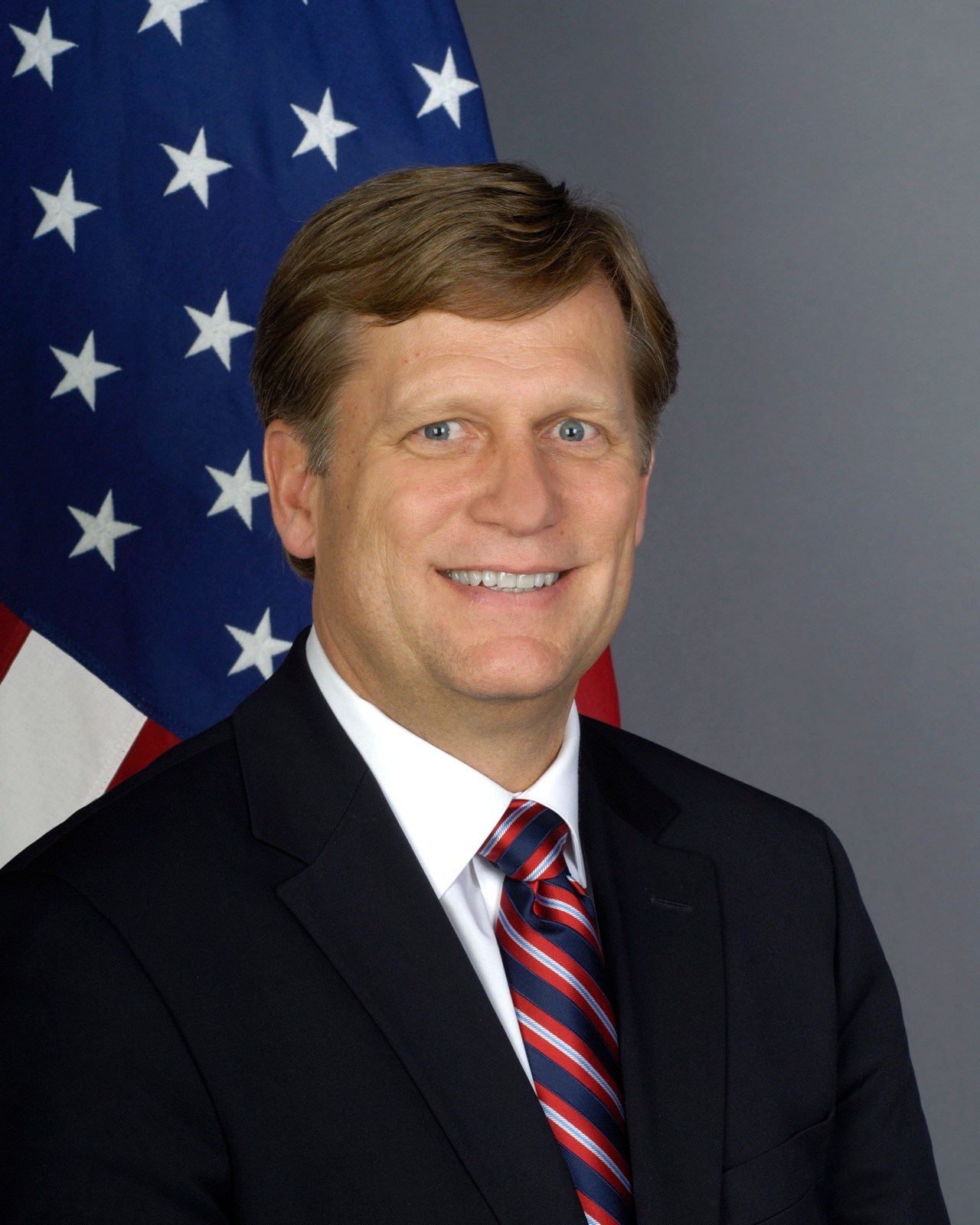
Michael McFaul
Michael McFaul is a former U.S. Ambassador to Russia during the Obama administration.
Episode Summary
This week on One Decision, hosts Christina Ruffini and Sir Richard Dearlove, former head of Britain's MI6, are joined by Michael McFaul, former U.S. Ambassador to Russia during the Obama administration. In this conversation, McFaul breaks down President Donald Trump’s proposed 28-point peace deal for Ukraine and what it means for American and European security. McFaul also brings personal insight, reflecting on his time watching Vladimir Putin up close, from meeting him in 1991 when he first entered politics to becoming the increasingly paranoid dictator he is today. Plus, McFaul dissects China's precarious geopolitical position, caught between its strategic partnership with Russia and their need to avoid conflict with the U.S., and what a win for Ukraine would mean not just for halting Putin's army, but also for possibly creating the first real opening in years for political change inside the Kremlin.
Michael McFaul’s new book, Autocrats vs Democrats: China, Russia, America and the New Global Disorder, out now: https://t.co/fLOoG1j8me
Episode produced by Situation Room Studios. Original music composed and produced by Leo Sidran.
Listen & Subscribe
- Watch on YouTube
- Listen on Apple Podcasts
- Listen on Spotify
Transcript
COLD OPEN
Mcfaul: He wants you to forget that when he was in London in 2000, he said Russia should join NATO. There's no question that,
Dearlove: Zelensky's internal position, certainly weakened by this recent corruption scandal. You know, weeding that out of the administration in Ukraine is a complicated business.
Mcfaul: Xi Jinping and Putin have brought their two countries together closer. Nobody called up Moscow in 1949 to say, hey. Hey, Mr. Stalin. Are you okay with us creating this NATO alliance?
Raffini: For those of us not watching, Richard just threw his hands up. But yes. Yes.
Mcfaul: Crazy that we're on that side. One couldn't believe it.
INTRODUCTION
Raffini: Hello, and welcome to One Decision. I'm your host, Christina Raffini, joined, of course, by my cohost, Sir Richard Dearlove. And, Sir Richard, you are in a tie today because you said you had meetings, but it is nice to see you even though you're outdressing me here on the feed.
Dearlove: I know. I'm looking very smart today, even though I say.
Raffini: If you do say so yourself. Also looking smart and joining us in today's episode, we're speaking with Ambassador Michael McFaul. Before his nomination to be ambassador to Russia, he worked for the NSC as special assistant to the president under the Obama administration and senior director of Russian and Eurasian affairs. His new book, Autocrats versus Democrats: China, Russia, America, and the New Global Disorder is out now.
Mcfaul: Yes. Released October 28. So thanks for having me, and thanks for talking about it.
Raffini: Congratulations. Thanks.
INTERVIEW
Raffini: I think to start off, I just wanna ask you about kind of the latest headlines coming out of Ukraine and Russia. You know, we're hearing from Zelensky now saying he's willing to at least negotiate about these terms and this Trump peace proposal. I mean, I have some things I wanna dig into, but what's your initial take on that? Are you surprised that he's saying that?
Mcfaul: I'm not surprised he's saying it because he has no choice. He can't get in a fight with President Trump. That's happened from time to time before and has not been good for Ukraine. I have to confess, I made a mistake in listening to the president several weeks ago. I thought after a decade of calling Putin his friend and appeasing Putin that he'd finally changed, that he finally understood who Putin really was because President Trump made some critical remarks about Putin for the first time in a decade. And then they put sanctions for the first time in their second administration on two oil companies. So I thought the tide had changed, but this peace proposal, let's make no mistake. It's not a new peace proposal. It's all the old talking points, all the old positions that Putin has had for years, and it's capitulation. If Zelensky was to sign this document, I fear for him. I think it would lead to perhaps even a revolt within his own country, within his own soldiers. So I will be surprised if he accepts all these points. I don't think that'll happen. What I think he's trying to do is to show that he's being realistic. He wants to engage, and he wants to work on the document to try to preserve some things that he could sign up for, but then try to gently move away from things that are just non-starters.
Dearlove: Ambassador, but as a European, why does Trump keep walking back to these really unworkable proposals? Because, let's face it, for European security this deal if it was agreed would be a complete, utter disaster. There must be people around Trump telling him that, and yet every time, like you said, we get an encouraging sign that maybe things are going in the direction that we would all expect, we go right back to zero.
Mcfaul: So I think what you just described is another reason why this is such a bad idea for American national security and American interests. Here in The United States, we get to round up about what's good for Ukraine or not. I think this is bad for America. One, it shows our fealty, the president's fealty towards Putin. This is capitulation. This is appeasement. This is listening to his laundry list of things he wants, including, you know, asking Ukrainian soldiers to leave parts of their own country that they currently occupy, that they currently hold. He hasn't been able to conquer Donbas since 2014, so now he wants Trump to do it for him. But the second point is a really important theme of my book where I say, paraphrasing Churchill, the only thing worse than going to war is going to war alone. I look at how we prevailed during the Cold War in the twentieth century in this book. One of the most important advantages we had over the Soviets was powerful enduring democratic allies. And I just think President Trump just doesn't understand how important that will be for America in the twenty-first century, not only in Europe, but in Asia as well. And they just move without consulting allies. Obviously, that's what happened here. It seems to me it's Mr. Witkoff meeting with Mr. Dmitriev, not consulting with anyone. And then to the explanation point, their interagency process, from what I understand, has completely broken down. So for better or for ill, you know, we made mistakes in the Obama administration. I'm happy to talk about that. I write about those in my book. But we had a process where we sat in the White House Situation Room to deliberate about very important national security issues. When it got to the highest levels, the President of The United States sat in that chair, secretary of state on one side, secretary of defense on the other, national security advisor at the table. This administration just doesn't do that. And it's on every issue. It's not just this issue. And then therefore, that means that this special envoy, Witkoff, who knows nothing about diplomacy and nothing about Russia and grossly underestimates his interlocutor in President Putin, meets with Dmitriev, and Dmitriev hands him a proposal. This seems like the Russian proposal, by the way. This is not a Russian-American proposal. And somehow, well, we now know, it's been reported that Dmitriev himself leaked the proposal to tie the Trump administration's hand. That's just bad diplomacy. That's just, you know, one-oh-one about the interagency process they don't do. And I think it hurts American national interest, not just Ukrainian interest.
Raffini: Even if you are trying to give the Trump administration the benefit of the doubt here, Richard and I were kind of at a loss to figure out how some of these concessions benefit American or European security, particularly the guarantee that Ukraine will never join NATO, and they wanna limit Ukrainian forces and even, you know, pare them back. I don't see how having a weaker Ukraine with no backstop protects Europe or frankly America. Can you, I mean, put on your most generous hat here and is that at all beneficial to United States, either of those two elements of that proposal?
Mcfaul: No. But let me add some layers to it. So first of all, anytime we get in the business of limiting the sovereignty of another country on behalf of a rogue imperial country like Russia, that is a slippery slope. So, you know, think about how that plays in Taiwan. I just was in Taiwan four months ago, saw lots of Ukrainian flags, by the way, in government offices because they get how these things are going. They understand. If we're gonna limit Ukrainian sovereignty, that means we're gonna acquiesce to that with respect to Taiwan. Second, to your point, it is in America's security interest, and I presume, talking to Europeans, in European security interest, to have a strong Ukraine. They're the strongest military in Europe right now. We want them to be stronger as an element of deterrence about future aggression. You don't need a PhD in political science to figure that out. And c, over the long term President Trump doesn't want Ukraine to join NATO. NATO works on consensus. I get it. But in the long term, I believe, and I've believed this for a long time, NATO will be enhanced with Ukraine as a member. So trying to tie those hands now of the Ukrainians and the NATO alliance also weakens the alliance as a whole. And the last thing it does, again, back to that theme that these guys are pretty good at, it just insults our allies. Who gave us permission to speak on behalf of the entire NATO alliance? I would say the same thing about Russia allegedly giving Ukraine permission to join the EU. Last time I checked, Russia's not a member of the European Union. If we begin to allow Moscow to have these veto points in what we do, that is a horrible thing. Nobody called up Moscow in 1949 to say, Hey, Mr. Stalin, are you okay with us creating this NATO alliance? Nobody called them in 1955 when the NATO alliance said, We're bringing in West Germany. Mr. Khrushchev, are you okay with that? Are you good with that? And I think if we begin to do that, that will severely weaken what I think is our most important asset in the twenty-first century, which is our alliance with our democratic allies in Europe.
Dearlove: But, Ambassador, there's no question that Zelensky's internal position, I wouldn't say it's compromised, but it's certainly weakened by this recent corruption scandal, which, let's face it, we've all understood there was a severe corruption problem and that, you know, weeding that out of the administration in Ukraine is a complicated business. But I would have thought that Zelensky can't possibly agree to this. Because, I mean, if he does, it's a sort of betrayal of the country and everything they've stood for.
Mcfaul: Well, first, I agree with you about the corruption scandal. I think this is horrific. There's nothing more unpatriotic in my view. Let's leave the legalities to the lawyers. I'm not a lawyer, but there's nothing more unpatriotic than practicing corruption when your country's at war for its existence. And it is disappointing that it's, you know, allegedly, I need to keep adding that adverb, that it is somebody close to President Zelensky. We'll find out the facts later. It is also the case that we know about this corruption because Ukraine is a democracy and has these anti-corruption institutions. This kind of stuff happens in Russia all the time. Nobody ever hears about it because they don't have a NABU. They don't have a civil society. They don't have an independent media. I think that's important to underscore too. But in this moment, it weakens Zelensky at a time when he needs to be strong. That's just an analytic tragic statement. To your point about what happens next, what I hope happens next is that the Europeans come to the rescue again. You know, the president's talking to European leaders. It happened after Alaska. Alaska, you know, in my view, the meeting between Trump and Putin was a disaster. And I wanna be clear. I support the president's goal of trying to end the war, and I also support President Trump's idea to engage with the Russians to do so. I just wish he would have a much more coherent strategy for that engagement. And I thought Alaska was a big setback. We treated this dictator, this terrorist, as a dignitary. We literally rolled out a red carpet for him, had American soldiers kneel to do that. The images of that were just deeply disturbing to me. And we achieved nothing. We achieved absolutely nothing there. And then the Europeans came to the rescue. Two days later, there was a meeting in Washington, and I thought very deftly with a kind of team group effort in various Zone of diplomacy, got things back on track, and I hope that that will happen again.
PUTIN AND THE EVOLUTION OF RUSSIA
Raffini: What are the biggest shifts in Russian policy and in Russia in general and Russia and The US since your time when you were over in Moscow?
Mcfaul: Well, I'd even go back further because I've been going to Moscow for a long time. I was a student there in the Soviet Union. I was there in 1990, '91, the year the Soviet Union collapsed. Spent time working for democracy-promoting organizations in the nineties. And I would say the big pivot, of course, is when Putin came in as a president, completely accidental president. There was no groundswell of support for his ideology. I think that's a myth that he's propagated very effectively for twenty-five years. And then I met Putin in 1991, so I've followed his career for a long time. I dealt with him for five years in negotiations in the government. Russia today, I think, is more autocratic than the late Soviet period. I think on many different metrics, more political prisoners, less freedom. He's assassinated two of his major political opponents, Boris Nemtsov and Alexei Navalny. That's different, absurd, of course, than the Gorbachev era, but even the late Brezhnev era, I think, was freer. That's the biggest change internally. Now, the external piece also evolved. You know, he came in initially wanting to be friends with the West. He wants you to forget that when he was in London in 2000, he said Russia should join NATO. Now there's all this mythology that this whole war was about NATO expansion. He wanted to expand it to the Ural Mountains, by the way. People forget that. That was his view. But what happened was not NATO expansion threatening Russia. NATO's never invaded Russia or The Soviet Union, never will. It was democratic expansion that threatened Putin and was first in Ukraine in 2014, the revolution of dignity. When he couldn't stop that through invasion, then he had to go into full-scale invasion. What scares him the most is a Slavic nation, which he claims is no different from Russia. Remember, he makes that argument. Ukrainians are just Russians with accents. But if they're practicing democracy, that undermines his arguments for his legitimacy at home. And that's been the big change over the time that I was in the government, his paranoia about Ukrainian freedom and Ukrainian democracy threatening him. That was the biggest change.
Raffini: What was he like as a younger man? What was he like when he first came into office? I mean, you knew him on a personal level. You dealt with him face to face?
Mcfaul: You know, when I first met him, he was the deputy mayor of Saint Petersburg. He worked for a very charismatic pro-European, pro-democratic mayor. His name was Anatoly Sobchak. If you had asked me back then, name 5,000 people that might become the next president of Russia, he would not have made the list. Another piece that he wants everybody to forget is that he was a systemic guy. He was not in opposition to Yeltsin. He worked for Yeltsin. And initially, he was not a very confident guy. He was against democracy, against media, but he kind of listened to others with respect to markets and with respect to foreign policy. But gradually, he got this chip on his shoulder over what he believed were these color revolutions against his allies. Right? So Serbia 2000, Georgia 2003, Orange Revolution in Ukraine 2004, and then it repeated again in his view. That's when I listened to him complain about it. The Arab Spring in 2011, mobilization against his own country, his own regime in 2011, and then Ukraine again in 2014. And in his view, that was the West, you know, the deep state, CIA supporting revolutionary movements against his allies and ultimately against him. And I wanna be clear. To the best of my knowledge, we were not involved in fomenting revolution against Mubarak in Egypt. He was our ally. We did not have a plan to overthrow Putin. That's the charge leveled against me, by the way, that I was sent by Obama to foment revolution against Putin to this day. Those memes are still floating out there. But that's the way he perceives the world, and that's when he became, you know, antidemocratic, anti-European. And then over time, he's become just more conservative. So paranoia with conservative values and thinking of the West as just being decadent and anti, what he considers Russian, you know, orthodox values.
Dearlove: I went, I mean, my experience, not as detailed as yours, but I went to Moscow with Blair in those early days, and, you know, we thought that we might have a different relationship with this guy. And we tried pretty hard for a brief period of time to launch a different sort of relationship. I mean, I had some quite extraordinary experiences meeting people like Sergei Ivanov, who you remember was Defense Minister and Deputy Prime Minister. We honestly thought we might be launched on a different road, but when things started going wrong, there were various bilateral issues with The UK that you probably remember like Berezovsky's extradition and all that stuff. We wouldn't play ball with them. I mean they said to me, Well, you know, just stick them on a plane and send them to Moscow. And we said, Well, hang on a moment. We have something called the rule of law in The UK. You have to make an extradition request to the courts, and you know if it doesn't go through the courts you can't extradite it. But I mean it was very interesting to see the way that one started off thinking maybe this guy's different, but very quickly once you started having specific disagreements with him, it became very tricky. My last visit to Moscow, which must have been in 2004, was an extremely problematic and difficult event. I thought it was worth adding that to your analysis because I think you described spot on this sort of transfer. And I mean the other thing which was bizarre was the way that the Orthodox Church was brought in to support Putin's exercise of power. I remember one of the biggest banquets they gave for me was in the Danilov Monastery of all places. All these KGB officers sitting around with Orthodox crosses in their buttonholes. They just removed the Soviet emblems and put an Orthodox cross in their buttonhole instead. You probably had this experience as well.
Mcfaul: Great story. I've been to meals there, but you're onto something there that's important. One, there were episodes where, you know, The UK and The United States did cooperate with Putin on things of mutual interest. President Bush had that relationship with Putin for a while where we did things together. Second, when President Medvedev came in, he's a pathetic person now. The things he says are just horrendous. But back when I was in the government, Medvedev was this young, you know, Gorbachev-lite leader that thought he was gonna lead to political liberalization. And those are the eras when independent TV, TV Dozhd, opened then. That's when Navalny's anti-corruption organization opened. And with him, my view may be different than other people in the administration, but our view was always we're gonna engage with them to do things that are in our national interest. It was not about a good relationship with Russia or not, but we wanted to get rid of nuclear weapons. We signed the New START treaty. You can't do that without dealing with the Kremlin. We wanted to sanction Iran. We wanted to do that through the UN. We did that by cooperating with the Kremlin. We wanted to expand the war on terrorism into Pakistan. When we came in, 95% of our supply routes went through Pakistan. We opened up a new one and expanded it to go through Russia to supply our soldiers in Afghanistan. Those are very concrete things. And we had some momentum until Putin came back and his paranoia of the West just overrode any of those cooperative things.
Raffini: So talk to me about the NSC, kind of The US-Russia reset policy.
Mcfaul: So when President Obama went to Moscow, big summit 2009, I organized that summit. He met with Medvedev, and we signed some agreements. He met with Putin for four and a half hours. I was at that meeting. That was a pretty contentious meeting. And then he spent the rest of his second day meeting with civil society, business leaders, students. He gave a speech to students, and he ended that day meeting with the Russian opposition. That was our strategy. We weren't, like, pretending those things didn't matter to us.
Raffini: That's interesting to me because I covered Pompeo, and we went a lot of places. You know, we met with Lukashenko. Like, we went a lot of places, but he actually did still have those meetings. I mean, this was the first term, but there was almost always it was almost always closed press, which annoyed the hell out of me, but those were still in the ethos at that point. You know? Pompeo, say what you will about him. He did believe in the rule of law and democracy, especially in the Eastern Bloc, and he understood what a strong bulwark that could be against Russia, against Putin, and I don't get any whiff of that this time around.
Mcfaul: You're, I agree with you on Secretary Pompeo. He understood this is one of America's powers, you know, to think about these things in those terms, especially with respect to China, by the way. And I just don't get the sense that you have a voice in this administration. And I used to know Senator Rubio. You know, he was at my confirmation hearings, by the way. He was on that committee.
Raffini: Did he vote yes or no?
Mcfaul: He voted yes. He was a huge supporter of mine.
CHINA, RUSSIA, AND THE NEW GLOBAL DISORDER
Dearlove: Ambassador, you mentioned China and, you know, obviously, this brings up the issue of the relationship between China and Russia, and I think certainly what's happened sort of imperceptibly since my professional career ended, the balance in that relationship really has changed and we're now in an extraordinary position really of Russia being China's vassal. I mean, if that really is the case and if that relationship is going to become even more exaggerated, as it were, in terms of Russia's dependence on China, As someone who teaches diplomacy, what we're talking about really is a new international security situation, don't you agree? I mean, relations with China, which seem to be so awkward for many of us, I mean, I'm talking about countries, are the sort of key to future international security. What's your sort of interpretation and view of that situation?
Mcfaul: I think you're exactly right. I mean, my book's called Autocrats versus Democrats. The subtitle is China, Russia, America, and the New Global Disorder. And it's because of this relationship between China and Russia that the autocrats now are more organized. And, you know, I talk about adding on Iran and North Korea. We're less organized. The tensions that we have, tragically, as I write about in the book, in the democratic world are weakening our posture vis-à-vis China and Russia. And, you know, I think we've got to get this back on track. I think if we don't, we're going to be in trouble. The good news from my point of view is that I think in the long run, if we can remain united, the free world, we have more military power collectively than they do. We have more economic power collectively than Russia and China and their other autocrats do. And we have better ideas. You know, quoting Churchill, horrible system of government, that democracy, paraphrasing Churchill, let me be clear, horrible system of government except for all the others tried. Well, most people in the world actually agree with Churchill. That's another great power we have if we use it properly. And then the last thing I'll say right now, I write about this in the book, Xi Jinping and Putin have brought their two countries together closer than in any time in history. Even right after Mao took over in '49, they weren't even as close as they are today. So that's real. That's there. I see, you know, here in The United States, there's some that say we should peel off Russia to contain China. That's never gonna happen. Reverse Kissinger. There's no way Putin's gonna do that. So that's off the table. But in the long run, to what you said, Richard, Russians don't like being a vassal of the Chinese. You know, they don't like that situation that Putin has put them in, where they're just exporting raw materials to China at very bad prices. I think that will create tensions. Conversely, China, in this global order that they're trying to anchor, this new global order, Putin's a bit of a rogue actor there. Invading Ukraine was not something that they supported. And interestingly, if you look at votes in the UN General Assembly, we, The United States, now votes with Russia and Belarus and North Korea and the other rogue countries against resolutions criticizing Russia for invading Ukraine. China abstains. That is just a small signal that I—
Raffini: For those of us not watching, Richard just threw his hands up, but yes. Yes.
Mcfaul: Crazy that we're on that side. One couldn't believe it.
Dearlove: But there's another issue, so to get your view, if you take the CRINK Alliance, which people now talk about, it's on the point of, let's say, losing its vowel. Iran really, in my view, is militarily defeated. The axis of resistance has fallen to pieces. The new spat with Israel has really provoked, let's say, a medium- to long-term crisis. How important in terms of what you're thinking about the sort of balance between democracy and autocracy is the disappearance of Iran as let's say a weather maker because let's face it, it isn't one any longer and the future looks pretty bleak. I mean I'm pretty sure that the theocrats there will be at some point a challenge and Iran may be, if we're fortunate, move back in the direction of becoming more of a democracy. But do you agree that the, as it were, loss of the vowel in CRINK is crucial or is it just a sideshow given that Iran isn't exactly a major power? I mean, it may be a major player, but it isn't a major power.
Mcfaul: Yeah. That's a great question, and I don't have an easy answer. I think it definitely signals weakness for the autocrats in a very important part of the world, although other autocrats are strengthening as a result of that. I think it also signals, I hope, to the rest of the world what a feckless ally Russia is. You know? Russia did not come to their aid. Russia did nothing for them, and that created a big debate inside Iran. I published a piece with my colleague here at Stanford, Abbas Milani, about how this withdrawal sent a signal of Russian weakness and a big debate inside Iran about why are we allied with them. Same with the fall of Assad, right? So Putin propped him up in 2015, but then they collapsed, and they did nothing. And I hope other allies, you know, quote unquote allies of Russia understand that they're not very powerful. And when the going gets rough, they retreat. And I think that is a very powerful lesson that other countries should learn about Iran's fate today. I hope you're right. We have a project here called the Iran Democracy Project we've had for twenty years here at Stanford. And it seems like it's just around the corner. But right now, actually, I think the regime, the theocrats are weaker than ever. And if there ever is a breakthrough, Iran could easily become one of the most pro-European, pro-American countries in the region.
Dearlove: When I was going to Moscow and going to Washington, on one occasion the Russians asked me to carry a message to Washington, the nature of which basically, you know, why don't the Americans give us more consideration? This is during, obviously, George W. Bush's administration, and I'm with who's probably a colleague of yours now, Condi Rice, and I'm saying to Condi, Look, the Russians asked me to pass you this message. Condi's reply to me at the time was, Richard, they have a GDP a bit bigger than Denmark, but not much bigger. Why on earth should The United States treat Russia as an equal? Did we miss an opportunity at that point historically in not giving Russia more strategic consideration?
Mcfaul: That's a big question. I've answered it in a couple of ways. Number one, I heard then-prime minister Putin make the same exact complaint about the Bush administration when we met with him, when President Obama met with him in 2009. It was exactly along the lines that you just described. Had you just treated us as a more strategic partner, we could have done a lot of things, even on Iraq, by the way, he mentioned. Even on Iraq, we could have been more cooperative had you treated us with respect and as a great power. I don't know the answer to that because I think it's not just about respect or not. It's whether you're a democracy or an autocracy. And in the long run, American history shows we've had autocratic allies from time to time out of necessity. But in the long run, our most enduring allies are democracies, not autocracies. That he kept pushing Russia in this more autocratic direction made it more difficult for us to treat him with respect. That, I think, is something he just didn't understand. But number two, what we did get wrong, and I spend a lot of time talking about this in my book, it's not just power is just one element of international politics. Right? GDP is just one metric of capability. Counting up ships is another metric of military capability. And on those dimensions, when we're talking about America, China, and Russia, obviously, The United States and China are in a different category, much more powerful than the Russians. But what we leave out, and I said this when I was in the government, and I believe this in the run-up to this tragic horrific war, we stop studying intentions. Putin does not have the capabilities of China or The United States, but his intentions to use what he has in this horrific way are much greater. He's a greater risk taker, and we have been ignoring that at our peril. So the formula for dealing with great power competition is not just capabilities. It's understanding their intentions. And in my view, because of that, he's a much more destructive figure today than Xi Jinping has been, at least so far.
Raffini: You know, people are always kind of wondering how Putin ends, if Putin ends, how he comes out of power. I wanna tweak that a little bit and ask you who you think stays in power longer, Putin or Trump?
Mcfaul: Tragically, I'm gonna predict Putin. I just don't see him out of power anytime soon. But I also think that, I'm gonna go way out on a limb here and predict that Putin will not rule Russia forever. That is a good sign. And I don't know what happens in the post-Putin era. And I wanna be clear. We're not very good at predicting the future, neither is the CIA. But in the long run, I do think, as I write about in my book, that the long run of history, we have better ideas, the Democrats than the autocrats. We have more power, economic and military power. And in a country like Russia, there are still millions of people that would rather be part of the West than isolated. Of course, they've got their heads down and they're not speaking out. But when there's a moment for breaking, I think after Putin, there'll be another big debate in that country about, do we want to be part of the West? Do we want to be isolated as a vassal state to China, like we were talking earlier? And I don't know who's going to win that debate. In the interim, the bad guys will win that debate. Right? Putin two-point-oh will take over. That's easy to predict. But in the longer term, you know, remember, after Stalin, many decades of brutal dictatorship, you eventually got Khrushchev. After Brezhnev, eventually, after a couple of guys passed away, you got Gorbachev. And I, at least, am a little bit optimistic that that could happen in Russia again. But we're not just passive actors in this. We can accelerate that by helping Ukraine win. There's nothing more liberating for small-d democrats inside Russia or living in exile than defeating Putin's army in Ukraine. That would be good for Ukraine, but would also be good for political change inside Russia.
Raffini: I think that's a good thought to leave it on. For more of Ambassador McFaul's insights, please go pick up his book, Autocrats versus Democrats: China, Russia, America, and the New Global Disorder. Ambassador, thank you so much for joining us. Sir Richard, as always, lovely to speak with you. That's gonna do it for this week's episode of One Decision. For more conversations with leading decision makers and thinkers, check out 1decision.com, our YouTube page. If you like the podcast, give us a like, leave us a comment, and check out our website when you can. I'm Christina Raffini. Thanks so much for listening.