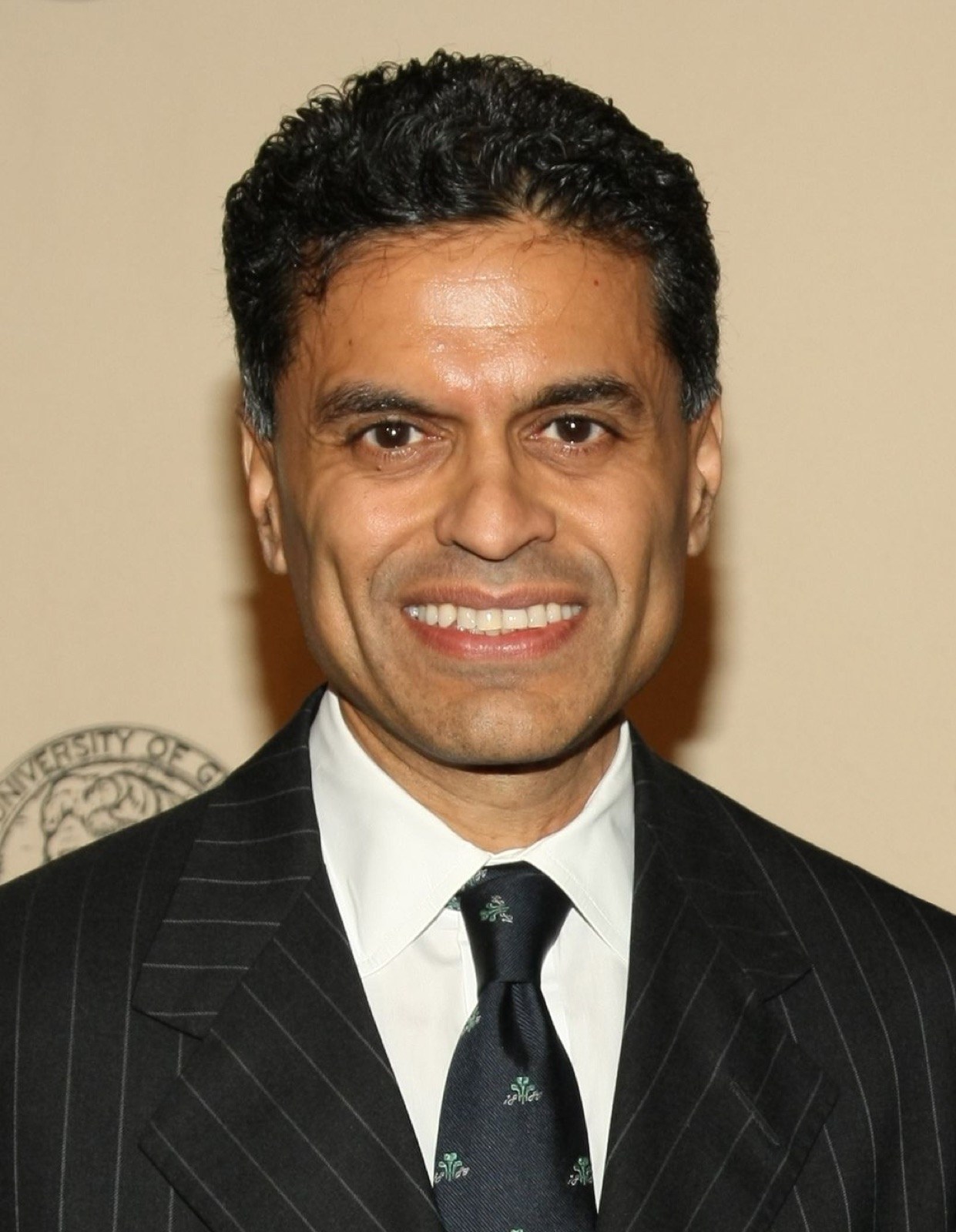
Hosted by Christina Ruffini and Sir Richard Dearlove
Guest
Fareed Zakaria
Fareed Zakaria is a veteran journalist, author, and host of CNN's Fareed Zakaria GPS who examines Israel's war strategy and the restructuring of global power.
Episode Summary
This isn’t just another Middle Eastern conflict—it’s a fundamental restructuring of global power. Sir Richard Dearlove and guest co-host Baroness Ayesha Hazarika with Fareed Zakaria, veteran journalist, author, and host of CNN’s Fareed Zakaria GPS. Together, they examine Israel’s war strategy, and whether or not the war aims of President Donald Trump and Prime Minister Benjamin Netanyahu are misaligned. They also discuss the entry of the Houthis into the conflict on Iran’s behalf, as well as why the war in Iran could prove far more consequential to daily life across the globe than the Iraq War ever was.
In this episode:
01:43 – Israel’s Campaign in Lebanon
08:06 – Does Israel’s “Buffer Zone” Have an Ulterior Motive?
11:29 – Do Netanyahu and Trump Have Different War Aims?
15:10 – Will America Put Boots on the Ground in Iran?
17:14 – End of a Strategic Conflict, or a Massive Gamble?
22:22 – The Houthi Strategy
28:35 – Why Russia Wins and Europe Loses
32:20 – Geopolitics in a Post-Trump World
36:28 – Can the UK Still Rely on the US?
41:47 – Why the Iran War Hurts Ukraine
46:24 – What’s Trump’s Next Move?
48:40 – Sir Richard and Baroness Hazarika Discussion
Hosted by Sir Richard Dearlove (former MI6 Chief) and Baroness Ayesha Hazarika (Member of House of Lords).
Listen & Subscribe
- Watch on YouTube
- Listen on Apple Podcasts
- Listen on Spotify
Transcript
COLD OPEN
Zakaria: One of the lessons we have learned about the Middle East is you can very easily go from a state to some kind of power vacuum.
Hazarika: The Houthis are firing those attacks into Israel. Is Iran telling them to do that? Do you think that Netanyahu's and Trump's war aims are actually aligned?
Zakaria: What this depends on is how much pain can the Iranians take.
INTRODUCTION
Hazarika: Hello, and welcome to One Decision. I'm your guest cohost, Baroness Ayesha Hazarika, and I'm joined by our cohost as ever, Sir Richard Dearlove. Sir Richard, hello. Welcome.
Dearlove: Hi, Ayesha. Good to be with you again.
Hazarika: I'm really excited about today's podcast with Fareed.
Dearlove: Yes. It's going to be an excellent discussion, and we have a lot to get through.
Hazarika: Now this week, we zoom into Lebanon and the Gulf States. Israel's buffer zone military campaign in Lebanon threatens sectarian peace, while Gulf nations shift towards a self defense posture towards Iran. With the region feeling that it's at breaking point, we today turn to a veteran journalist, political commentator, and best selling author, Fareed Zakaria, for some much needed insight. Fareed hosts Fareed Zakaria GPS on CNN, and he's a columnist at the Washington Post. His most recent book is Age of Revolutions, Progress, and Backlash from 1600 to present. And I'm delighted that Fareed joins us now. Fareed, welcome. Thank you so much for taking the time to speak with us. Well, look, we've got a lot to get through. Let's start our discussion point, looking at what's been happening with Israel, Lebanon, Hezbollah. What are your thoughts on these developments in the last few days, Fareed?
INTERVIEW
Zakaria: It's such a pleasure.
Zakaria: Well, let's first remember the background, because sometimes that does get obscured because of Israel's very, shall we say, aggressive actions, which is that in Lebanon, you have this organization, Hezbollah, which in some ways represents the Shia of Lebanon, but has also become a kind of paramilitary militia power unto itself, which does, you know, whenever it feels the need, rain rockets into Israel, creating a kind of untenable situation. For a long time, Israel put up with it because it didn't have any options. At this point, and I think this is a very important shift, Israel has really become the military superpower of the Middle East. And it has decided, particularly after the October seventh attack, that it's not going to put up with these kind of pin prick attacks, this kind of unsettled problem on its north, and it took the battle to Hezbollah. It has now essentially invaded Lebanon. And in previous versions of these attacks, it rained missiles, and it sent fighter planes into Lebanon. Now it's actually got ground troops in there. And the idea is to kind of root and branch get rid of of Hezbollah. It's understandable, in my opinion, given, you know, I don't think a country would be comfortable with the kind of situation they have with Lebanon, but I doubt that it will work. Israel has tried this before. It has invaded Lebanon before. And the problem is once you invade a country and once you put ground troops there, you become in some way responsible for what you're left with. You know, the chaos, the mess, and this gets us to Iran as well. No matter how mixed people's feelings may be about Hezbollah in Lebanon, and they are mixed. There are many people who support it. Nobody likes to be bombed by foreigners. Nobody likes to have, you know, foreign troops come and invade your country. And no matter how surgical the bombing is, there's huge destruction taking place. So I think, you know, whatever the line of somebody in the nineteenth century about a way of foreign policy action, he said it's worse than a crime. It's a blunder. I think it may be, setting aside the morality of what's going on, I don't think strategically it will work. It's frustrating for the Israelis. They have to kind of keep at it. But there's a tendency to believe in the Middle East that you can solve some problem once and for all or, you know, get rid of it root and branch. And, you know, we tried that in the Iraq war. We tried that with Afghanistan. Sometimes you have to live with and manage problems rather than assume that magically, because you're so strong militarily, you can, in one fell swoop, solve the problem.
Dearlove: Fareed, there is one thing I think rather different this time. And, you know, we've all followed Hezbollah and bearing in mind, you know, they almost beat Israel in the 2006 war, although IDF came off very badly. But there isn't, you know, there's no Syria now, so Assad's gone. And there's no Iran, really, because Iran's lifeline to Hezbollah has been cut off through Syria. So Hezbollah is on its own. And, okay, the Lebanese government since the ceasefire haven't really managed to manage Hezbollah as they promised to do to disarm them. But it strikes me that the Israelis this time maybe have more of a chance than you were suggesting to, I wouldn't say definitively solve the problem, but make it a lot better and perhaps to reinforce the authority of the Lebanese government. I mean, I'm just putting that forward as a sort of shaded different interpretation of these events.
Zakaria: I think that's a very intelligent point, and you're absolutely right. Hezbollah had two big patrons, Syria and Iran. A lot of the funds and the missiles they got came from there. Even many of the militias, you know, Iranian militias will come over and help Hezbollah. And I think you're right. The question is what would success be defined at? You know, if you're saying they can be crippled, they can be weakened militarily, again, they can be almost destroyed militarily, I agree with you. But Hezbollah also does represent the Shia of Lebanon. You know, it's this very strange organization. It's part political party, part social welfare organization, part terrorist group, and it does all of them. And so I guess I just think that those first two elements remain strong enough that I'm not sure you can completely get rid of it. Though to emphasize your point, it is striking that the Lebanese government has asked for or said it would be willing to enter into talks, which I think expresses both their weakness vis a vis Israel, but their strength vis a vis Hezbollah. Hezbollah in the past would have always vetoed any such negotiation. And the fact that the Lebanese government is willing to do it tells us that, Sir Richard, you're probably right. Hezbollah is weaker than we might realize, and maybe this Lebanese government can assert its authority without Hezbollah, though you do have the reality of the Shia who are the largest community in Lebanon and do feel that the government typically is Sunni and Christian dominated and therefore doesn't reflect them, represent them.
Hazarika: And, Fareed, there has also been some speculation that, yes, Israel is obviously thinking about its safety and it's thinking about this buffer zone. But there have been some who have talked about a potential ulterior motive in terms of expansion of the Israeli state. What are your thoughts on that?
Zakaria: There hasn't been much of a territorial drive regarding Lebanon. They clearly have it with regard to the West Bank, where the Israeli government even now has been annexing outposts, tracts of land, you know, on probably the most aggressive schedule that they have ever done. So while, you know, in a sense, the world is distracted by the war in Iran, they have taken advantage and moved into the West Bank. They've done that in Syria around the Golan Heights. Of course, Gaza, they now, most people don't realize, but they have essentially reoccupied Gaza after having withdrawn from it. But maybe they are trying to create a buffer zone that will be permanent, which will then create a kind of permanent problem which will exist between them and Lebanon and between them and Hezbollah. And maybe their thinking is they're so powerful vis a vis Hezbollah now for the reasons Sir Richard said that they can permanently maintain this buffer zone as it seems they may intend to maintain in Gaza and, you know, that they already have with Syria. Yeah. It's, I mean, this is one of the big shifts that's taken place in my professional lifetime. You know, one thought of Israel when I started out as this small embattled country surrounded by these vast armies, the Syrian army, the Egyptian army, the Iraqi army. And now Israel is the superpower, and, you know, Iraq is mired in dysfunction. Syria is mired in dysfunction. Egypt is minding its own business, and Israel is dominant and can, you know, kind of run its writ around its borders.
Hazarika: What do you think is going to be the consequences of a lot of destabilization in the area, particularly displacement of people in that area as well, Lebanon?
Zakaria: Well, I worry about whether or not Lebanon collapses in a sense, not quite into a civil war, but its economy is already in very bad shape. It certainly does not get helped by what's going on in Iran. And as far as I can tell, what the Israelis are doing is pretty broad scale destruction of infrastructure. It's not very targeted. A million people have already been displaced. One of the lessons we have learned about the Middle East is you can very easily go from a state to some kind of, you know, power vacuum, and then all kinds of things kind of follow from that. You know, ethnic groups, religious groups, sectarian groups start fighting a free for all, and you do get some kind of a civil war.
IRAN AND THE WIDER CONFLICT
Dearlove: Widening the discussion, Fareed, obviously, to Iran now, although what we're discussing is intimately connected, of course. Do you think that Netanyahu's and Trump's war aims, to the extent that they have them, are actually aligned, or is there a fundamental difference between where Netanyahu stands and where Trump stands?
Zakaria: I think they're very much not aligned. In fact, I wrote right as the war started, this was my first concern and the first column I wrote, which was if you watch the military campaigns, it's very clear that they are very different. The Israelis were going for a kind of destruction of the Iranian state, the decapitation of the top leadership, the decapitation of the military. They were even going for the destruction of command posts, command infrastructure, including police headquarters, including police outposts. What they were trying to do was to create an Iran that really did not function coherently as a state. The Americans were trying to degrade Iran's outward projection. It was the missiles, the missile depots, things like that. They had already bombed the nuclear sites. So what that reflects, I think, is that Israel, Bibi Netanyahu, is very comfortable with an Iran that lapses into chaos. In a sense, that would mean an Iran that looks the way Syria did for ten odd years. It takes an adversary off the battlefield. But for the United States, that creates an enormous amount of chaos in a region where it has very strong allies. And America's interest is peace, integration, the free flow of goods, commerce, tourists. That's what the Gulf States want. That's what the United States benefits from. So I do think they're not aligned. And you can see this, Sir Richard, in the way in which when sometimes Trump is asked or administration officials are asked, why did you take out Ali Larijani, the, you know, the guy who apparently was one of the easiest people to negotiate with? The Americans say publicly and privately, oh, that was the Israelis. That wasn't us. Trump said at one point, we're trying to negotiate with these guys, but they keep getting killed, which is a rather odd thing to say because, of course, he's, in a sense, doing the killing of them. If he wants to negotiate with them, he could just stop killing them. But what he's really saying, and Trump often in this way is very transparent, the Israelis are killing these people. And there seems to be, I wouldn't call it tension, but there seems to be a kind of incoherence. And I say there doesn't seem to be tension because Trump doesn't seem to mind this. I think he views it maybe as a kind of good cop, bad cop routine where, you know, you can say, the Israelis are unleashed, if you don't come to an agreement soon, I can't control them. I don't know what to make of it because, of course, the American goals are so incoherent and have been changing so often, they aren't quite sure what they are, but they do seem to not include this very dramatic plunge of Iran and its state into total turmoil, which is clearly something the Israelis are comfortable with.
Hazarika: And, Fareed, there's been a lot of speculation about the prospect of American and potentially Israeli troops actually going into Iran or going to Kharg Island, some form of boots on the ground. What are you picking up on that?
Zakaria: It is being floated as a live possibility, which I can't tell whether that means that that is meant to be a very powerful threat so that the Iranians come to the negotiating table or whether they are actually thinking of it. I would suspect it's a little bit of both. You know, it's a bluff, but they have to be ready if the bluff is called. And that's why you have, I think, about 60,000 American troops in the region now. The problem is twofold. One, of course, the obvious military one that Sir Richard could talk to better than I can, which is the Iranians have a home team advantage. They know the land. They can put IEDs. They can put mines. They can do all kinds of attacks. Once you take land, you then become a sitting target. But the larger problem, I think, is the Iranian counterattack, the asymmetry at the heart of Iran's strategy, is to raise the price of oil. If you take Kharg Island, you are basically taking Iran's oil supplies off the market. Iran is one of the few places whose oil is flowing freely into the global market. It's about 2,000,000 barrels a day. You take that off, the price of oil will go up. Similarly, you try and open the Straits of Hormuz by bombing the hell out of it. The Iranian ships won't get through. The Chinese ships won't get through. The Indian supplies won't get through. Price of oil will go up. So it's very difficult for me to find an action that the Americans can take that penalizes Iran without further raising the price of oil, which is already elevated. That's the dilemma.
Dearlove: Is it possible, though, that the situation really has escalated to a point now where it's difficult to envisage a negotiation and that if you regard the conflict as the last chapter, which I tend to do, in a war which has been running either warm, hot, or cold for ten to fifteen years, that actually, not just Trump and Netanyahu, but the Gulf States are looking, although they hate the war, they also are looking for a resolution to a problem, which for them has over time been really debilitating, which is the character and style and activity through the axis of resistance of this Iranian government, and that we are, as it were, in the last chapter of a strategic conflict, which has deep roots that go back a very long way. I mean, I know this is not a very fashionable view, but I'm beginning to think that Trump wants to go down in history. And he is a gambler, not a calculator in my view, as the guy who perhaps cut the Gordian knot. And in a way, that sort of Sunni-Shia tension is the Gordian knot which has made Middle Eastern politics so complicated in the last fifteen to twenty years.
Zakaria: Yeah. I think you put it very well. That is, I think, now that's always been at the heart of the Gulf States' kind of view of the region. And they've kind of veered sometimes toward a sense of, look, we can live with this, and sometimes a view that they just can't live with it. My experience talking to Saudi officials, they were very anti-Iranian, and they were very much of the view that you just described. Then after a while, they came to the view, look, they're pretty defanged in terms of the nuclear stuff. They're contained. It's in a box. The Americans and the Israelis are mowing the grass, as they say, you know, periodic strikes. They reached out and had a kind of rapprochement. And so the idea was, you know, we'll try to find a kind of modus vivendi. As you said, they initially were not in favor of this war because they had found this modus vivendi, and they thought the United States and Israel were, you know, kicking over the bucket. But now that the Iranians have attacked them and also exposed the weaknesses in their fundamental kind of economic model, which for many of them involves trade and tourism and, you know, the idea of the business model of Dubai is welcome to Dubai. You're not actually in the Middle East. You know? You're in this wonderful Switzerland that is safe and secluded. Well, that becomes hard to promote given what's happening now with missiles being lobbed at you. So now I think they have moved back to this much more intransigent and intolerant view. And I think you read Trump exactly right. You know, remember, even in business, he was never a careful calculator. He was a gambler. He gambled on a couple of big buildings in Manhattan, did very well, then took all his winnings and gambled them on six casinos in Atlantic City and did terribly in the whole thing. That's where all his bankruptcies come from. So that's always been his mode. The challenge is the Iranians get a vote in this too. Right? And so is it the last chapter if the Iranians say, we are going to just hang in there? And what this depends on is how much pain can the Iranians take, you know, and it's really a story of pain, isn't it? How much pain can the Iranians take, and how much pain can the Gulf States and the West take in terms of high oil prices and economic dislocation? And who will cry uncle first? Because I think you're right, Sir Richard. The demands, if you look at the negotiating positions, they're very far apart. It's difficult to see how you bridge the one side saying, we want permanent control of the straits. We want war compensation for all the destruction that's been done. And the other side saying, you know, Iran must never have nuclear enrichment, let alone anything more than that. No ballistic missiles. So at least in the current talks, these positions seem fundamentally incompatible, and both sides are expecting that the other side will feel the pain enough to moderate substantially their demands.
Hazarika: And, obviously, there's still a sort of probably quite a thin hope that all the allies and all the countries watching this who are affected by the pain of this, particularly the economic pain, are hoping for some kind of off ramp, and they're hoping for some sort of de escalation, Fareed. But it doesn't feel like things are de escalating at the moment, particularly with this speculation about some kind of troops on the ground. And then the other big development we saw was the Houthis getting involved and the Houthis firing those, you know, attacks into Israel. What does that tell you, the Houthis getting involved? Do you think that is Iran telling them to do that, to flex the muscle and show, look, we still have these proxies who will support us in the region, or do you think the Houthis have done this by themselves?
Zakaria: No. It's almost certainly done at the behest of Iran. The Iranians have not had much success in most of their proxies helping them. Hezbollah hasn't done very much. The various militias in Iraq have not done very much. Part of it is they're all weak, you know, as a consequence of two, three years of the Israeli campaign against them. Part of it is I think they know that the Israelis will rain destruction on them, and so they're somewhat cautious and deterred. And so I was a bit surprised that the Houthis got involved in a fairly ineffective attack. They lobbed a few missiles at Israel, did not get through, of course, Israel's air defenses. So I wonder whether the idea is to kind of remind the world that they could do something more dramatic, which was, of course, close the Red Sea. That would really be quite dramatic because then you'd have both the Straits of Hormuz and the Red Sea blocked. I don't see them really mounting a major offensive. They're playing their own game, which is really just survive and, in some way, be viable in Yemen. And it's not clear to me that being a vassal of Iran and a pawn in the Iranian game helps them that much. So I think they did a little bit to make the Iranians feel that they got something for their money's worth. The Iranians have supported them. But it didn't seem very effective or large scale, and they didn't use the main weapon they have, which is closing the Red Sea.
Dearlove: And that's fascinating in terms of your commentary on the Houthis because they do hold this huge card, which is if they deny Saudi oil access by closing the strait at the end of the Red Sea, the Bab al-Mandab Strait. I mean, oil will go to $150 a barrel at least, maybe even higher. So it seems to me that accidentally the Houthis find themselves in an extraordinary significant position. But I think I agree with your interpretation, but I do feel very febrile about this particular issue because they could, as it were, double the cost of the war for the international community, and yet they seem to be holding back.
Zakaria: Yeah. You know, this whole thing has made us, I think, aware of, there's this wonderful book out called Chokepoints, that while we think we're living in the wonderful digital world, but actually it's extraordinary how there are these actual physical places where you can choke off so much global economic activity. So we've focused on the oil, but we haven't focused, for example, on many of the byproducts. So for example, the whole developing world is facing a huge agricultural crisis because fertilizer, which is a petroleum derivative, comes out. That is being affected. And so you're seeing huge issues with regard to agriculture everywhere from Egypt to India to Thailand to Indonesia. You have the reality that even data centers, apparently, when you lay the copper wires, everything except the copper is a petroleum product, the casing and all that kind of thing. I mean, the world of plastics, as it were, is all petroleum derived. The Gulf States, for example, are powerful buyers of lots of agricultural products from all over the world. And the whole system has been upended very much in the way that COVID did, which is why I wonder whether markets are actually still being a little bit more sanguine, that these things are gonna take a long time to get back in the right order. The ships are all in the wrong places. Oil wells, when you shut them off, it takes a while to turn them back on. There are all kinds of frictions in the process. And you can see this in the fact that the oil is now, whatever, at roughly $100 a barrel or $110 a barrel. But that is the paper trade of oil. In other words, those are contracts which are really bets about the future of oil. When you hear what the price of Brent crude is, that is people betting, exchanging paper. The actual physical price of a barrel of oil being sold in Asia today is more like 120, 130, 140. And so what that's telling you is that the paper trade is assuming that this crisis will go away, but that actually, if you need to buy a barrel of oil in, you know, Taiwan, you're paying $130, $140 a barrel. And of course, it could go the other way, which is that the paper trade might catch up with the reality that, in fact, this is what oil is gonna be for a while. And that really will slow down economic activity.
Hazarika: You used the word pain earlier, and this war feels incredibly painful to everybody involved, of course. But it's having huge consequences to economies across the world, I mean, here in the United Kingdom, all across the world. And there feels like there's a lot of anger being directed at Trump right now, particularly from British citizens who are seeing their mortgages go up, they're seeing the cost of food going up, filling the car is going up. This is probably happening all over the world as well. How much damage or what do you think the impact is going to have on America's reputation this last month that we've seen, Fareed? Because this isn't just, oh, look at Donald Trump. He's saying this, and we might not like what he's saying. This is having real life consequences now in everyday citizens' lives across the world.
Zakaria: Yeah. Ayesha, I worry a great deal about this because it was a war of choice. It was not something you had to do. Iran was, in many ways, contained. The nuclear program had been set back for years by that very powerful twelve day bombing campaign last June. And this was something that Bibi Netanyahu sold Donald Trump on as, you know, a quick win. The Iranian regime would collapse, and a new, much more amenable regime would spring up in its place. And, you know, none of that has happened. Meanwhile, you have oil prices, gas prices, electricity, and all these other products, all these prices going up in Europe, in large parts of Asia, which are the most badly hit. Meanwhile, the principal geopolitical adversary to the United States, at least in the short term and certainly to the West, is Russia. So Russia is the big winner. Europe, big loser. The other big losers are the countries like India, Taiwan that import energy. China actually does not do badly because it has really diversified away from oil and natural gas. They made massive investments in electric trains and high speed, you know, electric vehicles, solar, wind. So you look at all of that, and I have to say, if this continues to go badly, and that is a big if, if this does not get resolved, and if this continues for another two months, let's say, I think you could make the case that as publicly disastrous as the war in Iraq was, this has much broader negative consequences for the world. The basic problem with Iraq was the US went in and thought it was gonna be able to hand it over to a good government. In fact, they got chaos and a civil war, which sucked the US in for fifteen years. But it didn't have that strong an impact on the rest of the world. Here, you have an emboldened Russia, a China that benefits from it, a weakened Europe, a weakened NATO as Trump demands that NATO get involved, you know, an India whose growth rate is gonna get slashed, a Taiwan that faces huge energy crisis. You run this out, and you think to yourself in a strange way, again, if this does not get resolved, you could be looking at a situation where the geopolitical consequences of the Iran war are worse than the ones in the Iraq war.
AMERICA, THE WEST, AND THE SPECIAL RELATIONSHIP
Dearlove: Fareed, can I therefore ask you the sort of bigger strategic question because you're such an experienced observer of the international scene? I guess the way I would express it, is Trump an aberration? And what I mean by asking you that question, okay, whatever he does, there's gonna be a legacy. But is there a likelihood that, you know, US politics, US leadership of the free world will become, again, more predictable, more what we're used to when Trump eventually disappears from the political scene? You know, you could say, well, he'll lose the midterms. He's got another two years. He won't get reelected. I'm not asking you to speculate necessarily on the politics, but I spend a lot of time in the States and talking to Americans. Most of my conversations are what you would expect to have about geopolitics with knowledgeable Americans. And yet Trump seems so far off the norm, I can't believe that the political change in America, and I am an optimist, is that fundamental?
Zakaria: Yeah. And to reinforce the point you make, let's remember, he is very unpopular. Trump's approval ratings now are the lowest of any president in the history of the United States. That is at least since we've had polling. He's somewhere 38, 39% on the averages. There are polls in which he's as low as 36%. To be somewhere in the mid thirties is a very bad place to be. Now if you look at Republicans, it's true that he's still polling very well. But, you know, independents, Democrats, very, very badly. This war has the lowest approval ratings of any war the United States has been in since World War II in its initial phases. The problem, I think, Sir Richard, is that unless the next election, and by that, I mean the next presidential election, turns out to be a kind of complete repudiation of Trump and MAGA, the rest of the world is going to look at this and say, okay, we don't like Trump, and the Democrats are more internationalist, but these are the two big forces in the United States. And there's a 50% chance in any election that MAGA wins. And if they win, we have to deal with them. And so what will happen is countries will start to buy insurance. I'll give you an example. A senior Canadian said to me, a leader, look, for the last thirty five years, we made a bet strategically, which was closer integration with the US. We've gotten to the point where 75% of our exports go to the United States. He said to me, what we have to do is for the next ten years, we have to get that number down from 75% back to around 50% because we cannot be so reliant on the US. Yes, Trump may lose. But you know what? An election later, J. D. Vance may win or Donald Trump Jr. may win. So the problem here is that everyone will start buying insurance. Everyone will start hedging. And you already see that, right? And once you do that, it becomes a self fulfilling prophecy. But the world will have to react. And once it reacts, it sets off a chain reaction. That's my fear. I have to confess. That's my analytic side. As an immigrant American who fell in love with this country, I share your optimism, but I think I would be kidding if I didn't say it's more of a hope than a calculated, rational, strategic argument. But I do have that hope.
Hazarika: And just to follow on from what you were saying, Fareed, I sit in the House of Lords in the United Kingdom, and just this week there was a report published. It was a joint group of members of parliament and members of the House of Lords with a specific interest and expertise in national security. And the conclusion of this report was essentially saying that Britain can no longer rely on America as being its primary ally when it comes to strategic defense matters. And that's a big deal for us here in the United Kingdom because obviously we talk a lot about the special relationship. It's important in terms of culture and trade. But we've always felt that our number one ally on defense is America. No questions asked. Our Trident missile nuclear deterrent is very much bound up with America. Our intelligence is bound up with America. Culturally, we feel our defense is bound up with America. And yet this report has come out saying, no, that time is gone. Britain can't rely on America anymore. Is that shocking to you, or does that just flow from what you were saying beforehand?
Zakaria: It's very sad. I wouldn't say it's shocking. It's an understandable reaction to the way that Donald Trump has treated all America's allies, including Britain. Look. Britain was so close. I remember talking to somebody, well, he's dead now, so I can say. I was talking to Colin Powell during the Iraq war. And we were talking about Britain and Blair and the Blair government's role, and he said, Britain for us is not a foreign country. It's part of the interagency process, meaning, you know, that when he deals with the Defense Department and the CIA, the British government is essentially one among that process. And, again, it's a kind of group of equals. And that's extraordinary for a foreign government to be regarded with that level of trust and to be integrated that much in the military planning. It's been very, very close. I think it's been closer than at any point, other than probably World War II. But, unfortunately, that government report that you're describing reflects exactly this problem, that Britain has to worry about its own security. Right? It has to ask itself what happens in extremis. And if the Americans were to say, you can't use this intelligence. So everyone starts moving towards some degree of self sufficiency or something like that. And we lose the magic of the West. You know, the West was this extraordinary thing, which was a political alliance of countries that had come together, shared values, shared interests. And in order for it to work, the leading country really had to play the role that the United States has played, which is to say, we will take care of you. And to say it in this completely unqualified manner the way that American presidents have constantly repeated. Now what flows out of that? Unfortunately, what flows is a weakened West because there's a good scenario in which this is the kick in the pants Europe needs to get its act together and to create one strategic unit. It's not gonna happen. You know? At the end of the day, Europe is a collection of different countries. And you can see that even now, even after all that has happened. When you get to the point where you start talking about a common air defense system, the French won't buy the German one, the Germans won't buy the French one, the British won't buy either. I mean, that's just the reality of the fact that these are different countries with deep, deep histories. You know, people sometimes talk about this as the United States of America during the period of the Articles of Confederation. But, you know, that was not these deeply rooted countries and cultures that have their own many, many thousands of years of history.
Dearlove: Let me just add. I can remember being the beneficiary of what Colin Powell said to you. I recall flying on his helicopter to Camp David to see the president and having a similar conversation with him during that chopper flight. And in a way, he's right. And I think that the closeness of that relationship, which I very much hope survives, but I can see why people think it is at risk. And I much admire your response on hedging. I think, you know, to make that commercial parallel, wise companies hedge, for example, on the price of oil all the time. And I think we're very much in that situation at the moment.
Zakaria: Think of India, for example. They are now clearly diversifying. They're buying a bunch of stuff from the French. They are continuing to buy stuff from the Russians, which they had been winding down. They've actually ramped up the orders to Russia because they don't want to be that too reliant on the United States.
Hazarika: And while we've been focusing on Europe and how this conflict could reshape the West, what do you think all of this means for what's happening in Ukraine, Fareed?
Zakaria: It's terrible. As Russia is the biggest winner, in some ways, Ukraine might be the biggest loser because, first of all, the equipment it needs that the Americans might have given it is all going to the Middle East. There's some reports that, in fact, even stuff that the Europeans have paid for, American military equipment, is being diverted, which would be a violation of contracts, it would be completely, how to put it, unprecedented and unethical, but that does not mean, unfortunately, with the Trump administration that it is not happening. We haven't seen, we need to get that confirmed, but there are some reports out there. And the Americans are the only ones who can produce enough of the kind of kit that the Ukrainians need to fight. They're doing amazingly well with the drones, but you can't fight the war entirely with drones. And so if this continues to place an economic burden, that's why I think the FT had a long piece about, are we returning to an era of stagflation, which is really the most scary scenario where you have the growth slows down, the governments don't have the fiscal room to ignite growth again. But because of this being an oil shock, prices stay high and inflation stays high enough that you were stuck in that world that we were in the 1970s. All of which, again, to look at the bright side of this, all of which does suggest that maybe Trump realizes this needs to get done fast and we need some kind of an off ramp. And the one superpower that Donald Trump does have is he can turn on a dime, and he can convince himself that, in fact, they've won and that this is the exact outcome that he had been waiting for. And he is able to convince his followers. I've never seen anything like this. You know? He can say to them China is the enemy, and they will believe him at 95%, and then he will say China is my best friend, and they'll believe him. I mean, after all, this is a guy who campaigned on the idea that Middle Eastern wars were a terrible idea and that this is where the Republican Party had gone astray. And now here he is launching a Middle Eastern war, and he had 90% support before, and he has 90% support now within the Republican Party. So that is his superpower. The connection that he has with his base is stronger than any connection I have ever seen with any politician with his base in my adult lifetime of following this. Thirty five years. I've never seen anything like it. It's stronger than Erdogan's. It's stronger than Modi's. It's almost like a personality cult. And so that means he has the power to reverse himself, to flip, and maybe he will see the pain and say, you know, I don't wanna go down this path. I'm gonna choose door number two. And if the Iranians were smart, they would realize if they can survive, that's a huge victory for them. And so some concessions on enrichment and things like that are a smaller issue than facing the combined wrath of the United States and Israel at the end of the day. It could be very, very, very damaging. Life is not gonna be pretty for them. And one more piece on that. Very interestingly, to Sir Richard's point about how the Gulf States are fed up with the Iranians. Now we all know that Dubai is the place that all the Iranian black money corruption sat. That's where the Revolutionary Guard and the mullahs kept their bank accounts. That's where they bought apartments. That's where they had shell companies. If in fact that is what the UAE has done, that is a very powerful weapon because all the ill gotten gains of the Iranian regime, or at least a substantial part of it, are in Dubai. And if that's all been frozen now, the Iranians have an incentive to make a deal to have that unfrozen.
Hazarika: Fareed, we could talk to you for hours. You are just this font of knowledge and information and strategic big thinking, but our time is coming to an end. Before we let you go, just tell us, what's the one decision that you'll be watching out for this week?
Zakaria: More than anything else, I think it's Trump because the Iranians, they're very guarded. The funny thing about Trump is he's quite transparent. You know, he says the most extraordinary things for a leader. The other day, he was riffing in some speech of his, and he said, you know, I hate meeting people who are more successful than me and having to listen to all their tales of success. He said, you know what? I like to sit around people who are less successful than me, who like to listen to me telling everybody about my success. Now, if you think about it, there's something wonderfully disarming about it because actually, he is a twice elected president of the United States. There are not a lot of people who are more successful than him. But he's telling you in his mind, and a businessman his whole life, that that's how he approached things. Right? He didn't like to meet people who are richer than him. He liked to meet people who were poorer than him. So in a way, what I'm watching is to see whether, in these moments, he lets us in on whether he's thinking that the real path here is an off ramp and a deal, or is the real path here you're just gonna have to pummel them a little more? And I think we'll get more of a sense of that from him than from the Iranians.
Hazarika: Well, Fareed, it has been such a pleasure speaking with you. What a brilliant, rich, wide ranging conversation. Thank you so much for being such a brilliant guest.
Zakaria: Thank you. Oh, it's my pleasure. Thank you, Sir Richard. And, Baroness, I have to confess, I've never been interviewed by a baroness before. I feel like, you know, it's one more feather.
Hazarika: I did notice you didn't curtsy when you came on, but I let that go. Well, Sir Richard, what an absolutely brilliant conversation. I mean, I was just gripped by everything he said. What were your thoughts? What's the big thing that you were thinking about after that chat?
ANALYSIS WITH SIR RICHARD DEARLOVE
Dearlove: Well, I think what he is particularly good at articulating are the, let's say, the ripple effects from the war in Iran and the perspective that he gives it internationally. Some of the more strategic questions that we asked him at the end, his comments on how Trump fits in as an American leader and the impact. And what particularly impressed me was when I asked him about whether Trump was an aberration and what the longer term effects were, and he started to talk about hedging. And I think he's got that exactly right because of the uncertainty and the example that he pulled up in particular of Canada and the way that Canada built up its trade balance with the United States and now felt it had to cut that back. And, you know, he touched on this similar issue when you asked him about the special relationship without calling it that. And I think that was the right thing to do. And, you know, he said, well, even the UK maybe has to think differently about its strategic position vis a vis its national security.
Hazarika: Yeah. I think my big takeaway is just how consequential this war could be. And I think he made a very interesting parallel with Iraq, saying that everybody, you know, whatever you think about Iraq, and he's got his views on Iraq, you'll have your views on Iraq. He said actually our lives across the world, we might not have liked what was happening in Iraq, but we weren't directly affected that much by what was happening. This is completely different. This war with Iran is already having a direct impact, particularly economically, on so many citizens in other countries. So I think my takeaway is him saying that in many ways, this could be as consequential as Iraq, if not more so. And I think that's very profound. I think there's a lot to think about there.
Dearlove: I absolutely agree with his observation. I think Iraq is not nearly so consequential as this war. This is a much, much bigger deal, and the knock on effects of this are much, much more profound. Although, emotionally and psychologically, Iraq made its huge impact, particularly in the UK politically. I think this is much more important.
Hazarika: Well, that's all for this episode. For more conversations with leading decision makers and thinkers, check out 1decision.com and our YouTube page where you'll find additional commentaries, conversations and explainers. I'm Baroness Ayesha Hazarika. Thank you for listening.