Hosted by Christina Ruffini and Sir Richard Dearlove
Guest
Richard Fontaine
Richard Fontaine is the CEO of the Center for a New American Security and reveals why he believes a US strike is likelier than not in the coming weeks.
Episode Summary
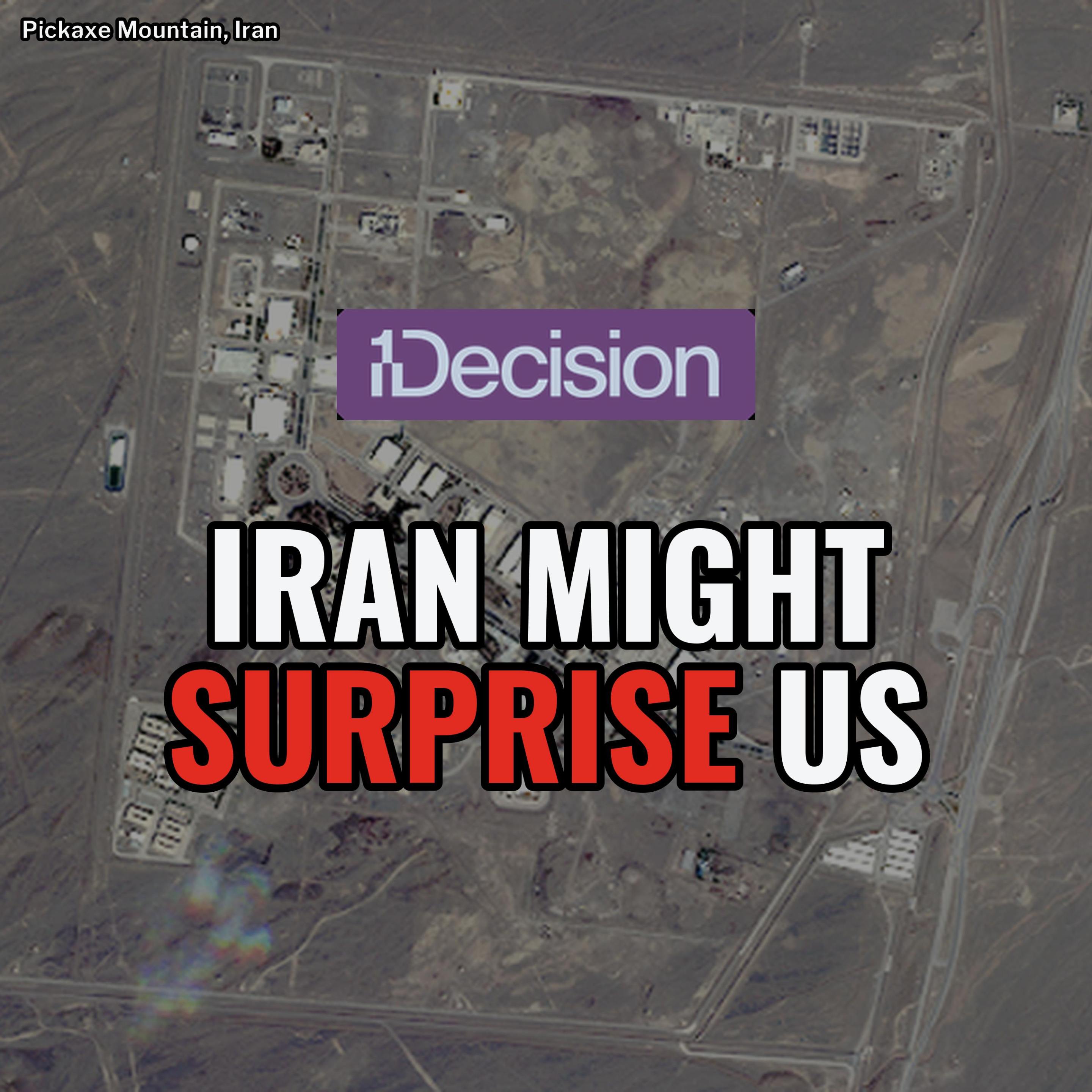
Is the US on the verge of military intervention in Iran? Richard Fontaine, CEO of the Center for a New American Security, reveals why he believes a US strike is "likelier than not" in the coming weeks—and what Trump's Venezuela operation tells us about his appetite for regime change.
In this episode of One Decision, we explore:
Why US aircraft carriers are massing in the Middle East
The "Venezuela model" – a new blueprint for intervention?
China's strategic opening as allies hedge against Trump's tariffs
China’s President Xi Jinping's shocking military purge and what it means for Taiwan
Whether Trump's foreign policy represents a permanent shift or a passing aberration
Hosted by Kate McCann (Political Editor at Times Radio) and Sir Richard Dearlove (former MI6 Chief).
Listen & Subscribe
- Watch on YouTube
- Listen on Apple Podcasts
- Listen on Spotify
Transcript
COLD OPEN
Dearlove: Is the time now for the West, for other NATO allies, change our approach? China's not gonna defend Europe. China's not gonna fend off the Russians. And I think, frankly, the president after Venezuela thinks that he's on a roll.
Dearlove: How much of Trump's foreign policy is attached to Trump's personality, or are we moving into a completely new area of foreign policy?
INTRODUCTION
Mccann: Hello, and welcome to One Decision. I'm your host, Kate McCann, and I'm joined by One Decision co-host, Sir Richard Dearlove. Hi, Richard.
Dearlove: Hi, Kate. Nice to be on the podcast again.
Mccann: Well, it's good to see you. And we are really lucky today because in a world which is fraught with so many different foreign policy strings to pull at, we are joined by Richard Fontaine, who is a foreign policy analyst, currently serves as the Trilateral Commission's Executive Director, as well as the Chief Executive of the Center for a New American Security. Richard, welcome to the program.
Fontaine: Thanks for having me. It's good to be here.
Mccann: Well, it's great to have you, especially after the last couple of weeks. And I feel like that's really where we need to start. Given everything that's happened, and maybe we're starting to see the dust settle a little bit, where do you think America's reputation stands right now in terms of its place in the world?
INTERVIEW
Fontaine: Well, it's certainly been a big kick off to the New Year for sure. If you look at Maduro operation in Venezuela, at least some of the rhetoric around Iran, the president's speech at Davos, and some of the menacing talk about Greenland and on and on. I think the result of all of this has been to leave the world scratching its head about what The United States will do next. A lot of unpredictability, a lot of thinking that The United States might actually do what was previously unthinkable. For example, capturing the president of Venezuela and having him go to bed that night in a courtroom in New York City. Or at least a week or so ago, the talk was maybe even using force to seize Greenland. And so countries are trying to make sense of where The United States is going, and they're also trying to protect themselves both security wise and economically and looking for other relationships so as to better insulate themselves against what The United States might do.
Mccann: These direct interventions like coming in behind the Israelis with the bombing in Iran, you know, of the nuclear facility and Venezuela to an extent. Those are evidence of his direction of travel. How do you read his mood when it comes to intervention in Iran? Because he seemed to get the ball rolling towards America stepping in to help. Tens of thousands of people who have been out on the streets who are being killed. We can't verify the numbers because we can't report from inside Iran or it's very difficult to. But then he pulled back. But now he seems to be warming up again. How do you read his mood when it comes to Iran right now?
Fontaine: I think the president was very close to using military force in Iran at the height of the protests. From all of the reporting, it sounds like two things were in place that sort of waved him off at the last minute. The first is that The United States wasn't really postured the way it would choose to be. We didn't have an aircraft carrier strike group in the region. There was one in the Indo-Pacific, another in The Caribbean to deal with the Venezuela business. Now there were other things that we would like to have in place in order to defend against an Iranian counterattack on either American bases in places like UAE or against the Israelis. So that was one. And the other, and related to that, was communications both from Israel and from the Gulf Arab states saying, not yet or now is not the time or, you know, hold your fire for now. In part, not entirely because of that lack of defense in place, but that was part of it. So the president essentially laid down a red line saying that if Iran killed the protesters, then they would be hit very hard where it hurts. They did kill a lot of the protesters and they weren't hit very hard where it hurts. That said, since that statement, there's been a large amount of US force posture or force structure that has been congregating in the region. And so today or very soon there will be that aircraft carrier strike group will arrive. There are some defensive equipment and personnel that are coming from The United States to the region. Sometime in the near future, there will be more military options available to the president than were available at the height of the protest. The question is to what end? What's the objective? I mean, if there was a window, it may have closed for some sort of intervention. And it is hard at this point to say what one might actually achieve through a military strike if the goal is to weaken the regime's hold on the population itself.
Dearlove: There are reports coming out of Iran of a new massacre of a demonstrator. I mean, the details aren't precise. Say we've got that on the one hand. And certainly my impression is that the Israelis are actually expecting an American intervention at some point in the coming weeks. So, I mean, I don't think this problem has gone away. And I think it's quite easy to see a move which will knock the regime over. But then, you know, your question what happens next is going to be rather chaotic inside Iran, if that is the case. But I think my guess would be that we're on the cusp of the fall of the regime in Iran.
Fontaine: I would like to think that, but I would put the odds likelier than not that the regime survives 2026. We'll see. I also think, to your point, that it's likelier than not that The United States uses military force here in the not so distant future against Iran. And there's a variety of options available to The United States. It could go after the kind of short and medium range rockets that weren't taken out by Israel during the twelve day war. It could go after command and control and communications facilities. It could go after political leadership. But again, you can bomb places, but it's hard to know what objective that actually meets, what that actually achieves. If ultimately your goal is to topple the regime, we've seen that it's pretty hard to do that just through bombing anyone. And this regime of course has been around since 1979 through thick and thin. So it's a big unknown at this point.
Mccann: And what's motivating Trump to want to get involved here? Because there's no guarantee that what would come after would be stable or in many ways better.
Fontaine: Well, it probably would be better for lots of people in their eyes, but there's no guarantee of it. Trying to enter the president's head on some of these things is more than difficult, to say the least. I mean, the Pentagon on Friday night put out its national defense strategy, and at the very beginning of it, it pledged no more interventionism and no more regime change. And I thought, well, what about Venezuela? And what about what at least the rhetoric has been on Iran that seems not to square?
Mccann: Venezuela was a police operation deliberately designed not to change the regime.
Fontaine: Right.
Mccann: But certainly it was a military intervention. Right? So they've argued police, haven't they?
Fontaine: They've argued police with military support, right? Yeah. Well, look, yeah, you can talk your way out of any of these things. But the reality is, you know, none of these sort of stated rules and changes are very hard and fast. And I think, the president after Venezuela thinks that he's on a roll. And, I mean, I'm old enough to have remembered. I was working at the State Department after the US invasion of Iraq. And if the US invasion of Afghanistan had not gone so well, it's very unlikely that Iraq would have happened. People have a hard time remembering, but Iraq at the very beginning was very successful. It was three weeks to the toppling of Saddam Hussein and the fall of Baghdad. So what happened next? Well, the United States government immediately started threatening Syria and saying the same thing might happen to them and the Iranians better watch out and Qaddafi started wanting to talk. And of course, once the wars became quagmires, nobody talked about that anymore. But you're seeing some of this play out here with the success of the taking out of the Iranian nuclear sites last year and then the Maduro operation. Immediately, the president started threatening the president of Colombia saying that the government in Cuba was gonna fall, saying that, you know, Iranian protesters should seize their institutions and take them away from the regime. So there's a certain momentum that builds on itself politically when a leader feels like he's had a major success, especially done something that others would have thought is impossible. The problem is it doesn't mean that the next thing is gonna be a success just because the last thing was. But I think that is what explains this appetite for, frankly, intervention in The Middle East and potential regime change by an administration that said it didn't want to do intervention in The Middle East and didn't want regime change.
Dearlove: Don't we also have with Venezuela what I would say a new intervention model? I mean, I'm fascinated by the fact that you leave the government in place, you leave the administration in place, but at the same time, you're exercising massive external pressure, which has a military presence, to back it up. I mean, you could argue in Iraq, which, of course, for me, because of my past career, has a sort of personal element. Some of us argued in Iraq that we should have left the Iraqi military in charge, plus the Baathist administration, and as it were, allowed them to run the country for a period of time whilst we pressured them in the direction of a new change, rather than wiping away all of that, as it were, control mechanism. And I think if you look at Venezuela, it's quite, whether it's Trump's idea or somebody else's, it's quite a subtle policy, because you haven't got a chaotic country, but you've got a country now which is pretty much constrained to change political direction over time. And you could make a similar argument in relation to Iran if there's an Iranian intervention which takes out the supreme leader.
Fontaine: Yeah. It's an incredibly, I guess, interesting new model to your point because, of course, in Iraq, the combination of disbanding the Iraqi army and deep, deep de-Baathification turned out to be catastrophic for everything that we sought to achieve and catastrophic for the Iraqi people, of course, and we're still dealing with the reverberations of those decisions very early on. So whatever a better policy would look like, it had to be different than what we actually did. The Venezuela model is something of an experiment for sure, where you change literally one person and try to work through all the others. It turns on a couple of things. It turns on the ability to continue to coerce that government indefinitely and so, I mean among other things, The United States has a blockade on the Venezuelan coast and it can only export oil with the permission of The United States. It also turns on, at least for the meantime, keeping the opposition out of power. And there are a lot of Venezuelans who celebrated the fall of Maduro, not because they wanted to see Delcy Rodríguez in charge, but because they thought it would bring freedom. You know, is that a stable situation over the long run? We will see. And then the third thing is instead of getting rid of all the Chavistas kind of a la Iraq and trying to replace them with democratically minded officials in Venezuela, The US is working through the existing government. But a lot of those folks are criminals. I mean, some of them are ideologically motivated, some are not, but it turns out criminals may be more malleable than those who are ideologically motivated. It seems much harder to do that kind of thing with Iran. I mean, if we were to say, well, we'll work with the Quds Force and the IRGC if the supreme leader is not there. I don't know. That's a much tougher sort of thing than to deal with drug traffickers who, you know, are looking to maintain their own survival in power.
Dearlove: I'm assuming you dump the IRGC and go with the rump of the Iranian military. But anyway, that's for the discussion.
Mccann: Watching Canada look to China. And this week, the Prime Minister of The United Kingdom, Keir Starmer, is also going to visit China to meet with Xi Jinping. How do you see that playing out? Is that a good move by those countries in your view?
Fontaine: I don't think it is a good move. There's been a parade now of world leaders headed to China, many of whom hadn't been there in quite a while. And this really began with Prime Minister Modi last year of India who went to China for the first time in seven years and was, if not seeking any kind of alignment, seeking some sort of accommodation with China. And again, I think this was driven by the deterioration of US-India ties. Now we've seen the same thing with Canada. We'll see the same things with The United Kingdom. I don't think it's likely to be productive for the leaders that are doing this ultimately over the long run, but I think it is understandable. And what's understandable about it is, for example, if The United States is closing off or threatening to close off access to its market, well, The United States is the number one economy in the world. Where would you go for alternatives? Well, China's the number two economy in the world. And so the hedging that countries are starting to engage in to diversify their ties beyond that with The United States, I think is unfortunate. I think it's probably unlikely to be very productive, but I do think it's very understandable.
Dearlove: On the very day, you know, that Carney's talking about going, Starmer's on the point of going, Xi Jinping has just sacked his most senior general in the People's Liberation Army. I think in the last eighteen months, he's sacked another 13 senior generals, and, of course, there's the issue of his defense minister disappearing. I mean, this suggests to me that all is not happy in China. We look to China and think it's solid. But I think he's facing, Xi maybe facing a power struggle with the People's Liberation Army. There's clearly something going on which isn't just about corruption. And, you know, maybe we look at China and think, well, it's an alternative to The States, but it isn't this great sort of solid autocracy with Xi in total control. Something is wrong. Do you agree with that observation?
Fontaine: So Xi Jinping has sacked General Zhang, who was the top general in China. The public explanation given for this among other things was accusing him of giving nuclear secrets to The United States, which I find frankly very hard to believe. But there's been a variety of reasons given for the sacking of multiple senior military personnel over the past year plus, including the senior officials in the PLA rocket forces and so forth. So if you looked at a chart today of the senior military command about a year and a half ago, there would be X's across almost every one of the faces except really about one right now. So this has been a wide scale purge. It's very hard to understand from the outside what exactly is driving this. There's all kinds of rumors about what has ultimately driven this, but I think we could at least conclude that Xi is continuing to consolidate his own position within the government and within the power structure and eliminating any alternatives or even potentially remote threats to that position. I think there's potentially broader implications for this because those who are looking at, for example, you know, China interested in at some point making a military move on Taiwan or something like this, clearing out your top military command would not normally be a prelude to some sort of major military operation. So if they are thinking that way, does that put more time on the clock for that kind of thing? Again, very hard to say from the outside exactly what's happening and why. But certainly this is just a titanic shift in the senior security personnel around Xi Jinping. He's the one who, of course, remains on top.
Mccann: Should countries like Canada and The UK, I mean, as you say, it's hard to know exactly what the motivations are, but it makes him a more dangerous man.
Fontaine: Well, Xi Jinping is the most powerful Chinese leader since Mao Zedong clearly, and of course has a bit of the cult of personality grown up around him to go with it. The penchant for purging those who are seen as insufficiently loyal to the president and the move from collective rule after Mao Zedong back to really one person rule, which was characteristic of Mao. But one of the reasons why China moved away from one man rule to collective rule under Deng Xiaoping was because of some of the terrible things that happened under Mao. The Great Leap Forward and the Cultural Revolution are eras that most Chinese are not eager to kind of replicate. Xi Jinping is the unmatched, unrivaled power center in China. It does lead to another challenge, which is if you're not talking to Xi himself, it's hard to know what messages are getting through and who the interlocutors are and so forth. So you see a much bigger emphasis than what would normally be the case on direct communications with Xi Jinping himself. That may well be behind the decision of The UK Prime Minister to travel out there, as you say. It's a break from where we have been over the last couple of years.
Mccann: Where would you say China's mindset is currently in terms of opening up new trade routes, working with new partners, allying itself with nations around the world, which perhaps it hasn't been able to do so for ten, fifteen years? Is it minded to think about doing that?
Fontaine: China's got a major interest in doing this for really two big reasons. One, of course, it has a demographic challenge that is making headlines all over the world. There were fewer births in 2025 in China than there were in the last couple of hundred years in China. I mean, an astonishing decline in population and there's been a corresponding reduction in economic growth over the years in China. I mean, long gone are the days of double digit economic growth in China, and countries around the world are less open to receiving just a flood of Chinese exports. And so this gives the Chinese a strong incentive to look for destination markets, especially when The United States is putting such high tariffs on their own and stuff like that. But there's another reason too, which is this is an opportunity of sorts for China. I mean, it's not every day that The United States simultaneously worries or alienates most of its allies and trade partners, and that they are then looking for alternatives. China would like to be that alternative to some degree. I think that's unlikely to actually work out for China. They've squandered many similar opportunities in the past. But that's the opportunity I think they see.
Mccann: And Sir Richard, I know you have some security concerns. I mean, background obviously makes you very aware of the ways in which countries can exploit trade. But China particularly, when it comes to The UK's reaching for green power, wind turbines, solar panels, electric cars. There is a huge sort of integration of China now within the economy in The UK and in other nations too. Are you still very worried about the security implications of that?
Dearlove: I think China are very good at creating dependencies. Their dependencies are designed, as it were, to knock other people out of the market. And I think there are aspects of the dependencies which have a serious national security implication, particularly in areas like telecommunications, computer chips. There are just many of the areas which are strategic and crucial for us in national security terms. So yes, I am worried about that. But I think the existential question that ultimately we're talking about is how to live with China when our economies are actually intertwined and inseparable, but at the same time, how to deal with them when they are a significant threat to our national security system. And it's been stated publicly in The UK by the head of MI5, China is the big threat in the medium to long term, maybe not tomorrow. I think this is an issue which the question is posed to all of us. And, of course, it's blurred because you have Trump's behavior producing a benefit for China, which they're very able to exploit at the moment. So I mean, I'd be very interested to hear what Richard thinks along those lines, particularly the question of how we manage China in the medium to long term. I mean, ultimately, what we're talking about is a new security system which replaces Pax Americana.
Fontaine: Well, on the economic side of things, I think it's important to distinguish between the elements of the economic relationships with China that do carry national security risk from all the others. And I think it's probably actually a minority of areas that do carry national security risk, but there are some. There are things that we wish China not to receive that we might export, for example, high end semiconductors that it might use for reasons that clash with our own national interest or things we wish not to be dependent on China for, pharmaceutical precursors, critical minerals, other things because of the possibility that those would be used coercively against our own economies or areas that in technology, for example, that could be the subject of compromised telecommunications equipment manufactured by China. So what do you do in those areas? Well, it seems to me that the answer is to trade less with China in those areas and trade more with our partners and allies in those areas. That seems pretty straightforward except of course that's not what we're doing at all. We're trying to trade less, I guess, with everybody in the world by putting simultaneous tariffs on the entire world. But that would be an answer. And then the areas where there is not identifiable national security risk, I think that that could continue to be the substance of an economic relationship with China over the longer run. So in that sense, I think that what to do is relatively straightforward with the small exception of it's not what we are doing today.
AI AND THE CHINA RACE
Mccann: I want to just come back to how Donald Trump might interpret some of the new relationships with China. But I know that you also have an interest in AI, and it's an area that you are very involved in. Where is China in terms of its advancement in AI? Because we often talk on this podcast about the use of drone technology and AI when it comes to conflict in Ukraine. But where's China in that market right now?
Fontaine: There's probably around five frontier AI models or, you know, most advanced AI models that are out right now. All five of those are made in The United States by US companies. But right behind is China and DeepSeek in particular, which had some innovations beyond the use of semiconductors and some algorithmic innovations and engineering innovations that really has allowed it to advance. So China is, you know, moving fast, not quite as fast as the American companies and the American producers, but it's moving fast. The other thing that China is doing more effectively, I think probably than any American competitor is on the open source side. And so it's open sourced its AI or one and more of its AI models, which allows that to be an AI model of choice for use by many people around the world as opposed to proprietary models that are on offer by The United States. So it's very much a competition. It's very much a race. And if you look at AI and the ability not only to transform our economies, but also to augment state power, military power, political power, influence, things like that. The stakes of this are quite high. And I think the Chinese understand this as much as the Americans do.
Mccann: Let's bring it back to how these relationships, these new relationships are going to be seen by Donald Trump. We've seen his reaction to Canada, to Mark Carney. We've seen what levers he reaches for when he is displeased. But if it's not just Canada, if it's also The UK, if it's also other, you know, allies, where does this leave America? What do you think Trump's reaction is going to be?
Fontaine: It's interesting because the initial instinct is to interpret Trump's displeasure with Prime Minister Carney's China dealings as displeasure with the China dealings. But it's not clear to me that that's the displeasure because last week, when asked about a possible deal between Canada and China, Trump said, yeah, that's what he should be doing. You know, Canada should be going for that. That's what we would do too. And then he's come out and said, there'll be this gigantic tariff on Canada if they strike a trade deal with China. So what's the difference between a week ago and now? Well, the difference is not the dealings with China. The difference is the Davos speech that Mark Carney gave, and I think Trump saw that as a slight against him. And as we know, the president of The United States doesn't deal well and doesn't respond well to perceived slights and instead responds often with some sort of aggressive move. So I think the difference, the response, the Trump response actually does extend more from things like that than the pattern of hedging and the pattern of dealing with China that one might see that, you know, most other folks would think is by far the more important element in all of this.
Dearlove: In terms of my conversation with my friends in The States, many of whom are quite well placed, how much of this is an aberration? How much of Trump's foreign policy is attached to Trump's personality? Or are we moving into a completely new area of foreign policy, which, as it were, is going to be irreversible? I mean, obviously, some of what's happening will remain in place. But there seems to me now an extremism in some of Trump's behavior and activity, which is causing perhaps a revulsion which isn't expressed politically in The United States. And, you know, he may well be seen as an aberration, and we'll have a reversion, not to where we were before, but a reversion towards, let's say, a more what I would describe as a more normal American foreign policy. And I mean, this applies to China, it applies to Greenland, it applies to Europe, it applies to NATO, it applies to Russia, it applies in so many areas.
Fontaine: Yeah. So I travel quite a bit internationally, and one of the top questions that I will hear from foreign officials is how much about what's going on today is about Donald Trump and how much is about America? And I think that gets to the heart of your question. And I think it's a mix. If you look at some of the departures that President Trump has made from what one might say is kind of traditional American foreign policy, I think there's a number that are likely to stay. So his skepticism of free trade, for example. If Joe Biden had been president, I don't think he would have put in place all of the tariffs that Donald Trump put in place in his first term, but he didn't take any of them off when he had the chance to. There's deep skepticism of trade and globalization as a whole in a way that there wasn't before. The same thing is true when it comes to illegal immigration in particular and to some degree immigration more broadly. Great skepticism of long wars and US intervention other than very sharp, brief military intervention. So no one is looking to do another Iraq or Afghanistan and that's not just about Donald Trump, it's about, you know, really America right now. And then there's other things that are just extremely idiosyncratic that if Donald Trump wasn't president, I don't think you would see the next president have this complete obsession with winning the Nobel Peace Prize, for example, in a way that really animates his approach to, you know, foreign policy. Or probably the fixation on Greenland and this attempt to try to distinguish between something that one owns, like a piece of real estate that you would defend and something that you would lease, which you wouldn't, which I've referred to as the no one washes a rental car theory of international relations. But I mean, that's a Trump thing, I think. And so I think it is a mix of these kind of specific idiosyncratic impulses and these kind of broader trends that aren't going to go away even if you have a different president.
Mccann: Often the question that people are really asking when they talk about the longevity of these policies is do we need to change our approach? Or can we just sit tight and ride this out? Is the time now for the West, for other NATO allies, to seriously have a think about their direction of travel?
Fontaine: The problem that especially Europe and The UK have, and Canada, is it's like anything else in life. If you don't like something, what is the available alternative? And China's not really an alternative to The United States. I mean, maybe on the margin, it's something of an economic alternative in trade partner and maybe some capital ways. But China's not going to defend Europe. China's not going to fend off the Russians. It's on the wrong side of the Ukraine war. China doesn't share values, political values. I mean, for all the distance right now between The United States and Europe and The UK on some of the political values issues, that distance is minuscule compared to the distance between all of us and China. You know, then there's talk about, well, the medium powers kind of gang up together more effectively. Theoretically, sure, but it's hard to know exactly what that means. I mean, Europe has not been able to defend itself since 1945 without American assistance. It won't be able to defend itself at least for a significant number of years without The United States. So, yes, in theory and on the margin, I think countries are all rethinking their relationships and looking for alternatives. It's just that there's not a lot of alternatives to be had.
Mccann: Richard, we have to draw this to a close. It's been fascinating speaking to you. I mean, podcast is called One Decision. So I suppose the question is, what is the one decision that you are either expecting or waiting for in the next couple of weeks that you think is going to be the big one?
Fontaine: I think it's Iran. I think it's whether to use military force against Iran. We're postured or will be postured militarily very soon to do it. All of the questions remain that we were just talking about, about if we do it, what that will accomplish. And if we don't do it, will this amount to Trump's version of Obama's Syria red line that was crossed and nothing was done about it. So I think that's the big decision here. But one thing we know from 2026 already is that there will be something else waiting in the wings for major decision too if we just sit tight and wait a little time.
Mccann: Yeah, we're not even through January yet. And that is, no truer statement has been spoken. Richard Fontaine, absolutely great to speak to you. Thanks so much for sharing your expertise with our listeners. It's been really fascinating stuff.
Dearlove: Richard, thank you very much.
Fontaine: Thank you for having me.
Mccann: And thank you all for listening. For more conversations with leading decision makers and thinkers, check out 1decision.com and our YouTube page where you'll find plenty more like this, conversations and explainers too. I'm Kate McCann. Thank you for listening.