Hosted by Christina Ruffini and Sir Richard Dearlove
Guest
Episode Summary
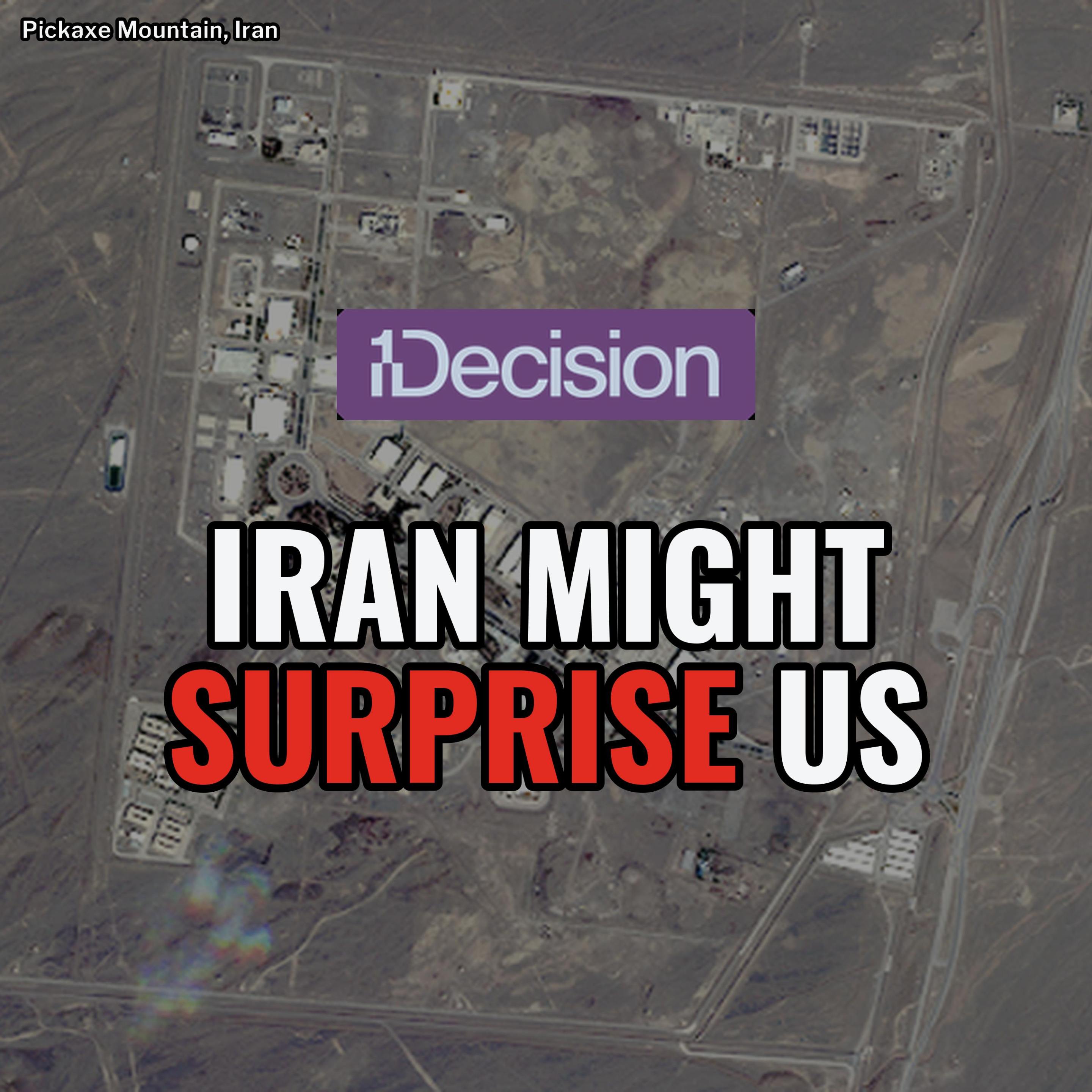
On this episode of One Decision In Brief, guest host Rosanna Lockwood and Sir Richard Dearlove, former head of MI6, unpack the shifting landscape of U.S. foreign policy on Greenland and Iran. Rosanna questions whether the United States is abandoning 75 years of post-war foreign policy in favor of a return to regional hegemony and balance-of-power politics reminiscent of the pre-World War II era. Sir Richard outlines Greenland’s strategic importance, highlighting its critical geographic position between North America, Russia, and China, and addresses the controversy surrounding Trump’s comments about full ownership of the island. The discussion then shifts to Iran, as protests intensify and the regime comes under economic pressure. Sir Richard examines Iran’s vulnerabilities and argues that internal divisions within its security forces will more likely determine the regime’s future than U.S. involvement.
Episode produced by Situation Room Studios. Original music composed and produced by Leo Sidran.
Listen & Subscribe
- Watch on YouTube
- Listen on Apple Podcasts
- Listen on Spotify
Transcript
INTRODUCTION
Lockwood: And welcome to One Decision in Brief. I'm Rosanna Lockwood joined today by my co-host Sir Richard Dearlove. And today we're going to be discussing everything going on in America's all new foreign policy adventures, if we can call them that, Richard, because some people are arguing we're sort of in a renewed American foreign policy state. I was talking to somebody the other day who was saying that they're sort of shifting back in The US to what could be argued as like a 1920s, 1930s balance of power, a regional hegemony approach basically focusing on the Western Hemisphere and seeing what they can do in terms of that basically undoing about seventy five years of foreign policy strategy as we know it. Do you agree with that?
GREENLAND
Dearlove: To an extent, there are obviously links that go back to the Monroe Doctrine and American isolationism. I mean, if you take the Greenland issue, we've all forgotten that it's not new and that it was very much on American foreign policy cards in the early 1950s, and there has been discussion of this issue before. And the fact that Trump's revived it has really significant antecedents, and the purchase of large unoccupied territories is a profound part of American history, given the Louisiana Purchase and the purchase of Alaska. Okay, maybe now you see it in a rather different context, but there are precedents and it's just that we're not used or we hadn't even imagined that America could behave in this particular way. I'm certainly of the view with regard to Greenland that America has a case to be in Greenland in a significant capacity, and I just cannot imagine that it isn't possible for Denmark and The United States to reach agreement. That's the thing that confuses me, why the Danes can't make a significant concession, and that everyone should stop talking about sovereignty and should think more about the strategic security of Northern Europe. Iceland took its complete independence, I think, in 1948 and was treated very much as second class citizens by the Danes, and Greenland has lacked Denmark's investment and interest over many many years. So, it's not quite as black and white as people would like to say. And why on earth did the Danes lease it to The United States? The United States could make a huge investment to pay off the population of Greenland. I worked out they gave each individual Greenlander $100,000. It would cost them 5,200,000,000, which is a drop in the water. That would transform the economy of Greenland. They could commit to the Danish welfare system as part of the lease and the Danes could make a very good deal out of it, but no one seems to be thinking along those lines. I think that the Greenlanders should be negotiating with the Trump administration without Denmark present, given that it's a semi autonomous region.
Lockwood: To that I would say about the sort of opening negotiation on a lease, Trump speaking on Air Force One to reporters saying, quote, I need Greenland psychologically for success and he said ownership gives you things and elements that you can't get from just signing a document, that you can have a base psychologically. Greenland is important for me. And he also said, quote, now maybe another president would feel differently, but so far I've been right about everything. So it sounds very much like he's saying he won't just do paperwork, he wants full ownership. But just to add Sir Richard to your point there, Lord Peter Mandelson, is Britain's former US ambassador who got removed from the position thanks to links to Epstein, but he did an interview at the weekend with the BBC where he actually said, look we all know that Trump is not gonna take Greenland by force. I'm not sure I agree with him on that to be honest, but he does say similar to what you're saying there, Peter Mandelson was saying, you know, are we in Europe, are we in Britain prepared to stump up the forces, the radars, the anti missile systems, the air defense systems to protect Greenland and the Arctic? We don't probably not. And that's where The US comes in, and that's kind of Trump's point. Right?
Dearlove: And if you look at the projection of Greenland geographically and you look at its position between North America and Moscow and China, I mean it sits in an absolutely vital place, and I'm sorry, but the West, Europe, Continental Europe and The UK to an extent have neglected its strategic importance.
IRAN
Lockwood: There just seems to be a general anathema in Europe, particularly in The UK, about The US intervening anywhere, US sort of overseas escapades and intervention, and it's not what Trump campaigned on doing either, to return to my previous point, is, you know, we're just seeing something different to what he promised, but that's another discussion because we've got to talk about Iran. You know, I do feel it's dating so quickly, this conversation, because things are moving so fast. But the latest, as we're speaking now, is that you've had Iran's foreign minister saying Iran is not seeking a war but is fully prepared for war, but they're also open to negotiation. They're saying whilst Trump meanwhile has been saying, well, we've got a range of options on the table cyber attacks, direct strikes by The US and Israel, etc. That's the Associated Press citing sources. I mean, when we take into account what we've just said about Greenland, what we just said about the Trump administration, what do you see happening when it comes to Iran in the coming days?
Dearlove: Well, I think that the regime is in a fragile position. That's clear. And these riots, demonstrations are much more serious because it's not a cultural issue like women wearing the hijab. It's actually a fundamental economic issue about the needs of the population and the fact that they're suffering massive inflation, that the price of basic foods has gone up 70% in the last eighteen months. So the context is different and it's clearly generalized, but of course the machinery of repression that the Iranian regime can exercise is well practiced and it's clearly extremely lethal and unrestrained. Well, first thing about the Iranians provided they're in no state to defend themselves against an aerial attack, which is what we're talking about. All of their defenses were knocked out by the Israelis and they haven't got much left which is effective or efficient. So, an Israeli strike, let's say, on the headquarters of the repressionary forces in Iran or an American strike, more likely an American strike, is possibility if Trump cares to go down that track. Now what I hope is happening in the White House is that there is very good intelligence coming both from Israel on a liaison link and from CIA telling the American administration what the heck is going on inside the theocratic government because as sure as eggs are eggs, there will be massive disputes because of the seriousness of the situation. I don't expect the Americans to intervene militarily, but they may well continue to try to press for some sort of regime compromise, but I think it's impossible at this point to say exactly how things are gonna play out because a lot will depend on what's actually going on inside Iran, and the reporting at the moment is very fragmentary, and we don't really have a full picture at all.
Lockwood: I mean speaking, you know, I'm based in The Middle East and, you know, we here in The Gulf even, you know, experience what it was like to have Iran sending missiles over to Doha earlier this summer, and there is a slight sense of unease, but also sort of colloquially conversation amongst people is the regime, you know, lot of Iranians who speak to of course a lot of Westerners here say the regime must go, it's repressive oppression, there aren't words to describe it but at the same time as a journalist observing these things you don't often see protest movements even on this scale overturned unless as you say there is enormous cracks and fissures in the government itself, in the regime, that can be exploited and taken advantage of and there's enough infighting but like you said, we need the intelligence to know that for sure. My big fear is that the regime can overthrow the protesters with the tactics they're using already, which unfortunately is lethal violence from the reporting that we've got, minimal reporting we've got, and internet blackouts and the rest, and you can eventually crush these rounds of protests. So it's fissures within the regime that is kind of the hope that those who don't want to see the regime continue have to hold on to. And in terms of whether or not something's going to happen in coming days, spoke to somebody who said they're expecting US intervention this month, but the wording we're getting from Trump is, you know, I may not even wait for the meeting tomorrow. We may see US action, but we know that that's part of his sort of bluster and diplomacy at this point. It's sort of sending out signals and messages. So I'm somewhat reassured that you don't think there is going to be strikes.
Dearlove: Well, what could he strike? I mean, let's think about this realistically. What could he actually do? I mean a lot of the repression carried out by these biker gangs, which only have a quasi official existence in Iran, so do they have centers which can be targeted? They've already killed a lot of the IRGC command or the Israelis did. Do they attack IRGC headquarters? That's already been done, to my understanding, during the major Israeli attack on Tehran during the I think what's now called the twelve day war. So, I just don't quite see the logic of what Trump is threatening. Okay, we had the same question over Venezuela, and the outcome I thought was unsurprising. But I don't think you're going to be able to go and kidnap the supreme leader and remove him, you know, through a special forces operation because Iran, when it comes to a ground attack, is a very different prospect from Venezuela. The Iranian bluster saying, Oh, well, you know, we'll protect ourselves. We'll go to war. They won't have anything to go to war against. They're not adjacent to Israel geopolitically. They're not adjacent to The United States, and they're vulnerable hugely vulnerable to air power attack because they've got no defenses left. They've been destroyed.
Lockwood: When I say I'm reassured by the prospect that there may not be US strikes imminently in Iran, I say this purely from somebody who wishes not to see further Middle East instability that spills over into other regions and an ongoing conflict, you know, through roping everyone back in. Of course, from my personal point of view, think some type of intervention that could help the people of Iran is overdue and very welcome. So you're saying, Sir Richard, that there potentially is strike opportunities that could be tactical enough that it could help without causing wider spillover and disturbance in the region?
Dearlove: Yeah, I suppose that's all I'm saying, and I think that's unlikely. Look, the crunch would come in Iran as it did in 1979 or whenever, when the security forces refused to shoot the population, and they will not obey orders to go out and murder their own citizens. And I would have thought that there must be significant elements of the regime's supporters who are going out and suppressing who begin to think, my god, you know, how long can we do this? Should we be doing this? And the question is, you know, will that crack and as it were demolish the Praetorian Guard that are keeping this dreadful regime in power. And I would have thought that that turning point, that tipping point, is actually reasonably clear even if it's not imminent at the moment. And my prediction still is that this regime will fall in the coming months.
Lockwood: That's the one coherence I'm hearing in voices across the board, which is that the regime has never been as weak as it is now. So if there is ever a time for any type of foreign intervention to maybe happen and to see things happen or support a revolution, then I'm sure that it's keeping the regime up at night. Sir Richard Dearlove, always good to speak to you. That is it for this week's One Decision in Brief. Of course, be sure to stay tuned for our regularly scheduled episode this Thursday in which we've got an exclusive conversation with doctor Anthony Vinci, the author of the new book, The Fourth Intelligence Revolution, The Future of Espionage, the Battle to Save America. Now, Sir Rich and I had a very interesting conversation with doctor Anthony about this. Needless to say, having both an American and a British former spy in the conversation added richness to that discussion. Essentially, doctor Vinci's argument is that China and AI are the forces to be reckoned with as we head into the coming decades. Join us for that and please feel free to leave comments, questions or any feedback you have and for more content with global leaders visit onedecision.com and our YouTube page where you'll find an array of shorts, explainers and much more. I'm Rosanna Lockwood. Thank you for listening.