Hosted by Christina Ruffini and Sir Richard Dearlove
Guest
Episode Summary
This week on One Decision In Brief, Sir Richard Dearlove and Kate McCann upack the high-stakes meeting between Donald Trump and Benjamin Netanyahu as the world watches for a potential ceasefire. Plus, Chinese President Xi Jingping's puzzling withdrawal from the global stage and what UK Prime Minister Keir Starmer's meeting with French President Emmanuel Macron could reveal about Europe's new power dynamic.
Episode produced by Situation Room Studios. Original music composed and produced by Leo Sidran.
Listen & Subscribe
- Watch on YouTube
- Listen on Apple Podcasts
- Listen on Spotify
Transcript
INTRODUCTION
Mccann: Hello and welcome to One Decision in Brief. I'm Kate McCann and I'm joined today by my co-host Sir Richard Dearlove. Morning, Richard. I'm good, thank you. Nice to see you. Today, we are going to be talking about the meeting between Benjamin Netanyahu and Donald Trump, the future of Gaza and what any future Gaza plans might look like. We've had an inkling into some of those. We'll talk about President Xi of China and why there are some concerns about him not being seen in public for quite some time. And we'll also talk about a meeting between French President Emmanuel Macron and UK Prime Minister Keir Starmer, which is due to happen here in the UK. So Richard, shall we start off with Benjamin Netanyahu and Donald Trump? Because there's a lot been going on between Israel and America recently. What do you think the status is of their relationship right now?
TRUMP AND NETANYAHU
Dearlove: Good morning, Kate. How are you? Well, I think it's pretty much as it's always been. You've got Trump on the one hand publicly, I mean, in terms of projecting his image, wanting to be seen to sponsor a new ceasefire, but on the other hand, you have got Hamas making excessive demands for a ceasefire, and Netanyahu really leaning on the fact that Trump isn't going to sell him down the river. I mean, that's my reading at the moment. But clearly, there's quite a lot of international pressure now for a renewed ceasefire and the release of hostages, and not just international pressure. Obviously, there's huge pressure inside Israel too. But Netanyahu has been extraordinarily intransigent, and I think the hardliners think, well, why should we make significant concessions to Hamas in particular when we're on the process of at least rubbing them out militarily. Okay, that's a rather horrible and bold statement, but I think that's pretty much where we're at. Do you agree?
Mccann: Yeah, I do. And I think the pressure on Netanyahu, I'm really interested in because I know a lot of people talk about — I think this is the third time Netanyahu's visited Trump since, well, in this time in the White House. I think that's a record for the number of visits from another leader. And so some people might look at that and think, well, the two of them are very close, it's a very, very strong relationship, and I think, you know, America has been unwavering in its support for Israel in terms of outwardly what is happening. But there's definitely some conflict between those two, and I think you can hear in Donald Trump's language and rhetoric, he really is pushing for a ceasefire now and he wants to use this meeting to push Netanyahu over that line. There is pressure on Netanyahu from his own government and I thought, so Richard, the decision by the IDF, the Israeli Defense Forces, to sign up — I think it's over 50,000 Orthodox Jewish students to fight — basically in the last twenty four hours is a real sign of where things are at when it comes to Netanyahu's power, the IDF's power, that internal conversation, because it's my understanding that the IDF has done that even though the government in Israel does not necessarily agree with it. And it shows you something about where they are in terms of their capability, I suppose, as the Israeli Defense Force, but also maybe about how they feel about where this conflict's going.
Dearlove: Well, I think that's correct. And if you want a classical parallel, what we're talking about is the new Sparta. What they've achieved in the Middle East in the last two years, they've completely remade the politics, not just of the Middle East, but the reverberations of this internationally, I think, are huge. And, you know, China, Russia have not been able to alter the situation strategically. And what's the IDF done in the last few days? It's now gone after the Houthis in Yemen and attacked their ports. You can see what their agenda is. They're now gonna rub out the Houthis. It places them in such a hugely important geopolitical position at the center of a change which has global significance. So you're absolutely right. They're self-confident. Although they have this fragile political alliance holding the country up, the actual success of the IDF in taking on each of their opponents and effectively defeating them. And we have, you know, the end game in Iran hasn't played out yet. What on earth is gonna happen there? My expectation is that the regime will implode at some point. Exactly how it does that is a different issue. But I think your identification of the sort of self-confidence and power within Israeli society now of the IDF, it's a huge deal, huge, massive.
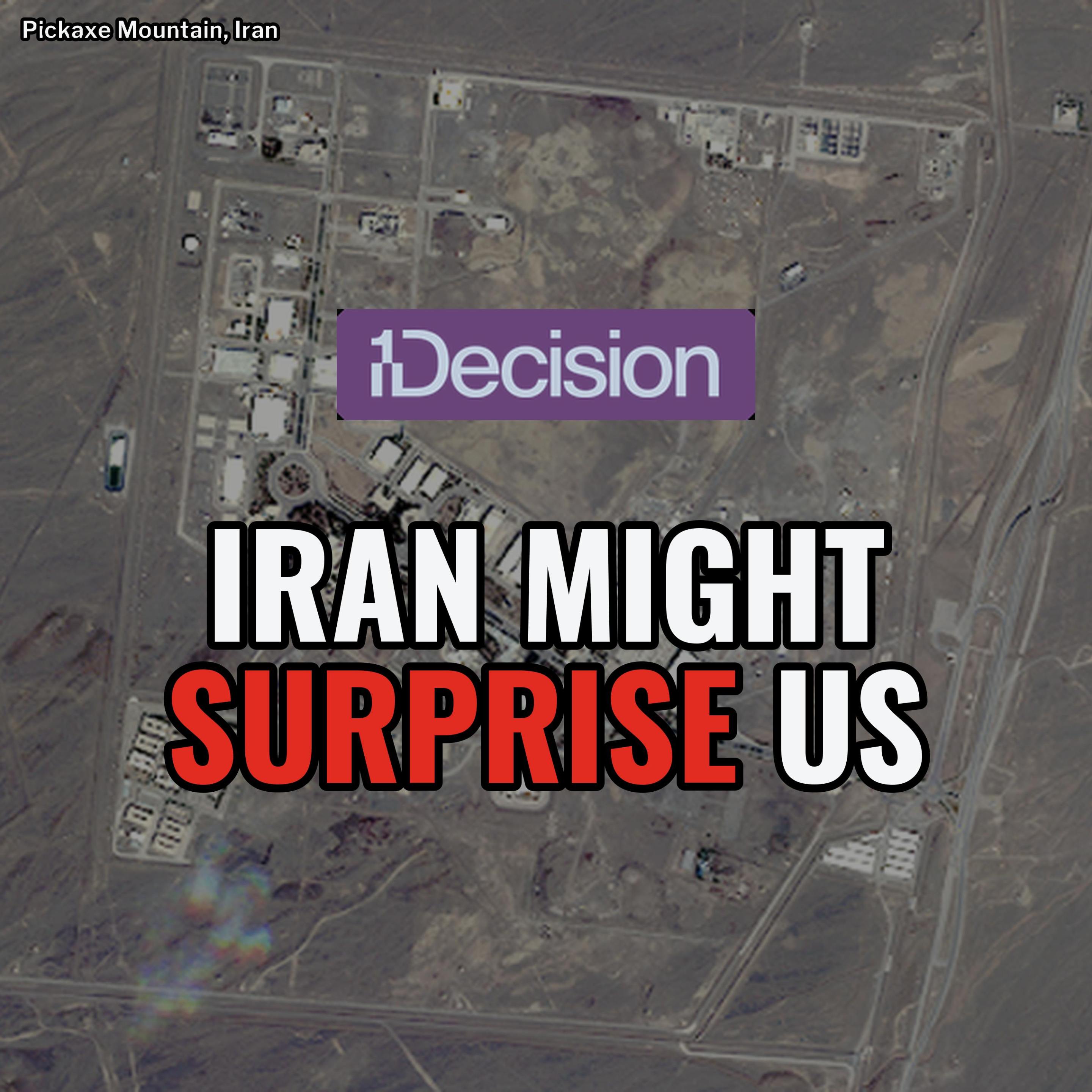
Mccann: That point about what happens next with Iran is so important here because Donald Trump, of course, in the beginning had urged Israel not to eliminate the Ayatollah, and of course that didn't happen. But we also know that he was, if not dragged in, certainly had his arm twisted, Donald Trump, into joining this conflict, bombing those nuclear bases, persuaded perhaps by the idea that it would be a quick success. And that's certainly how America has sold this. You know, we've won, we've bombed them into oblivion, they're never gonna make a nuclear weapon again. But the big question is Iran may well potentially start to rebuild. What does America do then?
Dearlove: Well, I think it does it again. The bottom line is pretty bleak if that's the case. I don't think they can rebuild quickly. The moment there's evidence that they are on that track or seriously on that track, because of the threat that that would apply to the whole Middle East. Because, you know, the implication is, well, we were defeated, we'll now be even more aggressive. So your opponent's got to take an even tougher line to make sure that you can't be more aggressive. That seems to me to be the logic of the situation. I mean, my expectation is that if the theocracy goes down, it would be some sort of internal power change, let's say, with the Iranian military taking over for a period of time. And if that's the case, that's not necessarily a friendly regime, but it might be a regime that says, fine, we're not gonna do the nuclear thing, but we're not gonna be your friend either. It's not a complete volte-face by Iran to a different position. I just don't think that's realistic at all because it's such a huge country, hugely nationalistic, huge sense of pride, huge sense of history, and all of these things are massively important to Iranians. So you can see where it might go, and it won't be straightforward, and it won't be simple, and it won't be a clean political shift either.
THE FUTURE OF GAZA
Mccann: One of the things that has been discussed, and my understanding is still very much on the table and part of this discussion, is Donald Trump's original idea of creating a Riviera in Gaza, Trump Riviera in Gaza. And there's been a couple of stories by the Financial Times in London about Boston Consulting Group and now Tony Blair, staff from Tony Blair's Institute, have been looking into and developing these plans for the future of Gaza. And some controversy around suggestions —
Dearlove: And, you know, these have been downplayed by some people involved and talked up by others, of paying people to leave Gaza so that it can be redeveloped as an industrial center. I've just read the Financial Times article with, you know, the revelation about the BCG's plans and the difficulty that is put on Tony Blair's consultancy saying they weren't involved in them, or maybe they were to an extent. And, yeah, I mean, the problem is you've got this Gulf State model of Dubai. The idea, you know, is very superficially attractive, that you can somehow, over the next twenty years, create a new Gulf State in Gaza, which has a different sort of role, you know, so that tax exiles want to go and live there and the rest of it. I just don't think at the moment that that takes account of the realities of a really postwar catastrophe. Let's face it. That's what the situation is in Gaza, and it's all very well coming forward with these beautifully packaged ideas. I've been involved in one or two other ones in the Middle East, which were more to do with water and water supplies and desalination, and there's some huge ideas about building canals to take water into the desert. And I mean, these ideas come thick and fast. I don't think they're very practical, and I don't think that's going to be the solution to Gaza, at least not initially. It's a way, way off.
CHINA AND PRESIDENT XI
Mccann: Yeah. It's a very difficult situation, and we will see how far those Trump-Netanyahu talks bring the two sides towards a formal ceasefire. But one person, one nation will be watching what happens, how powerful Donald Trump is right now, what he chooses to focus on with real interest, and that is of course China. All of this we're talking about is set against the backdrop of Donald Trump's tariff regime. There's a lot of change happening this week when it comes to the tariff regime. A lot of the exemption or grace periods are due to end in the middle of the week, the UK's exemption period also due to end, there's talk of future trade deals coming down the track, I think Donald Trump has said he's sending out letters, so countries need to have a look in the post and watch out for whether they're going to be getting more tariffs or a trade deal. But look, for China, the implications of this trade policy have been huge. We haven't though heard very much from President Xi.
Dearlove: Well, the mystery is where is President Xi? You know, he's disappeared from public view. And the latest news seems to be that he's not attending the BRICS summit in Brazil, which I think in my personal view is highly significant because at this point in time, given what Trump is doing, that BRICS summit is symbolically hugely important, and the Chinese presence is really the key one. We know that Putin's not going because the Brazilians said they would serve an ICC warrant if he did. So, you know, that's not a surprise. But Xi's absence from the world stage is creating massive speculation. My Chinese commentator friends say the most likely thing is he's been in hospital and had an operation and is recovering, and there's nothing sinister about this. But I think one's reaching the point in time where if that were the explanation, I'm surprised the Chinese haven't said something. Because the longer you leave his absence from world view unexplained, the more people speculate there's a political crisis taking part in China. We don't know. And I'm not saying that there is, but it's pretty peculiar, his absence from the world stage.
Mccann: And the BRICS summit, for people who are maybe coming to that word for the first time, it's Brazil, Russia, China, South Africa and India. Interestingly, I mean the timing of this is fascinating because Donald Trump has got really cross about the BRICS countries and basically said, well I might well slap an extra 10% tariff on all of you because, you know, I'm annoyed that you're meeting up and talking about things. But you're right. The absence of Xi from this political conversation on the world stage is really telling. Think, how long is it since we've seen him formally now?
Dearlove: I don't know. There's been, you know, fractions in the military commission of the Chinese Communist Party, which apart from the central committee is the other hugely significant body. There have been a number of senior generals who've been disgraced and sacked for corruption. Of course, the PLA, People's Liberation Army, has been heavily involved in business and in business opportunities and making money for individuals. You have the basic scenario for some sort of power struggle. I think it was Churchill who said, you know, these power struggles are out of view. They're like bulldogs fighting under the carpet. I think that was the phrase that he used. And this could be going on. I mean, if it is going on, I'm sure the better global intelligence services know something. But I'm surprised that if there isn't something happening, it hasn't leaked somewhere, somehow, because it would be so significant if there's a challenge to Xi.
MACRON AND STARMER
Mccann: Yeah, you're definitely right, it would be incredibly significant. You did mention Churchill though, which seems like a good time to bounce back to the UK, because Emmanuel Macron and Keir Starmer are meeting this week in the UK. It's a really big visit and we know that Macron sees himself as sort of the main key European voice, especially when it comes to the Ukraine-Russia conflict. He's definitely been pushing for a change in tone, really trying to push forward with working out some conflict resolution there. I think he sees himself as the leader of the pack of the UK, France and Germany certainly, but Poland also in there of course. But there is a domestic issue they're likely to talk about which is immigration, the small boats policy, and the suggestion that Starmer had wanted to go into this meeting with a deal on the table with Macron, a one in one out policy where every person who came over here there'd be one return to France. That now looks like the EU is going to block it. What do you think we're going to see from this visit from these two men?
Dearlove: Well, I think not a great deal. I mean, they're both politically weak. Macron's massively unpopular in France. And it's a state visit, so you get all the bells and whistles and the flags on the Mall and the state banquets and all the other things that happen. And so it'll be a spectacle. But I think there's one issue by which, let's say, the popular view of the visit will be judged, and that's in the UK at least, not so much in France, but in the UK as to whether, you know, something happens about the illegal crossings on the channel. Well, you, we all know in the last week or two, the French police slashed a couple of these taxi boats, which are inflatables, to stop them leaving on the basis that the boats were overcrowded and therefore dangerous. I mean, what Starmer needs, having stupidly said before he was elected, I will smash the gangs, you know, he needs to show some result for his populist voters that this problem is going to be solved by cooperation. It's a very, very tricky issue because the French don't have a great incentive to stop people crossing the channel because they dump them on us rather than having them dumped on them. So unless they really reach some agreement which has a European dimension to it, because it's not just France, it's other European countries as well.
Mccann: Interestingly, we spoke to Jeremy Hunt, who's a former UK foreign secretary, about this issue, and he praised Donald Trump's approach, which is not what you necessarily expect to hear from a conservative politician in this country. You can catch up with that episode of One Decision on our YouTube page or on 1decision.com or wherever you get your podcasts. Well, that's it for this week's One Decision in Brief and do stay tuned to our regular scheduled episodes. As I said, you can find those on our YouTube page, on onedecision.com or wherever you get your podcasts from. I'm Kate McCann. Thanks very much for listening.