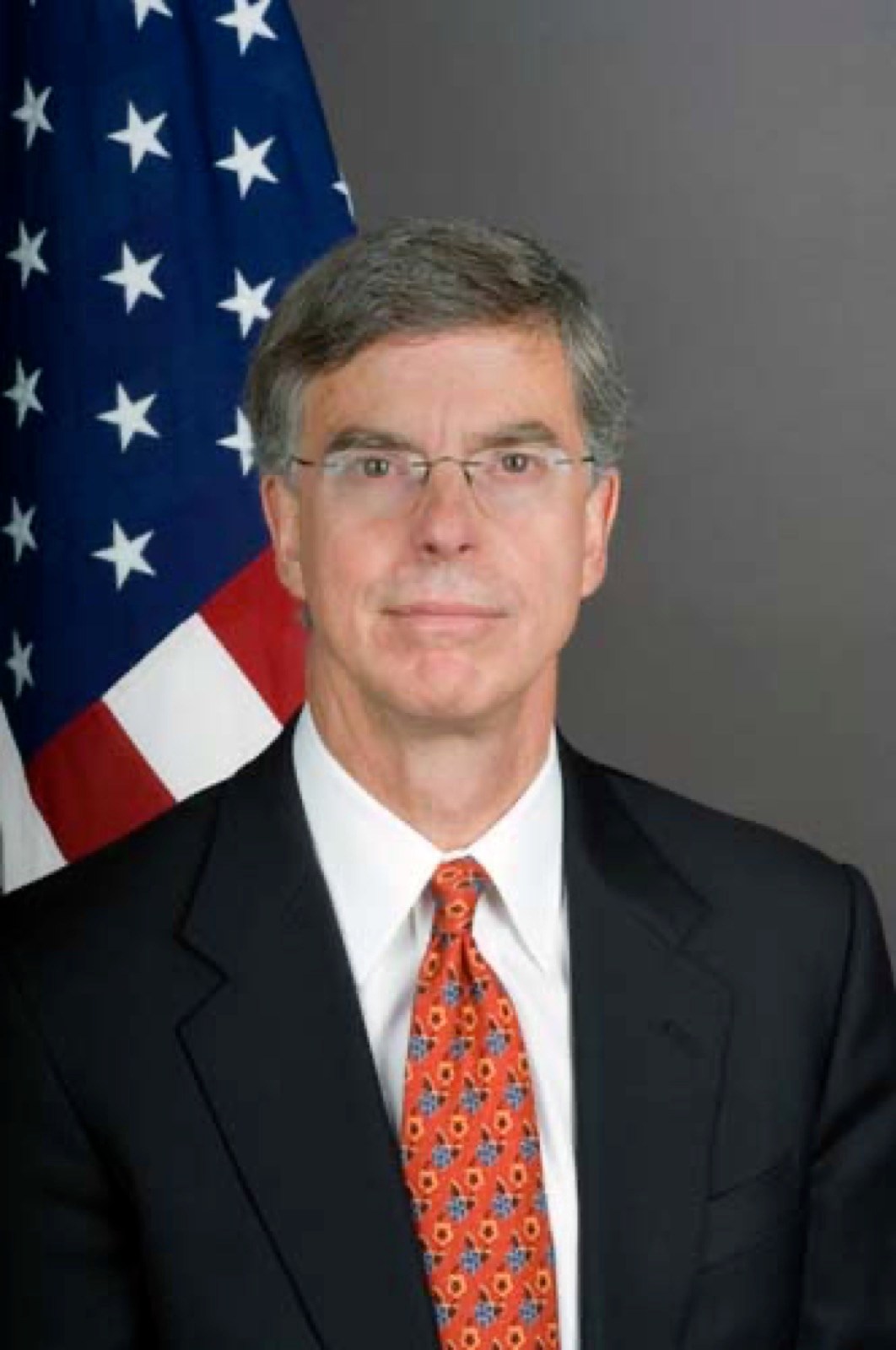
Hosted by Christina Ruffini and Sir Richard Dearlove
Guest
William B. Taylor Jr
William B. Taylor Jr. is a former US Ambassador who served twice as a diplomatic official in Ukraine and details the logistics of making a Ukraine ceasefire happen and what it means for Russian President Vladimir Putin's grip on power.
Episode Summary
In this week's episode, Sir Richard Dearlove, former head of Britain's MI6 sits down with former US Ambassador William B. Taylor Jr, who served twice as a diplomatic official in Ukraine. They detail the logistics of making a Ukraine ceasefire happen and what it means for Russian President Vladimir Putin's grip on power. They also explore how Putin's legacy could be affected by a ceasefire and reflect on the 50th anniversary of the fall of Saigon, Vietnam amid tariffs and growing economic tensions with the U.S.
Listen & Subscribe
- Watch on YouTube
- Listen on Apple Podcasts
- Listen on Spotify
Transcript
COLD OPEN
Taylor: If, as you say, Putin has to swallow an agreement that is less than he promised, it's possible that that could shake his support, that the people around him could be convinced that he's not the right leader.
INTRODUCTION
Dearlove: Welcome to the One Decision Podcast. I am Sir Richard Dearlove, the former chief of British intelligence, MI6. And today, our special guest is Ambassador William Taylor, who served twice in Ukraine and has had a very distinguished and varied diplomatic career in a number of the world's trouble spots. Ambassador, welcome to One Decision. It's great to have you on our podcast.
Taylor: Sir Richard, it's a pleasure to be here with you.
Dearlove: I've really wanted to start off by asking you to talk a little bit about your career. I see that you are or you are a decorated Vietnam veteran. And, of course, today is the fiftieth anniversary of the fall of Saigon, which for people of our generation was a very significant and emotive event. But, also, you have this transformation in the relationship between The United States and Vietnam. But that was a grim and difficult moment historically, even for those of us sitting watching on our televisions, those extraordinary photographs and shots which live on as evocative documents.
Taylor: They do live on, Sir Richard. You're exactly right. That was a grim chapter in our history and in Vietnamese history. You talk about the evolution of our relations with Vietnam. They've been complicated, but they've actually been pretty positive. I've not been back. I've flown over Vietnam, but I've not been back. My brother reported a very positive attitude among Vietnamese for Americans. And indeed, we have gone to great lengths to repair that relationship and to develop that relationship into a good economic relationship. They still have a form of government that we don't agree with, but that's their choice. If we can have a trading relationship with them, that's good. Senator McCain, who spent a lot of time in North Vietnamese jails, was a leader in that reconciliation effort between The United States and Vietnam. I've participated in a couple of those kinds of exercises as well, where we had conversations with Vietnamese generals who remember being on the other side of the battle lines when I was there. We've been able to share experiences and in some sense, bury the hatchet, as we say. And so these tariffs are counterproductive. The tariffs are not helpful for this relationship or other relationships with other friends and allies. It is a time to look back and see that we have made great progress between The United States and Vietnam over these years, but there's clearly more to be done.
INTERVIEW
Dearlove: Well, I'm really keen, I guess, you know, because it's so topical to ask you about Ukraine. And I think first, it would be great if you could explain why the security of Ukraine is now so important, not just to the West, to The United States. Because I think some of us are wondering about the White House view of this issue.
Taylor: It's a great question, and it's an important question. And there's a good answer to this question. That is Ukraine is effectively defending us from an aggressive Russia. Russia has demonstrated over the past three years, and indeed of course from its first invasion, its initial invasion of Ukraine in 2014, Russia has demonstrated a willingness to invade its neighbors. There has been a trend, a historical trend of expansion, and it is focused now on Ukraine. And it is then important, it gets to your question, why is it important for us to support Ukraine? It's important for Ukraine to continue to stop them. Ukraine has stopped the Russians from their inexorable movement towards Europe and towards NATO nations and towards American soldiers deployed in Europe. Ukraine is defending Europe and US interests in Europe and, indeed, US forces in Europe from an aggressive rule breaking, rule ignoring Russia.
Dearlove: So my follow-up question, which is really the obvious one, is where do you think we now stand with US policy, with this administration towards Ukraine? I mean, I follow it very closely, but I'm confused. And you may not know the answer, but I think you are certainly so familiar with the issue that you can speculate as to what point I mean, is The US really going to abandon support for Ukraine and leave it to the Europeans? I guess that's the key for me.
Taylor: And I don't think we will. I don't think The United States will abandon Ukraine. One part of that policy, I think, has been very clear and consistent, actually, since President Trump, then candidate Trump was campaigning. That is stop the war. President Trump, to his credit, has made this, I think it's fair to say, and I know the administration does say, has made this the top foreign policy priority for this first three months, first hundred days. Where we are right now is at a very important point where proposals are on the table. And I say proposals, plural, because The United States, maybe two weeks ago, kind of leaked out a proposal. They said it was going to be presented to the Ukrainians and presented to the Russians. And it would be the basis of some kind of a ceasefire and then eventually a settlement. I say proposals because there have been counter proposals now, which I think are useful because the first proposal that the Americans put on the table was not perceived to be balanced. Let's put it that way. It was perceived to be pretty favorable to the Russians who again initiated this war. They started this war. So the counter proposal from the Europeans, from the Brits and the French and the Ukrainians has been useful input into what I hope will be a revised American proposal sometime soon. Putin is emerging as the problem. We've understood that. However, the administration and maybe President Trump has not understood that. But I believe they are becoming aware of that. It's becoming clearer that Putin is the problem.
Dearlove: I mean, a ceasefire, what are we then looking at? Are we looking at it like a line of control, a truce line as it were between North and South Korea, the last armistice line of the Cold War, which still survives, or the post Cold War period. It's very hard to imagine, at the moment, at least, Ukraine really regaining substantially significant bits of territory. I mean, I think they've lost about 20% of the country. How do you see that playing out if we can achieve a ceasefire?
Taylor: I think this ceasefire, I think the elements of this ceasefire are becoming clearer, through these two different proposals, one from the Americans, the other from the Europeans and Ukrainians. And it is something that you, as you described, along the current line of conflict, which again, as we both agreed, hasn't changed very much in two years. So that's been a pretty static line of conflict. And that would be the temporary de facto line between the 80%, as you rightly say, there's 80% of Ukraine that is not occupied and 18.7%, 19%, they'll say 20% of Ukraine that is occupied by the Russians. And you're right that that 18%, 19%, 20% is unlikely to be returned militarily. It's unlikely that the Ukrainians will be able to mount an offensive to push the Russians out of that 18% anytime soon. So the ceasefire agreement will, I think, recognize de facto the reality that the Russians are there in that 20%. But there's no need, no need, in fact there's a strong argument against recognizing that de jure as legally there. The Russians are not legally there. West Germany agreed that it would not try to take back East Germany from the Soviet influence militarily. That allowed West Germany to get into NATO and to join the organization that eventually became the EU and develop its economy and develop its democracy. Ukrainians want to develop their economy, their democracy, join the EU, eventually join NATO.
Dearlove: Yeah. I was going to actually ask you specifically about that because you have been one of the people who've advocated strongly Ukrainian membership of NATO. I mean, when I went there last summer, you know, the conversations I had at a pretty senior level in the, you know, national security structures were that, well, you can't afford not to have us in NATO because we are such a significant military component of, you know, the European continent. And that's a powerful argument. But I've always been worried about the prospect of actual Ukrainian membership of NATO, in that I felt that that would be, certainly, at the moment, a bridge too far for the Russians, and they just wouldn't ever conceptually be able to accept that. But I mean, the parallel you're drawing with Germany is an interesting one. Maybe the methodology of getting Ukraine into NATO isn't as lethal to the Russian psyche as I'm imagining.
Taylor: You know, I think that's right. I think that's right. The Russians will always say they hate the idea. But when Finland decided to join NATO, the Russians barely shrugged. So it's not NATO that's the issue. Putin just wants Ukraine. And so once he's convinced that he has lost Ukraine in the ways that I talked about earlier in terms of convincing him that economically, militarily, diplomatically, he's not going to dominate that 20% and maybe even the rest of Ukraine, but he's certainly not going to dominate that 20%. Then eventually the question of NATO comes back on the table. And we haven't talked about one other element, which if it's not NATO, then what is it that will secure Ukraine during a ceasefire as they work out a final settlement? And that is where the Brits and the French and many other Europeans and some others, the Japanese have said that they would like to create a coalition of the willing to put together a military force. We're not talking here about peacekeepers. We're not talking about blue helmets here for verification, monitoring. No. We're talking about, and the Brits and the French are talking about, a coalition of willing to actually put forces at the disposal of the Ukrainians or on Ukrainian territory to deter the Russians from coming back again. And if the Europeans are willing to provide that security guarantee, then the Ukrainians are willing to sign up for this ceasefire.
Dearlove: Yeah. That's, I mean, obviously a crucial possibility. And I've always myself been skeptical about actually deploying, let's say, a coalition of the willing in terms of boots on the ground. But it seemed to me that there is a practical solution, and that would be to provide air cover, which would be based outside Ukraine, but obviously deployable at an instant. So you could cover the whole of Ukrainian territory with a very sophisticated and powerful air force, which would be composed not obviously, it wouldn't be a NATO air force, but it would be composed of a group of nations, and I think that's a very important de jure distinction. But I honestly the frontier, if I'm right, you know, the line of truce is over 2,000 kilometers in length. If you talk to any military people here, you would need tens of thousands of boots on the ground to police it in any way, whereas air cover would solve most, I mean, not exclusively, but it would solve most of the problem. Do you agree with that sort of analysis?
Taylor: I agree with that analysis because it is a long border, and one concept that addresses that question is how this coalition of the willing force, let's call it the deterrent force, how this deterrent force is deployed, whether it's just air cover or whether it's actually troops on the boots on the ground, as you've said, it would be controversial. But the Ukrainians, with a million men under arms right now, would be the first line of defense along that long contact border, temporary in some cases with Russia and Belarus. So the Ukrainians would defend their borders. They would be the front line. The force, whether it be an air force as you've indicated or a ground force, which is one option, would be deployed behind those lines back from the front in Ukraine, so able to respond to a threat or an incursion or a ceasefire violation with force. Now there could be another force. There could be a monitoring verification force as there have been in other conflicts. These are not well armed. During the 2014 to 2022 low level conflict generated by the Russian invasion, the OSCE mounted a special monitoring mission up and down that temporary line of contact in Donbas, and they just reported on ceasefire violations. That's not what we're talking about here. What we're really talking about in this deterrent force is a real capability, military capability.
THE FUTURE OF RUSSIA
Dearlove: But you made me feel more optimistic than I have felt about this, and you're probably well placed to give that interpretation. But how do you see the future in Russia? Because, or getting briefed and talking to people about what's going on there. I mean, there must be significant vulnerability around Putin. I mean, his leadership and we said there's no reverse gear. I mean, the results are pretty catastrophic. And the cognoscenti around him, or let's say the kleptocracy around him, were probably not getting the deal that they anticipated when this group pushed him into power and has given him this very dominant position. How do you see that playing out? Because the implications could be pretty serious for Russia's own political future.
Taylor: I think you're right, Sir Richard. I think it's exactly right. You will know better than I, but people tell me about Russian history where Russian leaders lose wars, they don't last as leaders very long. If, as you say, Putin has to swallow an agreement that is less than he promised, it's possible that that could shake his support, that the people around him could be convinced that he's not the right leader. The US policy is not to get rid of Putin or regime change. No. But our policy is to support Ukraine and our policy is to get Ukraine to a just and lasting peace. If they can come out of this war in an advantageous position going towards Europe as eventually even in NATO, certainly in the EU, then that's a win for Ukraine. I think it's a win for Europe. I think it's a win for The United States, and I think it's a defeat for Russia. And if that leads to some changes in the Kremlin, that's okay with us.
DIPLOMATIC CAREER AND DECISIONS
Dearlove: I was gonna ask you, as we're the One Decision podcast. You must have, in your diplomatic career, given the places that you've been, which were full of necessary decisions, what do you pick out from your career where something you had to decide or you had to progress really made a difference?
Taylor: One effort we undertook. I've spent some time in Jerusalem trying to get the Israelis and the Palestinians to agree on a way that the Israelis could withdraw from Gaza. This was a complicated question. Of course, if they did withdraw, from which they eventually did only to have gone back in, of course, as we know, but this was in 2005. If the Israelis withdrew from Gaza that would have given the Palestinians for the first time access to the outside world through the border with Egypt, and on the border with Egypt this town called Rafah, and Rafah after the Israeli withdrawal would be open for people to come and go, goods to come and go, traffic to move back and forth across the Gaza Egypt border. The Israelis were very uncomfortable with this. Others that I worked with came up with an idea that would use The US technical advantages to put monitoring systems, cameras and other sensors on the border at the Rafah crossing so that the Israelis not on-site, the Israelis 20 kilometers down the border could be able to monitor what was going back and forth across and enable them to be comfortable that weapons were not moving back and forth across the border. This was not easy. There was a technical problem. There was also political problems. We had many conversations between Israelis and Palestinians and Americans and the rest of the quartet on how to do this. In the end, we got that done. In the end, Rafah opened for some period of time. That was a small step that allowed people to provide humanitarian and other construction goods.
Dearlove: Now, all that of course is gone. I suppose at the time, I mean, when you were doing a deal, you know, to bring in the Palestinian Authority and training them, you know, to take over in Gaza, and then, of course, they got pretty much annihilated, all the leaders of the Palestinian Authority, by Hamas, when Hamas, you know, emerged as that significant force. During that period, I mean, given historically what's happened since, how clear was it to you that, you know, Hamas was there like a sort of dark sinister shadow waiting to make its moves, of course, with the backing of the Iranian Revolutionary Guard Corps and the Quds Force from Iran.
Taylor: Well, exactly. Exactly. So the work that I just described was in 2005, but then you will recall early 2006 the Palestinians had an election which Hamas won. And Fatah, the ruling organization in the West Bank, conducted a very inept political campaign. And Fatah ran several candidates in the same district whereas Hamas was very well organized and they ran one candidate and they won. And that was the end then of our work into the quartet, but also the beginning of big problems in Gaza as you've described.
Dearlove: But looking more broadly at your diplomatic career, I mean, there are always moments of levity and moments of hilarity even when one is dealing with quite serious situations. I was just wondering whether you could recall any specifically.
Taylor: I've been posted to Ukraine twice. Once in 2006, 2009, the other in 2019, 2020. In my first posting, my defense attaché came to me. This is about 2007. My defense attaché came to me and said, you know, Mr. Ambassador, we're gonna go train. Just wanna let you know. We're gonna go train with the Ukrainian military. And I said, great. What are you gonna do? Well, we're gonna train with their paratroopers, with their airborne troops. I said, great. What are you gonna do? He said, well, we're going to jump with them. And I said, great. I wanna join you. And, you know, you can imagine this army colonel kind of sucked air through his teeth. I don't know, where ambassador, that, you know, I'm not sure we can arrange this, but he did. He called back to USAREUR, our headquarters in Germany, and Germany didn't like the idea, but they sent a very senior command sergeant major out to inspect the Ukrainian equipment and training and all of this to be sure this was going to be okay for The US ambassador to go jump out of helicopters with the Ukrainian military. And we went and trained with them. Four or five defense attaché personnel and I went out. It was very interesting, Sir Richard. You'll appreciate this. The Ukrainian parachutes are bigger than the American army parachutes, and thus they come down slower. So we're trained, the American army is trained, when we're about to land in these parachutes, to turn into the wind, which slows down the movement across the ground. Ukrainians, because they're coming down slower, they're not trained that way. So they're trained to stay with the wind and hit the ground without falling. They just hit the ground running. We're trying to land on our side, parachute landing fall. So we did the training and then went up, jumped out, dragged our parachute back over to the landing zone when we had landed. And the general there said, good work. Do you like it? Yes. You want to do it again? Sure. So back up we went and jumped again.
Dearlove: Well, you're very courageous. I've never been persuaded to jump out of an airplane on the end of a parachute. I've done lots of weird stuff, but that's one thing I drew the line at.
Taylor: It was a lot of fun. And but the bigger message there, of course, two messages. One is the Ukrainian military, even then we could see that there was the colonel, the essence of a disciplined, competent Ukrainian military, number one. And number two, the Americans supported them, had confidence in them. And we would demonstrate that support and that confidence later on.
Dearlove: The incident I was going to recall was flying into Bagram at night in a Herc with Tony Blair when he was prime minister. So I can't remember where we boarded the plane, somewhere in the close Middle East to Afghanistan to fly in. And when we got on the plane, the advice was to sit on your flak jackets. Don't put them on. Right? Because if we get shot at, it'll come up from underneath. So that was quite reassuring.
Taylor: You probably corkscrewed down into that airport, into Bagram.
Dearlove: That's exactly. And a vertical takeoff as well. But the other thing was that as we approached Bagram, we must have been brushed by a radar system or something, and it set off all the counter flares from the side of the aircraft. And if you're not used to that and you're flying, you know, in darkness in battle gear and everything, it was a spectacular firework display. Fortunately, I knew what was happening because some of the people on the plane really freaked out. Ambassador, thanks for your fantastic insights and interpretation of this really complex international situation.
Taylor: Sir Richard, it's an honor to be here with you. Thank you for having me.
Raffini: Alright. That does it for this week's episode of One Decision. I'm Christina Raffini, of course, here with my cohost, Sir Richard Dearlove. As always, for more exclusive content and key discussions with global leaders, be sure to check out our website, onedecision.com, and of course, our YouTube. I'm Christina Raffini. We'll catch you next time.