Episode Info
- Season19
- Episode4
Hosted by Christina Ruffini and Sir Richard Dearlove
Guest
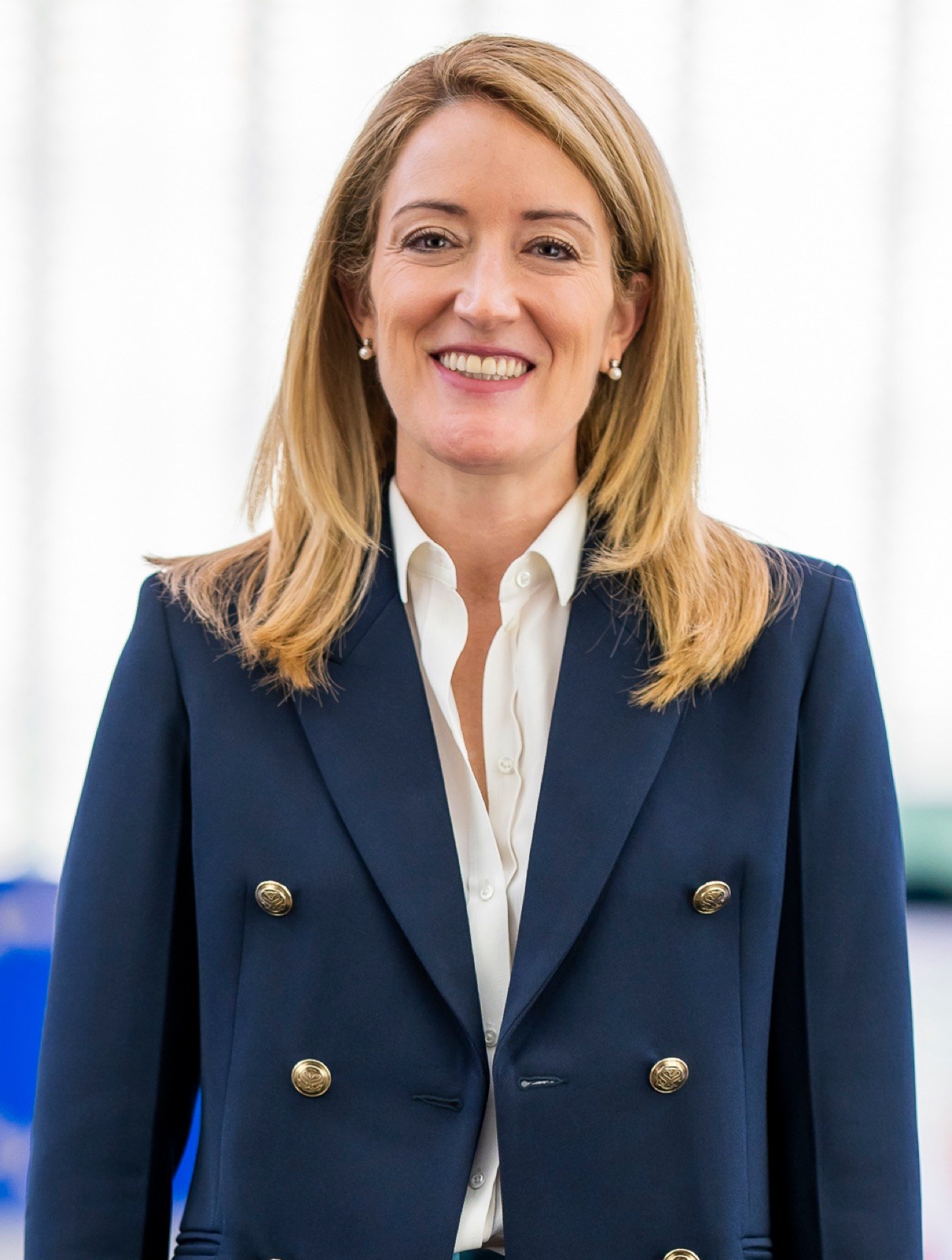
Roberta Metsola
Roberta Metsola is the President of the European Parliament.
Episode Summary
Europe today is being tested like never before in its recent memory—war and instability are on the edges of Europe, threatening to spill over into its borders; Russian influence and propaganda are sowing divisions across the continent, and rising inflation and unemployment are giving oxygen to divisive populist politics. One Decision sits down for a sweeping and wide-ranging conversation with Roberta Metsola, the President of the European Union Parliament to discuss the bloc’s biggest security priorities and what needs to happen now to address them, what the EU is doing about Putin weaponizing its energy needs, the migrant crisis and how populists have been exploiting divisions across the continent.
Listen & Subscribe
- Watch on YouTube
- Listen on Apple Podcasts
- Listen on Spotify
Transcript
COLD OPEN
Metsola: You asked me for my opinion as president of the European Parliament, but I will start with my personal opinion first. There's not a day that goes by that I think for every decision that we take, how would this decision be taken if the UK was still around the table?
INTRODUCTION
Mcfarlane: You're listening to One Decision, the podcast that looks at the choices made that shape our world. I'm your host, Julia McFarlane. Seven years ago, the UK voted to leave the European Union, the first of its nations to quit the bloc. But the UK, and to some extent, the US, have not been able to leave behind many of the issues facing their European partners, issues that truly impact us all. Europe today is being tested like never before in its recent memory. Putin's war is raging at the borders. Russian influence and propaganda is sowing divisions across the continent. There's the throttling of critical supplies of energy, cyber attacks, and not least of all, the wider stresses on the global financial system, high inflation, unemployment, and rising bills. European unity and solidarity forged in the aftermath of two brutal world wars now beyond our living memory, is under pressure. Roberta Metsola is the Maltese president of the European Parliament. She's been in office since January 2022, and high on her in-tray these days has been European security in the wake of Putin's full scale invasion of Ukraine last year. She's worked on the EU sanctions against Russian energy and has spearheaded efforts to decouple Europe from Russian energy. How successful have those efforts been, and how durable is the European project at a time of rising Euroscepticism, of populist politicians no longer confined to the fringes of society, attacking the European Union and its ability to address some of its biggest issues today, such as the migrant crisis and the disproportionate impact it has on its southern states. I met with Roberta Metsola last month in New York during the UN General Assembly, and I had a really fascinating conversation with her about Europe's security priorities. We talked about all sorts of things. Everything from how Putin was weaponizing European energy and what the EU was doing about it, to talking about the migrant crisis and how populists have been exploiting divisions over it. We also talked about the legacy of Brexit and how she felt about it all these years later. I was really surprised by some of the things she said, and so I'm delighted to bring you this conversation only on One Decision.
INTERVIEW
Mcfarlane: So on the 24th of February 2022,
Metsola: I think it was the loudest, I would have expected it to be louder earlier, alarm bell that we woke up to with the realization that some countries in the immediate neighbourhood of Russia, member states of the European Union, were 100% reliant on Russian gas. It was that realization that put us all around the table immediately, giving ourselves the need to take decisions about how to cut off our dependence with an understanding that Russia, as always, had never seen energy as a way to help or to supply neighbors, but as a political tool. How to help Ukraine, how to switch the dependence of Ukraine and connect it to the European Union's electricity market. How to make sure going into then the winter we had enough gas stored.
Mcfarlane: When it comes to storage, there was this phrase that went around quite a lot during the 2008 financial crisis, particularly in my country in the UK, which was, you have to fix the roof when the sun is shining. Because obviously when it rains and there's a hole, you're in for big trouble. How prepared was Europe before the immediate strains on energy and after the invasion of Ukraine?
Metsola: Well, I said earlier that it was an alarm bell because it was literally one thing where we had to start to list what our options were, because you had some countries that are very advanced on renewables and some countries that in parts of them people are still heating their homes with wood. This is the same European Union. These are member states where EU citizens in them realize that their equality of access is completely different. For different reasons, but purely, I mean mostly economical. We had so many energy islands, countries that would talk to each other and say, you keep your nuclear, I keep my gas, and let's all be happy about it. That ended, because we realized we needed each other more than ever before. And at the same time, it also meant that we started to talk to the United States, to Norway, to Canada, also countries to our south more because we needed to diversify our supplies. And I think that was perhaps a realization that what was maybe a lack of political will was found, and because we had no option.
Mcfarlane: Yeah, you've mentioned, you've spoken on the need for sort of triple diversification, which is Europe diversifying its energy sources, its suppliers, and its supply routes. Can you tell me at what stage is Europe? Is Europe sort of entirely sort of decoupled from Russia where there is no interaction between Russia and Europe on any of these three key areas?
Metsola: Well, I can give you statistics that on the 24th of February 2022, there was an up of 90% dependence, and now there is a below of 10% dependence. So the difference is huge. We have uncoupled. My fear, of course, and we see it, is that you don't have the whole globe on board. So, you have countries that are aiding Russia. You have countries which are being used in order to place products back on our markets in different forms.
Mcfarlane: So, like repackaging Russian crude—
Metsola: —places in the Gulf and then sending them back to Europe. We are seeing that. And of course, that also means that how are we going to respond to that? And that's a new thing.
Mcfarlane: Right. Can you name any names?
Metsola: No, I won't name any names because what I would like is, especially in this week's general assembly, we have a renewed effort to bring those democratic countries on board in stating that you do not aid a country that has simply decided to illegally and brutally invade a sovereign neighbour and think that some part of that land is suddenly yours. It has to start with the strongest of political statements and an understanding that if you do not align with the implementation of our sanctions, then you cannot depend on the European Union for help in other areas.
Mcfarlane: You mentioned the need for Europe to sort of sit up and recognize and admit, really, that Putin uses energy trade as a political weapon. But through the course of diversifying energy sources in Europe, we've turned to countries like countries in the Gulf, who arguably do the same thing. So, is it a long term solution, diversifying to take more Saudi fuel and more Gulf states, other sort of countries that perhaps don't align with European values?
Metsola: I mentioned the US, Canada, and Norway before for a reason, because the transatlantic alliance for energy diversification was not so strong before. These are our allies, and these are countries that we can continue, hopefully, to rely on. With regards to other countries also that you mentioned, from a parliament perspective, of course, our concerns are high, continue to be high. We do not want to go from one unreliable partner to another, and we are that institution that asks the questions. We are the ones who legislate on gas storage, on gas procurement. We're the ones who are elected by our citizens and who are asking us very much those questions. So, what I would hope for is a discussion around the table. And I know that President Zelenskyy has spent quite a lot of time with leaders of those countries as well in terms of identifying also new alliances from an economic and trade perspective, supply routes as well, because that was never there before, in terms of Ukraine used to rely on other routes. So I'm ever hopeful of the fact that we can engage in dialogue with everybody, because as we're also seeing today, if we look to our south, how many partners do we have? And do we just talk at them or do we talk with them? And I fear that the former is too true for too many.
Mcfarlane: Yeah. That is absolutely something that is on my list of questions for you. Norway, Canada and the US, you're sort of hinting that these are sort of your sort of stalwart allies and getting a closer partnership through energy trade is an important part of that. I mean, the US, Canada, Norway cannot feed Europe's needs alone. But if Europeans do try to focus most of their mutual energy trade with their allies, are we not losing something by not having economic relationships on critical things that we need? With countries like Saudi, I'm not arguing that we should not decouple from Russia, but when you're only trading with your friends, do you lose an important aspect of politics where you can maybe get people to work together to maybe change a bit about how they govern their people or persuade them to play by the rules in the international order when there's so much money at stake?
Metsola: Yeah, this is an interesting point that is also raised by our Latin American partners, actually. We had the EU–Latin America Summit in July, where our partners there said, talk to us more. We're talking about critical raw materials, without which any basic machine, either produced on European soil or imported, requires a certain finite amount of resources that comes from outside the European Union. So how can the European Union talk about its own strategic autonomy when 98% of permanent magnets, for example, come from outside? So, don't only look at one country, in that case it was China, look at also us because we can create a Critical Raw Materials Alliance, which is now in the process of being created, was announced last week, in my opinion too late, but at least better late than never, in order to identify also with our partners in Africa where we can share. In other words, where wealth can grow everywhere. And that does not mean basically emptying one country of its raw materials by bringing in your workers and leaving devastation behind, which is happening right now in Africa. And it is extremely worrying for me, for our parliament, and also for the European Union should be. But when we talk about going back to what we mean by strategic autonomy, it's precisely this. In other words, where do we identify what we need, and how are we going to end up not being hostage, either to our own decisions or to others? And we were not prepared for that debate five, three, two years ago. We were worried about, as you said, pandemic. And one of my main things, I mean, I've been in politics for a long time now, is that we need to admit where we failed. And we also need to admit where we don't explain our decisions. So, a Prime Minister said to me last week, you know, I'm facing a situation where so many people this summer lost their homes because of floods or fires, but we're still in a situation where we're discussing solar panels on their roofs, and that's the only way I can get EU funds. And I need to tell my citizens that they can continue to rely on having help to have a roof over their heads. And if we lose that discussion, our citizens won't be able to understand how their bills are continuing to grow, and absolutely no help whatsoever is being given to them. It's creating, if you talk about, for example, specific countries, you know, where heat pumps, Germany, for example, are discussing the introduction of heat pumps in homes.
Mcfarlane: And in the UK, there's a big debate on that as well. And the cost is very high.
Metsola: And if you are a middle income family, we're not talking about families or individuals who are below the poverty line, but those families that could otherwise survive month to month are now telling us they can't. How do we help them as well?
Mcfarlane: Well, it's something that is happening around the world, but there are obviously huge economic stressors on Europe and a large part. We've all been through the pandemic. We've all been through the supply chain chaos in 2021, and then the war in Ukraine. I think it is so important to sort of pay tribute to the unity that was displayed by Europe and coming together to support Ukraine, the willingness and the grit to put up with economic hardship in order to support Ukraine across so many countries, I think was a really important success story. But that European unity and resilience, it's going to be put under pressure, as there are more sort of economic troubling headwinds, and particularly this year and into next year, the ECB has raised interest rates for, I think it's the sort of the tenth hike in fourteen months or something, and don't get me started on the UK, the UK's interest rates. I believe there will be elections next year. Do you fear that European unity will start to fracture? Or do you think there's gonna be an issue with families under pressure turning to more sort of populist parties as a backlash to all of this?
Metsola: I was asked the same question a year ago. So, six months after the war, do you feel like fatigue has set in, we're not ready to take the next steps, and people are going to start to look away? And I was as emphatic then as I will be today that fatigue, it is our responsibility for it not to set in. Statistics and polling show that support for Ukraine is still very, very high. Ukrainian communities are still active in our communities, so there is a lot of visibility to what is happening to a country, and now as we speak, actually, is being bombed day in, day out. And there is an understanding in Europe that this is in our immediate neighbourhood, and this could happen to all of us. You know, I'm married to a Finn, and this is something we discuss at home a lot, you know, that ever since I've been sort of close to that country with a very difficult relationship with Russia and its history, it has never been, you know, the tension is palpable, people are worried about the possibility of this escalating, and if it escalates, where do we go? So, that is why we need to continue to push the course, because that is exactly what Putin would want, that that unity starts to fracture. Now, in terms of internal decision making, I mean, you know, what we've done is absolutely amazing. 11 packages of sanctions, €50,000,000,000 that are being earmarked in order to go for Ukraine in terms of reconstruction but also continuing to help. This comes of course on top of a very difficult discussion internally. How does our budget adapt? We also talk about enlargement: how many countries could the EU grow to? For the parliament, it's very clear: this is economical as much as it is political, a larger European Union is a more secure one.
Mcfarlane: But that's quite a divisive concept. I mean, and it was also quite difficult getting a lot of countries on board with those sanctions, the Hungarians, the Croatians had a lot of dependency.
Metsola: It was all of them. In fact, you can see that every country, you know, needed its own carve outs, I can tell you from sort of intimately reading and being in those discussions. But if you had asked me whether Ukraine would be a candidate country today and potentially starting accession negotiations by the end of the year, I would also have told you, no, I don't think that's possible, but it is there. When my country joined the European Union together with nine others, the same discussion was then: are we ready? And of course, it's particularly sensitive in a post-Brexit scenario, but this is one thing I could say, perhaps, at the beginning of this mandate — so we are now in the end of our five year legislature, which has been quite difficult — is that I would have thought to see more countries, you know, discussing whether or not to stay in the European Union. That discussion does not exist anymore, and that's because we have had to come together like never before.
Mcfarlane: But there has been a big rise in fringe parties, and there are populist parties, and perhaps a lot of these, if not Eurosceptic is the right word to discuss some of these parties on the fringe across Europe, perhaps the intention is not to threaten to leave as the UK did, but certainly their aim is to frustrate the European project, and there has been a rise of that in recent times.
Metsola: And I think the responsibility is also ours, you know, I consider myself to hold sort of a pro-European constructive majority in the center of the political spectrum, and we did not communicate, discuss, listen enough. And you have people in rural areas, you have younger people in urban parts of the larger cities who feel disenfranchised, disgruntled. You know, next year in June, so the elections are between the sixth and the ninth of June next year, where the whole European Union will be asked to choose its next parliament and its next leadership, next commission, next representatives, and we have four countries of those where 16 year olds will vote for the first time. And I would like those 16 year olds to not feel that all politicians are the same and that they are not ignored by a European Union that only speaks in a language that is not understood and whose tangible results are not felt. And I think we have a lot to learn by these national elections, where either people did not vote as a result of which the extremes won, or people actually voted for the extremes. And I see that in governments where some of those parties are in today, and they're being asked to take decisions. And most of the decisions they take are not different to those that have been taken by the so called establishment parties in the past. And that if you become, you know, if you get elected on a, you know, we call it the no factor, you know, where you say no to everything, realize that you can't govern like that. So, I would say, you know, engage in a debate and push back against the narrative that being climate ambitious, for example, is mutually exclusive to being competitive or creating jobs or losing the safety net that we need around our businesses and industries, and being human centric. And I think we can carve out that messaging in advance in order to keep that majority that we need. Because otherwise, as you said, we will have a European Union down the line that is not recognizable to what the one I have grown up in, and one, you know, that is an institution I now lead, and we would only have ourselves to blame.
MIGRATION
Mcfarlane: Well, you talk about the need to listen to these people's grievances, and of course, migration, and you must really hate being asked about migration by journalists, it's such a quagmire, it is a morass of an issue, and one that has no easy clear solutions, but we have, just in the last month, we have seen two huge natural disasters on the African continent, on the other side of the Mediterranean, we have seen climate change leading to large parts of the earth becoming uninhabitable. We are gonna continue seeing people trying to come to Europe because they are fleeing not just persecution, but also inhospitable landscapes. And the EU, I mean, obviously this is a huge issue in the UK as well, and I'm sure as a European, must be very frustrating to see the Brits arguing about migrants crossing the channel when they receive far fewer migrants per capita than countries in Europe. But there has to be something that is large scale, radical program that is not simply based on stopping people smugglers or these trafficking gangs, because they will always be there as long as there are people who want to move. As far as human civilization has happened, people have always migrated. Political boundaries are actually quite a new thing in our modern history. So this is an issue that causes such corrosive politics in the EU as well as in other countries, but in the EU, doesn't something really big and radical need to be done about it? And is there political will for that?
Metsola: So, I'm gonna be as radical in my reply. Our migration policy has failed. I've worked in this area for decades. I come from a country which is bang in the middle of the Mediterranean Sea and has been faced with a phenomenon, a challenge, but one that, as you say, will not go away. You are right in saying that there are hundreds of thousands of desperate people across the Mediterranean to our south that no matter what, will try to cross. And we have to ask the question why. Why have we not yet identified a solution whereby you do not have to have no option but to cross the Mediterranean Sea and face an almost certain death to seek asylum, if you're eligible. Because what is happening today is that people arrive, small percentage are eligible, their asylum application is not processed quickly enough. They disappear. Other countries immediately close the border so that you are stuck in one. The country and its leadership is in trouble. The opposition is up in arms, taking any advantage, and here I talk about any opposition. This is not about right or left. This week, we had four pregnant women who died in the Mediterranean Sea. We had yesterday a newborn baby dead on one of the arrivals. Minors who are alone arrive there without their parents, 14 and under. Can we not find a solution for us to be able to? And this used to be possible before. The United States used to have a very, very good resettlement program, the United Kingdom as well, the northern part of Europe as well, where you would identify individuals who would be granted what are called legal and humanitarian corridors to be able to find asylum in the European Union. Today, once you are rejected, there is no mechanism to return you. And I understand our populations when they are asked that they are in a situation where they have to accept, this is our international obligation, those who are eligible, then solidarity will be shown, but there is no possibility to process fast enough and return those who are not. And it makes such a difference, of course, between whether you have a land border or a sea border, because those who have land borders can easily — you understand this from the UK — you know, close, but you can't do that when people are arriving on boats. And look at us today when we are still talking about needing to process applications faster, needing more solidarity, needing better returns, and cracking down on smugglers? Where are our discussions with our partners? Countries of transit, countries of origin. Where are our, you know, projects with those countries where at least going back to what you said in terms of, look, are compelling circumstances which give them no choice. You know, I'll never forget the phrase of, you know, it is safer for parents to put a child on a boat than to leave him on land. I mean, we are still there, and we have not managed to identify situations where you can really grant protection from outside the European Union and bring those in and avoid the drownings, avoid border crossings, and really not end up having to still debate between an open Europe and a fortress Europe. We haven't managed that. And at the same time, we have huge labor market shortages. Aging populations. It's decreasing almost like the solution is staring us in the face. And, you know, this is a subject that is very close to my heart, and the easiest would be for us to say big words, you know, and say, these are our solutions. We need to have multifaceted debates and not talk at those countries. And maybe, sorry, I've taken a bit long, I'm passionate about the subject. Is that you can never forget that each person who tries to come to Europe, let's use the word try, or is aiming to come to Europe or anywhere is a person. You know, you become blind to that by thinking that they're just statistics, they're just numbers. How many thousands today behind each person there are hopes and dreams? And what are we as a European Union or actually as a world where migrants are or persons are looking to seek a new life doing in response? We haven't done anything. And that's extremely painful for me to have to say this today.
SCOTLAND AND THE EUROPEAN PROJECT
Mcfarlane: The last question I wanna ask is about the question of Scotland. The SNP often campaign on a basis of if Scotland were independent, it could rejoin Europe. It is a difficult debate to be had in Scotland. And I think a lot of Scottish voters who hear this messaging from the Scottish government, parts of the SNP, are fed a very optimistic, almost schedule on when and how Scotland could rejoin, and I use the word rejoin in quotation marks. The fact that I have the president of the EU parliament sitting next to me, I would like to ask you on behalf of these Scottish voters for as candid an answer as you can give me on if that would be possible, if that would be likely, if it would be easy, or if the SNP are indeed selling Scottish voters a pipe dream?
Metsola: Well, thanks for that. You asked me for my opinion as president of the European Parliament, but I will start with my personal opinion first. There's not a day that goes by that I think, for every decision that we take, how would this decision be taken if the UK was still around the table? Really? I do that. I spent years working in the security and terrorism migration field with the UK diplomats and then politicians sitting next to me. And their leadership, and I say it openly, is sorely missed. I think the same whenever we take decisions on Ukraine, on energy, on democracy, on human rights. And I have to say this because it's really one where I really, really, really regret the decision, even though I accept it as a democratic vote that took place and a decision of a country to leave the European Union, which was followed by a very difficult period, and which has now finally, with the Windsor framework, found its way in terms of a manageable move towards how do we work together as the largest trading partners and also in terms of movement of people. Our people are there. I have a sister who works there, and, you know, everybody has a member of the family who works there, and it's actually one that keeps us going in the hope that we can get closer. In terms of an independent Scotland, so any country that would then ask to join. You know, I travel a lot to countries. We didn't mention Moldova in this. You have populations upon populations who look to Europe as their home. And for me, and this is the European Parliament position, that for any population who look to the European Union as their home, then our doors should be flung wide open. And every country has its own path. There is a process. That process is set. My country had to go through it. It took ten years, a painful ten years. There are some countries that have been waiting for much longer. Western Balkans ask us every day, where are we at? Do not forget us. We campaign, win, fight, or lose elections on the basis of European Union membership, only for us to be told that we need to wait even longer. And that's a sad reality, because my answer is that if we give that hope, then we need to walk our talk. If those countries are ready, then we need to be ready. Today, we are a Europe of 27. We are not ready to be a Europe of 32, 33, or 35. 36 if you put Scotland there.
Mcfarlane: And would Scotland be at the end of the queue?
Metsola: Every country will have to go through the process, but I'll tell you one thing. When I was in Kyiv on the 1st of April, so a few weeks after the invasion, and I sat across from President Zelenskyy and I said, you know, you will have to wait for the first step, which was the so called questionnaire where the European Commission sets out a set of questions, after which you would need to reply, and then reforms are identified before you go to the next step. President Zelenskyy told me with a beaming smile saying, we will be able to answer that within one hundred days. No other country has ever done that, but Ukraine did. So, if a country is ready to be faster and actually implement the reforms that are needed, then the next steps are always taken. So, it's a process.
Mcfarlane: The process is one thing, but it's also politics. And there are European member states that have separatist streaks in their own borders, and they have their own considerations. And you started answering my question by expressing a lot of kindness and warmth for the UK. And so there is the question also about if the EU were to accept Scotland or to at least posture like they might accept Scotland, that relationship with the UK would surely be in jeopardy. So there's the politics to consider as well, because obviously on paper, yes, there is a process and yes, it's crossing the I's and dotting the T's, but the real answer lies in the politics and the political will, and a lot of these sort of stalemates with countries like Cyprus, like other countries around Spain, that have concerns that if they were to posture like they would accept Scotland, it would then start to foment their own separatist flanks.
Metsola: That is not a new circumstance. I mean, Cyprus, I will go there in a couple of weeks, you know, without a united Cyprus, Europe is still divided, and that is clear. The Spanish situation is particular at the moment because of the ongoing government negotiations. But, you know, one would need to be in a situation where Scotland is a country, and then the discussion takes place, and that therefore has to be preempted by a decision that is being taken by the Scottish people and the United Kingdom, and we've seen that happen before, and the outcome of a referendum there. So, any such question or answer to this will have to be preceded by a whole domestic debate in the United Kingdom, and then step by step from there. Talking about political will, it's about negotiation, about sitting around the table and seeing whether you can get there. But you asked me as European Parliament. I gave you the answer for European Parliament. What I would not, or what I say I regret, is as you said, you know, that we find ourselves sometimes in situations where after years, let's put it, bring over the case of Romania and Bulgaria, they've been asking to join the Schengen Area for over a decade. Said they're ready. They are ready legally, on the ground, everything, but politically they've been blocked. That is what leads to a rise of Euroscepticism and extremism, if you will. And that is not a position that is held by the European Parliament because the European Union is stronger if it is larger and if it is more integrated. While not giving up of course sovereignty of each member state and taking decisions where European Union should not be taking them. I'm, you know, I'm more of that point of view, but it's really one thing that we need to start to walk our talk and press big, let's say, titles and headlines just won't work anymore.
Mcfarlane: That's it for this week's episode of One Decision. We drop new episodes every Thursday. Like and subscribe so you never miss an episode. Drop us a line. Tell us your thoughts. What decisions have impacted you and where you live? You can write to us. Our email is 1decision@1decisionpodcast.com. From me and the team, thank you for listening, and see you next time.