Episode Info
- Season17
Hosted by Christina Ruffini and Sir Richard Dearlove
Guest
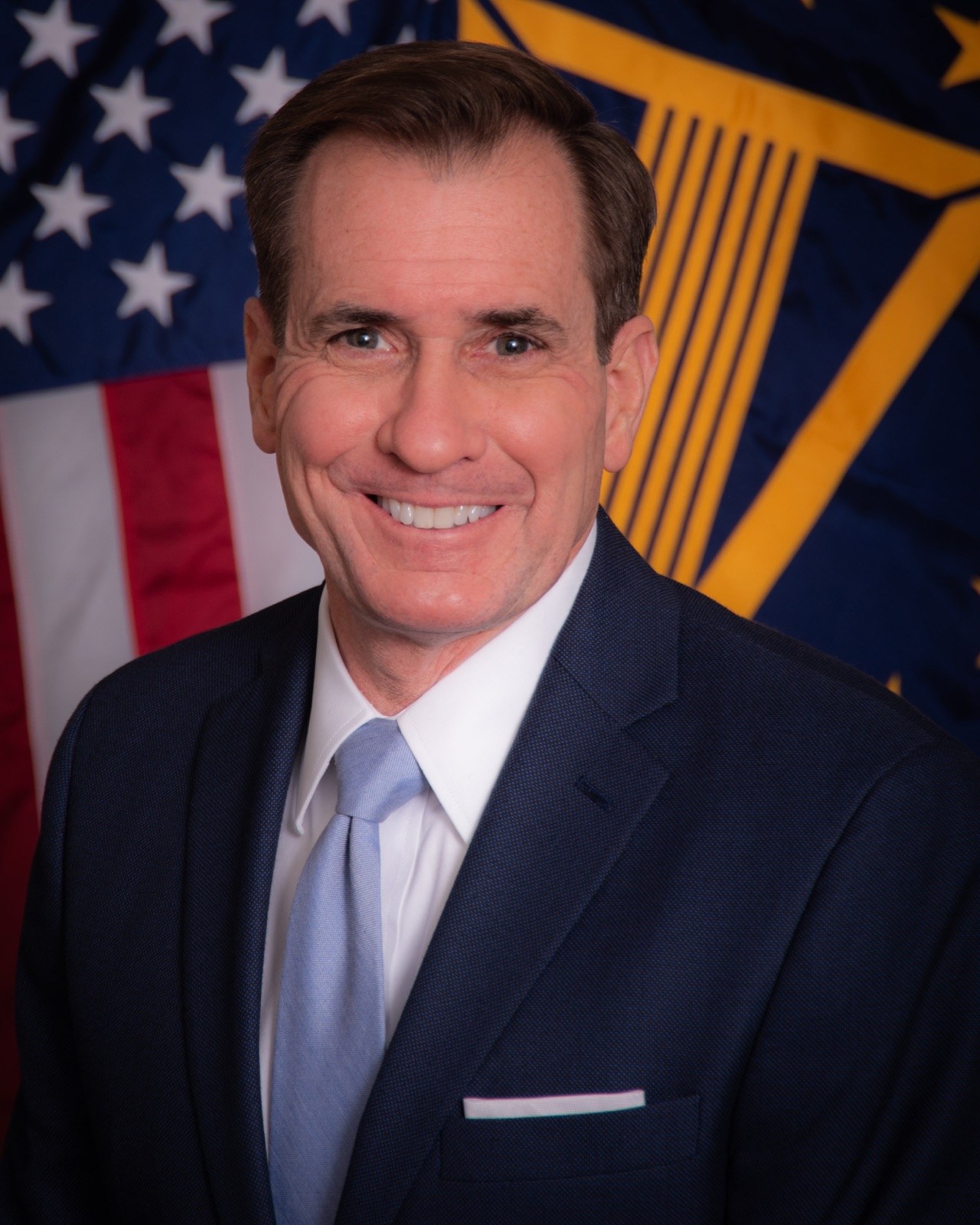
John Kirby
John Kirby is the head of Strategic Communications at the National Security Council discussing United States and NATO's long-term security commitments to Kyiv.
Episode Summary
One Decision’s Julia Macfarlane and former MI6 Chief Sir Richard Dearlove caught up with John Kirby, the head of Strategic Communications at the National Security Council just before the NATO summit in Vilnius, Lithuania. Kirby discusses the United States and NATO's long-term security commitments to Kyiv, plans to deal with Ukraine's artillery shortage to support the counter-offensive, and concerns over Vladimir Putin moving tactical nuclear weapons to Belarus.
Listen & Subscribe
- Watch on YouTube
- Listen on Apple Podcasts
- Listen on Spotify
Transcript
INTRODUCTION
Mcfarlane: You're listening to One More Decision from the team that brings you One Decision, the podcast that looks at the big choices made that shape our world. I'm your host, Julia McFarlane. And together with my cohost, Sir Richard Dearlove, the former chief of MI6, we're bringing you a short update on the NATO Summit this week taking place in the Lithuanian capital of Vilnius. After some visible angst and frustration from the Ukrainian leader, President Zelenskyy, on the prospects of his country joining the military alliance, he leaves the Baltic capital with what actually does seem to be some pretty tangible wins. Allies have promised him unprecedented long term security commitments and, crucially, a simplified path to membership, which pretty much all nations agree is a matter of when, not if. The secretary general, Jens Stoltenberg, saying Moscow doesn't have a veto on that. We are moving,
Stoltenberg: Ukraine closer to membership. We make all the decisions today, which is the strongest, the most united message on the path towards membership NATO has ever issued to Ukraine. And, of course, you do that knowing that Moscow will protest as they did when Finland joined or when Sweden is joining or North Macedonia or
Mcfarlane: all new allies. No timetable has been agreed, and much anxiety remains about promising accession to a nation currently at war with Russia. But there's been some pretty significant announcements that Kyiv can take heart from. There is now, according to the British defense secretary, a cultural acceptance that Ukraine belongs in NATO, that there are no longer any countries asking if Ukraine should join, but when. The White House has offered unprecedented Israel style security guarantees for Kyiv, and there is a growing block of allies to support it now that Turkish president Erdogan has apparently dropped his opposition to Sweden's membership of NATO. Sir Richard Dearlove and I managed to snatch a brief chat with Admiral John Kirby ahead of the NATO summit. He runs strategic communications at the National Security Council in the Biden White House.
INTERVIEW WITH ADMIRAL JOHN KIRBY
Kirby: We understand that between now or when the war ends and potential NATO membership, that Ukraine's still gonna have security concerns. They're still gonna have a long border with Russia no matter what the end of this war looks like, and they're gonna have legitimate needs to protect their people. So the United States is gonna stay committed to working through with them what those kinds of commitments could and should look like for the long haul. And I know we're focusing on now in this discussion about the security commitments, but it'll be really important for the allies to get a sense of what the situation on the ground is and what immediate security assistance, additional security assistance needs to be provided as they fight this counter offensive. The Ukrainians themselves have said it's not going quite as fast as they would like it to go. We know they're advancing on multiple lines of axis all the way from Bakhmut, who if you just follow that circle down around to the Southwest towards Zaporizhzhia, they've got multiple lines of access that they're moving along and they're not moving as fast as they would like. But weather has been a factor and the minefields have been a very significant factor, particularly in those lines of advance south of Bakhmut in the Mariupol region and around south of Zaporizhzhia. They have run into stiff entrenched Russian defenses, including significant minefields. As anyone who's tried to go through minefields, whether maritime or terrestrial, it's slow going in the best of circumstances. It's particularly slow going when you are being fired at, and they are every single day by Russian artillery and airstrike. So they've run into a pretty significant defense and depth by the Russians that they are working their way through.
Mcfarlane: Admiral, those minefields have been cited by the Biden administration and other US officials as to one reason why these cluster munitions, which is getting a lot of discussion on the airwaves this week, why those cluster munitions would be quite helpful for Ukraine. You said on ABC recently, you said this is literally a gunfight. They're running out of inventory. We're trying to ramp up our production of the kind of artillery shells they're using most, but that production rate is still not where we wanted it to be. We spoke to one of our colleagues at a defense journal recently who said that arms companies are not willing to ramp up production to the kind of scale that Ukraine needs without assurances from government that the demand will be there to meet it down the line and that that demand will be sustained post Ukraine. Can you tell us if the Biden administration is trying to work with the defense and arms industry to try and meet some of the guarantees that they want with regards to increased production?
Kirby: Well, the short answer is yes. I mean, we are absolutely working with our defense industrial base here in the United States to ramp up that production. And we have already started to do that by many thousands of rounds per month, and now we're trying to get it even higher. And we think that towards the end of this year, we'll be able to reach sustainable production rate that we can all rely on and that Ukraine can also rely on and get more what we call unitary 155 millimeter artillery shells there that are not the cluster munitions variety. We're working very, very closely with our defense industry partners, and we believe we'll be able to do that in fairly short order.
Mcfarlane: And is the ammunition shortage, is that tied to what Europe is or isn't doing insofar as individual nation states contributions to Ukraine. That also with regard to the 2% minimum spend. Are there any European, certain European nations that the US will have tough messages for this week? Who isn't pulling their weight?
Kirby: Well, I think I will let the diplomatic conversations be diplomatic conversations. I mean, obviously, we want to see everybody in NATO meet that 2% pledge, and some are there, and some are working very closely to get there, and some still have a little way to go. We understand that. They each of these nations have sovereign economic concerns and domestic concerns that they have to deal with, but, clearly, we want everybody to reach that 2% spending rate. I will tell you that this summit isn't really going to be about delivering tough messages because the allies are truly more united and resolved and determined than the alliance has ever been. Now, of course, there's a real sense of energy inside the alliance. Yes. Our allies know that we've gotta continue to support Ukraine. They each are doing it in their own way. And you asked about, you know, artillery production in other nations. I can't speak to what the production rate is in other nations, but it is a gunfight. And artillery is proving to be one of the most vital capabilities that Ukraine needs as they conduct this counter offensive. They are facing not just artillery on the Russian side, but as I said, cruise missile strikes and drone strikes as well as significant minefields. So the artillery is really, really important. We are urging our allies and partners to continue to look at their stocks and their inventories to try to find more artillery shells as well.
Mcfarlane: Can I also ask you about the situation at the Zaporizhzhia nuclear plant? The recent moves by US senators Blumenthal and Graham to designate any instance of radiation leaking into European countries as a potential attack on NATO allies. What's the Biden administration stance on that? And as well as the use of tactical nukes by Belarus also meeting the same criteria according to the senators.
Kirby: I'm not in a position to lay down an administration position on that proposed legislation by members of congress. We'll see where that goes. I will just tell you that a couple of things. Number one, president Biden has said that we take our article five commitments to the alliance very seriously and that we will defend every inch of NATO territory. Number two, we've backed that pledge up by an additional 20,000 American troops on the European continent, and the president has put forth processes to keep those 20,000 mostly on a rotational basis, but to keep that number of a 100,000 in place for the foreseeable future. So we really have done our part to bolster NATO's eastern flank. Now you mentioned Zaporizhzhia and Belarus. So let me just address each in turn. We continue to monitor the events at Zaporizhzhia as best we can. We have ways of monitoring radioactivity. We don't see any activity there at Zaporizhzhia that gives us concern that there's about to be some sort of radiation event or some major nuclear catastrophe. We're in touch with the IAEA regularly. We note that they still have inspectors there and that they don't see anything that's imminent right now. That said, look. A nuclear power plant should be no place for military operations, and we've long maintained that the Russians need to leave Zaporizhzhia. Let the Ukrainian scientists and engineers back in, back to own it. It's their nuclear power plant. There's no reason for
Mcfarlane: You're not concerned about the mining of the reactors that the Ukrainians—
Kirby: We are certainly concerned. As I said, this is not a suitable place for military operations of any kind, including mining. That's why we think the Russians need to leave, and the fighting needs to stop around Zaporizhzhia because it's a dangerous place for any kind of military operations. And then on Belarus, all I would tell you is that we continue to monitor, as best we can, Russian nuclear activity, and we have seen nothing that would indicate to us that the Russians, or in this case, the Belarusians either, have any desire to use nuclear weapons in Ukraine or anywhere else on the continent. And we've seen nothing that would cause us to change our own strategic deterrent posture, but we're watching this as best we can every day.
Dearlove: Can I just ask you where you think we are on the next NATO secretary general? We're a little disappointed in the UK that Ben Wallace appears to be being pushed aside by President Biden. I mean, I know this isn't an authoritative statement, but we're a little alarmed to see that von der Leyen might be the US candidate. And I would just remind you that there are many of us in the UK who regarded her as the worst German defense minister ever, and I'm rather appalled if she is going to be pushed as the secretary general of NATO. Maybe she isn't.
Kirby: Well, I certainly won't get ahead of the president here on whatever his recommendations might be for the next secretary general. We're grateful that secretary general Stoltenberg has agreed to extend again. I think this is his fourth extension. He's leading at a critical time, and he's done a magnificent job. So the president is very grateful for his continued service. And, you know, we'll see where this goes, in terms of a successor for him, but I wouldn't get ahead of the president or the president's thinking on that.
Dearlove: Good.
Mcfarlane: Richard, that's very, very strong opinions on the von der Leyen. Admiral Kirby, thank you so much for your time. I hope we can catch up with you again soon. It'd be great to welcome you back on the podcast for a longer discussion down the line.
Kirby: I was delighted to join you and happy to do it again at any time.
ANALYSIS WITH SIR RICHARD DEARLOVE
Mcfarlane: Wonderful. Thank so much. That was brilliant, Richard. You really have to get an opinion on German politics these days. You mustn't always be sitting on the fence quite so much.
Dearlove: I mean it's pretty extraordinary, she shouldn't really be being pushed for that position because she was pushed upstairs because Scholz wanted to get rid of her as Defence Minister, so he had to promote her to the European Commission.
Mcfarlane: I can't see many other European countries being happy with her as Secretary General of NATO, so I don't think the UK is an outlier on that.
Dearlove: Mark Rutte, the Dutch Prime Minister is an alternative, and he would actually, he's a good administrator, he's a sensible, balanced guy, he would be a good candidate, you know, he's certainly a very realistic alternative to Wallace. I'm just not quite sure why they are not keen on Wallace's candidature, but there we go.
Mcfarlane: Well, there's all sorts of rumors for why that may be the case, but I guess we'll have to wait and see what ends up happening. You never know what the behind the scenes is. I thought that was interesting. Admiral Kirby there saying that actually there are talks going on between arms manufacturers and the US government. I mean, I don't know, Richard, do you think we're in a new sort of a new era of conflict and of there being more of a market for artillery and arms? Or do you think we will start to see governments trying to prioritize asymmetric warfare and things that aren't really deployed on a battlefield when it comes to future conflicts down the line?
Dearlove: Well, I think the surprise that we've all had to take account of in Ukraine is that you've got to look at conflict down both traditional and new avenues. So on the one hand, you've got asymmetric conflict, you've got drones, you've got all this new technology, but on the other, it's quite clear that boots on the ground, artillery, logistics, ammunition, all of these traditional considerations are still relevant. If you're not going to deploy any, let's say weapons, I don't like weapons of mass destruction, weapons of mass effect is a better terminology, so you're not going to deploy tactical nuclear weapons, you're not going to deploy chemical and biological weapons for obvious reasons of restraint, then you're into more traditional conflict. And I think he did say one thing which I think was striking and very important was that by the autumn they would ramp up production sufficiently to meet Ukrainian needs. That's a really big deal if it's true, because bear in mind there are two types of artillery Ukrainians are using. There's the modern NATO standard 155 caliber, so there's that, but I mean, they've still got the old Warsaw Pact artillery, which has a different caliber, I think it's 153, and it's the old artillery shells which are very, very difficult to get hold of now because, you know, the manufacturing presumably is mostly within Russia or Belarus, and it's sort of getting old factory lines in countries like Poland and I think Slovakia to produce the old shells. But I mean, maybe there's less of that artillery being used now as more modern supplies get to the Ukrainians. But this is clearly an absolutely crucial issue at the moment.
Mcfarlane: Well, I think it's interesting because in this country, in the UK, we have seen years and years and years of whittling away defense cuts across our defense department. And one of the things the government has said time and time again is we have to adapt our military to be a more modern military. It's not about having the highest number of soldiers, but it's also about having cyber capabilities, technological advanced kind of warfare. And they've kind of used that argument whilst implementing rounds and rounds of cuts to our armed forces. But what's interesting about the battle in Ukraine is it's showing that actually the military is might. And while the Russians are trying to do things like attack Ukrainian infrastructure, hacking away at their companies and businesses and systems, it is the age old, the old traditional warfare, military logistics, feeding your soldiers enough, giving them the kit that they need, that appears to be what is really making a difference on the ground.
Dearlove: Absolutely. And supply of tanks, supply of just the hardware in terms of artillery is crucially important, and no wonder you've got these statements being made, for example, by the head of the army in the UK, the Chief of the General Staff, that the UK's military land capability has been hollowed out, and it's quite clear from Ukraine that that is a highly unsatisfactory situation. I mean, we might be sophisticated in areas of, let's say, asymmetric conflict, like cyber, and you know, those types of things, but it's clear you've got to have both. And I think it presents the government with a massive problem when government spending is under huge pressure. How are they going to ramp up defense expenditure? And if so, by what percentage? And then what proportion are they going to spend on conventional weaponry, which, you know, as you say, has been run down and neglected over a long period of time, and I think there's an urgency about this because it's not just about land warfare, it's about naval warfare, the whole question of how much capability we now need at sea. I mean, given that the UK's traditional naval power, we've just been hugely neglectful, so any government, whether Labour or Conservative, is gonna have to put this right.
Mcfarlane: That's it for this week's episode of One Decision. We drop new episodes every Thursday. Like and subscribe so you never miss an episode. Drop us a line. Tell us your thoughts. What decisions have impacted you and where you live? You can write to us. Our email is 1decision@1decisionpodcast.com. From me and the team, thank you for listening, and see you next time.